Two SMS messages. Same product, same offer, same copy. One ends with bit.ly/x9Za The other ends with go.brand.co/offer
That difference is the business case for branded links SMS: recipients are more likely to tap a link when they can recognize the sender before clicking.
A branded short link is a shortened URL that uses your own custom domain instead of a shared public shortener. In business messaging, it works as a trust signal: it keeps the link short, but still shows the brand behind the communication.
This is crucial because SMS, RCS, and Viber are high-attention channels with low tolerance for doubt. If the link looks unfamiliar, generic, or hidden behind a public shortener, the recipient has to make an extra trust decision. Many will simply not click.
In this article I explain why branded short links improve click-through rate, why generic shorteners can create deliverability risk, and why a custom short domain should become a default hygiene rule for messaging campaigns.
Branded vs. generic short links: What is actually different
A branded short link and a generic short link can do the same basic job: shorten a long URL. The difference is what the recipient sees before the click.
| Link type | Example | What the recipient sees |
|---|---|---|
| Generic short link | bit.ly/x9Za | A shared public shortener with no sender identity. |
| Branded short link | go.brand.co/offer | A short domain connected to the brand. |
A branded short link uses a custom short domain controlled by you – the sender. A generic shortener uses a shared public domain used by many unrelated senders. That significantly affects the signal the URL sends in the message.
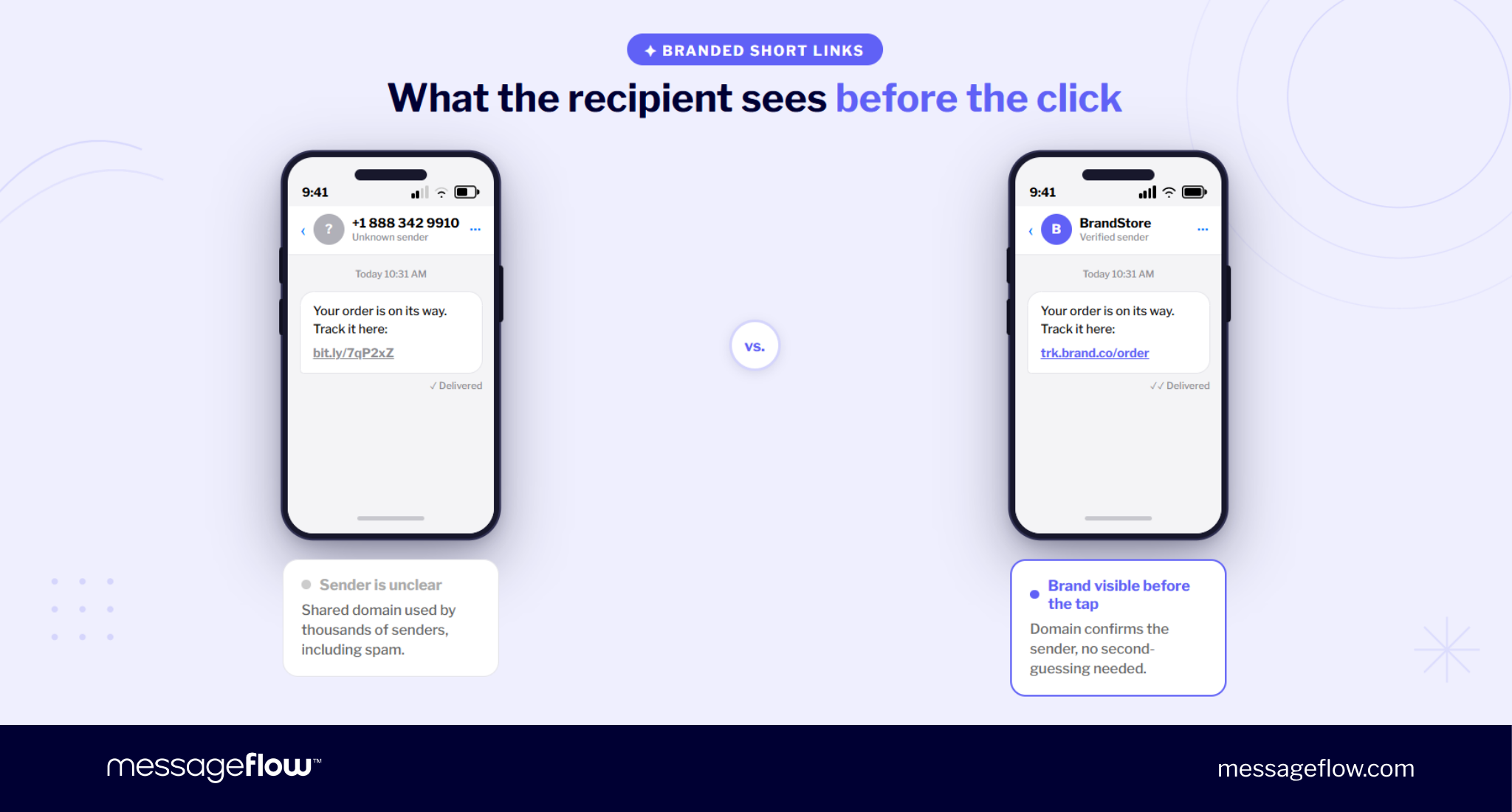
What a branded short link looks like
A branded short link usually has two parts:
- a custom short domain such as go.brand.co
- a readable slug such as /offer, /track, or /sale
Together, they turn the URL into a small sender identity cue. The recipient does not need to guess who owns the link. The brand is visible before the tap.
This makes branded short links more than cleaner formatting play. In a short SMS or Viber message, the URL may be one of the strongest trust signals the recipient sees.
What a generic shortener costs you beyond characters
A generic shortener saves space but it removes brand context. The message may say it comes from your company but the URL points to a public domain the recipient does not recognize.
That leads:
- Lower trust: the recipient has to decide whether the link is safe.
- Weaker sender identity: the final CTA does not visually belong to the brand.
In high-volume messaging this hesitation can be costly. If the offer is good but the link looks anonymous, the campaign can lose clicks at the final moment.
💡 The takeaway: Generic links shorten the URL, branded links shorten the URL while keeping the sender visible.
Why branded links get clicked more: Trust, recognition, and branded links CTR
Branded links get clicked more because they reduce doubt at the exact moment the recipient decides whether to tap. In business messaging, that moment is particularly fleeting. The screen is small, the copy is short, and the link often carries the entire conversion path.
CTR, or click-through rate, measures the share of delivered messages that generate a click. SMS performs strongly here, with values ranging 21-35%, according to sources. A branded link does not create that attention on its own. It helps convert existing attention into a safer-feeling action.
💡 The evidence is directional but consistent. Rebrandly’s testing reports up to 39% higher click-throughs for branded links compared with generic short URLs, while other sources place the lift around 34%.
Those numbers are not a universal guarantee. Brand recognition, offer quality, audience trust, and message context all matter. But the mechanism is clear: people click links they recognize more readily than links that hide the sender behind a public domain.
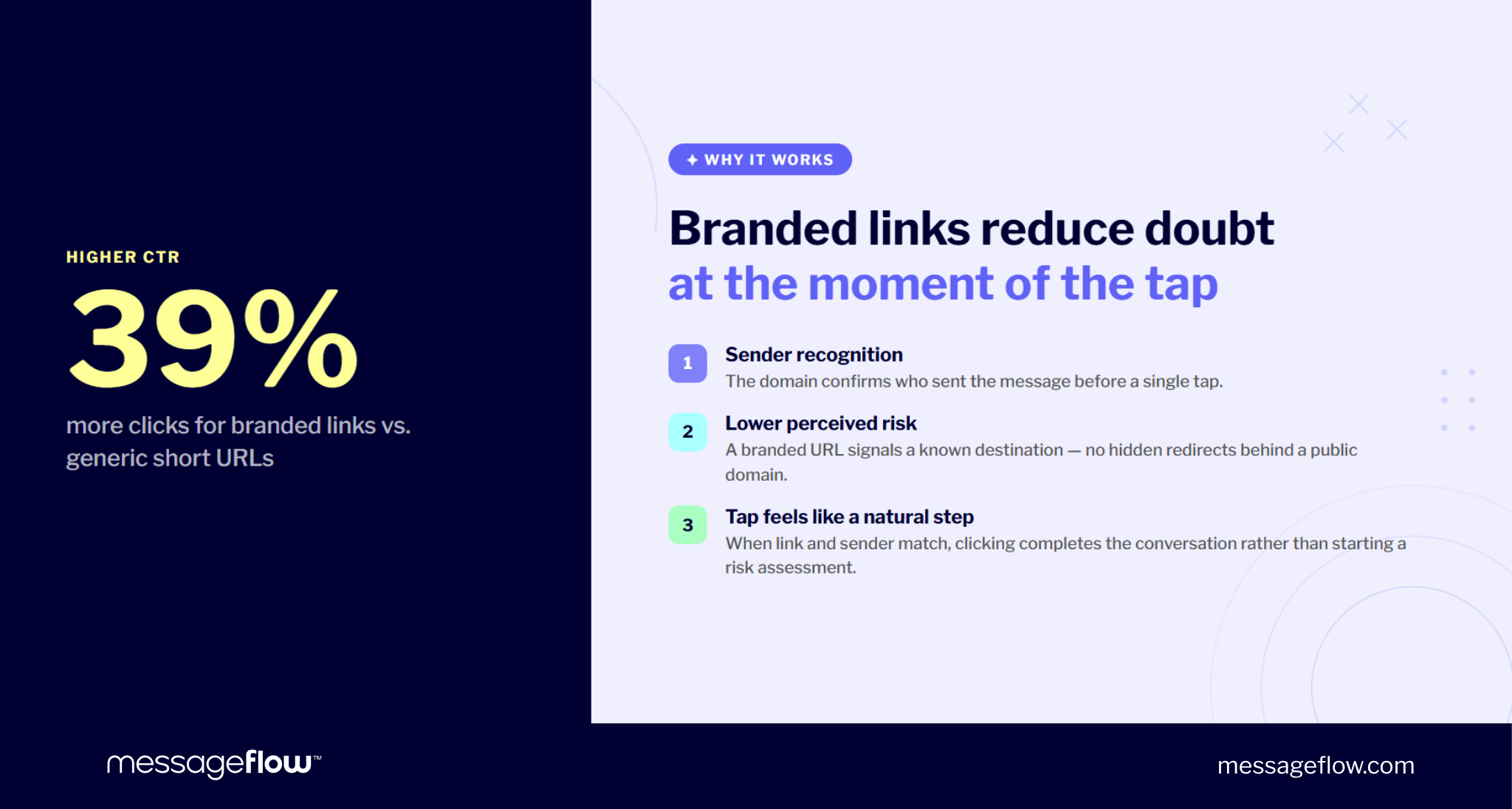
Imagine a customer receiving a delivery update. trk.brand.co/order feels like part of the conversation with the company. tinyurl.com/7qP2 forces a second question: where does this actually lead?
That second question is where clicks drop.
Branded short links in SMS work because they turn the URL into a trust signal. The link confirms sender identity, lowers perceived risk, and makes the tap feel like a natural next step instead of a gamble.
💡 The takeaway: Branded links do not magically fix a weak offer but they remove avoidable hesitation from strong messaging campaigns.
Deliverability reality: Why shared shorteners trigger carrier filtering
Generic shorteners do not only affect trust but can also affect whether the message reaches the recipient cleanly.
A public shortener is a shared domain. Thousands of senders use the same link infrastructure, including legitimate brands, low-quality campaigns, and bad actors trying to hide destinations behind short URLs. That shared reputation creates the problem.
Carriers and SMS filtering systems look at links as part of message evaluation. If a public shortener has been abused for phishing, cloaking, or spam, links from that domain can receive more scrutiny. Some carriers and messaging providers restrict or reject generic shorteners in bulk SMS because they make destination reputation harder to assess.
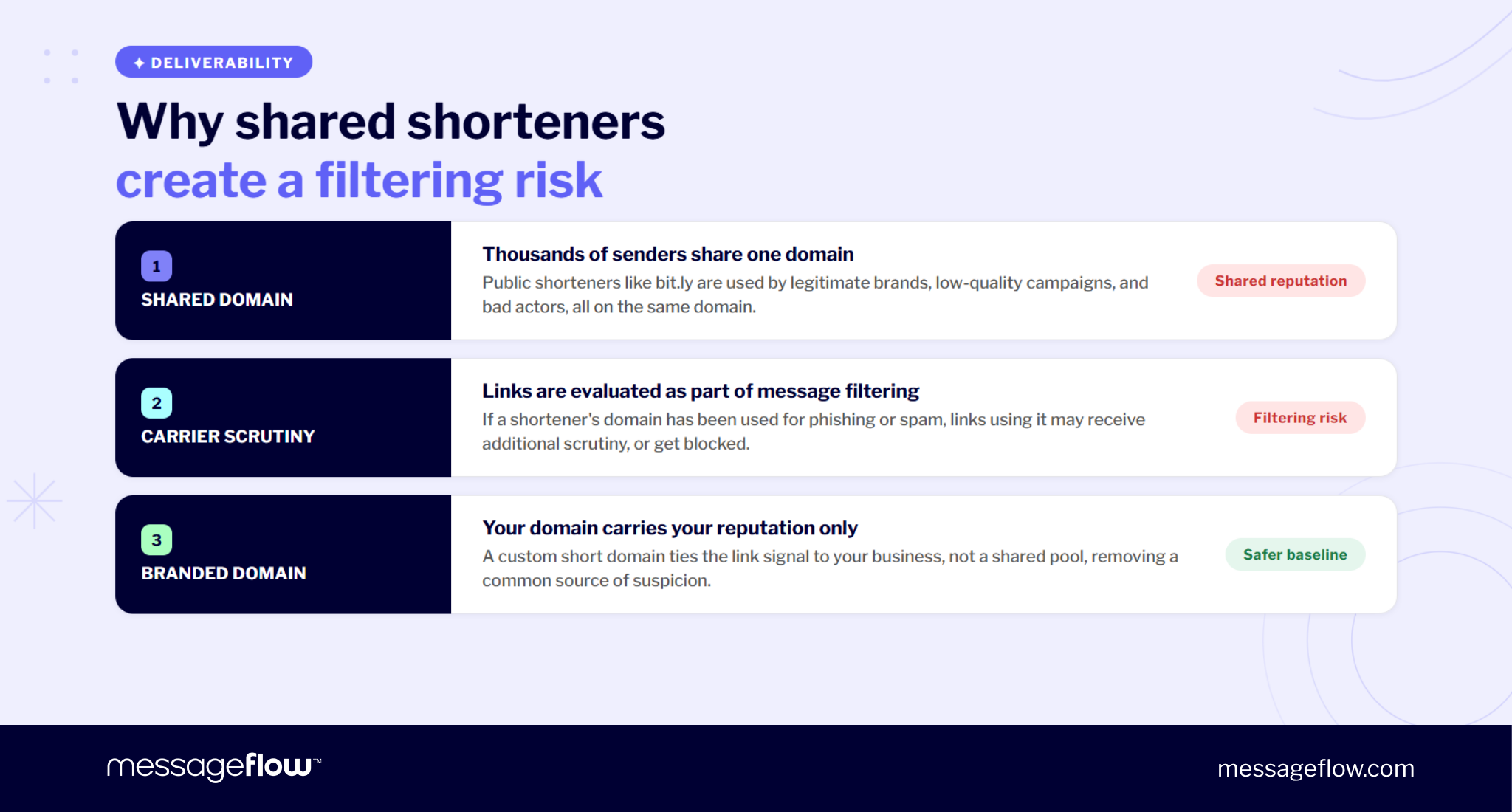
A branded short domain changes the signal. Instead of borrowing reputation from a shared public domain, your campaign uses a sender-branded URL connected to your own business. That does not make every message automatically deliverable but it sure removes a common source of suspicion.
The lesson here is simple: a URL shortener SMS setup should not depend on a public domain if the campaign truly matters. Even before you get into deeper policy or compliance requirements, branded links are the safer operational baseline.
💡 The takeaway: Shared shorteners inherit shared reputation. Branded short domains keep the link signal tied to the sender.
The hygiene rule: Branded short domains as the default in business messaging
For SMS, RCS, and Viber, branded short links should be treated as campaign good practice, not an optimization experiment. If your link is important enough to carry the CTA, it is important enough to carry the sender identity.
💡 The question you should be asking is not whether a branded domain might improve the campaign performance, but whether a customer-facing message should ever be showing the user a generic public shortener.
A custom short domain gives every campaign a cleaner baseline:
- the recipient sees your brand before clicking
- the link remains short enough for mobile messaging
- the CTA looks more consistent across channels
- the domain reputation belongs to your business
- branded link analytics become easier to connect across campaigns
Best business messaging platforms make a branded short domain setup a small configuration task, not a full technical project. Strategically, make sure your link is not the least trustworthy part of an otherwise well-planned campaign.
What changes across SMS, RCS, and Viber
Branded links matter across all messaging channels, but they do not appear in the same way everywhere.
| Channel | How the link appears | Why branding matters |
|---|---|---|
| SMS | Plain text URL in the message body | The domain is fully visible, so it directly affects trust and click-through rate SMS performance. |
| RCS | Often behind a button, card, or suggested action | The branded domain still matters in previews, fallbacks, and routing. |
| Viber | Visible in message text, buttons, or previews | The URL supports sender identity in a richer but still trust-sensitive environment. |
In SMS, the link is usually exposed. There is no rich interface to hide behind, so go.brand.co/offer does more work than many marketers realize. It saves space while keeping the sender visible at the point of action.
In RCS, users may tap a button instead of reading the URL. But the branded domain still matters when a fallback is sent, when an SMS link preview exposes the destination, or when the journey routes through a short link in the background. The same domain needs to stay recognizable when that short link is also responsible for routing into an app after installation.
In Viber and other OTT messaging channels, the communication can be more visual, but the same trust logic applies. If a URL appears in the body, preview, or button destination, a recognizable domain supports continuity between the sender, the message, and the action.
💡 The takeaway: The format changes by channel, but the trust gap between branded and generic links stays the same.
Make every campaign link recognizable
If you already send SMS, RCS, or Viber campaigns, your links are part of the customer experience. Use a domain your audience recognizes, keep the path short, and make the click feel like a continuation of the conversation with your brand.
MessageFlow supports branded short domains for messaging campaigns, helping teams keep links recognizable, measurable, and aligned with sender identity.
FAQ – Branded links in SMS, RCS, and Viber
A branded short link is a shortened URL that uses your own custom domain instead of a shared public shortener. For example: go.yourbrand.com/offer instead of bit.ly/xyz. Because the recipient sees your brand before clicking, the URL itself becomes a trust signal.
Yes, directionally. Rebrandly reports up to 39% higher CTR for branded links versus generic short URLs, while other cited sources point to a lift around 34%. The exact result depends on brand recognition, offer quality, audience, and channel, but the pattern is consistent: recognizable links reduce hesitation.
Generic shorteners use shared public domains. Since spammers and phishing campaigns also use those domains to hide destinations, carriers and filtering systems treat them with more suspicion. A branded short domain ties the link reputation to your business instead of a shared pool of unrelated senders.
A custom short domain is the domain you own, such as go.brand.co. A branded short link is the individual URL created on that domain, such as go.brand.co/summer-sale. In practice, both terms describe the same idea: your brand appears in the shortened URL.
Yes. In SMS, the branded URL is visible in plain text. In RCS, it may sit behind a button, but still matters in previews, fallbacks, and routing. In Viber, it can appear in message bodies, buttons, or previews. The format changes, but sender recognition still matters.
Usually not with a modern messaging platform. The basic process is choosing a short domain or subdomain, adding a DNS record that points it to the shortening platform, enabling HTTPS, and testing links before launch.