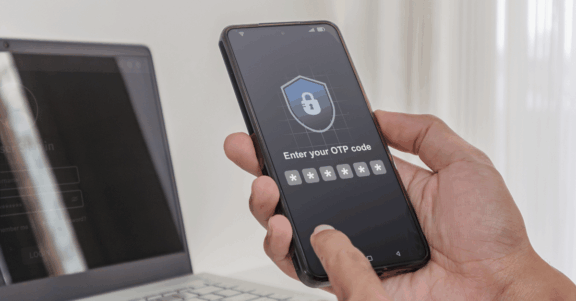
An SMS gateway is the infrastructure that connects business software with mobile carrier networks. It accepts a message from an application or sending platform, converts it into a format telecom systems can process, selects a route to the recipient’s carrier, and returns delivery information to the sender.
The term is often confused with SMS API because businesses commonly access a gateway through an API. The two describe different layers though:
- The SMS gateway handles message validation, queuing, protocol conversion, routing, retries, incoming replies, and delivery reports.
- The SMS API is the interface through which an application submits messages to that gateway and receives status updates.
A modern SMS API usually relies on REST and HTTPS, while high-volume telecom connections may use SMPP. Marketing teams can also access the same underlying infrastructure through an SMS marketing dashboard of a CPaaS platform without integrating an API directly.
This distinction matters when comparing providers. Clear API documentation can make integration easier, but it says little about the quality of the delivery routes behind the interface. Latency, carrier coverage, failover capacity, throughput, sender reputation and support, and the accuracy of delivery reports depend on the gateway infrastructure and its network connections.
Businesses use SMS gateways for both promotional campaigns and time-sensitive transactional messages such as one-time passwords, fraud alerts, appointment reminders, and order updates. In each case, the gateway does more than forward text: it manages the path between a business system and the mobile network, including what happens when a route fails or a carrier rejects the message.
How does an SMS gateway work?
An SMS gateway works as a controlled delivery pipeline. It receives a message from a business system, checks whether it can be sent, selects an appropriate carrier route, and reports the outcome. The API request starts this process, however, it does not constitute delivery by itself.
For example, an ecommerce platform may trigger an order confirmation immediately after checkout. Its backend sends the recipient number, sender identity, message content, and other parameters to the gateway through the provider’s developer platform. From there, several infrastructure components determine whether the message reaches the correct handset, how quickly it arrives, and what information returns to the sender.
The message path from application to handset
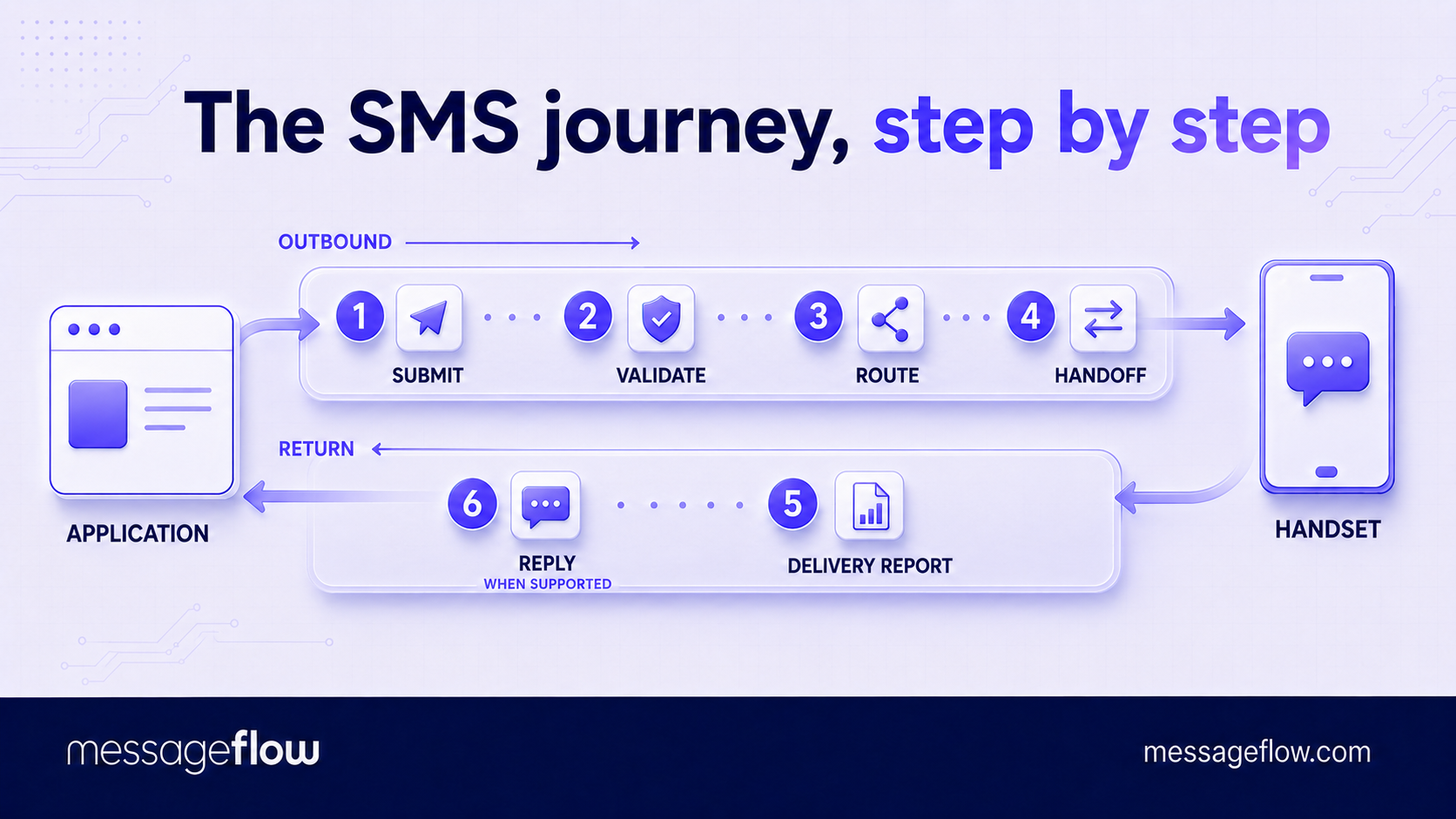
A typical application-to-person SMS follows six stages:
- Message submission. The application submits the message through a REST API, an SMPP connection, or another supported interface. The request usually includes authentication credentials, the recipient’s phone number, a sender ID, and the message body.
- Validation and preparation. The gateway checks the request before accepting it for delivery. It may validate the number format, sender permissions, message length, encoding, account balance, and country-specific requirements. A failed check should produce a clear error before the message enters the delivery queue.
- Route selection. The gateway identifies the destination country and mobile network, then selects a suitable route. The decision may account for message type, sender registration, required throughput, delivery priority, route availability, and price. Enterprise providers may maintain several routes and switch traffic automatically if one becomes unavailable.
- Carrier handoff. The message passes through a direct operator connection or one or more intermediary networks before reaching the carrier’s Short Message Service Center. The SMSC manages final delivery to the recipient’s device. If the phone is temporarily unavailable, the network may hold the message and retry until its validity period expires.
- Delivery reporting. The carrier returns a delivery report, commonly called a DLR. The gateway translates carrier-specific responses into standardized statuses and makes them available through a dashboard, API query, or webhook. A Delivered status normally confirms arrival at the device or network endpoint, it does not prove that the recipient read the message. Our guide to SMS delivery status explains these distinctions in detail.
- Reply processing, when supported. For two-way messaging, the gateway also handles incoming SMS traffic. It associates the reply with the correct number or campaign and forwards it to the business through a webhook or platform inbox. This requires a reply-capable sender such as a long number or short code. An alphanumeric sender ID is usually one-way.
SMS gateway vs. SMS API: What is the difference?
In most business deployments, an SMS gateway and an SMS API are not competing solutions. The API provides access to the gateway: one defines how your software submits instructions, while the other handles what happens to the message after submission.
| Area | SMS gateway | SMS API |
|---|---|---|
| What it is | Messaging infrastructure or a managed service | A programmable interface |
| Main role | Connects business systems with mobile networks | Connects an application with the gateway |
| What it handles | Queuing, protocol conversion, routing, failover, replies, and delivery reports | Authentication, request structure, message submission, status queries, and webhooks |
| Common access methods | REST API, SMPP, web dashboard, or integrations | Usually REST over HTTPS, sometimes SOAP or provider-specific protocols |
| Main evaluation question | Can the provider deliver traffic reliably, securely, and at the required scale? | Can developers integrate and manage messaging efficiently? |
💡 A useful analogy is a logistics network. The SMS gateway is the sorting centers, transport routes, local depots, and tracking system that move a parcel to its destination. The SMS API is the shipping interface through which the sender provides the address, selects a service, and requests tracking updates. A convenient interface improves the experience, but it is not the network transporting the parcel.
What does “SMS gateway API” mean?
An SMS gateway API is simply an API that gives software access to SMS gateway infrastructure. It is not a separate type of messaging technology.
Providers often combine the terms because customers usually buy the two layers as one managed service. The provider operates the carrier connections, routing logic, queues, and reporting systems, while exposing their functions through documented endpoints. A developer can then add SMS to an application without managing telecom protocols or negotiating separate agreements with mobile operators.
This combined wording also explains why search results sometimes treat “SMS gateway,” “SMS API,” and “text messaging API” as synonyms. From the buyer’s perspective, each phrase may lead to the same commercial product. From an architectural perspective, however, they describe different parts of that product.
Does a business need an SMS gateway or an SMS API?
A business usually needs gateway access, but it does not always need a direct API integration.
Developers use an SMS API when messages must be triggered automatically by events such as account registration, payment approval, order dispatch, or a suspicious login. Marketing and customer service teams may use the same gateway through a dashboard, where they can upload recipient lists, schedule campaigns, review results, and manage replies without writing code.
Large senders may connect through SMPP when they need persistent sessions and high throughput. Smaller or less complex applications generally use REST because it is easier to integrate and maintain. Both methods can reach the same underlying SMS gateway.
The practical buying decision is therefore not “gateway or API?” It is whether the provider offers the right combination of network quality, integration method, operational controls, and support for the messages your business intends to send.
Types of SMS gateways
SMS gateway can describe several technical and commercial models. These models are easiest to understand along two dimensions: where the gateway runs and how it connects with mobile operators. A cloud gateway, for example, may use both direct carrier connections and carefully selected intermediary routes.
Cloud-hosted SMS gateways
A cloud SMS gateway is operated by a messaging provider and accessed through an API, SMPP connection, web dashboard, or integration. The customer does not maintain telecom hardware, carrier contracts, routing engines, or delivery-reporting infrastructure.
This model suits businesses that need to send across multiple countries, absorb sudden traffic peaks, or give marketers and developers access to the same messaging service. Depending on the provider, deployment and billing may also be handled through an existing cloud environment such as Azure Marketplace.
The main benefit is not just remote hosting, but the transfer of operational responsibility. The provider manages capacity, carrier relationships, routing changes, platform maintenance, and regulatory adjustments across supported markets.
On-premises and SIM-based gateways
An on-premises gateway runs within infrastructure controlled by the business. Some deployments connect to carriers through SMPP, while smaller setups use GSM modems or mobile devices fitted with SIM cards.
This approach can make sense for a closed internal system, a restricted local deployment, or an organization with an established direct carrier agreement. It also gives the operator physical control over the equipment and software.
The trade-offs become more serious as traffic grows. SIM-based gateways offer limited throughput, depend on local mobile coverage, and may trigger carrier restrictions when consumer subscriptions are used for automated traffic. Expanding to another country usually requires new hardware, SIMs, contracts, and routing logic. Redundancy also has to be designed and maintained internally.
💡 Free websites and phone-based tools that send occasional texts are sometimes described as SMS gateways. They may serve individual users, but they are not substitutes for paid B2B infrastructure handling customer data, registered senders, delivery reporting, and high-volume traffic.
Direct-to-carrier and aggregator gateways
The second classification concerns the route between the gateway and mobile networks.
A direct-to-carrier gateway maintains connections with individual mobile operators. Fewer intermediaries can provide more control over latency, throughput, troubleshooting, and delivery reporting. Direct connectivity is particularly valuable for time-sensitive traffic such as authentication codes or fraud alerts.
An aggregator gateway reaches many networks by combining direct connections with routes supplied by other telecom partners. Aggregation is not automatically a sign of poor quality: no provider has a direct commercial connection to every operator worldwide. The relevant questions are how many intermediaries a route introduces, whether the provider monitors their performance, and how quickly traffic can move to a backup route.
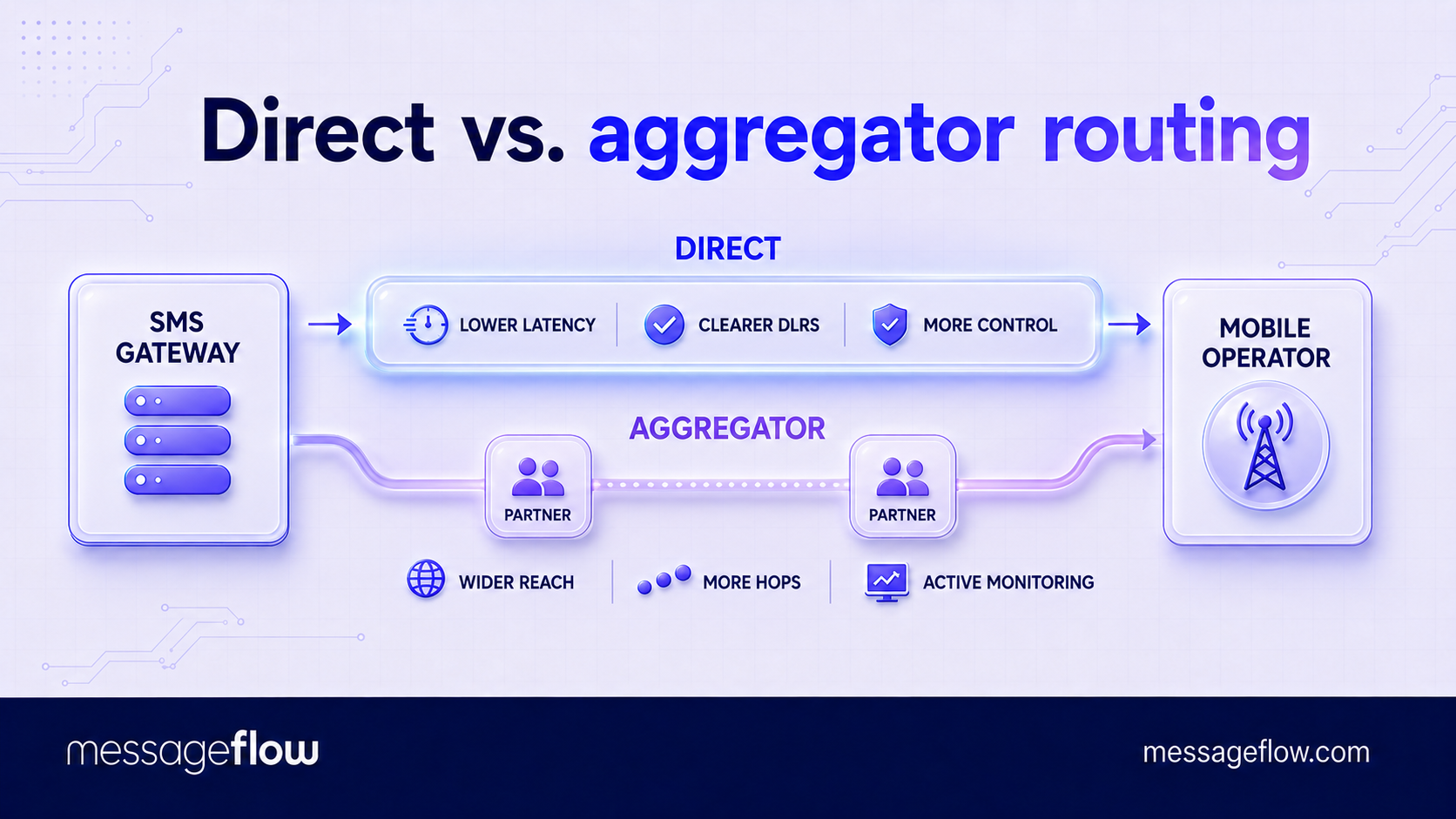
A global provider will often use direct connections in its most important markets and vetted partners elsewhere. That hybrid model can balance coverage with route control, provided the customer receives clear service commitments and usable delivery data.
What makes an enterprise SMS gateway?
An enterprise SMS gateway is defined less by one hosting model or protocol than by the operational guarantees surrounding it. It should support:
- predictable throughput during traffic peaks
- redundant infrastructure and automatic route failover
- service-level commitments for availability and support
- real-time delivery reports and accessible message logs
- registered sender IDs and country-specific sending requirements
- access controls, encryption, auditability, and data-protection measures
- both transactional and promotional traffic where required
- technical support capable of investigating carrier-level problems
The label “enterprise” has little value without measurable commitments behind it. A buyer should be able to verify which capabilities form part of the standard service, which depend on a particular destination country, and which require separate configuration or contracts.
What are SMS gateways used for?
An SMS gateway becomes valuable when sending requires automation, traceability, controlled sender identities, or more capacity than individual phones can provide. Volume matters, but the cost of delay or failure is often the stronger reason to use one.
A clinic sending 300 appointment reminders may have stricter requirements than a retailer sending 10,000 promotional messages. The retailer can measure a late campaign in lost engagement, while the clinic may have empty appointment slots and additional administrative work. The right gateway model therefore depends on what the messages do, not only how many are sent.
Time-sensitive transactional messages
Authentication codes, fraud alerts, payment confirmations, and account-security notifications need to arrive within a narrow time window. A one-time password delivered after the login session expires is technically delivered but operationally useless.
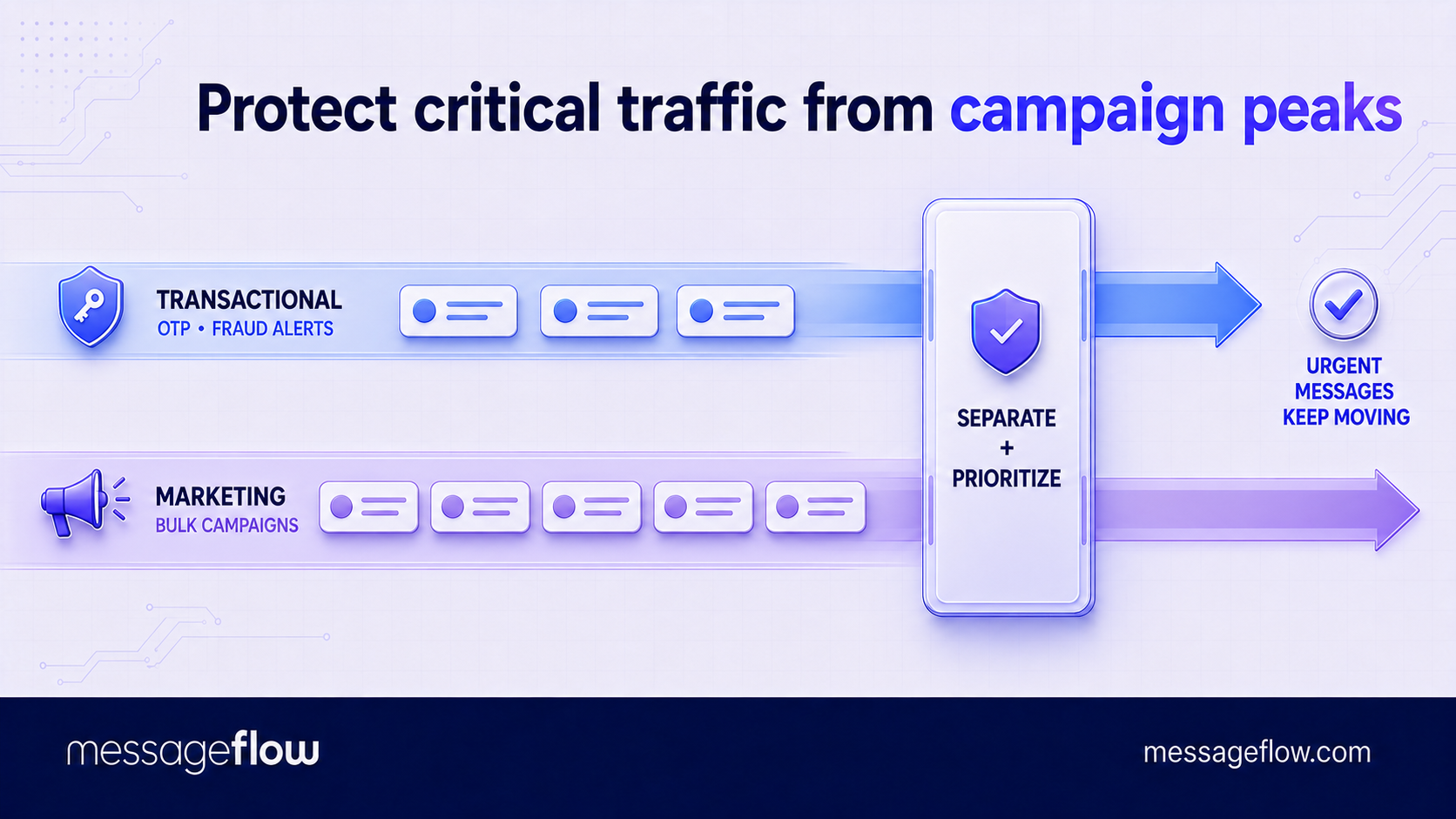
For this traffic, businesses should prioritize low latency, reserved capacity, automatic failover, configurable validity periods, and detailed delivery timestamps. Transactional messages should also be separated from promotional traffic where possible, so a large campaign does not delay security or service notifications.
Order, delivery, and appointment updates
Ecommerce platforms, logistics providers, healthcare organizations, and service businesses use SMS gateways to trigger updates from their operational systems. Common examples include order confirmations, delivery windows, appointment reminders, booking changes, and outage notifications.
The gateway removes the need for an employee to send each message manually. More importantly, it creates a record connecting the business event with the message ID and its eventual delivery status. Customer service can then distinguish between “the system generated the notification” and “the customer’s phone received it.”
Reply support can make these workflows more useful. A customer may confirm an appointment, request a different delivery time, or respond to a service notification without calling a support line. The business can process that reply automatically or route it to an employee.
Marketing and bulk SMS campaigns
Marketing teams use SMS gateways to send scheduled or event-triggered campaigns to opted-in audiences. The gateway handles recipient lists, personalization, sender IDs, delivery pacing, links, opt-outs, and campaign reporting.
Capacity planning matters here because promotional traffic often arrives in sharp peaks. A retailer may send hundreds of thousands of messages when a sale begins, while sending little during the rest of the week. The provider must absorb that increase without delaying the campaign or slowing down unrelated transactional traffic.
A high throughput figure alone does not guarantee good performance. Marketers also need controls for contact frequency, local quiet hours, consent status, sender registration, and automatic exclusion of numbers that repeatedly return permanent delivery errors.
Two-way customer communication
A two-way SMS gateway allows recipients to reply through a long number, short code, or another reply-capable sender. Businesses use this model for appointment confirmations, surveys, support requests, competitions, opt-in flows, and keyword-based automation.
Incoming messages can appear in a shared dashboard or pass directly to a CRM, helpdesk, or workflow engine through a webhook. The gateway must preserve enough context to associate each reply with the right customer, campaign, and original message.
Two-way capability should be checked by destination market. A provider may support replies in one country but offer only one-way alphanumeric sender IDs in another. “Global SMS coverage” does not necessarily mean global two-way messaging.
International SMS delivery
International sending adds country codes, operator-specific pricing, sender registration, content rules, and different levels of delivery-report support. A gateway reduces this complexity by providing one integration across multiple markets, but the business still needs visibility into what changes from country to country.
Recipient numbers should use the E.164 international format, but correct formatting does not confirm that a number remains active. The distinction between structural checks and live network data is explained in our guide to phone number validation.
International traffic also makes route quality more important. A cheaper route with several intermediaries may introduce latency, incomplete delivery data, or unexpected filtering. For high-value destinations, businesses should ask whether the provider uses direct operator connections, how it monitors partner routes, and what happens when the preferred route fails.
When does a business need an enterprise SMS gateway?
An enterprise SMS gateway is justified when at least one of the following conditions applies:
- messages must be triggered automatically from business systems
- delays or delivery failures create financial, security, or operational costs
- sending volume fluctuates sharply or reaches large peaks
- communication spans several countries or mobile operators
- teams need registered sender IDs, replies, or delivery webhooks
- security policies require access controls, audit logs, and defined data handling
- the organization needs contractual availability and support commitments
The threshold is not a fixed monthly message count. It is the point at which sending from individual devices, basic web tools, or an unmonitored integration creates more risk and manual work than a managed gateway removes.
How to choose an SMS gateway provider
Choosing an SMS gateway provider starts with the messages that must not fail. Their destinations, expected delivery time, peak volume, sender type, and business impact should define the requirements. A low promotional rate is irrelevant if the same provider cannot deliver authentication codes quickly or explain why messages were rejected.
Feature lists make providers appear similar. The differences usually emerge in routing quality, service commitments, country-specific support, reporting depth, and how the provider responds when a carrier route degrades.
Examine carrier connectivity and routing
Ask how the provider reaches the mobile networks that account for most of your traffic. Direct operator connections can reduce the number of routing hops and give the provider more control over latency, capacity, and troubleshooting. Indirect routes may extend coverage, but each additional intermediary can reduce visibility.
The goal is not to demand direct connectivity everywhere. Global coverage often requires a mixture of direct routes and telecom partners. What matters is whether the provider:
- discloses how routes are managed
- monitors latency and delivery performance by network
- maintains backup routes for important destinations
- moves traffic automatically when a route fails
- prevents marketing traffic from delaying critical transactional messages
- avoids unauthorized or so-called grey routes
A provider should be able to explain how routing differs between a domestic campaign, an international notification, and a high-priority OTP. If every traffic type receives the same generic answer, the routing policy may be less developed than the sales material suggests.
Read the SLA beyond the uptime percentage
A 99.9% availability figure sounds precise, but it does not tell you what is covered. The SLA may apply only to the provider’s API and exclude carrier networks, scheduled maintenance, degraded performance, or delayed delivery.
Check whether the agreement defines:
- platform and API availability
- minimum or committed throughput
- incident response and escalation times
- maintenance windows and advance notice
- recovery objectives
- support availability
- service credits and the conditions for claiming them
Availability also differs from timely delivery. An API can remain online and accept every request while messages sit in a queue or follow a slow route. For time-sensitive traffic, ask whether the provider measures end-to-end latency and whether any delivery-time commitments apply to specific countries or message classes.
Verify delivery reporting and operational visibility
Delivery reports should help teams diagnose problems, not merely produce an attractive dashboard percentage. Confirm which statuses the provider returns, how carrier-specific codes are normalized, and whether the original response remains available for investigation.
Developers should check webhook delivery, retry behavior, message identifiers, timestamps, and API access to historical statuses. Marketing and support teams need searchable message logs, filters, and exports that do not require engineering assistance.
Useful questions include:
- How quickly are DLR updates returned?
- Are submission, carrier acceptance, and final delivery timestamps separated?
- Can the customer distinguish permanent failures from temporary ones?
- What happens if a delivery webhook fails?
- How long are message logs retained?
- Can data be exported for BI or customer-service analysis?
- Does the provider expose destination-level delivery and latency trends?
Reporting quality affects both optimization and accountability. Without usable event data, the customer cannot tell whether a problem began in its own application, at the gateway, on an intermediary route, or inside the receiving network.
Check sender support market by market
Sender options vary by country. A provider may support an alphanumeric brand name in one market, require registration in another, and permit only numeric senders elsewhere. Two-way messaging may also depend on access to local long numbers or short codes.
Before signing, create a destination list and confirm for each country:
- available sender types
- registration requirements and lead times
- whether recipients can reply
- local opt-out requirements
- throughput restrictions
- prohibited or restricted message categories
- any recurring number or sender fees
Global coverage means little unless the required sender and use case work in the countries that matter. Coverage for one-way alerts does not automatically include branded campaigns, two-way support, or authentication traffic.
Assess security and data handling
An SMS gateway processes phone numbers, message content, authentication credentials, delivery events, and sometimes incoming replies. The security review should therefore cover the full data path rather than stop at a certification logo.
Relevant controls include encrypted connections, scoped API credentials, role-based access, single sign-on, IP allowlisting, audit logs, credential rotation, retention controls, and documented incident procedures. Enterprises may also need contractual commitments concerning data location, subprocessors, deletion, and breach notification.
Ask who can view message content, how access is logged, and whether retention can be adjusted for sensitive transactional traffic. If the provider claims compliance with a regulation or security framework, request the documentation that defines the scope of that claim.
The gateway can support compliant sending, but it cannot make an unlawful campaign lawful. The business remains responsible for consent, message purpose, recipient rights, and the rules that apply in each destination market.
Test capacity under realistic peaks
Average monthly volume hides the load pattern that infrastructure must handle. A business sending three million messages over a month has different requirements from one sending the same number in the first ten minutes of a flash sale.
Request throughput limits at the account, connection, sender, and destination level. Find out what happens when traffic exceeds those limits: messages may be rejected, throttled, or queued for later delivery. For urgent notifications, delayed acceptance can be as damaging as outright failure.
The provider should also support traffic prioritization when critical and non-critical messages share an account. Otherwise, a scheduled marketing campaign can compete with password codes or security alerts for the same capacity.
Evaluate technical and operational support
SMS problems often cross organizational boundaries. The application team may see a successful API response while the gateway sees a carrier rejection and the operator sees a sender-registration issue. Resolving that chain requires support staff who can investigate telecom-level data rather than repeat dashboard statuses.
Check support hours, response targets, escalation routes, and whether carrier incidents reach a network operations team. Ask how customers receive incident updates and whether the provider maintains a public service-status history.
For critical deployments, include support in the pilot. Submit a realistic technical question or simulated delivery issue and assess the usefulness of the response, not only its speed.
Compare the full cost, not only the SMS rate
The advertised price per message is rarely the complete cost. Pricing may also include:
- sender registration and recurring sender fees
- number or short-code rental
- inbound messages
- premium or priority routes
- platform subscriptions
- support plans
- number validation
- message logs or extended retention
- country-specific surcharges
- charges for messages split into multiple SMS segments
Clarify whether the provider bills on submission, carrier acceptance, or confirmed delivery. Also ask how failed, expired, and rejected messages are treated.
Create several representative billing scenarios rather than comparing a single rate. Model a standard campaign, a peak send, an international transactional flow, and a long message containing Unicode characters. This exposes cost differences that headline pricing conceals.
Run a controlled pilot before committing
A pilot should reproduce the traffic the gateway will handle after launch. Test the most important destination networks, sender types, message categories, traffic peaks, and failure conditions.
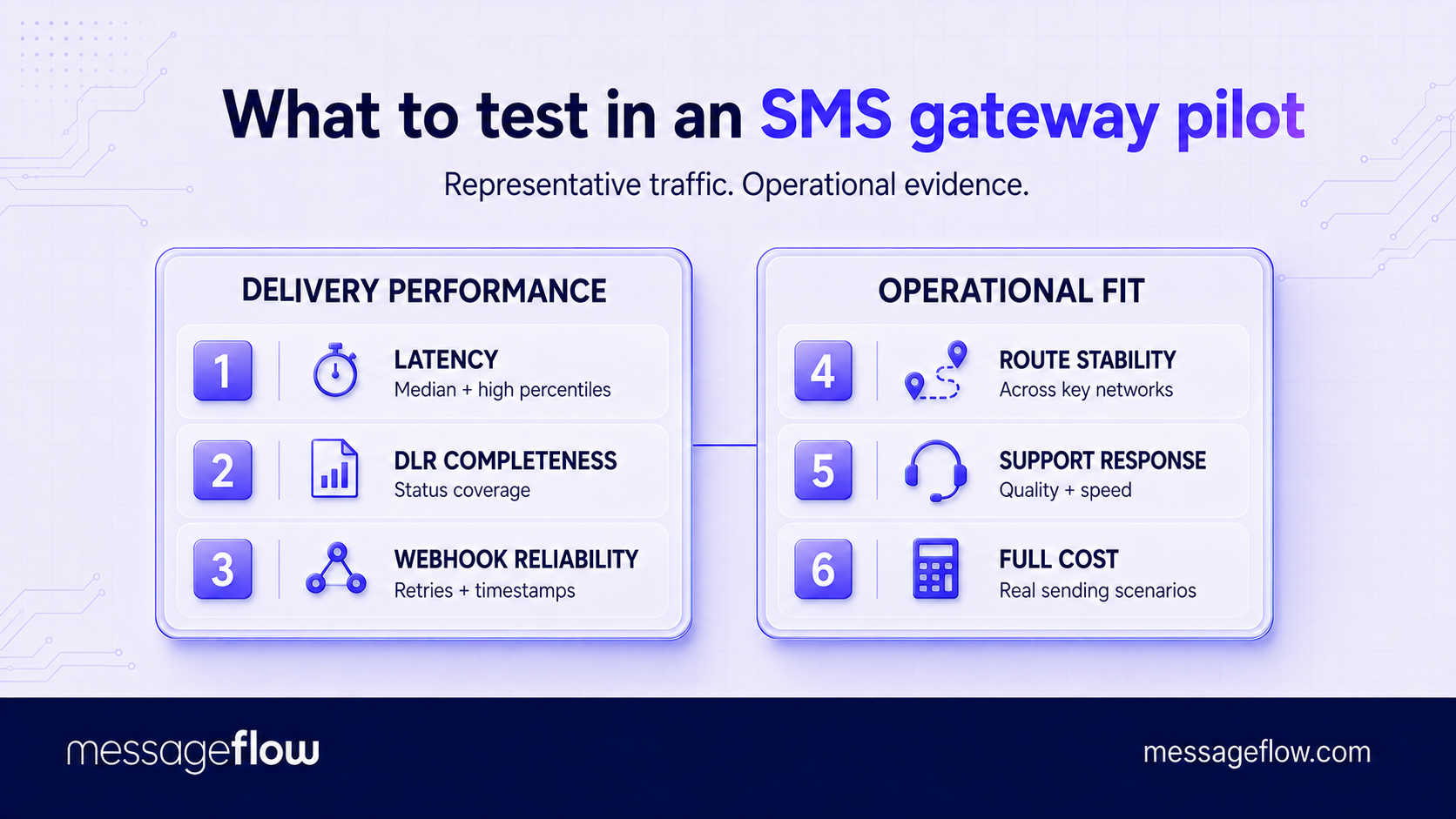
Measure more than the average delivery rate. Record median and high-percentile latency, DLR completeness, webhook reliability, rejection-code clarity, route stability, and support response. Averages can hide a small group of messages arriving too late to serve their purpose.
💡 The strongest provider is not necessarily the one that wins every metric. It is the one whose technical behavior, contractual commitments, and cost structure match the consequences of failure in your specific use case.
An SMS gateway is infrastructure, not merely a sending tool
An API makes SMS easy to trigger. The gateway behind it determines whether those messages behave like a dependable business channel.
That difference should shape both integration and procurement. Developers need clear documentation, predictable errors, and reliable webhooks. Marketing and operational teams need sender controls, usable reporting, and independence from engineering for routine tasks. The organization as a whole needs routes, capacity, security, and support that reflect the consequences of delayed or failed messages.
Before choosing an SMS gateway provider, define those consequences. Map the destination countries, traffic peaks, sender types, delivery-time requirements, and data-handling obligations that apply to your use case. Then test them with representative traffic. A provider comparison grounded in real message flows will reveal more than a feature checklist or headline price.
Frequently asked questions about SMS gateways
An SMS gateway is infrastructure that transfers messages between business applications and mobile networks. It validates requests, converts protocols, selects delivery routes, manages queues and retries, and returns delivery reports or incoming replies.
The sending application submits a message through an API, SMPP connection, dashboard, or integration. The gateway validates the request, chooses a carrier route, and forwards the message toward the recipient’s mobile network. It then returns status information generated during submission and delivery.
The SMS gateway is the delivery infrastructure, the SMS API is an interface used to access it. A business application sends instructions through the API, while the gateway handles routing, carrier connectivity, queues, failover, and reporting.
An SMS gateway provider operates the messaging platform and its connections with mobile networks or telecom partners. It typically manages routing, capacity, sender IDs, delivery reports, security controls, country coverage, and technical support.
Yes, provided the gateway supports both traffic types and the relevant sender, consent, and country requirements. Businesses should be able to separate or prioritize traffic so that a large promotional campaign does not delay authentication codes, fraud alerts, or other urgent notifications.
No. A gateway can improve routing, retry failed paths, and provide delivery data, but it cannot guarantee that every message reaches a handset. Invalid numbers, unavailable devices, carrier filtering, local restrictions, expired validity periods, and network failures can still prevent delivery.
Most managed gateways charge per message, with rates varying by country, carrier, volume, route type, and sender. Additional costs may include sender registration, number rental, inbound messages, premium routes, validation services, platform access, or extended support.
Messages containing Unicode characters or exceeding one SMS segment can also cost more because they are transmitted as multiple segments. Buyers should model complete sending scenarios rather than compare only the lowest advertised rate.
No. Occasional manual texts may not justify enterprise infrastructure. An enterprise SMS gateway becomes appropriate when messages are automated, time-sensitive, high-volume, international, subject to security requirements, or important enough to require contractual availability and specialist support.
Yes. A business can deploy gateway software and connect it through GSM hardware, SIM cards, SMPP, or direct carrier agreements. This may suit a narrow local use case or an organization with existing telecom capabilities.
The business then assumes responsibility for hardware, software, capacity, routing, redundancy, carrier relationships, monitoring, security, and compliance. For multi-country or high-volume messaging, a managed provider will usually remove substantial operational work.
The core criteria are carrier connectivity, route quality, SLA scope, throughput, failover, delivery reporting, sender support, country coverage, security, compliance controls, technical support, and total cost.