A phone number can pass every format check you throw at it and still be dead. The digits are right, the country code is valid, the length matches the national plan, and the SIM was switched off eight months ago. Send to it and you pay for a message no one receives, while your delivery rate slips.
An HLR lookup closes that gap. It asks the mobile network itself whether a number is real, currently active, and reachable, before a single SMS goes out. Used well, it trims dead weight from a list and informs how messages get routed. Used carelessly, it becomes a line item that promises more certainty than it can deliver. Both are worth understanding before you wire it into a sending process.
What an HLR lookup is
Every mobile operator keeps a master database of its subscribers called the Home Location Register, or HLR. For each SIM on the network it holds a permanent record: the phone number, the SIM’s internal identity (the IMSI), which services the subscriber is entitled to, and a pointer to where the device is currently registered. When someone calls or texts you, the network consults this record to work out where to send the traffic.
An HLR lookup is a query against that record. A provider sends a request across the mobile signaling network – historically SS7 – and reads back the current status of a number, without placing a call, sending a message, or notifying the subscriber. It reads the network’s own account of a number rather than inferring anything from how the number looks.
💡 One point of precision worthy mentioning here is that the classic HLR belongs to 2G and 3G networks. LTE replaced it with the Home Subscriber Server (HSS), and 5G uses the Unified Data Management (UDM) function. Commercial services still call the query an “HLR lookup,” and it still works, because operators keep the older signaling interworking with newer cores. The name is a holdover, the answer it returns – is this number live, and where – is the same.
What an HLR lookup actually returns
The response to a lookup is a small set of fields, each answering a specific question about the number. Read together, they tell you more than valid or not.
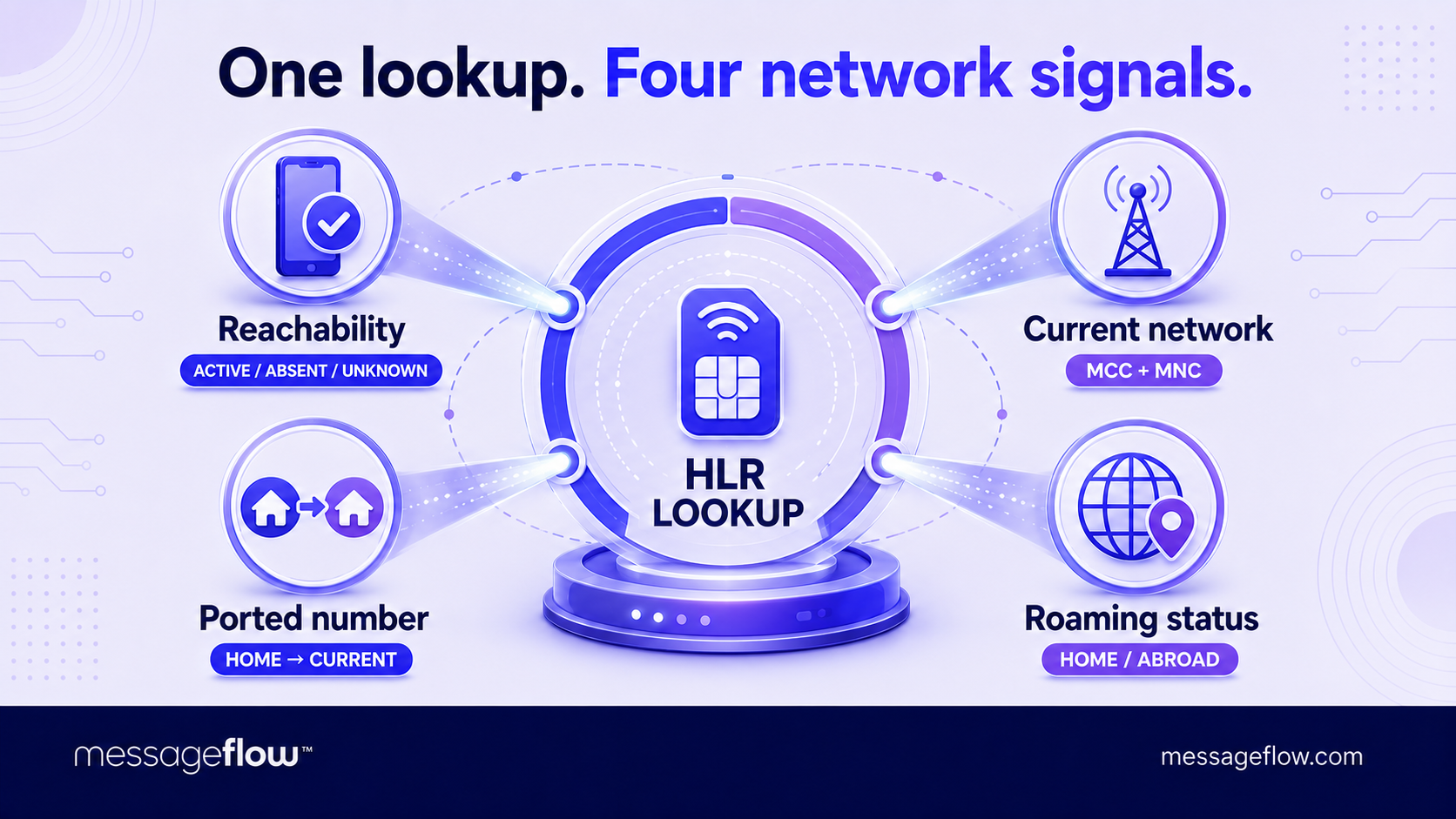
The first is reachability status. The network reports whether the number exists as a live subscriber and whether the device is currently registered, usually as a state like reachable, absent (the SIM is known but the handset isn’t registered right now, typically switched off or out of coverage), or unknown/not provisioned for numbers the network doesn’t recognize as active. This is the field most people mean when they say they want to check whether a number is active.
The second is the current network, identified by two codes: the Mobile Country Code (MCC) and Mobile Network Code (MNC). Together they name the operator the number is registered on at the moment of the query. On its own that looks like plumbing detail, but it drives real decisions like which route to use, which sender ID rules apply, and what a message to that operator will cost.
The third is ported-number detection. Mobile number portability lets subscribers keep their number when they switch operators, which means the network that originally owned a number range is often not the one serving it today. A lookup returns the current serving network, so a number that still looks like it belongs to Operator A is correctly resolved to Operator B. Getting this wrong is a common, invisible cause of failed or misrouted international traffic.
The fourth is roaming status – whether the subscriber is currently registered on a network outside their home country, and if so, which one. For most marketing sends this is noise. For fraud checks and some transactional flows, a subscriber roaming in an unexpected country is a signal worth acting on.
💡 What all four have in common is they describe the network’s account of the number at the instant you asked. That timing matters, and it’s where the honest limits come in later.
HLR lookup vs. E.164 validation
These two checks get mentioned in the same breath, which causes trouble, because they answer different questions and sit at different points in the process.
E.164 validation checks that a number is well formed. E.164 is the international standard that defines how a phone number should be structured – a country code followed by a national number, up to fifteen digits total.
Validating against it, usually with an offline library and numbering-plan data, confirms the number has a real country code, a plausible length, and a prefix that’s actually been allocated, often including whether that prefix belongs to a mobile or a fixed line. It’s instant, it costs nothing per check, and it catches many frequent problems: typos, missing country codes, landlines submitted as mobiles, numbers with too few digits.
What E.164 validation cannot tell you is whether the number is in service. It works from the shape of the number and published plan data, not from the network. A number can be perfectly E.164-compliant and belong to a SIM that was deactivated a year ago. The format is fine, the subscriber is gone. No amount of offline validation will surface that, because the information simply isn’t in the number itself.
An HLR lookup is what adds the live layer. It doesn’t re-check the format – it assumes you’ve already done that and instead asks the network for current status and the serving operator. So the two aren’t competing options, they’re sequential.
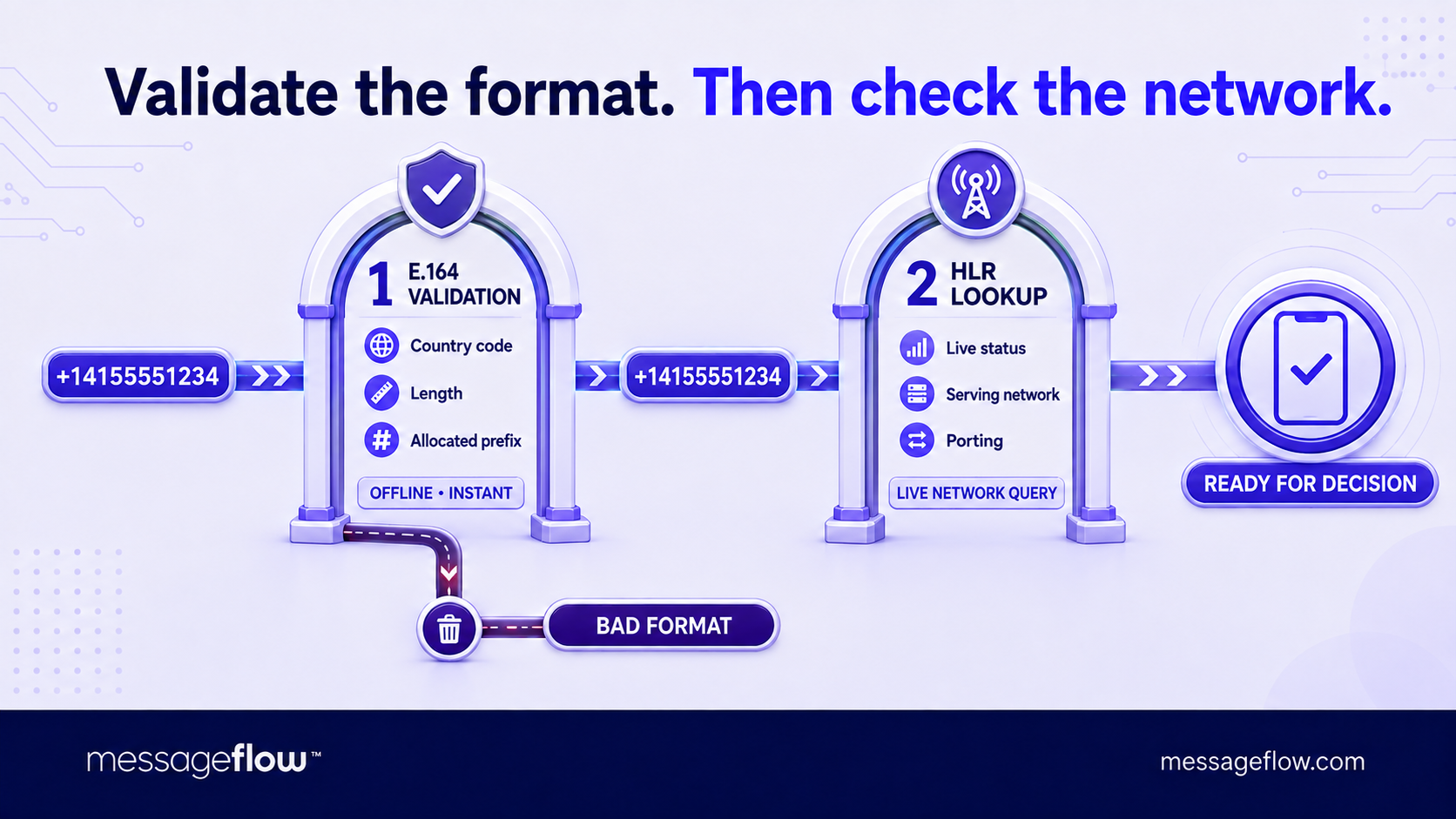
E.164 validation is the first-line filter you run on everything, cheaply and at scale. An HLR lookup is the second-line check you run on what survives, when knowing a number is genuinely active is worth a per-lookup cost. Skip the first and you waste lookups on garbage input. Skip the second and you’re trusting that well-formed means live, which it doesn’t.
Where number-status data helps
The value of a lookup isn’t the data itself but rather the decisions the data lets you make earlier and more cheaply. Four situations account for most of the genuine payoff.
Cleaning a list before a campaign
The clearest case is list hygiene. Contact lists decay: people change numbers, cancel plans, and abandon SIMs, and none of that shows up in a spreadsheet.
Running a status check across an older or bought-in list before a large SMS marketing send lets you drop the numbers a network reports as inactive, so you stop paying to message people who can’t receive it. The secondary gain matters as much as the saved spend: sending to a list padded with dead numbers drags down your delivery rate, and a poor delivery rate is one of the signals that erodes sender reputation over time.
Routing and ported numbers
Knowing the current serving network lets you route each message the right way instead of guessing from the number’s original prefix.
Because portability breaks the old assumption that a number range maps to one operator, a lookup that resolves a number to its real current network helps you pick an appropriate route, apply the correct sender ID rules for that operator, and price the message accurately. For domestic sends this is a refinement. For international traffic, where a misrouted message often just fails without you being aware of it, it’s the difference between reaching someone and paying for nothing.
Verifying numbers at the point of capture
Checking a number when it’s first submitted – at signup, checkout, or opt-in – keeps bad data out of the list rather than cleaning it up later. A real-time check confirms the number is a live mobile subscriber before you rely on it for a verification code or an order update, which cuts down on fake registrations and typos that would otherwise sit in your database until the first failed send exposes them.
Controlling international cost
International SMS costs more per message and varies widely by destination, so the waste from sending to unreachable foreign numbers adds up faster than it does domestically. For lists with meaningful international reach, screening out inactive numbers ahead of a send is a straightforward way to keep spend tied to messages that stand a chance of arriving.
The limits of an HLR lookup
A lookup is useful in proportion to how honestly you read it. Treated as a live status signal, it earns its cost. Treated as a delivery guarantee, it will let you down, because that isn’t what it measures.
Start with timing. A lookup describes the number at the instant you queried it. Someone reachable this morning can switch their phone off, travel out of coverage, or cancel their plan by the time your campaign sends this afternoon. For a real-time verification check the snapshot is fresh enough to trust. For a list you screened days before a send, the results have already started to age.
The status fields are also less absolute than they read. An absent result usually means the handset isn’t registered right now – likely switched off or out of coverage – not that the number is dead. Drop every absent number and you’ll discard people who are simply asleep or on a plane. Data quality varies by country and operator, too. Some networks return granular, reliable status, while others expose little or return results that don’t cleanly map to active or inactive. A lookup is a strong signal in well-covered markets and a weaker one in the long tail.
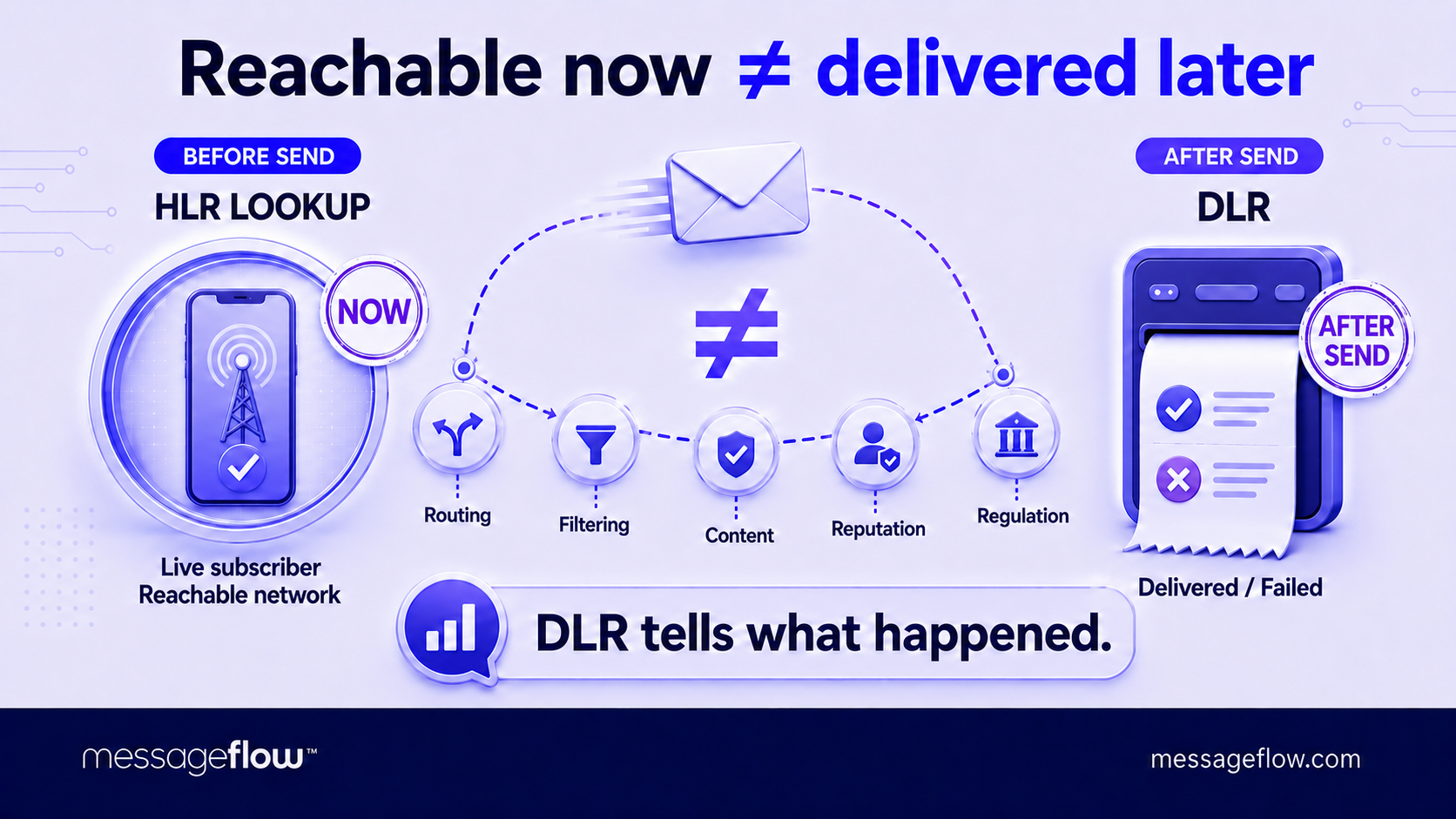
💡 The limitation worth stating plainly is that an HLR lookup does not guarantee that a specific message will arrive. It confirms a number is a live subscriber on a reachable network – nothing more. Whether your SMS actually lands still depends on routing, carrier-level filtering, message content, sender reputation, and local regulation, none of which a lookup can see.
The number-status check happens before you send. The real answer to “did it arrive” comes after, from the delivery status reported back by the network. If messages are failing despite clean status data, the cause usually sits in deliverability and sender reputation, not in the numbers themselves.
There’s a cost dimension as well. Each lookup carries a per-query fee, so at scale you’re weighing that cost against the price of the messages you’d otherwise waste. On a small, recently confirmed list the arithmetic often doesn’t justify it – you’d spend more checking than you’d save. That trade-off is the subject of the last section.
Privacy and compliance considerations
An HLR lookup queries data about a specific, identifiable subscriber, which puts it inside the scope of data protection rules rather than outside them. Under the GDPR, a phone number tied to a person is personal data, and checking its network status is processing that data so the ordinary obligations apply. You need a lawful basis for the check, a clear purpose, and retention that matches that purpose. Cleaning a marketing list and verifying a number at signup are defensible uses, running lookups to build a broader picture of someone is not, and purpose limitation is what separates them.
The roaming field deserves particular care, because it reveals which country a subscriber is currently in. That’s exactly the capability that has made HLR lookups attractive for surveillance and stalking, and it’s why the technique carries a reputation beyond its routine deliverability uses. Treating location-related data as sensitive by default, and only requesting fields you have a genuine operational reason to use, keeps a legitimate hygiene process from drifting into something harder to justify.
Provider choice is part of compliance, not separate from it. A reputable lookup provider will be transparent about where queries are processed, hold appropriate data-processing terms, and give you a defensible answer on how subscriber data is handled – the same due diligence you’d apply to any processor touching customer data. If a provider can’t explain that clearly, that opacity is itself the warning.
None of this makes HLR lookups off-limits. It makes them a tool to use deliberately: for a stated purpose, on data you already hold a basis to process, with a provider you’ve vetted. Handled that way, the check stays firmly on the right side of the line.
When it’s worth it and when it isn’t
The question worth asking in this context is whether the number-status data changes a decision you’re about to make. When it does, the per-lookup cost is easy to justify. When it doesn’t, you’re paying for reassurance rather than information.
Lookups tend to pay off in a few recognisable situations:
- Large lists, where even a small share of dead numbers adds up to real wasted spend.
- Old or bought-in lists, where decay has had time to accumulate and you have no recent evidence of who’s still reachable.
- International sends, where per-message costs are higher and misrouting from unresolved ported numbers fails quietly.
- High-stakes moments – verifying a number at signup, or confirming reachability before a time-sensitive transactional message – where the value of getting it right outweighs the fraction of a cent per check.
The cases where a lookup earns little are just as clear. A small list of people who opted in recently and engage regularly is already giving you live proof of reachability through their behaviour. Screening it adds cost without adding much you don’t already know. So does re-checking numbers you validated a few days ago, since the snapshot hasn’t had time to change. And no volume of lookups fixes a deliverability problem rooted in routing, filtering, or sender reputation. If messages are failing to reach confirmed-active numbers, the numbers were never the issue.
A workable default falls out of this. Run E.164 validation on everything – it’s cheap and catches the obvious faults. Reserve HLR lookups for the cases above, where confirming a number is genuinely live changes what you’d otherwise do. Wire the check into the point where the decision actually happens: at capture for verification, or ahead of a send for hygiene and routing, which is a matter of a single call to a messaging API. Applied with that discipline, an HLR lookup does one job well – it tells you a number is real and reachable right now and leaves the separate work of getting a message delivered to the parts of the stack built for it – a CPaaS platform.