TL;DR: Push or SMS? There is no single channel that works best in every scenario. Push notifications are a natural choice when you are communicating with app users and want a low cost per additional interaction, a fast response, and the ability to take recipients directly to a specific place in your app. SMS, on the other hand, lets you reach customers regardless of whether they use your app or have internet access, making it a strong option when you need broader reach or an additional communication channel.
That is why the push notifications vs SMS decision should not be based on message price alone. Four factors matter much more: whether the recipient can actually be reached through the channel, how important the message is, how much it costs to achieve the desired outcome, and what happens if the message is not delivered.
💡 In many cases, the most effective approach is not choosing one channel over the other, but combining them intelligently. This can be automated with features such as Message Booster. Push can serve as the first, cost-efficient touchpoint for app users, while SMS can extend your reach or act as an SMS fallback when the first channel is unavailable or does not produce the expected result.
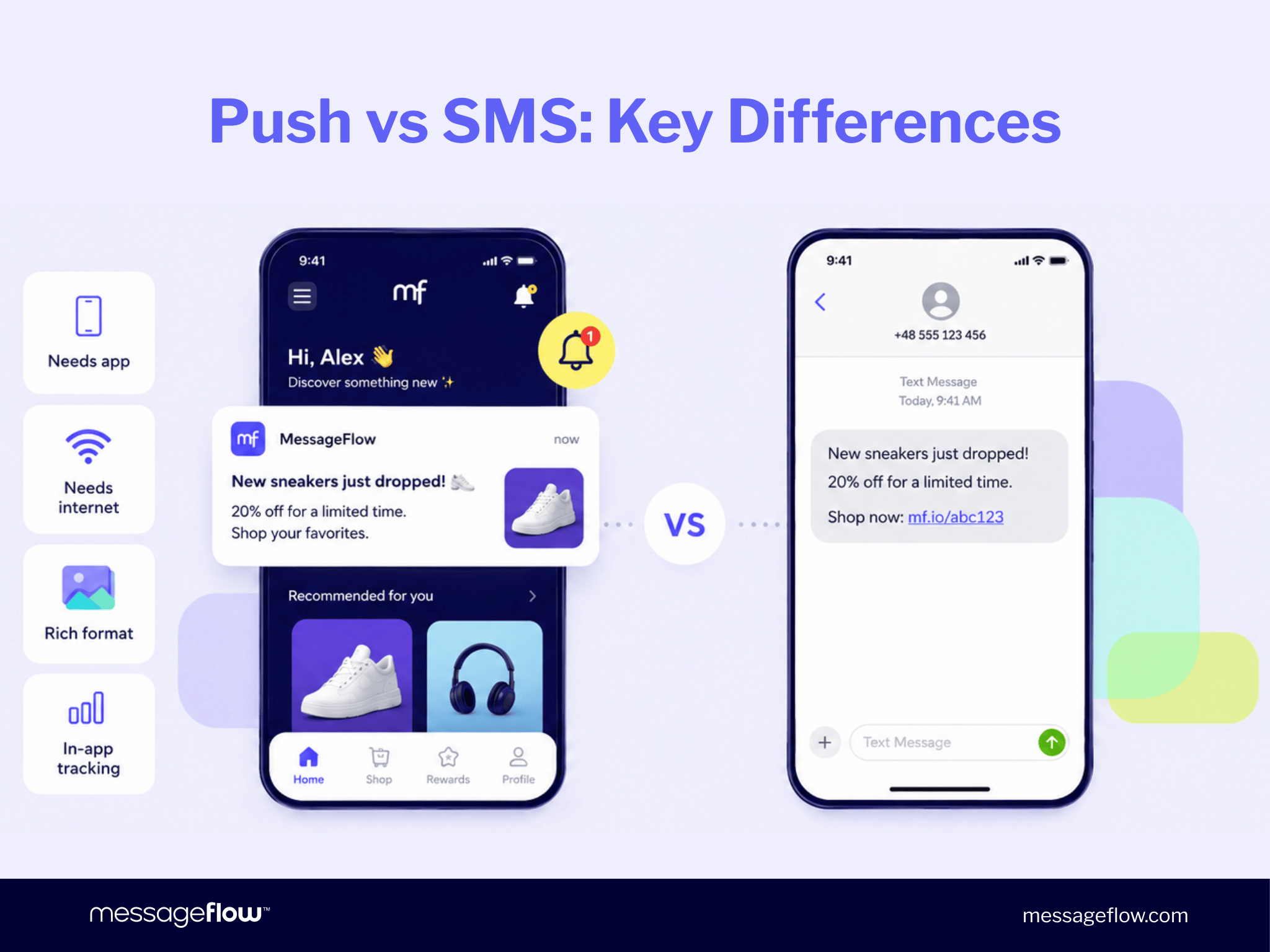
Push vs SMS: Key Differences
At first glance, push notifications and SMS messages work in much the same way: a short message appears on a mobile phone and can prompt an immediate response. From a business perspective, however, they differ significantly in terms of reach, cost model, dependence on an app, measurement capabilities, and the role they can play in the customer journey.
| Criteria | Push notifications | SMS |
|---|---|---|
| Requires an app | Yes | No |
| Requires internet access | Yes | No |
| Potential reach | App users who are able to receive notifications | Customers with an active phone number whom the business is permitted to contact in a given scenario |
| Cost model | Typically no per-message charge; costs depend on the platform being used | Every message sent generates a per-message cost |
| App context | Very strong — the message can take the user directly to a product, cart, or specific feature | More limited — the recipient can be directed elsewhere, for example via a link |
| Format options | Greater visual and interactive possibilities | Traditional SMS uses a simpler, text-based format |
| Response measurement | Interactions with the notification and subsequent in-app actions can be measured | Delivery status is available; responses can be measured through links or downstream conversions |
| Main limitation | Depends on the app, an active device, notification settings, and connectivity | Per-message cost and a more limited format |
The most important difference is therefore not simply that push is “cheaper” while SMS offers “greater reach.” What matters to the business is whether the recipient is actually reachable and how much it costs to achieve the intended outcome – not just the price of sending one message.
Before choosing between SMS vs push notifications, it is worth working through a few straightforward questions.
How to Choose Between Push and SMS: 5 Questions to Ask
The best place to start is not with a feature comparison, but with the specific business scenario. The same company might use push for in-app promotions, SMS to reach customers outside the app, and both channels together for messages where failed delivery carries a higher risk.
So instead of asking “Which channel is better?”, ask these five questions.
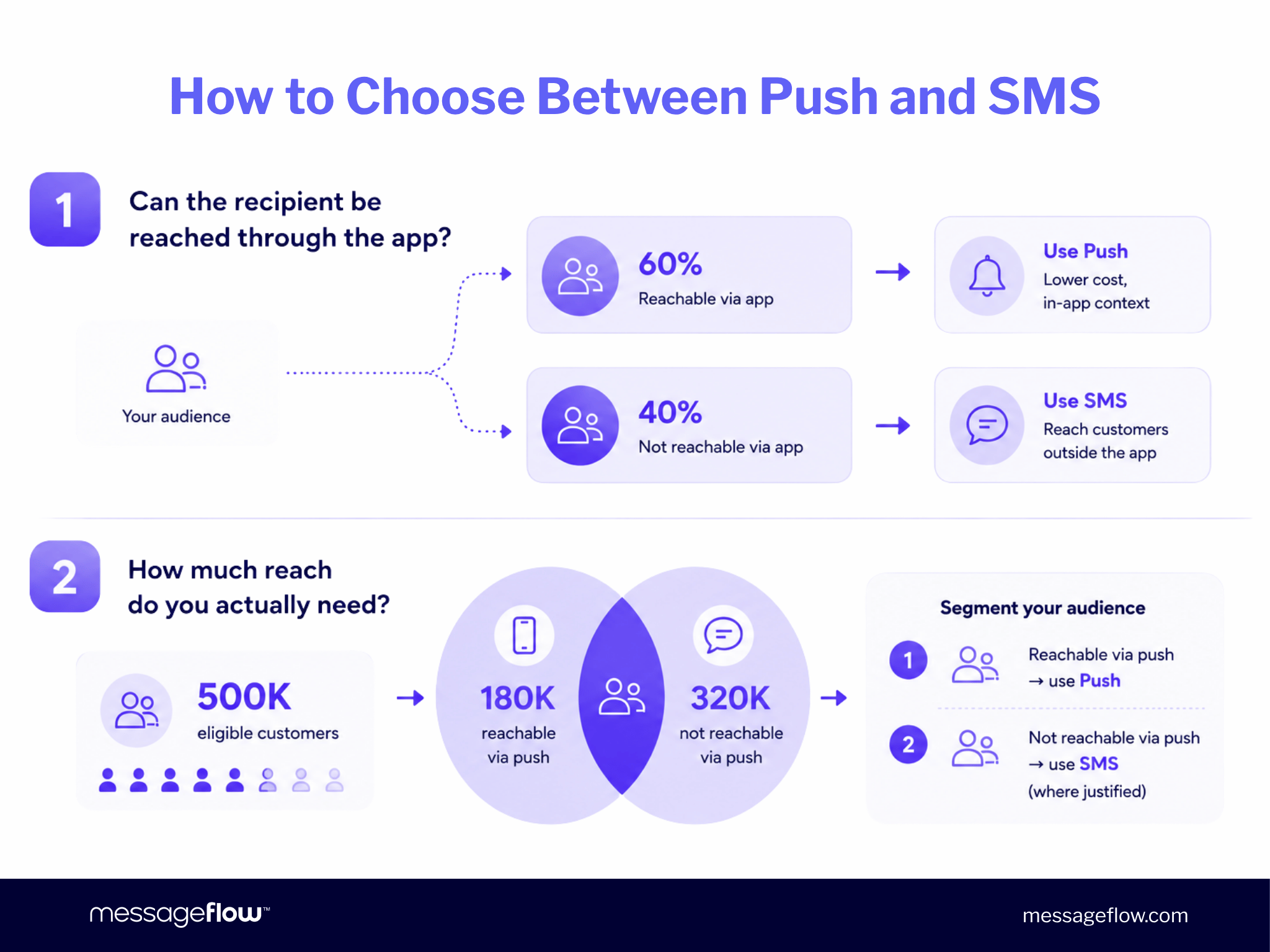
1. Can the recipient be reached through the app?
This is the basic requirement for mobile push. The user must have the app installed, and their device must be reachable through the push channel.
If a significant share of your customers does not use your app, push cannot be your only communication channel. SMS lets you reach customers outside the app ecosystem as well.
That does not mean you need to send an SMS to your entire database. If some recipients are reachable through push, you can use the lower-cost channel first and reserve SMS for the remaining segments.
2. How much reach do you actually need?
Not every message needs to reach your entire customer base. If a campaign is relevant only to app users, limiting it to push notifications may make perfect sense. But if your goal is to inform as many relevant customers as possible, push alone may leave a substantial part of your audience unreached.
For example, an online retailer might have 500,000 customers eligible for a campaign, but only 180,000 of them may be reachable through push. If the message needs to reach all relevant segments, the business will need an additional channel.
That still does not mean sending SMS to all 500,000 customers. A more efficient approach may be to segment the audience:
- Users reachable through push → push
- Users who cannot be reached through push → SMS, where justified by the communication goal
💡 Intelligent audience segmentation can help increase reach without unnecessarily duplicating messages or costs.
3. How important is it for the message to reach the recipient?
The next question is less about the channel itself and more about the cost of the message not being delivered.
Missing a promotional message is unlikely to have serious consequences. Missing information about a delivery date change or account security is a different matter.
The greater the risk associated with failing to reach the user, the less sense it makes to design the process around a single channel.
Remember: push notifications can fail to reach users too
A push notification may not be delivered if, for example, the user:
- has uninstalled the app,
- has disabled notifications,
- is using a device that is no longer actively associated with the service,
- has no internet connection when delivery is attempted.
Neither channel offers a 100% guarantee
SMS is less dependent on the state of an app and can reach a much broader audience, but it does not guarantee successful delivery either.
The phone number may be inactive or incorrect, the device may be out of coverage, or delivery may fail because of carrier- or network-related limitations.
This is also important when considering push vs SMS security for sensitive or time-critical communication. The key question is not which channel can guarantee delivery – neither can — but how your communication flow can increase the probability that an important message reaches the intended recipient.
That is where fallback comes in: if the first channel is unavailable or fails to meet a defined condition, another channel can be triggered.
4. What does achieving the outcome cost – not just sending the message
A push notification vs SMS cost comparison often starts with the price of a single message. Push has a natural advantage here because additional sends typically do not incur a unit cost in the same way SMS does. Businesses still incur costs related to the platform, integrations, app maintenance, data management, and automation.
With SMS, every message sent generates a cost, which varies depending on factors such as the market, carrier, provider, and sending volume. But that is still only part of the picture.
Cost per message does not tell you whether the campaign was profitable
For a business, the more useful metric is the cost of achieving a specific result. That might be a recovered cart, a click, a purchase, a confirmed appointment, or simply a successfully communicated piece of information.
If push achieves the desired outcome among app users, sending an additional SMS to the same people may simply increase campaign costs. Conversely, a channel with a very low sending cost is not particularly effective if a large proportion of your audience cannot be reached through it.
Instead of focusing only on cost per message, look at cost per outcome.
Suppose a company wants to reach 500,000 customers, 200,000 of whom are reachable through push. Instead of sending 500,000 SMS messages, the company could start with push for those 200,000 app users and send SMS only to the remaining recipients – or only to the segment where an additional contact is justified by the business value.
In this model, channel selection becomes part of overall campaign cost optimization rather than a simple comparison of the price of an SMS with the price of a push notification.
5. What should happen if the first channel does not work?
Push and SMS do not have to – and often should not – be treated purely as alternatives. In many scenarios, it is more effective to use them sequentially based on recipient behavior and communication context.
The flow might look like this:
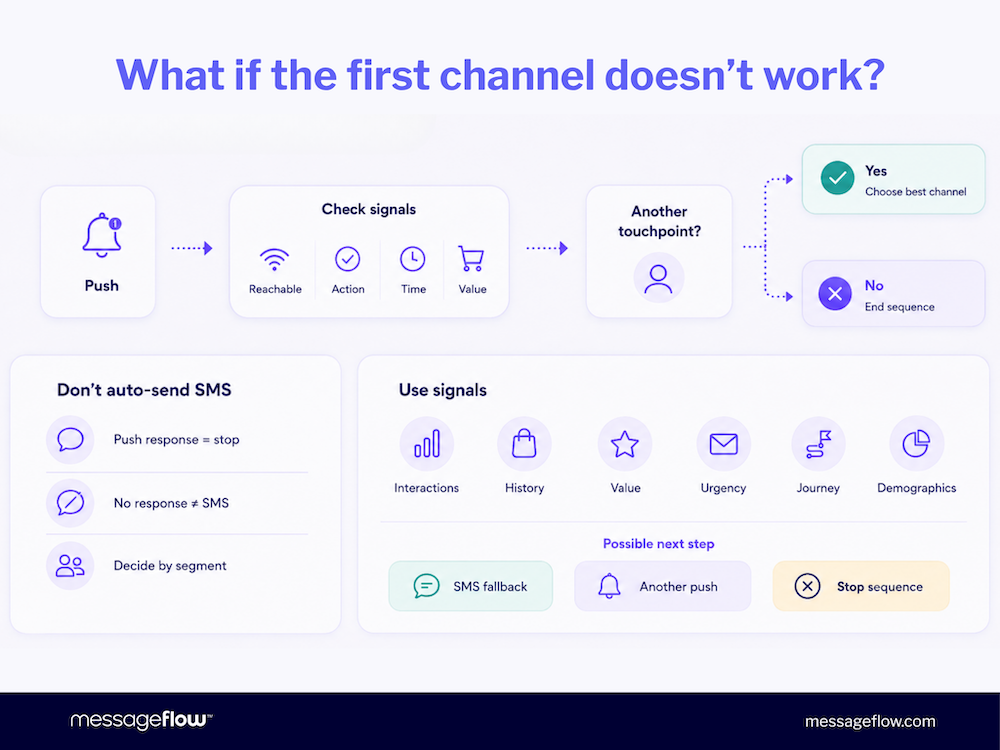
push → assess availability and response → choose another channel if needed
For example, an ecommerce business could begin an abandoned cart sequence with a push notification to app users. It could then check whether the recipient was reachable through that channel, whether they took the expected action, how much time has passed since the first contact, or whether the value of the cart justifies another message.
Only then does the business decide whether another touchpoint is necessary and which channel makes the most sense.
In a push-first strategy, SMS does not always have to be the second step
Fallback should not mean automatically duplicating every message through another channel. If the customer responds to the push notification, another message may be unnecessary. If they do not respond, the absence of a response should not automatically trigger an SMS either.
An effective communication model should choose the next channel for a specific customer segment using signals such as behavioral and demographic data. Relevant factors may include the recipient’s previous interactions with different channels, purchase history, customer or transaction value, message type and urgency, and current stage of the customer journey.
A stronger model therefore looks like this:
push → analyze signals and recipient profile → select the right channel for the right segment
In practice, this could mean using SMS fallback only for selected recipients, sending another push to a different segment, or ending the sequence altogether when an additional message would not provide enough value.
How to Measure Push and SMS Performance
A delivered message does not necessarily mean the channel has done its job. From a business perspective, what matters most is whether the communication resulted in the intended action.
That is why push notifications vs SMS should be evaluated not only by reach and sending cost, but across the entire journey to the business outcome:
sent → delivered → response → conversion
The data available differs by channel. Push is directly connected to an app, while in SMS the primary operator-side signal is usually delivery status.
What can you measure with push notifications?
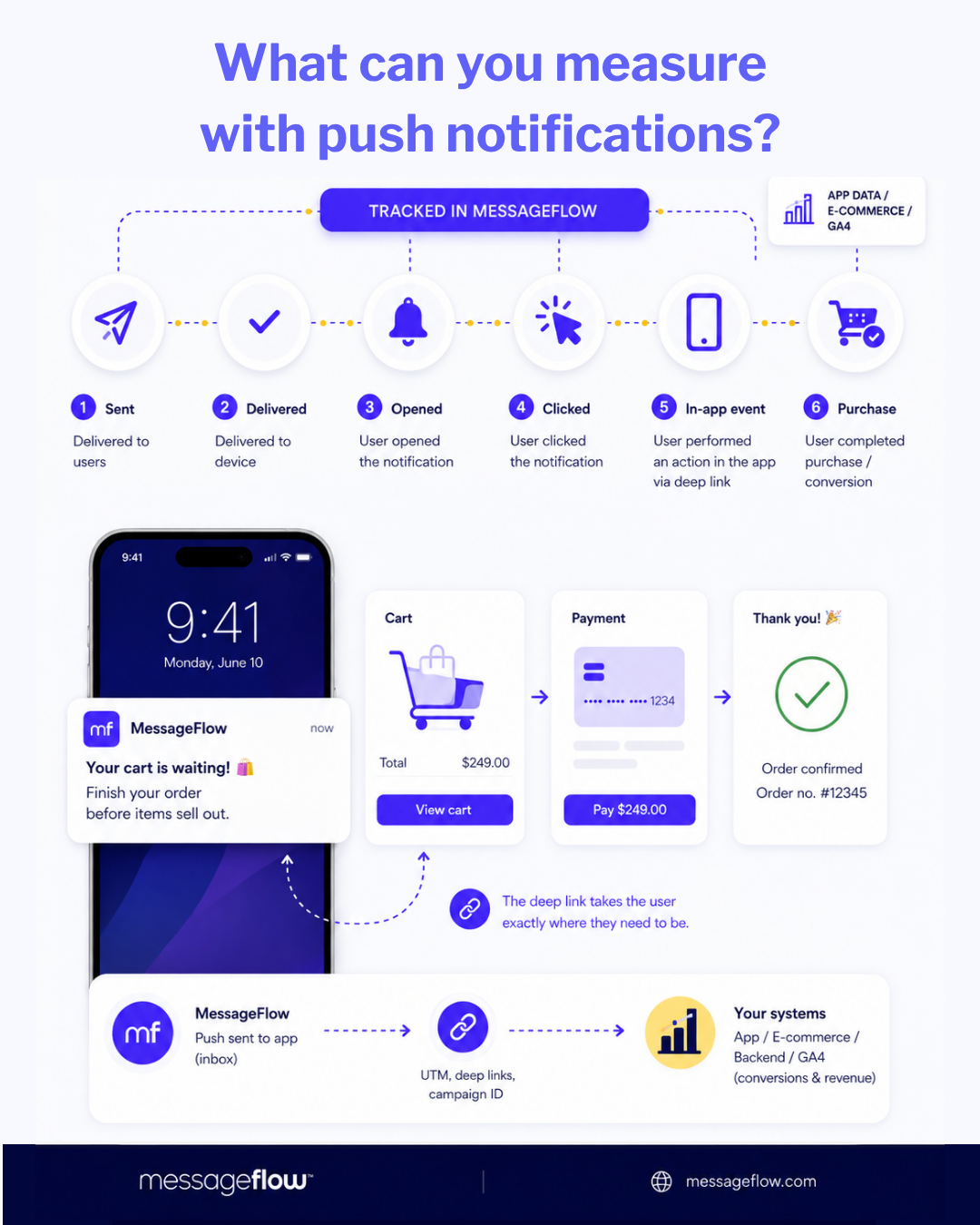
Because push notifications are closely integrated with the app, businesses can analyze not just whether a message was sent, but also what the user did afterwards.
💡 In MessageFlow’s omnichannel communication platform, you can monitor metrics including messages sent, delivery status, notification opens, clicks and other tracked interactions, as well as campaign performance over a selected period. Data can also be analyzed at the individual recipient level, including message status and the time a notification was opened or clicked.
But this is only the beginning of the journey. Using a deep link, a push notification can take the user directly to a specific location in the app, such as a shopping cart, payment screen, or individual feature. This makes it possible to connect the response to the message with the user’s subsequent behavior.
For example, an ecommerce business could send an abandoned cart reminder and take the user directly to checkout after they tap the notification. The company can then determine not only whether the recipient engaged with the message, but also whether they completed the purchase.
A push measurement journey might therefore look like this:
sent → delivered → opened → clicked → app visit → purchase
MessageFlow can directly measure the first part of this journey. Final conversions can then be tracked using data from the app, ecommerce platform, backend system, or an analytics tool such as GA4. UTM parameters, deep links, and campaign identifiers can help connect the two stages.
What can you measure with SMS?
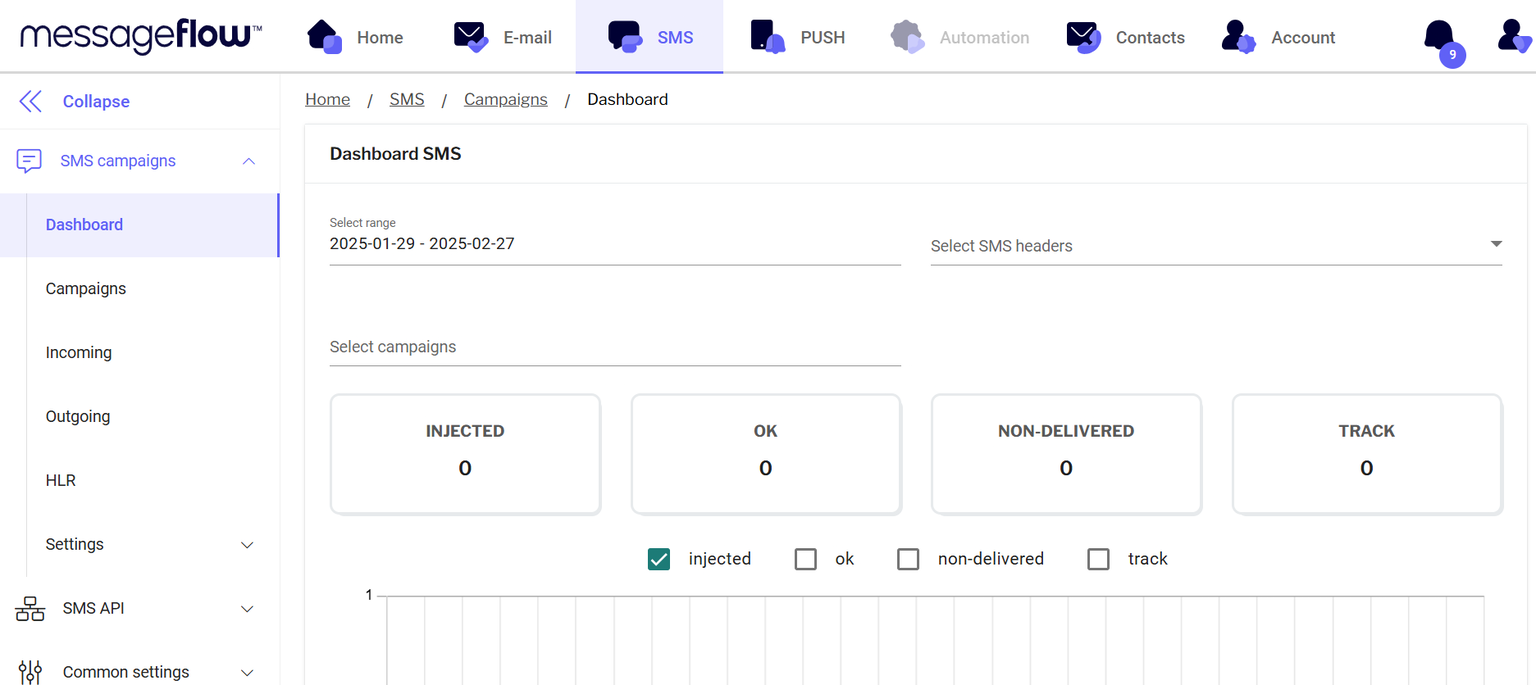
With SMS, the primary signal is delivery status. This does not mean that the recipient actually read the message. Traditional SMS does not provide a native open event, so an “SMS open rate” should not be treated in the same way as an open recorded in an app.
💡 In MessageFlow, you can analyze metrics including the number of campaign recipients, delivery statuses, and clicks on ide.do links used in messages. Reports can also be exported as CSV files, and recipients who clicked a link can be added to a separate audience for further communication. When links use suffixes, their statistics can also be reviewed in the SMS campaign settings.
If the campaign goal is a conversion – such as a purchase, payment, registration, or appointment confirmation – its performance should be assessed by combining sending and click data with information from your CRM, transaction system, app, or analytics platform.
This lets you determine not only whether an SMS was delivered and whether the recipient clicked a link, but also whether they completed the intended action.
Do not compare push and SMS using a single metric
One common mistake in SMS vs push notifications comparisons is trying to identify a single KPI that determines which channel performs better. In most cases, that tells you very little because the two channels may play different roles.
Push works well for active app users and can take them directly to a specific action. SMS can reach people who are unavailable through push or supplement an earlier interaction, although every send comes with an additional cost.
It is therefore more useful to evaluate several metrics together:
| Metric | Why it matters |
|---|---|
| Reachable audience | Shows how many recipients can realistically be reached through the channel |
| Delivery rate | Shows what proportion of messages were technically delivered |
| Open / interaction rate | Measures response where the channel supports reliable interaction tracking |
| Click rate | Shows how many recipients took an immediate action |
| Conversion rate | Shows how many recipients completed the intended business goal |
| Cost per conversion | Measures the cost of generating one conversion |
| Incremental uplift | Shows the additional impact of communication compared with a no-contact scenario |
Push or SMS? Summary
There is no universal answer to whether push or SMS is the better channel. Push is particularly effective when the recipient uses your app, the cost of additional interactions needs to remain low, and you want to take the user directly to a specific action. SMS, meanwhile, is less dependent on the app and can supplement communication when push does not provide enough reach.
The choice should therefore not come down to the cost of an individual message. What matters more is whether the recipient can be reached through the channel, how important the communication is, what result it is supposed to produce, and how much achieving that result actually costs.
In many scenarios, the best approach to SMS marketing vs push notifications is not to choose one and reject the other, but to combine both as part of a coherent cross-channel communication strategy:
push → analyze response and context → use another channel only when needed
SMS does not need to become an automatic fallback for every recipient who fails to respond to push. Whether to use it can depend on factors such as customer behavior and transaction value, previous channel engagement, message urgency, and the customer’s current stage in the journey.
Ultimately, an effective push notifications vs SMS strategy is not about maximizing the number of messages you send. It is about reaching the right recipient through the right channel at the right time, at a cost justified by the value of the expected business outcome.
FAQ: Push Notifications vs SMS
It depends on the recipient and the communication goal. Push notifications are a strong choice when the user has your app and you want to take them quickly to a specific action without generating a per-message cost every time you contact them. SMS is useful when you also need to reach people outside the app or extend the reach of your communication.
In many cases, combining both channels is the most effective approach.
The biggest difference is recipient availability. Push requires an app, an active device, enabled notifications, and internet connectivity. SMS does not require an app or internet access, which means it can reach a broader audience of customers with active phone numbers.
With push, additional messages generally do not incur a per-message cost in the same way SMS does. SMS, by contrast, involves a cost for every message sent.
That does not mean push is always more cost-effective. The more useful comparison is the cost of achieving the desired outcome, such as a purchase, click, or appointment confirmation, rather than simply the cost of sending one message.
SMS is worth considering when the recipient does not use your app, cannot be reached through push, or the communication needs to cover a broader customer base.
It can also serve as an additional channel in scenarios where failure to deliver an important message creates greater business risk.
Yes. SMS fallback can extend your communication when the recipient is unavailable through push or the first channel does not produce the expected result.
However, this should not mean automatically sending an SMS to every person who fails to respond to a push notification. The decision can depend on factors such as transaction value, previous customer behavior, message urgency, and the stage of the customer journey.
Neither channel guarantees 100% delivery. Push may fail to reach a recipient if they have uninstalled the app, disabled notifications, or do not have internet access. SMS can also remain undelivered because of an inactive number, lack of network coverage, or carrier-related limitations.
For important communication, it is therefore better to design a multi-channel process than to assume one channel will always be sufficient.
Push works particularly well for active app users, including promotions, abandoned cart reminders, and messages that take recipients directly to a specific location in the app.
SMS may be a better choice when a campaign needs to reach customers outside the app or when an additional channel is required to increase overall reach.
For transactional communication, the most important considerations are whether the recipient is reachable and what happens if the message is not delivered.
Push can serve as the first channel for app users, while SMS can supplement communication for recipients who cannot be reached through push. For high-priority messages, it is often better to design the process as a multi-channel flow rather than assume that one channel will always be enough.