TL;DR: OTP stands for one-time password (or one-time passcode), an autogenerated code that’s valid for a single login or transaction. OTP codes come in two types, HOTP and TOTP, and get delivered by SMS, email, or authenticator app. This guide covers how OTP codes work, what does OTP mean why NIST now flags SMS OTP as a “restricted” authenticator, and what actually determines whether an OTP arrives on time when it matters most.
Chances are you typed an OTP code sometime in the last week. Maybe it landed by text when you logged into your bank app. Maybe it showed up in an authenticator app before you approved a payment. An OTP code (one-time password) is an autogenerated passcode used for two-factor authentication, and it’s become one of the most common security steps online.
In this guide you’ll learn how OTP codes work, the difference between HOTP and TOTP, and why the code itself is only half the story. The other half is delivery: getting that code to the right person in seconds, every time, even when your platform is also blasting out a Black Friday campaign to a million inboxes.
What Does OTP Mean?
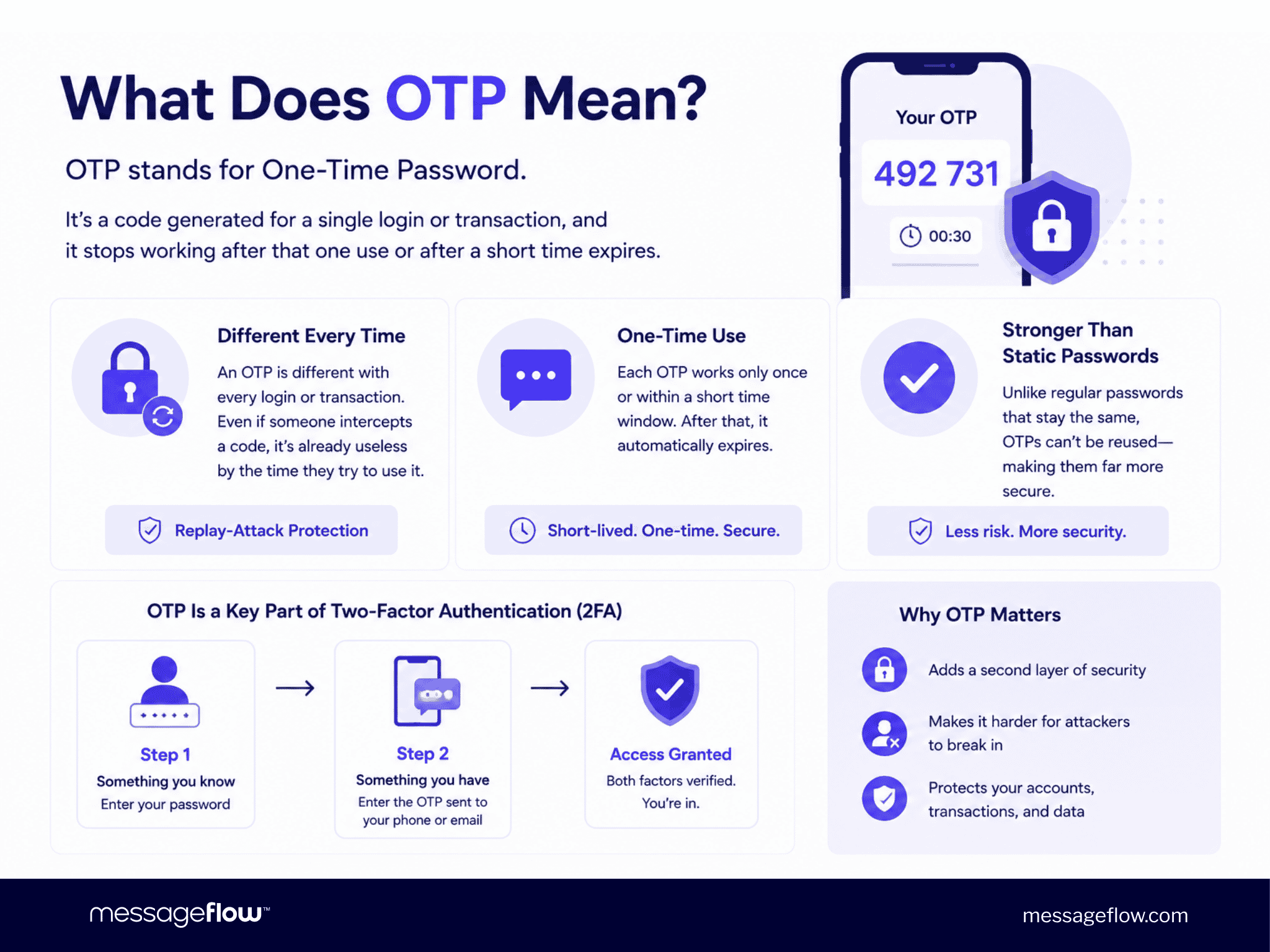
OTP stands for one-time password, also called a one-time passcode, one-time PIN, or one-time authorization code (OTAC). It’s a code generated automatically for a single login or transaction, and it stops working after that one use or after a short time window expires.
The idea behind OTP is simple. A regular password stays the same until you change it, which means anyone who steals it can use it again and again. An OTP is different every time, so even if someone intercepts one code, it’s already useless by the time they try to use it. This resistance to reuse, known as replay-attack protection, is one of OTP’s core security advantages over static passwords.
OTP codes are usually one piece of a broader two-factor authentication (2FA) setup. You enter your password first (something you know), then the OTP confirms you also have access to your phone or email (something you have). Together, those two factors make it much harder for an attacker to get in, even if they’ve already stolen your password.
How Does an OTP Code Work?
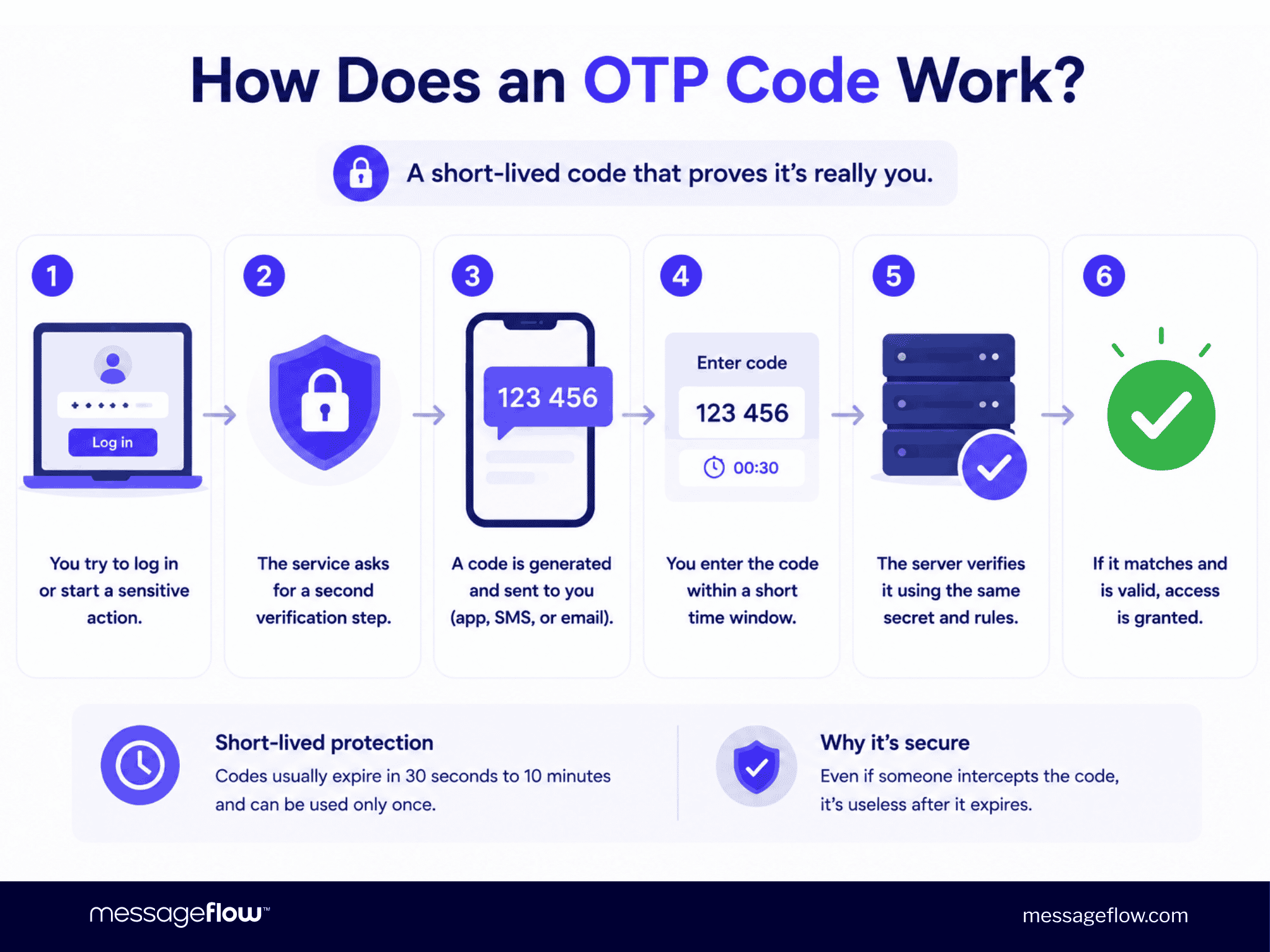
An OTP code works through a shared secret between your device and the service you’re logging into, combined with either a counter or the current time, run through a cryptographic function to produce a short numeric code.
Here’s the sequence in practice:
- You try to log in or complete a sensitive action, like a bank transfer or a password change.
- The service asks for a second verification step.
- A code gets generated, either by an app on your phone or by the service itself, and sent to you.
- You type the code into the login form within a short window, often 30 seconds to 10 minutes.
- The server checks the code against what it independently calculated using the same shared secret.
- If it matches and hasn’t expired or been used already, you’re in.
This is exactly the kind of flow that shows up in transactional SMS messages: a customer logs into an account, and the system automatically fires off a short, non-promotional text with a code. No sales pitch, no discount code, just the six digits the customer needs right now.
The reason OTPs work as security tools comes down to timing and scope. A static password gives an attacker unlimited attempts to use stolen credentials. An OTP gives them one shot, for a few minutes, before it’s dead.
HOTP vs. TOTP: The Two Types of One-Time Passwords
The two main types of OTP are HOTP (HMAC-based one-time password), which changes based on a counter that increments each time a new code is requested, and TOTP (time-based one-time password), which changes automatically every 30 to 60 seconds regardless of use.
HOTP relies on an event counter shared between your device and the server. Every time you request a new code, the counter goes up by one, and a new code gets generated from that counter value. Because the code doesn’t expire until it’s used, HOTP gives users more flexibility about when they enter it. The tradeoff is that a valid, unused code can sit around for a while, giving an attacker a longer window to intercept and use it if they get their hands on it.
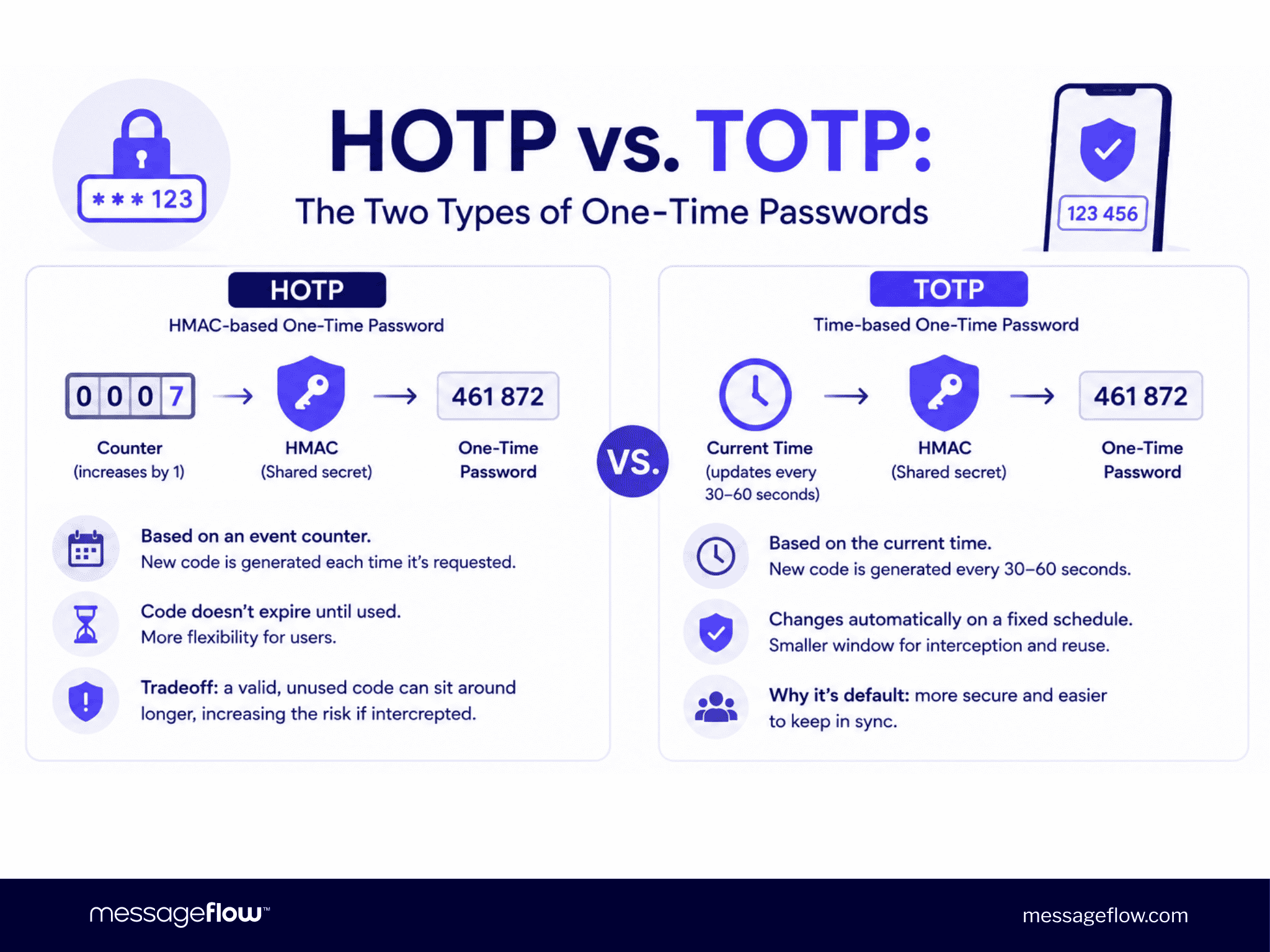
TOTP ties the code to the current time instead of a counter. Both your device and the server run the same clock, and every 30 to 60 seconds a new code gets generated from that timestamp. Because the code changes on its own schedule, there’s a much smaller window for anyone to intercept and reuse it. This is why most authenticator apps, including Google Authenticator and similar tools, run on TOTP rather than HOTP.
In practice, TOTP has become the default choice for most modern apps because it’s harder to exploit and doesn’t require the device and server to stay perfectly synced on a counter. HOTP still shows up in hardware tokens and some legacy enterprise systems where offline generation matters more than tight timing.
Where Do OTP Codes Get Delivered? SMS, Email, and Authenticator Apps
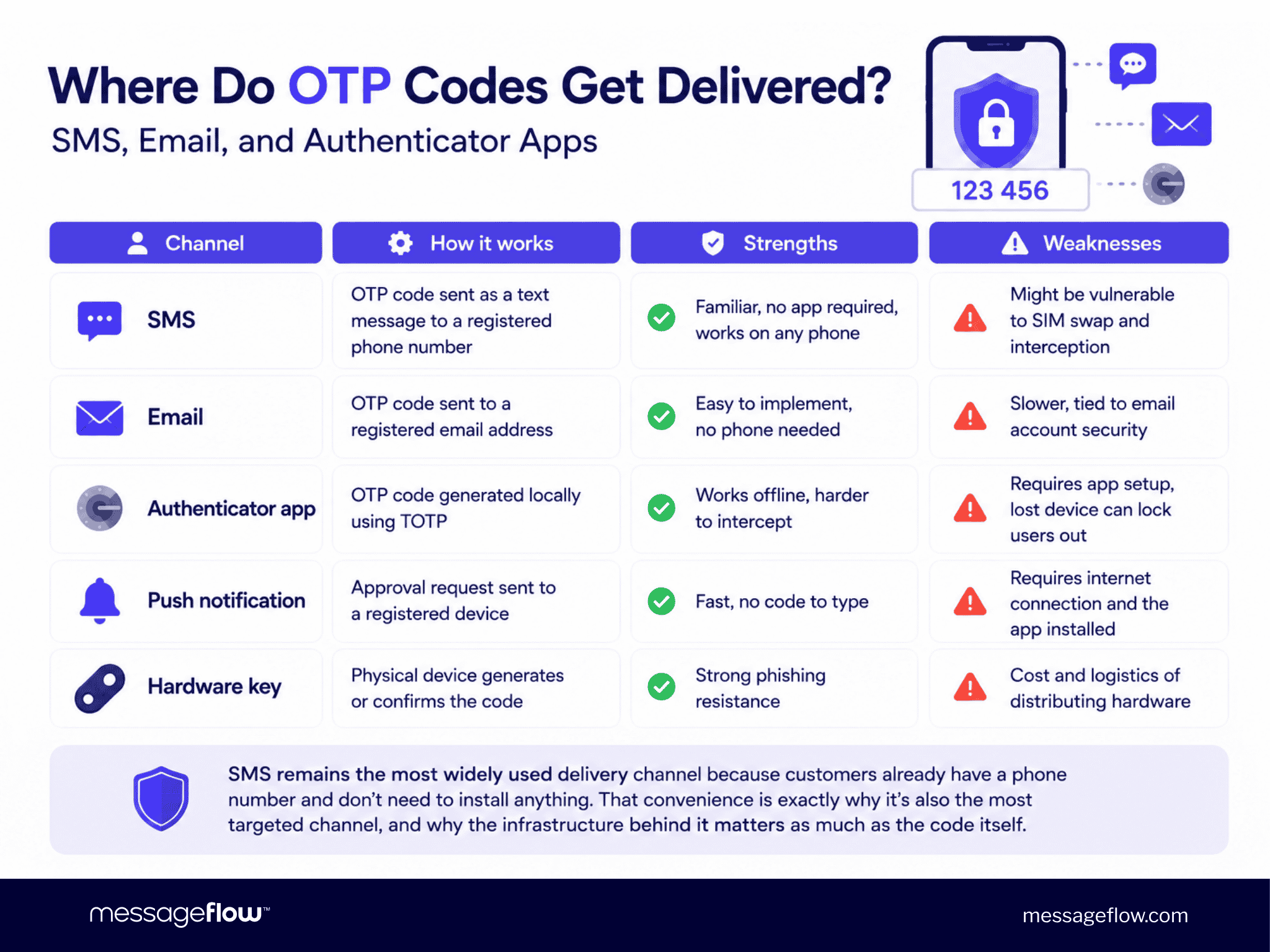
OTP codes reach users through a handful of channels, and each one comes with its own tradeoffs between convenience and security.
| Channel | How it works | Strengths | Weaknesses |
|---|---|---|---|
| SMS | OTP code sent as a text message to a registered phone number | Familiar, no app required, works on any phone | Might be vulnerable to SIM swap and interception |
| OTP code sent to a registered email address | Easy to implement, no phone needed | Slower, tied to email account security | |
| Authenticator app | OTP code generated locally using TOTP | Works offline, harder to intercept | Requires app setup, lost device can lock users out |
| Push notification | Approval request sent to a registered device | Fast, no code to type | Requires internet connection and the app installed |
| Hardware key | Physical device generates or confirms the code | Strong phishing resistance | Cost and logistics of distributing hardware |
SMS remains the most widely used delivery channel because customers already have a phone number and don’t need to install anything. That convenience is exactly why it’s also the most targeted channel, and why the infrastructure behind it matters as much as the code itself.
Why OTP delivery infrastructure matters for businesses
For businesses, OTP delivery infrastructure matters because a delayed or failed code doesn’t just annoy a customer, it blocks a login, stalls a payment, or breaks a compliance requirement, and the business bears that cost directly.
Picture an e-commerce checkout during a peak sales period. A customer enters their card details, the system sends an OTP to confirm the purchase, and the code takes 40 seconds to arrive because it’s queued behind thousands of promotional texts going out at the same time. By the time the code lands, the customer has already closed the tab. That’s a lost sale caused entirely by infrastructure, not by the customer’s intent to buy.
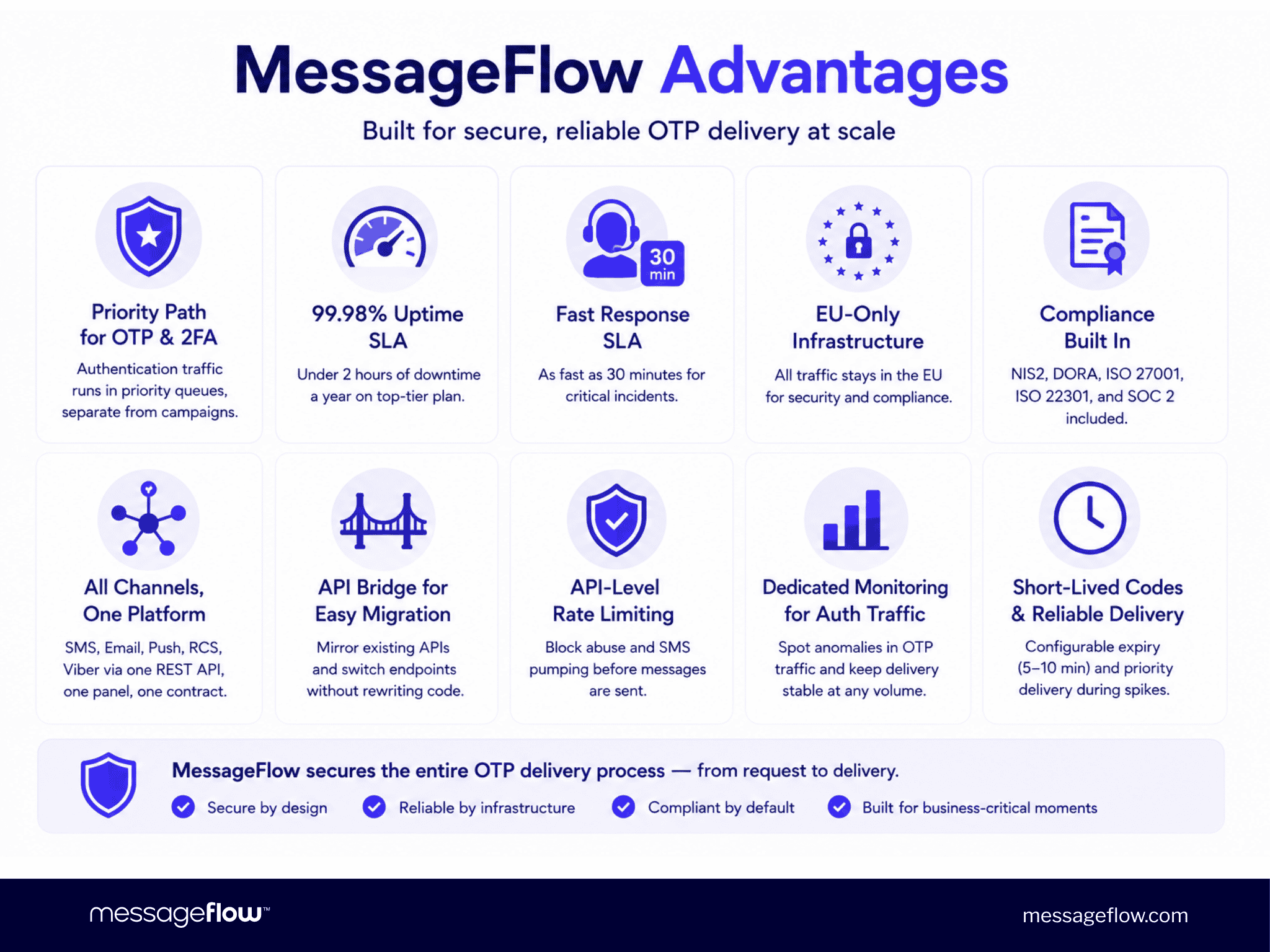
Priority path for critical messages & 2FA delivery
This is the exact scenario MessageFlow’s Priority feature is built to avoid. OTP and 2FA traffic can run through priority queues, separate from campaign traffic, so a Black Friday promotional blast never competes with a login code for the same bandwidth.
In practice, that means a financial services company confirming a transfer, or a retailer confirming a checkout, gets its codes delivered in seconds regardless of what else the platform is sending that hour.
💡 MessageFlow runs on a 99.98% uptime SLA, which works out to under two hours of downtime a year on the top-tier plan, and a response SLA as fast as 30 minutes for critical incidents rather than the multi-hour ticket queue that’s typical with global providers serving mid-market accounts. Talk to the team about setting up a dedicated priority path for your authentication traffic.
Compliance Built Into the Infrastructure Layer
There’s also a compliance angle that matters specifically for regulated industries.
Financial institutions and other critical-sector companies operating in the EU need to document how they handle security-critical communications under NIS2 and DORA requirements.
MessageFlow’s infrastructure runs entirely inside the EU, and NIS2/DORA documentation, along with ISO 27001, ISO 22301, and SOC 2 certifications, comes standard rather than as a paid add-on. That’s a meaningfully shorter due-diligence conversation than starting from “SMS usually works” or discovering a vendor’s OTP traffic is routed through US servers.
For teams managing more than one channel, OTP delivery doesn’t have to mean adding a fourth or fifth vendor to the stack. Email, SMS, push, RCS, and Viber run through a single REST API, one panel, one contract, and one place to check logs when something needs debugging at 2am.
💡 And if the migration itself is the blocker, an API Bridge layer can mirror an existing provider’s API, so switching endpoints doesn’t mean rewriting integration code or re-testing transactional flows from scratch. Get in touch to scope a migration that doesn’t touch your existing codebase!
The key takeaway: OTP delivery isn’t a feature to check off, it’s infrastructure that needs its own routing, its own monitoring, and its own uptime guarantees separate from campaign traffic.
Is OTP Authentication Secure?
SMS one-time passwords remain one of the most widely used authentication methods in banking, fintech, e-commerce, healthcare, and customer applications because they combine accessibility with strong security compared to passwords alone.
At the same time, security standards have evolved. In the 2025 revision of Digital Identity Guidelines (SP 800-63B), NIST classifies SMS OTP as a restricted authenticator. That doesn’t mean organizations should stop using SMS verification – it means they should understand its limitations, provide stronger alternatives where appropriate, and reduce the risks surrounding SMS delivery.
Those risks aren’t caused by the OTP itself. They’re caused by fraud targeting the delivery channel. SIM swap attacks, social engineering against mobile carriers, and SMS pumping campaigns all attempt to compromise authentication before a legitimate user ever receives a code. Securing SMS authentication today is less about generating a random six-digit number and more about protecting the infrastructure that delivers it.
Secure OTP Delivery Starts Before the Message Is Sent
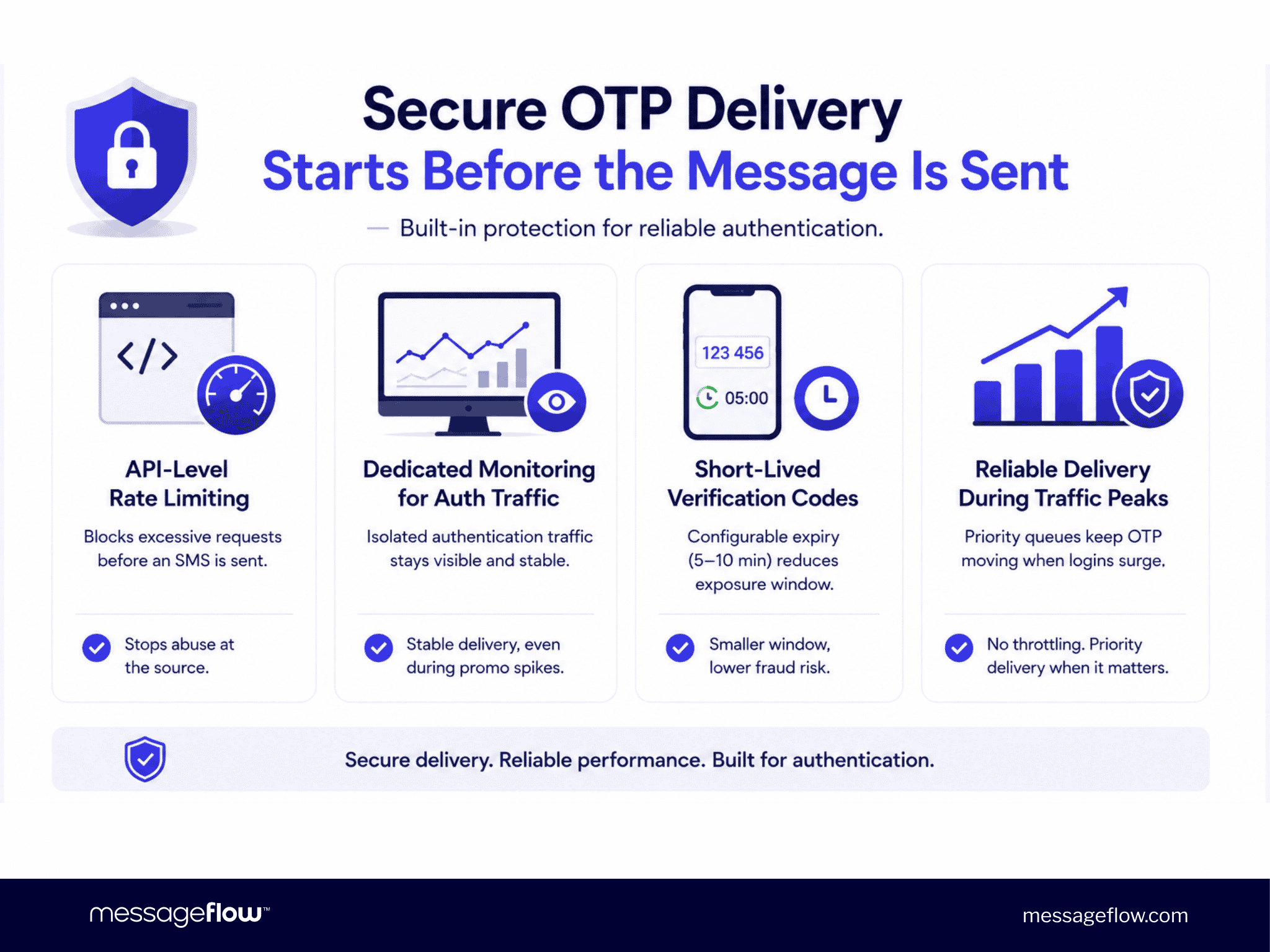
MessageFlow provides several layers of protection that reduce both fraud risk and operational failures without requiring any changes to your authentication flow.
API-Level Rate Limiting
Every OTP request can be protected by configurable rate limits based on phone number, account, or other business rules. If a number exceeds your defined threshold, MessageFlow blocks the request before an SMS is sent.
This stops common abuse patterns like SMS pumping at the source, before a fraudulent code goes out and before you’re billed for the attempt.
Dedicated Monitoring for Authentication Traffic
OTP traffic runs through the same dedicated transactional infrastructure covered above, which means an unusual spike in that specific traffic type is visible on its own, rather than getting lost in the noise of a concurrent marketing campaign.
That separation is also what keeps OTP delivery stable during periods of high promotional volume, in both directions.
Short-Lived Verification Codes
Security depends on limiting the window in which an intercepted code stays useful. MessageFlow supports configurable expiration policies, typically between five and ten minutes, which narrows the exposure if a message is delayed or intercepted somewhere along the way.
Reliable Delivery During Traffic Peaks
Authentication systems get tested exactly when demand spikes: product launches, login surges, seasonal sales, or fraud events. Unlike providers that silently throttle transactional traffic once volume climbs, MessageFlow prioritizes OTP delivery through the dedicated queues described earlier, so a legitimate spike doesn’t get treated like an attack.
No SMS provider can prevent a compromised mobile carrier or replace stronger authentication methods like passkeys or authenticator apps.
What MessageFlow can do is secure every part of the delivery process that’s actually under your control: rate limiting before a message ever sends, dedicated infrastructure that keeps authentication traffic visible and stable, short expiry windows that shrink the attack surface, EU-only routing for straightforward compliance, and priority delivery that holds up when traffic spikes for good reasons or bad ones.
OTP Best Practices for Secure Implementation
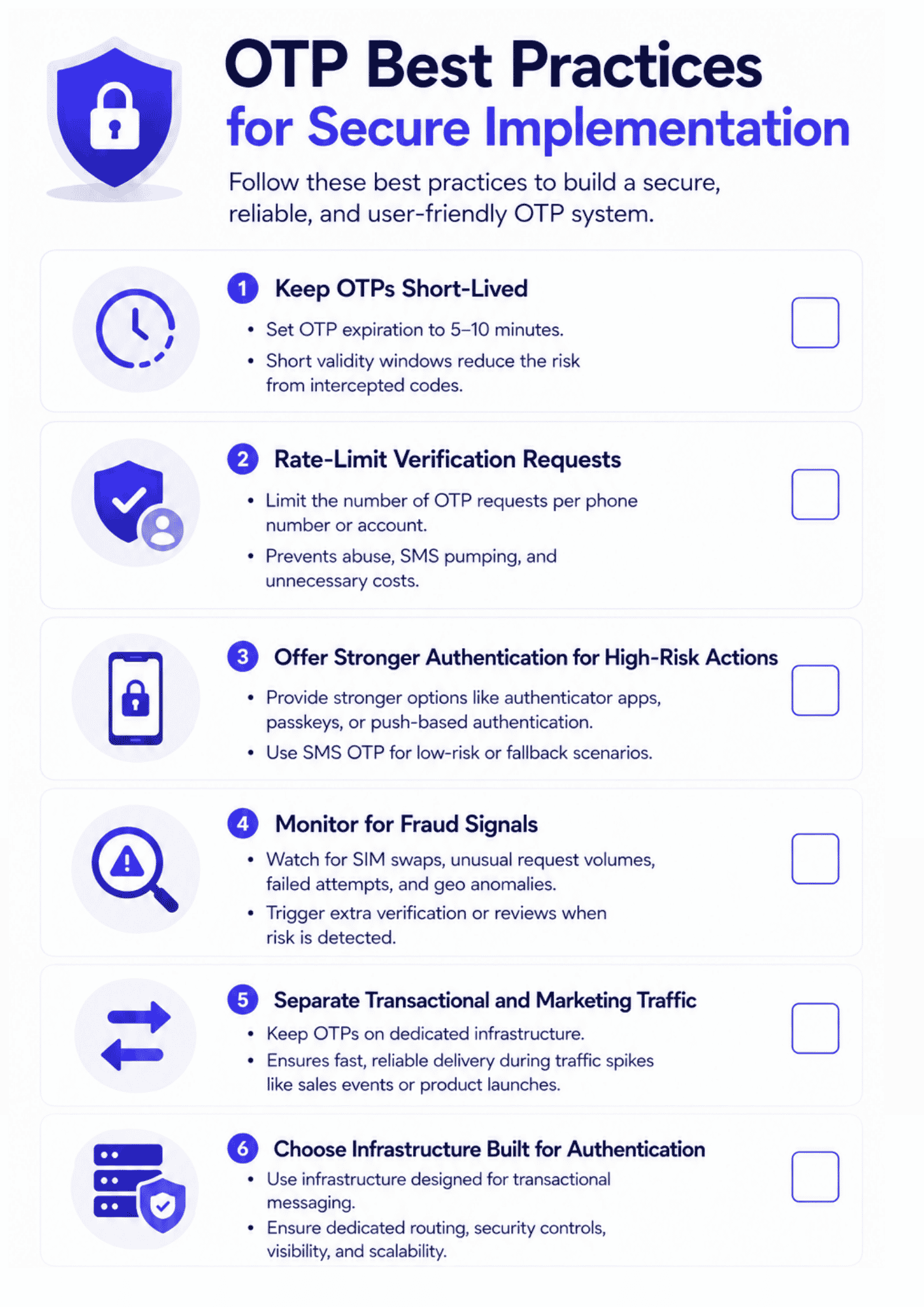
Generating a one-time password is only one part of secure authentication. The overall security of an OTP system depends on how requests are managed, how messages are delivered, and how abuse is detected.
Keep OTPs Short-Lived
Verification codes should expire quickly – typically within 5 to 10 minutes. Short validity windows reduce the opportunity for attackers to use intercepted codes while remaining practical for legitimate users.
MessageFlow allows you to configure OTP expiration policies that align with your security requirements.
Rate-Limit Verification Requests
Limit how many OTPs a single phone number or account can request within a defined period.
Rate limiting is one of the most effective defenses against SMS pumping attacks and automated abuse, preventing attackers from generating excessive verification traffic or inflating messaging costs.
MessageFlow enforces configurable rate limits directly through its API, blocking requests before messages are sent.
Offer Stronger Authentication for High-Risk Actions
NIST recommends providing stronger authentication methods alongside SMS OTP, particularly for high-value transactions, account recovery, or administrative actions.
Supporting authenticator apps, passkeys, or push-based authentication gives users a more secure alternative when additional assurance is needed.
Monitor for Fraud Signals
Authentication systems should look beyond the OTP itself.
Recent SIM swaps, unusual request volumes, repeated verification failures, or unexpected geographic activity can all indicate elevated fraud risk and should trigger additional verification or security reviews.
MessageFlow provides dedicated monitoring for authentication traffic, making abnormal OTP activity easier to identify without it being hidden among marketing campaigns.
Separate Transactional and Marketing Traffic
OTP messages should never compete with promotional campaigns for delivery capacity.
Using dedicated infrastructure for authentication helps ensure verification codes remain fast and reliable during peak traffic periods such as Black Friday, product launches, or large customer notifications.
MessageFlow routes OTP and other transactional messages through dedicated priority queues designed specifically for time-sensitive communications.
Choose Infrastructure Built for Authentication
Authentication messages have very different requirements from marketing campaigns. They demand consistent delivery, visibility into failures, and infrastructure that can withstand traffic spikes without introducing unexpected delays.
MessageFlow is built specifically for transactional messaging, providing dedicated routing, configurable security controls, EU-based infrastructure, and monitoring designed for authentication workloads.
Ready to Stop Treating OTP Delivery as an Afterthought
Every point in this guide comes down to one thing: the code is only as secure as the path it travels. Rate limits, short expiry windows, and NIST guidance all matter, but none of it holds up if your OTP is stuck in the same queue as a marketing blast, or routed through infrastructure you can’t fully account for in an audit.
💡 If you’re sending OTP and 2FA codes at scale and want them treated like the critical traffic they are, dedicated priority queues, EU-based infrastructure, and configurable rate limiting are already built into MessageFlow’s platform. Talk to our team about setting up a dedicated priority path for your authentication traffic, and see what your OTP delivery looks like when it’s not competing with anything else.
What Does OTP Mean? Frequently Asked Questions
OTP stands for “one-time password.” It’s a unique, automatically generated verification code that’s valid for only one login session or transaction. Businesses use OTP authentication to confirm a user’s identity when signing in, approving payments, resetting passwords, or accessing sensitive information.
In a text message, OTP means a one-time password sent via SMS to verify your identity. You’ll typically receive an OTP code when logging into an account, confirming a purchase, or completing two-factor authentication (2FA).
An OTP code is a temporary security code generated for a single authentication attempt or transaction. Unlike a traditional password, it expires after a short period or becomes invalid immediately after it’s used.
OTP codes can be delivered through:
- SMS
- Authenticator apps
- Push notifications
Because each code can only be used once, OTP authentication provides an additional layer of protection beyond passwords.
OTP authentication is a method of verifying a user’s identity using a one-time password. It’s commonly used as part of two-factor authentication (2FA) or multi-factor authentication (MFA), requiring users to enter both their password and a temporary verification code.
OTP authentication helps reduce the risk of unauthorized access, even if a password has been compromised.
Not exactly. An OTP is the verification code itself, while 2FA (two-factor authentication) is the overall security process that requires two different forms of verification.
In many systems, OTP authentication serves as the second factor, but 2FA can also use other methods such as:
- Authenticator apps
- Push notifications
- Security keys
- Biometrics
Think of a one-time password as one of several technologies that can power two-factor authentication.
HOTP (HMAC-Based One-Time Password) generates a new OTP code whenever one is requested, using a counter that increments with each successful authentication. The code remains valid until it’s used.
TOTP (Time-Based One-Time Password) generates a new code automatically based on the current time, typically every 30 to 60 seconds. Because the code expires quickly, TOTP reduces the window in which an intercepted code could be reused.
Today, TOTP is the more common implementation for authenticator apps such as Google Authenticator and Microsoft Authenticator.
Yes, SMS OTP is still widely used, but it should be implemented with appropriate safeguards.
NIST’s 2025 update to Digital Identity Guidelines (SP 800-63B) classifies SMS-based OTP as a restricted authenticator because of risks such as SIM swap fraud. The guidance doesn’t prohibit SMS OTP – it recommends that organizations understand its limitations, offer stronger authentication methods for higher-risk scenarios, and implement controls such as rate limiting, fraud monitoring, and secure delivery infrastructure.
For many businesses, SMS remains the most accessible way to deliver one-time passwords because nearly every customer already has a mobile phone.