TL;DR: SMS opt-in is the explicit permission a customer gives before receiving marketing text messages, while SMS opt-out is their right to withdraw that permission at any time. In the United States, TCPA opt-in requirements generally require prior express written consent before sending promotional SMS messages and businesses must honor the STOP SMS command without delay. In the European Union, GDPR and the ePrivacy Directive require clear, informed, and unambiguous SMS consent before a marketing message is sent. Building a compliant SMS compliance consent process means documenting every opt-in, providing a simple opt-out mechanism, and maintaining accurate consent records. Many organizations also adopt double opt-in SMS to strengthen proof of consent and reduce compliance risk.
SMS remains one of the most effective marketing channels available. Text messages are typically read within minutes and consistently achieve significantly higher open rates than email. That immediacy is also why regulators treat opt-in opt-out text messages so seriously. Unlike an email that can sit unread in an inbox, an SMS arrives directly on a customer’s personal device, making consent a legal requirement rather than simply a marketing best practice.
If your business communicates with customers via SMS, understanding SMS consent is essential. This guide explains how opt-in opt-out text messages work, what TCPA opt-in rules require in the United States, how GDPR and the ePrivacy Directive regulate SMS marketing in Europe, how the STOP SMS command should be handled, and why many organizations choose double opt-in SMS as an additional safeguard.
Getting SMS compliance consent right protects more than regulatory compliance. A well-designed consent process helps improve list quality, builds customer trust, reduces complaints, and minimizes the risk of carrier filtering, financial penalties, or litigation resulting from non-compliant messaging.
Disclaimer: This article is provided for informational and educational purposes only and does not constitute legal advice. Laws governing SMS marketing, privacy, and electronic communications vary by jurisdiction and may change over time. Their application depends on the specific circumstances of each organization. Before implementing any consent or marketing practices described in this guide, consult a qualified attorney specializing in data protection and telecommunications law. MessageFlow accepts no responsibility for decisions made solely on the basis of this article.
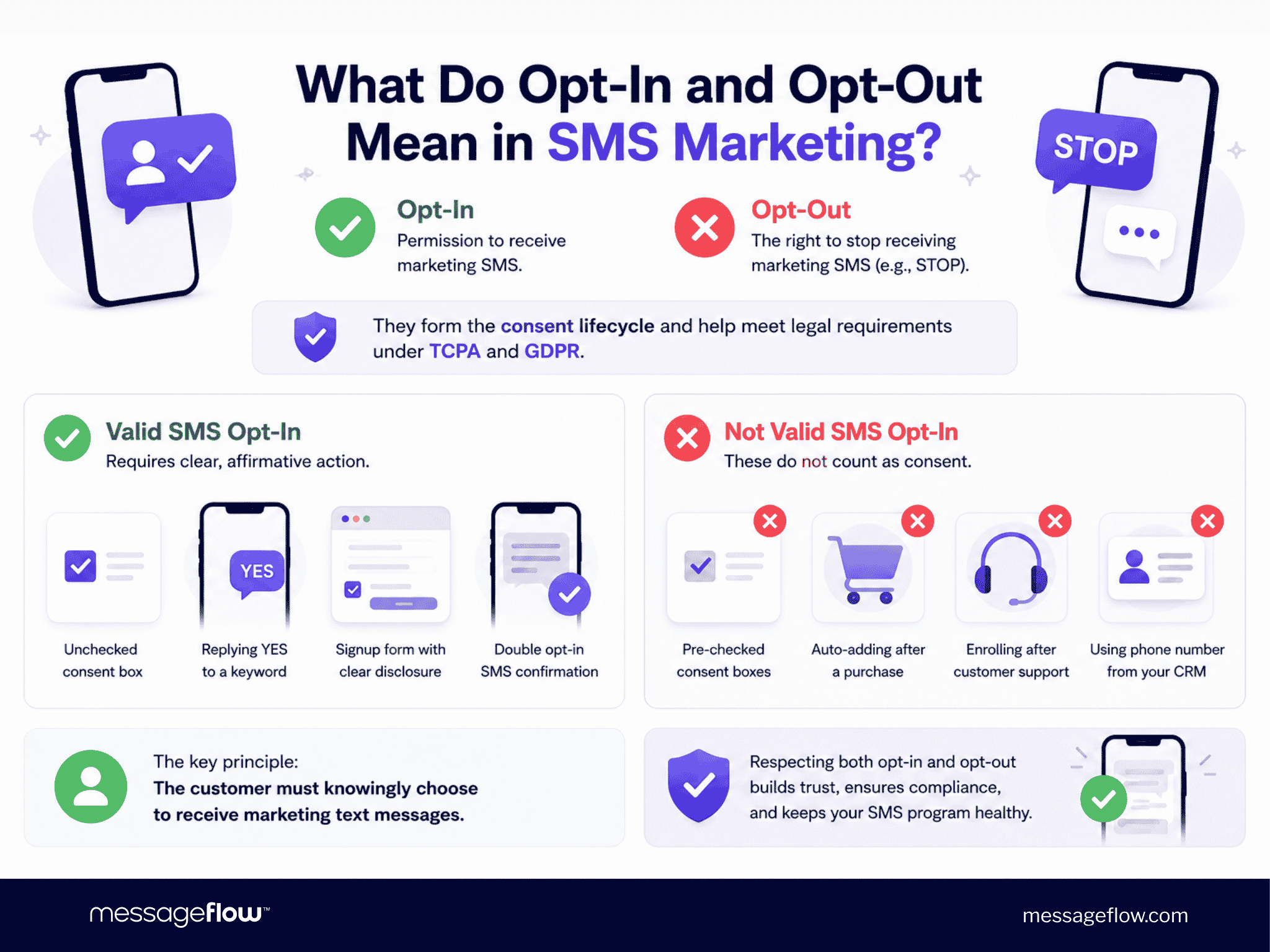
What Do Opt-In and Opt-Out Mean in SMS Marketing?
SMS opt-in is the explicit permission a customer gives to receive marketing text messages from your business. SMS opt-out is their right to withdraw that permission at any time, most commonly by replying with the STOP SMS command.
Together, they form the consent lifecycle that underpins SMS compliance consent and helps businesses meet legal requirements under regulations such as the TCPA and GDPR.
What Counts as a Valid SMS Opt-In?
A valid SMS consent requires an active, intentional action from the customer. Consent cannot be assumed simply because someone purchased a product, created an account, or shared their phone number.
Examples of valid TCPA opt-in methods include:
- checking an unchecked consent box,
- replying YES to a keyword,
- completing a signup form that clearly explains the SMS program,
- confirming participation through a double opt-in SMS process.
By contrast, these do not constitute valid consent:
- pre-checked consent boxes,
- automatically adding customers after a purchase,
- enrolling someone because they contacted customer support,
- relying solely on a phone number already stored in your CRM.
The key principle is simple: the customer must knowingly choose to receive marketing text messages.
SMS Opt-Out: Making It Easy to Leave
Obtaining consent is only half of the process. Businesses must also make it just as easy for customers to stop receiving messages.
The most common opt-out mechanism is the STOP SMS command. When a subscriber replies with STOP, END, UNSUBSCRIBE, or another supported keyword, the business should immediately remove that number from future marketing campaigns.
A compliant opt-in opt-out text messages process means customers can withdraw consent as easily as they granted it.
Transactional vs. Marketing SMS: Why Consent Requirements Differ
Not every SMS requires the same level of consent.
Transactional messages support an action the customer has already initiated, for example:
- order confirmations,
- shipping updates,
- appointment reminders,
- password reset links,
- one-time passwords (OTP).
These messages are generally subject to different legal requirements because they facilitate an existing transaction rather than promote new products or services.
Marketing messages encourage customers to make a purchase or engage with promotional content.
Examples include:
- discount offers,
- product launches,
- loyalty campaigns,
- seasonal promotions,
- abandoned cart incentives.
These messages typically require the highest standard of SMS consent.
One common compliance mistake is mixing both categories. For example, adding a promotional coupon to an order confirmation may cause regulators to classify the entire message as marketing, meaning the stricter TCPA opt-in or GDPR consent requirements apply.
Single Opt-In vs. Double Opt-In SMS: Which One Should You Choose?
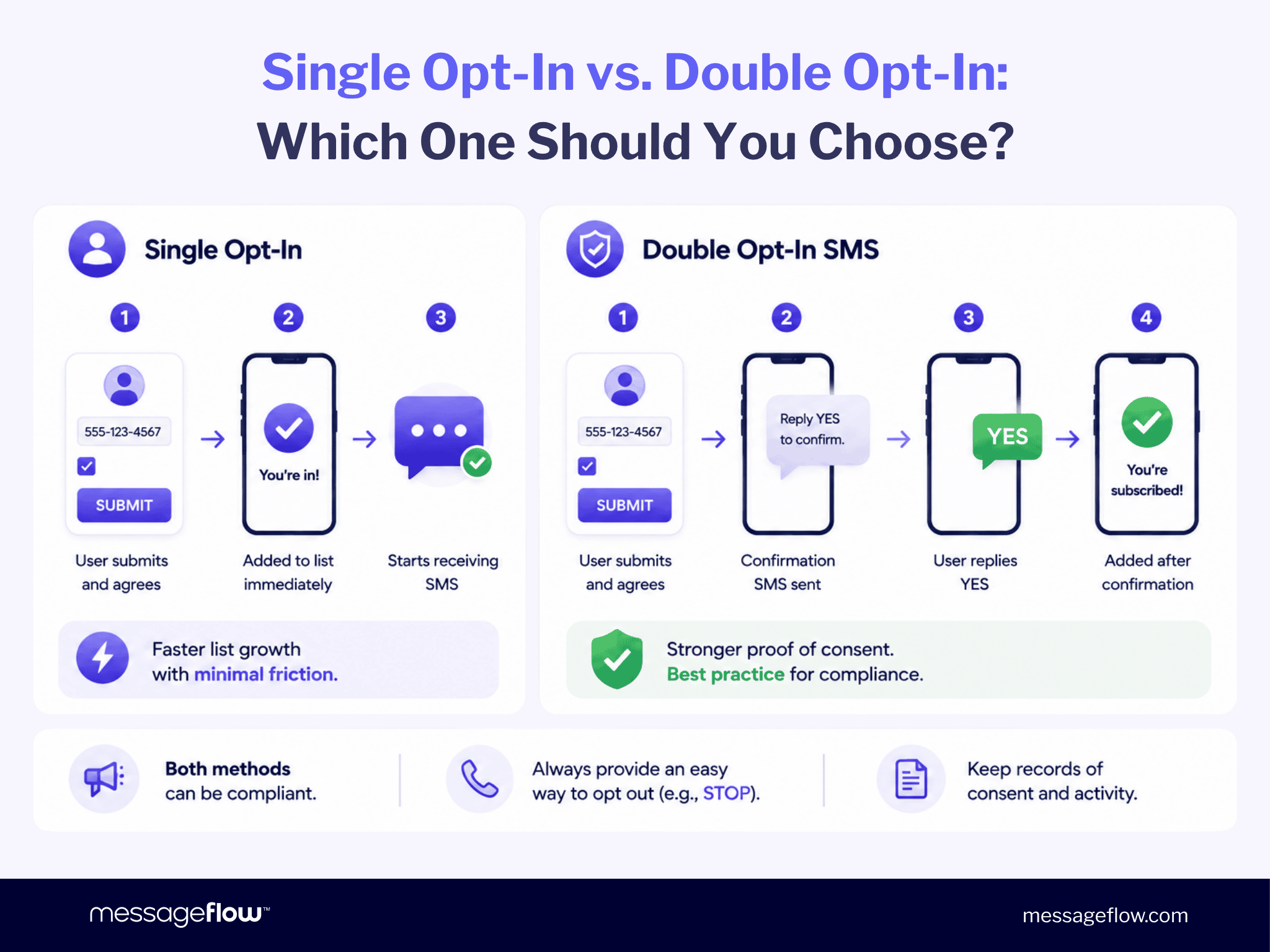
While both methods can support compliant SMS marketing when implemented correctly, double opt-in SMS is widely considered the best practice because it provides stronger evidence of customer consent.
What Is Single Opt-In?
With single opt-in, a subscriber is added to your SMS marketing list immediately after providing their phone number and agreeing to receive text messages.
There is no additional verification step. As soon as the signup form is submitted or the consent checkbox is selected, the customer becomes eligible to receive marketing SMS messages.
This approach minimizes friction and can help businesses grow their subscriber lists more quickly.
What Is Double Opt-In SMS?
With double opt-in SMS, the signup process includes an additional confirmation step.
After the customer submits their phone number, they receive a confirmation text asking them to verify their subscription – typically by replying YES or clicking a confirmation link. Only after completing this second action is the number added to the SMS marketing list.
Although double opt-in SMS is not always required by law, it is commonly recommended as part of a robust SMS compliance consent process.
Why Is Double Opt-In Considered Best Practice?
That extra confirmation step provides several practical benefits beyond regulatory compliance.
A double opt-in SMS process helps:
- verify that the subscriber actually owns the phone number,
- prevent signups caused by typing mistakes,
- reduce bot or fraudulent registrations,
- create a second, timestamped record of SMS consent.
If a customer later disputes joining your SMS program, this additional confirmation provides valuable evidence that the subscription was intentional.
What Is Soft Opt-In?
Some businesses also use a model known as soft opt-in.
This applies when someone has already shared their phone number in another context – such as creating an account or subscribing to an email newsletter – and is later invited to join SMS marketing.
Soft opt-in still requires a separate, affirmative action to receive marketing text messages. Existing customer relationships do not automatically replace the need for SMS consent.
Which Approach Is Right for Your Business?
For businesses sending recurring promotional text messages – particularly in e-commerce, retail, financial services, or other regulated industries – double opt-in SMS is generally the better choice.
Although it may slightly reduce signup conversion rates, it significantly improves list quality, strengthens SMS compliance consent, and provides clear documentation if you ever need to demonstrate that a subscriber knowingly agreed to receive your marketing messages.
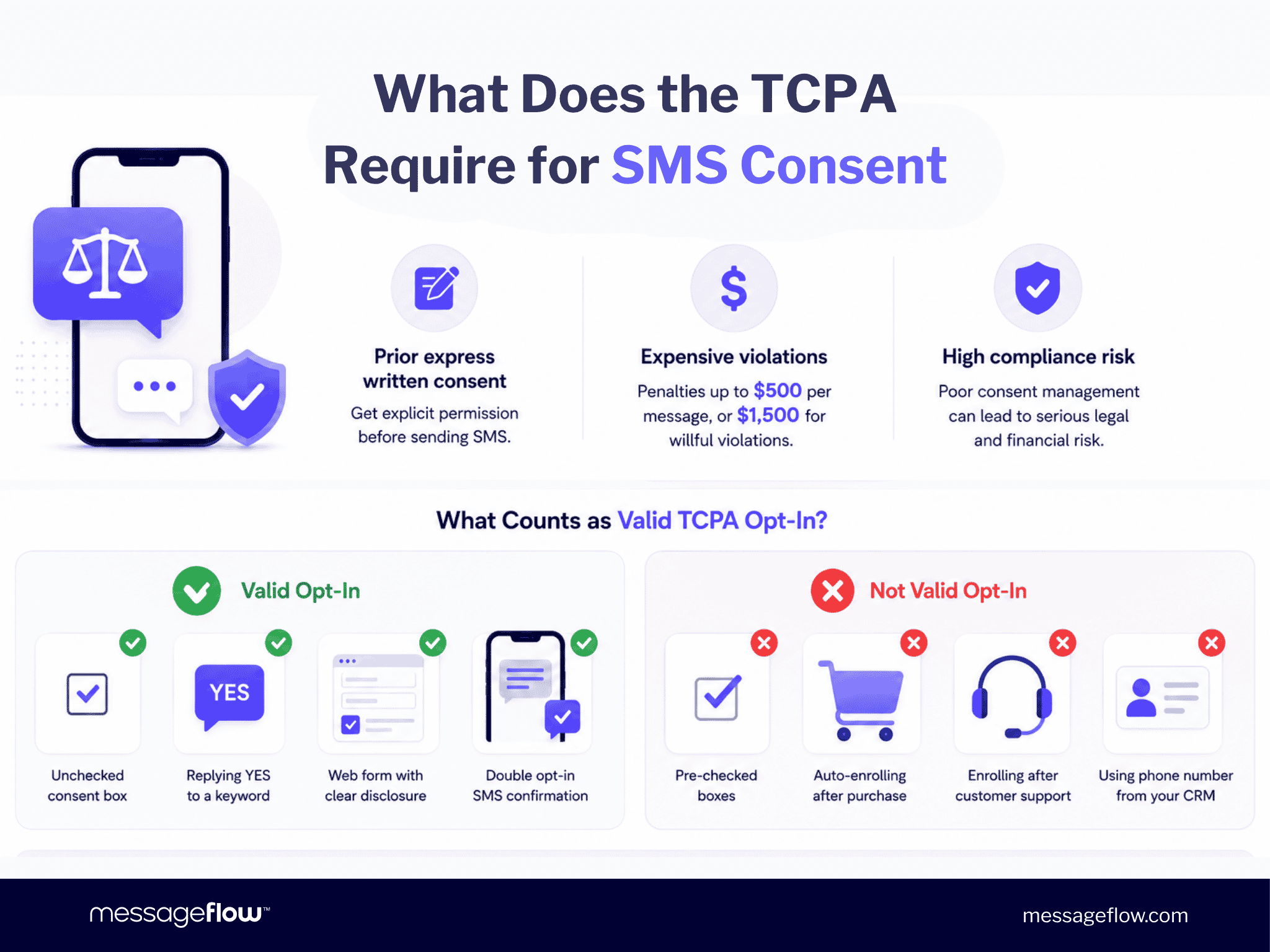
What Does the TCPA Require for SMS Consent?
In the United States, the Telephone Consumer Protection Act (TCPA) requires businesses to obtain prior express written consent before sending promotional text messages. Failure to comply can result in statutory damages of $500 per violating message, or up to $1,500 per message for willful violations, making poor consent management a significant legal and financial risk.
What Counts as Valid TCPA Opt-In?
A valid TCPA opt-in does not require a handwritten signature. Consent can be collected electronically as long as the customer takes a clear affirmative action and the disclosure explains:
- they agree to receive marketing SMS,
- consent is not a condition of purchase,
- they can opt out at any time.
Common examples include:
- checking an unchecked consent box,
- replying YES to a keyword,
- signing a web form electronically,
- completing a double opt-in SMS confirmation.
Keeping detailed records of every consent is a key part of SMS compliance consent.
New TCPA Opt-Out Rules
According to new TCPA rules, since April 11, 2025, businesses must accept opt-out requests made through any reasonable method, not just the STOP SMS command. Customers can revoke consent by text, email, phone, web forms, or other reasonable means, and businesses must process those requests within 10 business days.
Best Practice: Treat Written Consent as the Standard
Although TCPA requirements continue to evolve through FCC rulemaking and court decisions, the safest approach is to collect and document prior express written consent for every marketing subscriber. Using double opt-in SMS, maintaining detailed consent records, and honoring opt-out requests promptly are widely recognized best practices for reducing compliance risk
How GDPR and the ePrivacy Directive Regulate SMS Consent
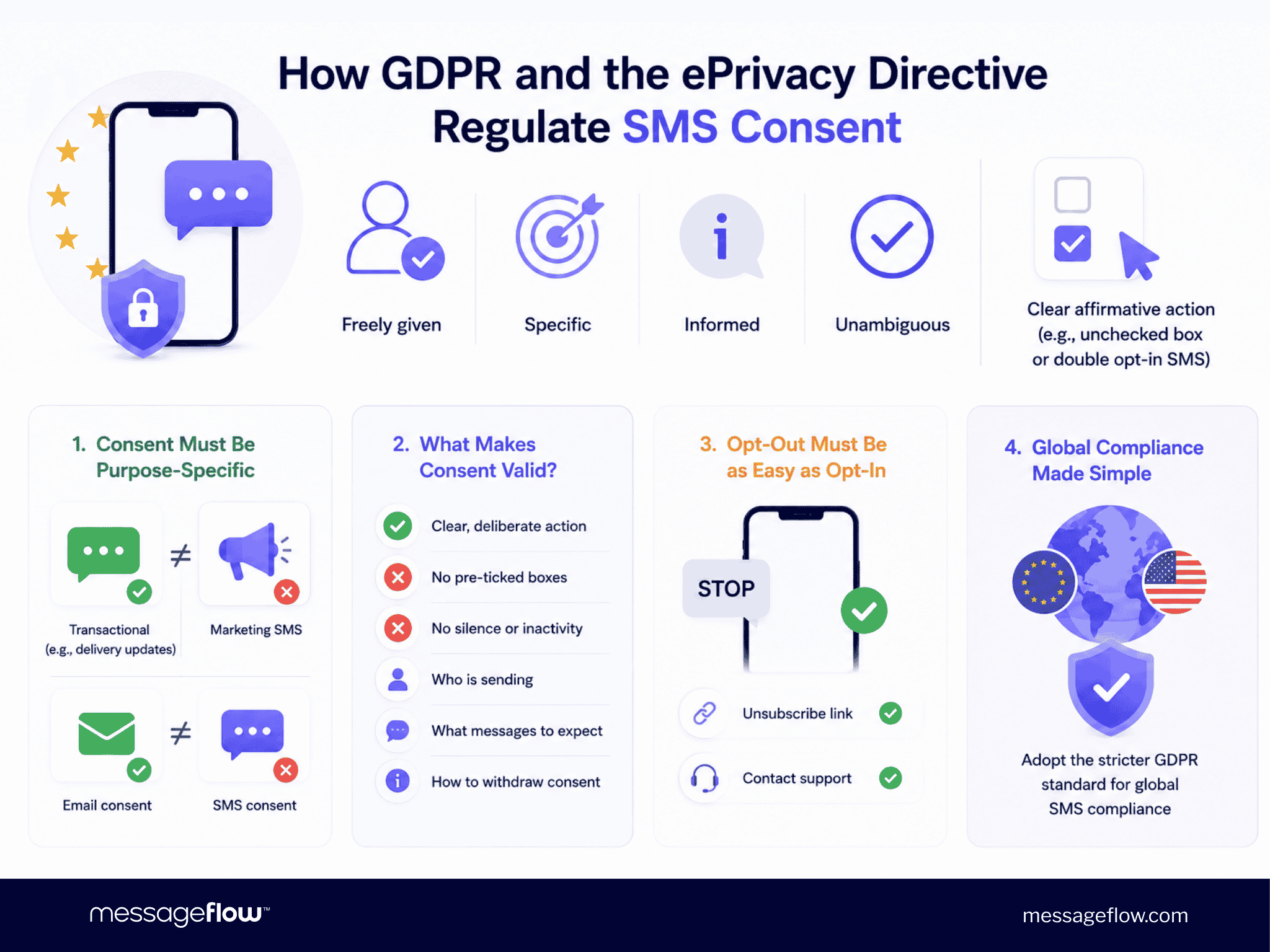
In the European Union, SMS consent is governed by both the General Data Protection Regulation (GDPR) and the ePrivacy Directive. Together, these laws require businesses to obtain consent that is freely given, specific, informed, and unambiguous before sending marketing text messages.
A customer must take a clear affirmative action – such as checking an unchecked box or completing a double opt-in SMS process – to join an SMS marketing program.
Consent Must Be Purpose-Specific
Under GDPR, consent is tied to a specific purpose. A phone number collected to send delivery updates, appointment reminders, or account notifications does not automatically authorize marketing messages.
Similarly, consent for email marketing does not cover SMS marketing. Each communication channel requires its own valid SMS compliance consent.
What Makes Consent Valid?
A valid SMS consent requires a clear, deliberate action from the individual.
That means:
- pre-ticked checkboxes are not allowed,
- silence or inactivity does not constitute consent,
- customers must know who is sending the messages,
- they must understand what type of SMS they will receive,
- and they must be told how to withdraw consent.
Hiding consent inside lengthy terms and conditions or privacy policies is generally insufficient under GDPR.
Opt-Out Must Be as Easy as Opt-In
Under GDPR, withdrawing consent must be just as simple as giving it.
Whether customers unsubscribe by replying STOP, clicking an unsubscribe link, or contacting customer support, businesses should process the request without unnecessary barriers.
For companies operating across both Europe and the United States, adopting the stricter GDPR standard for collecting and managing SMS consent is often the simplest way to maintain compliance across multiple markets while reducing legal complexity.
💡 Running SMS campaigns internationally? Managing consent under GDPR is only one part of the challenge. Learn how to plan compliant, high-performing global campaigns in our guide: International SMS Campaigns – How to Run Them?
How the STOP SMS Command Works (and What Happens Next)
The STOP SMS command is the standard way for subscribers to opt out of marketing text messages. When someone replies STOP, they are withdrawing their SMS consent, and your business is legally required to stop sending promotional SMS messages to that phone number.
While STOP is the most widely recognized keyword, carriers and regulators also support other common opt-out requests, including UNSUBSCRIBE, END, CANCEL, and QUIT. In the United States, TCPA rules also require businesses to honor any reasonable method of revoking consent – not just specific keywords.
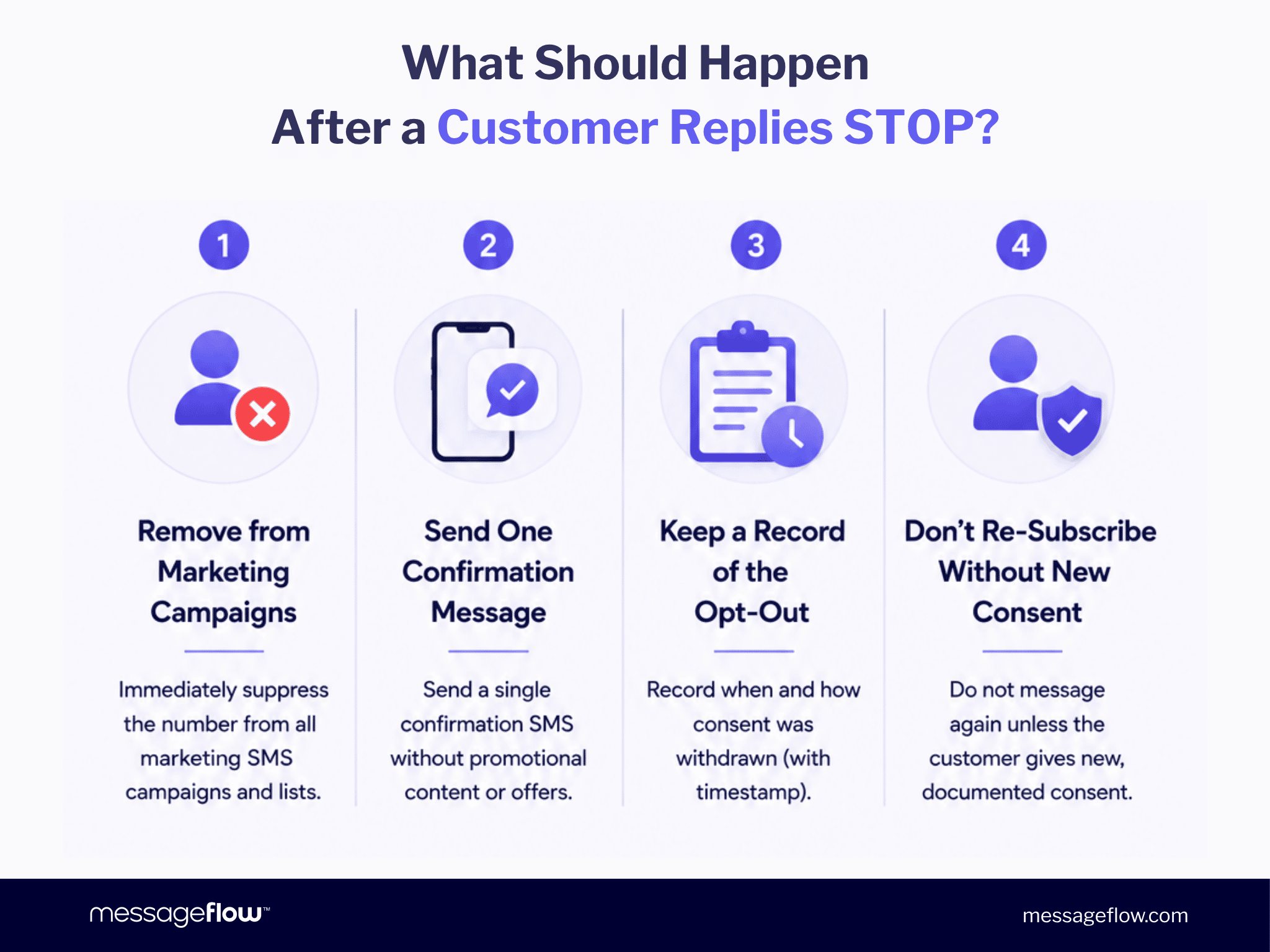
What Should Happen After a Customer Replies STOP?
A compliant opt-in opt-out text messages process should automatically trigger several actions.
Remove the Number from Marketing Campaigns
The subscriber’s phone number should be immediately suppressed from all marketing campaigns and mailing lists that could send promotional SMS messages.
Send One Confirmation Message
You may send a single confirmation text confirming that the customer has been unsubscribed.
This confirmation should not include promotional content, discounts, or marketing offers.
Keep a Record of the Opt-Out
Just as businesses document TCPA opt-in and SMS consent, they should also record opt-out requests.
Keeping a timestamped record of when and how consent was withdrawn helps demonstrate SMS compliance consent during audits, complaints, or legal disputes.
Don’t Re-Subscribe Without New Consent
Once a customer has opted out, they should not receive marketing text messages again unless they complete a new, documented opt-in process.
The previous consent is no longer valid.
Why Proper Opt-Out Management Matters
One of the most common compliance mistakes occurs when businesses manage multiple marketing platforms or vendors that don’t share suppression lists in real time.
For example, a customer may unsubscribe from one SMS program but continue receiving promotional messages from another system because the opt-out wasn’t synchronized.
💡 A centralized consent management platform like MessageFlow helps prevent these errors by applying opt-out requests consistently across every campaign and communication channel. See how MessageFlow simplifies consent management and keeps your SMS marketing compliant as your customer base grows.
Building a Compliant SMS Opt-In Flow
A compliant SMS opt-in process doesn’t have to be complicated. Whether you’re following TCPA opt-in requirements or GDPR, every signup flow should include these four steps.
1. Explain What Customers Are Signing Up For
Before collecting a phone number, clearly state:
- who is sending the messages,
- what type of SMS they’ll receive,
- how often they’ll hear from you,
- how to opt out (for example, by replying STOP).
2. Collect Explicit SMS Consent
Require an affirmative action, such as:
- checking an unchecked consent box,
- texting a keyword (e.g. JOIN),
- completing a signup form.
Never rely on pre-checked boxes or implied consent.
3. Verify with Double Opt-In (Recommended)
Send a confirmation message asking the subscriber to reply YES before adding them to your marketing list.
While double opt-in SMS isn’t always mandatory, it provides stronger proof of consent and improves list quality.
4. Welcome and Keep Records
After confirmation:
- send a welcome message,
- remind subscribers how to unsubscribe,
- store the consent record, including the timestamp, signup source, and consent wording.
Keeping accurate records is a core part of SMS compliance consent and can help demonstrate compliance if your practices are ever audited or challenged.
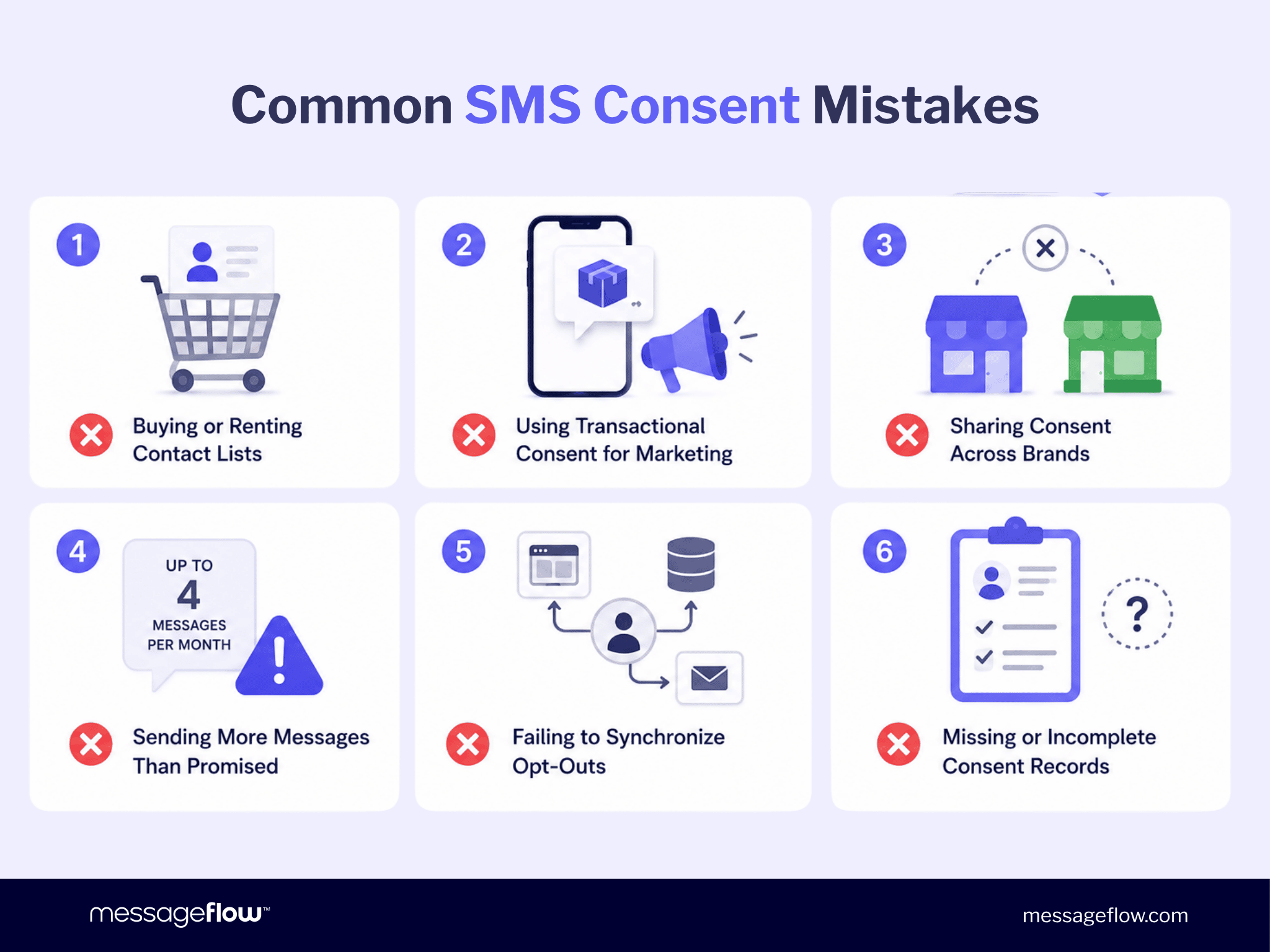
Common SMS Consent Mistakes That Trigger Fines or Carrier Blocks
Most SMS compliance consent issues don’t stem from complex regulations – they result from a few common operational mistakes. Avoiding these pitfalls can help protect your business from regulatory penalties, customer complaints, and carrier filtering.
Buying or Renting Contact Lists
A purchased phone number list does not include valid SMS consent for your business.
Customers must opt in directly to receive marketing text messages from your organization – not from a third-party list provider.
Using Transactional Consent for Marketing
A phone number collected for order updates, appointment reminders, or customer support does not automatically authorize marketing messages. Marketing SMS always requires its own TCPA opt-in or equivalent consent under applicable laws.
Sharing Consent Across Brands
If your company operates multiple brands or business units, consent collected for one brand should not automatically be used by another. Each brand should obtain its own clear SMS opt-in.
Sending More Messages Than Promised
If customers agree to receive “up to four messages per month,” sending significantly more than that can undermine the consent you collected and increase unsubscribe rates and complaints.
Failing to Synchronize Opt-Outs
Customers who use the STOP SMS command or another opt-out method should be removed from every marketing system – not just one platform.
Disconnected suppression lists are one of the most common causes of compliance issues and can damage your sender reputation with mobile carriers.
Missing or Incomplete Consent Records
If you cannot demonstrate when, how, and under what wording a customer opted in, proving valid consent becomes difficult.
Maintaining complete consent records is a fundamental part of SMS compliance consent and can be critical during audits, complaints, or legal disputes.
Getting Opt-In and Opt-Out Right, for Good
SMS consent is not a one-time form field. It is a lifecycle you manage from the first opt-in through every STOP request, and it needs to hold up under scrutiny months or years later. Build the disclosure, the consent action, and the confirmation into your sign-up flow from day one, keep opt-outs synced across every list and channel, and log every step with a timestamp.
Get this right, and SMS becomes one of the most direct, highest-performing channels available to your business, without the legal exposure that comes from cutting corners on consent.
That’s exactly the gap MessageFlow is built to close. If you’re a CRM or marketing manager, the platform keeps one consent record behind every channel, so a STOP reply on SMS can never get missed by a separate email or push campaign running on its own list.
If you’re the person on the technical side who has to actually implement compliant opt-out handling, that logic runs automatically, with timestamped audit logs, instead of being something your team builds and maintains from scratch.
None of that requires stitching together multiple vendors either.
💡 A single cross-channel platform for SMS, email, push, and RCS means your opt-in flow, your suppression list, and your consent history all live in one place, hosted on EU-based infrastructure with GDPR, ISO 27001, and SOC 2 compliance included rather than billed as an add-on.
Your compliance foundation stops depending on manual tracking or guesswork, and starts depending on infrastructure built for exactly this job.
Frequently Asked Questions about opt-in opt-out text messages
No single law universally requires double opt-in, but it is the recognized industry standard for marketing texts and strongly recommended by carriers. It gives you a stronger, time-stamped consent record, which matters most if a subscriber later disputes ever agreeing to receive your messages.
Marketing SMS needs explicit, documented consent to receive promotional content, often written consent under laws like the TCPA. Transactional SMS, like order confirmations or password resets, generally only needs the customer’s number provided for that specific purpose, since the message supports an action they already took.
It is treated as a compliance violation. Under the TCPA, this can trigger statutory damages of $500 to $1,500 per message, and repeated violations can lead to class action exposure. You should suppress the number immediately after any valid opt-out request.
Yes. Consent is channel-specific under both the TCPA and GDPR. Agreeing to receive marketing emails does not cover text messages, and you need a distinct, documented opt-in for SMS even if the contact is already on your email list.
A minimum of four years is a common standard, matching the TCPA’s statute of limitations, though some businesses keep records longer as a precaution. Each record should include the date, the method used to obtain consent, and the exact wording the customer saw at the time.