
An RCS message can replace a Black Friday campaign landing page when that page’s main job is to introduce a few offers and help shoppers choose where to go next. Product images, prices, concise descriptions, and individual action buttons can bring that decision into the messaging app.
Consider a homeware promotion featuring three discounted dining sets. Instead of asking recipients to open a campaign page to see the selection, you can display the sets in an RCS carousel, with each card linking to the relevant product. Google’s rich cards support this kind of browsing and comparison within a message.
That makes RCS for Black Friday useful when seeing the offer helps someone choose. A shopper who needs dimensions, delivery options, or checkout can continue on the website. Someone who already knows what they want may need only an SMS with a direct link.
The planning question here is specific: what can the customer decide inside this message, and which page can they then skip? The answer gives rich media a purpose and helps you judge whether the extra creative work is justified.
When an RCS message can replace a campaign landing page
Start by reviewing what your Black Friday landing page asks shoppers to do. A page that presents four offers and links to their product pages is a stronger candidate for replacement than one that helps visitors search a catalog, configure a bundle, or compare detailed specifications.
Three conditions make the case for moving that content into RCS:
- The selection is focused. You can present a useful shortlist without asking shoppers to filter by size, category, price, or availability.
- The offer is understandable at a glance. The image, price, discount conditions, and deadline give recipients enough information to decide whether to explore further.
- Each choice has a precise destination. A product card opens the corresponding product page. A bundle promotion opens that bundle. Sending every button to the same general sale page gives shoppers another selection task.
The practical difference looks like this:
| Campaign approach | Customer journey |
|---|---|
| Message linking to a promotional landing page | Read the message → open the selection page → choose a product → view product details |
| RCS carousel with product-specific buttons | Browse the selection in the message → open the chosen product’s details |
| SMS linking to a specific product | Read the offer → open the product’s details |
Key thing to remember here is that RCS can remove an intermediate selection page, but it does not automatically create a shorter route than SMS. If you are promoting one familiar product, either channel can take the shopper directly there. The reason to choose RCS would be the value of showing the product before the click.
Keep the landing page when shoppers need more help deciding than the message can comfortably provide. Detailed comparisons, configurable offers, and substantial eligibility conditions need room. Essential restrictions should also remain visible before the shopper acts. Shortening the journey should not make the offer harder to understand.
💡 A useful test is to sketch both routes for the same promotion. Identify the page RCS would remove and the information it would absorb. If you cannot name both, the campaign’s case for RCS needs another justification.
Three RCS campaigns to build for Black Friday
Here are three ways to use RCS for Black Friday, each built around a task shoppers can complete inside the message before heading to your website.
1. Put a curated product shortlist inside the message
Give shoppers a manageable choice from a category they have already shown interest in. For example, a homeware retailer could send customers who recently browsed lighting a carousel of three discounted lamps.
The selection matters more than its size. Each item should offer a clear reason to choose it: a compact footprint, an adjustable reading light, or a decorative design. Three near-identical products with unexplained differences leave the customer with work the message was supposed to resolve.
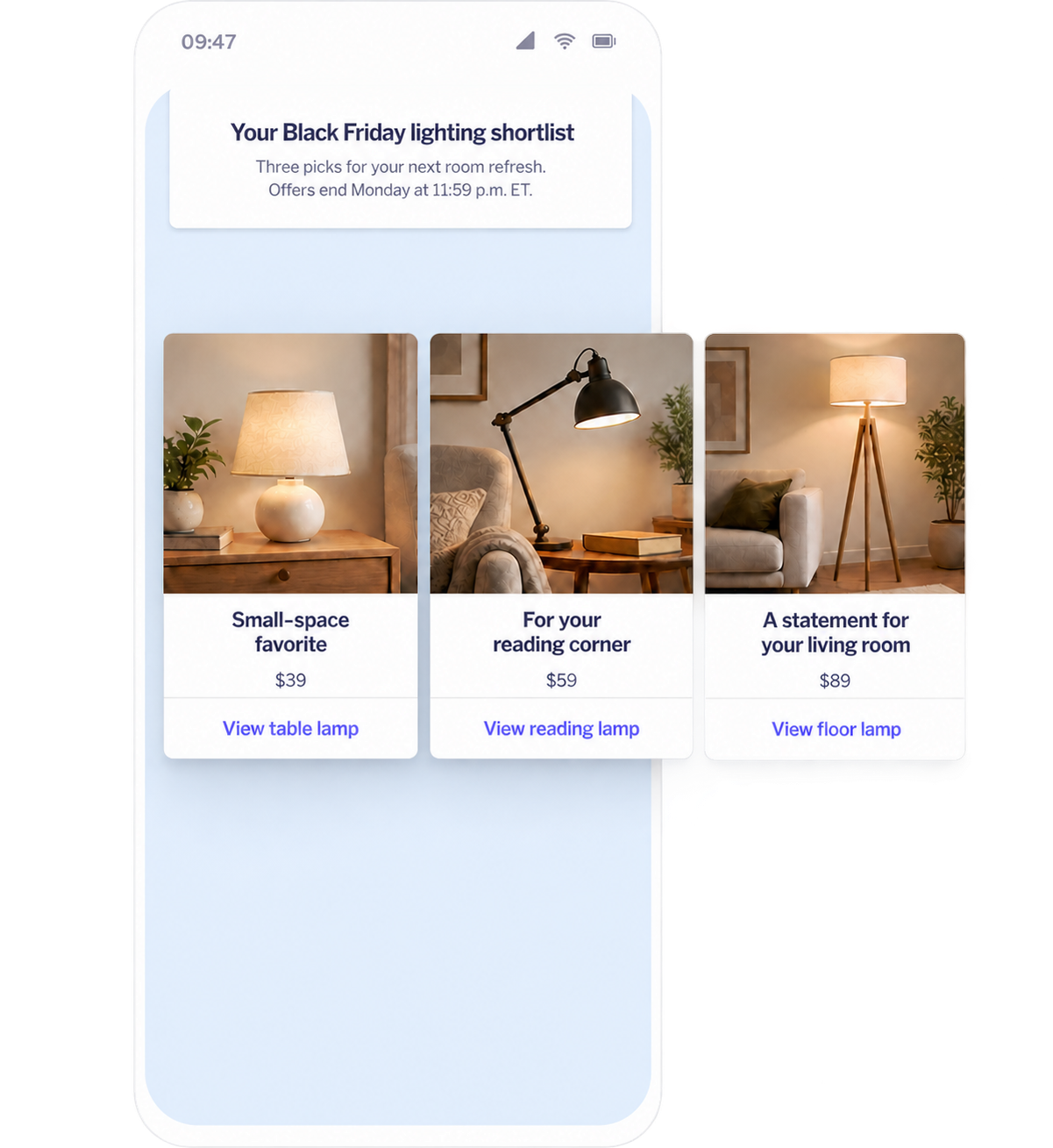
Each button opens that lamp’s product page, where the shopper can check dimensions, finishes, and availability.
💡 What it replaces: a campaign page presenting the same shortlist. If the cards only name broad categories such as “lighting,” “furniture,” and “accessories,” much of the discovery work still happens after the click.
2. Show what makes a Black Friday bundle worth considering
Use a single rich card when the offer needs a visual explanation rather than a product comparison. A skincare gift set, for example, can be difficult to judge from “three essentials for $59” alone. A clear photograph and a short contents list help the shopper understand what they would receive.
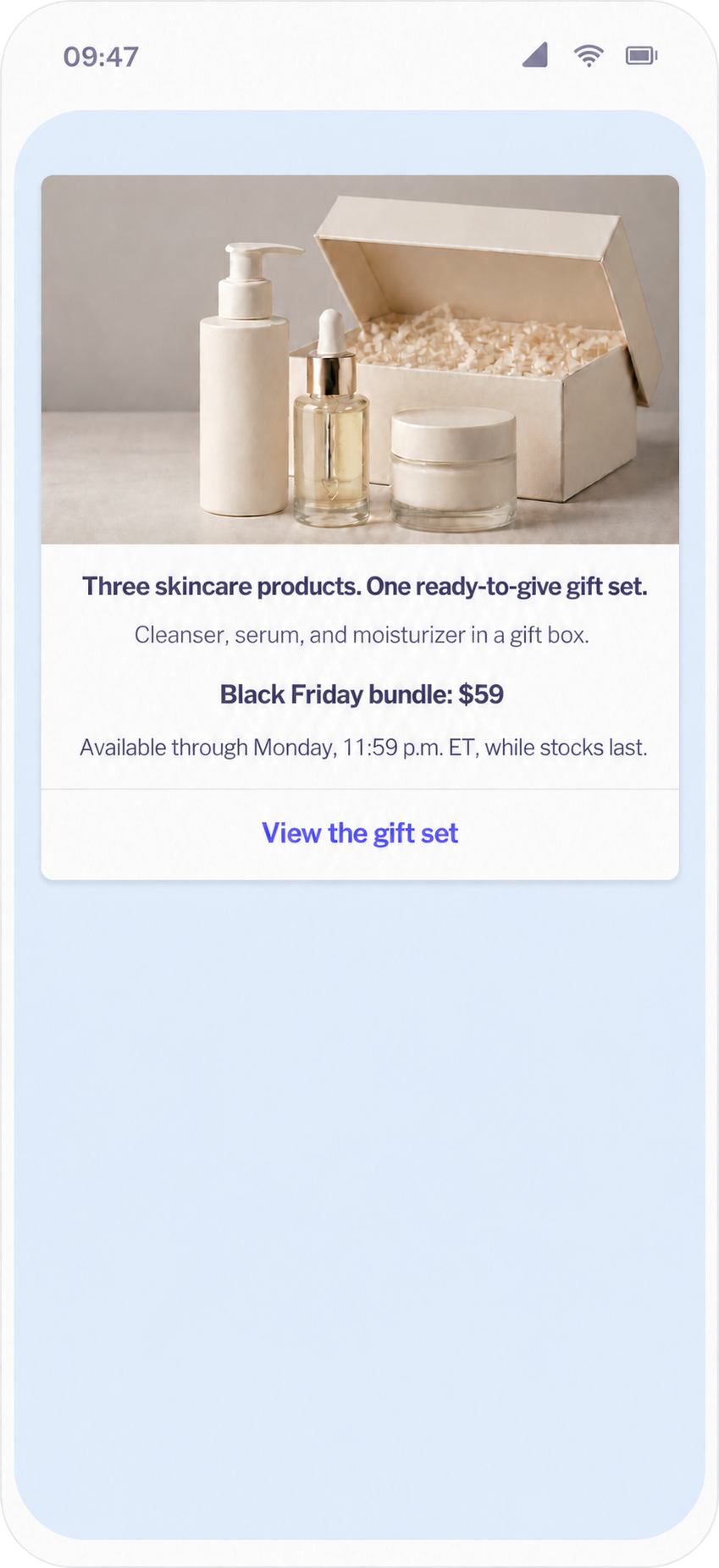
The photograph should show the actual contents clearly. Decorative props that look like included items can create uncertainty precisely where the message should resolve it.
The button should open the set as a purchasable product, with its ingredients, specifications, and delivery information. Asking shoppers to find and add three separate items would undermine the convenience of the bundle.
💡 What it replaces: a promotional page whose main purpose is to explain the set’s contents and presentation. If shoppers must choose shades, sizes, or components, take them directly to a page that supports those choices.
3. Help undecided shoppers choose an offer
When you know someone is interested in the sale but lack a useful product preference, a short exchange can establish one before showing a selection.
For a gift retailer, the opening question could focus on budget:
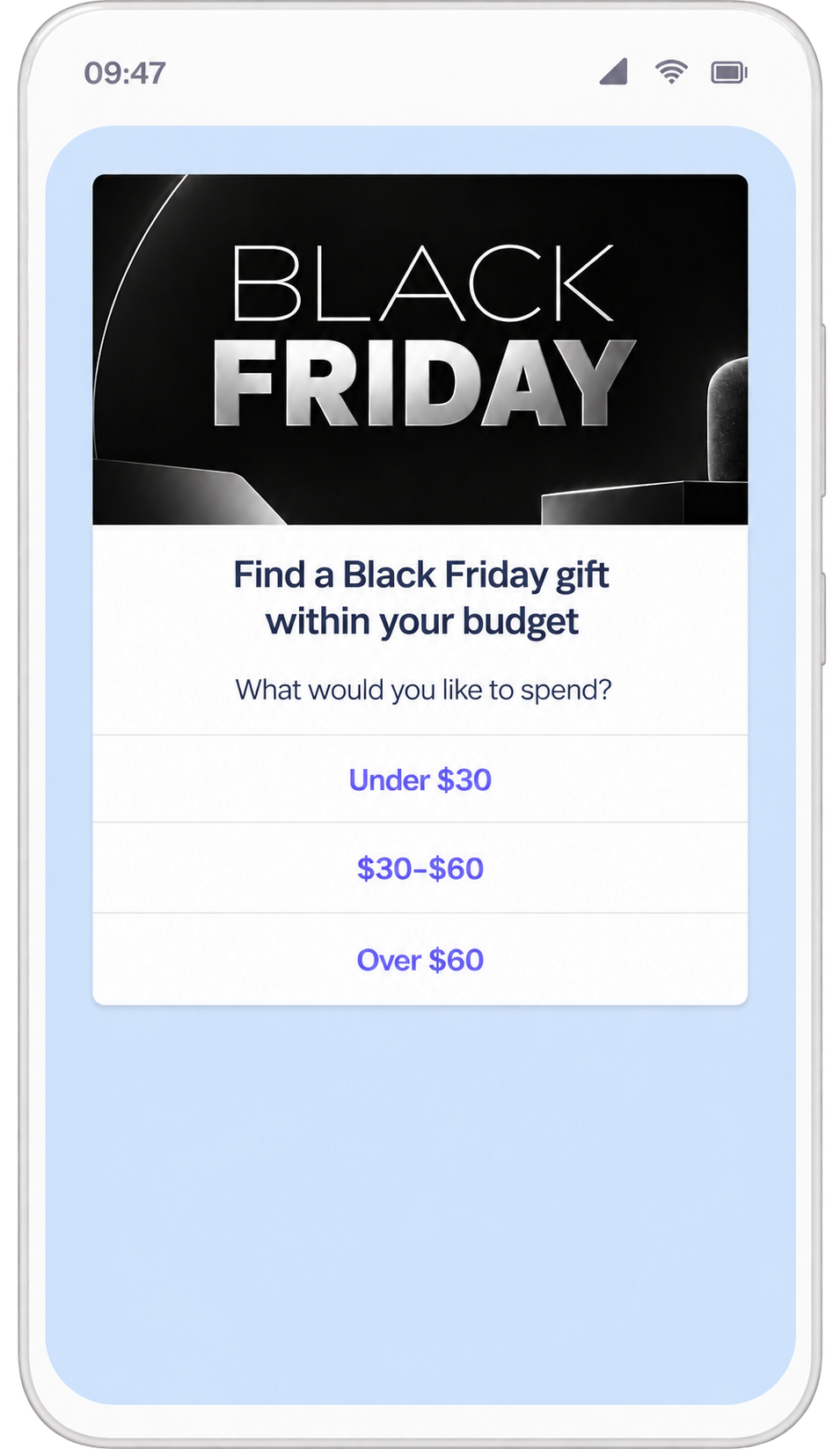
RCS supports suggested replies, but the campaign needs configured logic to process the selection and send the appropriate response. The buttons alone do not create a recommendation flow. Google’s messaging overview describes how user responses pass back to the business’s agent for handling.
Ask only questions that materially change the selection. If the campaign already targets shoppers interested in gifts under $30, send that shortlist immediately.
💡 What it replaces: the first filtering step on a gift-finder page. This approach may involve several taps. Its value is helping shoppers reach relevant products while keeping the initial exchange inside the message.
What home&you’s seasonal campaigns show
Homeware retailer home&you used RCS for Christmas and Easter campaigns featuring interactive product carousels and links to specific offers. Our case study with the brand describes how this format helped shorten the purchase journey and supported higher conversion rates.
The Christmas creative combined seasonal imagery with a carousel that let recipients browse items and open product details. For a home décor brand, that creates an opportunity to communicate both the look of a collection and the individual products available to buy.
For Black Friday, the useful adaptation is to make the commercial offer equally clear. A styled photograph can establish the appeal of a table setting, but shoppers still need to identify which items are discounted, what they cost, and whether the pictured arrangement is sold together or separately. Product cards can make those distinctions explicit.
The home&you example demonstrates a seasonal merchandising approach that can inform your Black Friday creative. Whether it deserves a larger share of the campaign budget requires a separate test: compare purchases and revenue against the cost of reaching comparable audiences with RCS and SMS for a possible answer.
Two situations where SMS is the better choice
Rich media earns its place when it helps the customer make a decision. Some Black Friday messages have a simpler job, and adding images or interaction gives the recipient little additional value.
1. The customer only needs a deadline reminder
Someone who has already explored an offer may need a timely prompt to act. If the product, discount, and destination are clear, a short SMS can carry the information needed.
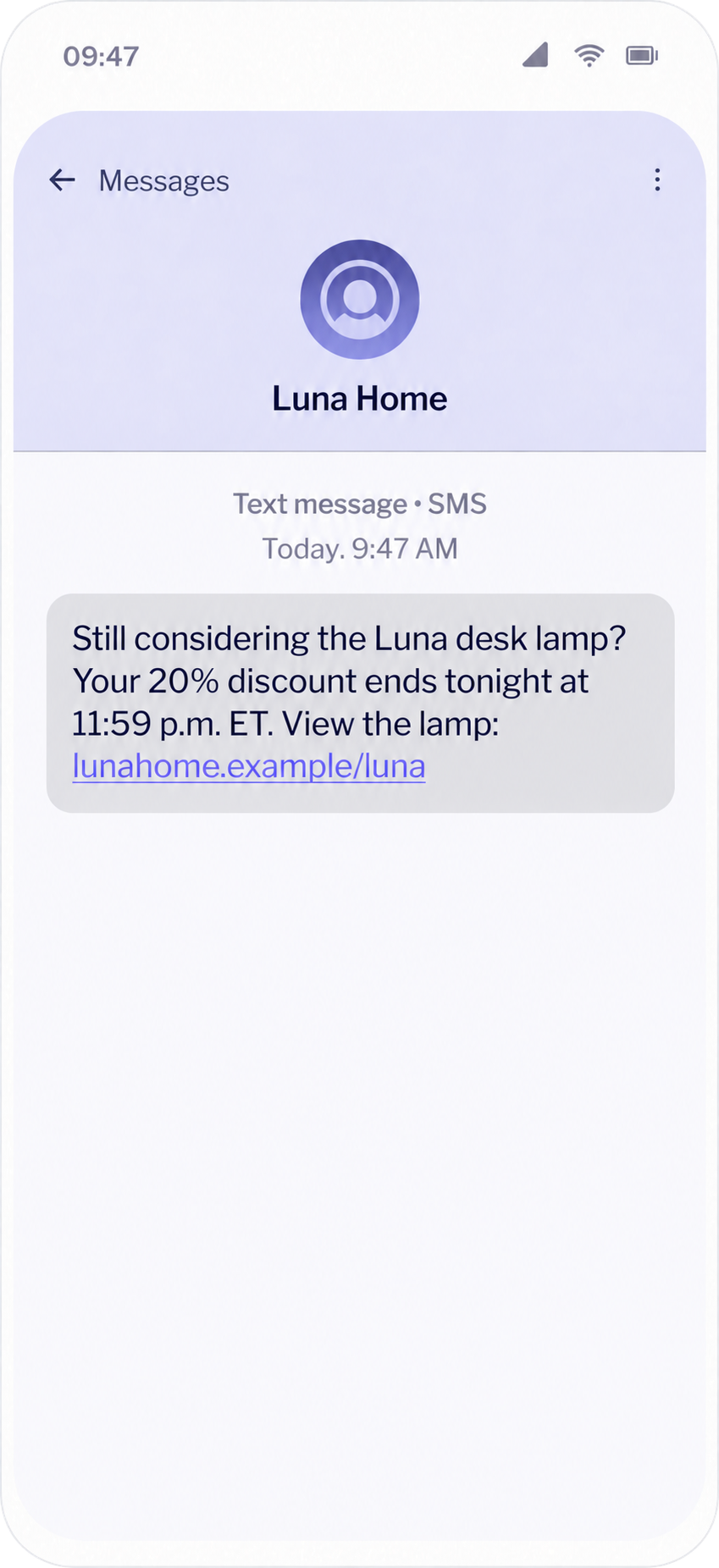
This works best when your audience’s earlier activity supports that specific reminder. Link directly to the relevant product or saved cart, and suppress the message for customers who have already purchased.
A carousel of alternative products could distract from the decision the customer was close to making. Choose SMS when the remaining task is to communicate urgency and provide a direct route back.
2. The likely return does not justify a separate RCS campaign
Consider a retailer sending a straightforward storewide discount to a small customer segment. The team already has an effective mobile sale page, while only a limited portion of that segment is confirmed as reachable through its RCS sender.
Creating, checking, and maintaining a separate set of rich cards may add more work than this campaign warrants. SMS can be the better choice if the offer needs little explanation and there is no strong reason to expect visual content to change purchasing behavior.
Make that decision using the provider’s actual pricing, confirmed audience reach, and production effort. Compare the additional campaign cost with the additional gross profit RCS would need to generate to cover it. A higher click-through rate alone does not settle the question.
💡 This also gives the two channels distinct roles within one Black Friday plan: RCS can introduce a visual selection, while SMS can deliver a focused follow-up where another product presentation would add little.
How to prepare and evaluate your Black Friday RCS campaign
Before launch, test the complete route from message delivery to purchase. A polished carousel is only one part of that journey: audience eligibility, fallback behavior, offer accuracy, and measurement determine whether the campaign works as intended.
Confirm who your sender can reach
Ask your provider to check RCS reach within the intended campaign audience and confirm that your business sender is active on the relevant networks. A customer’s ability to use RCS does not automatically mean they can receive messages from your brand. Google’s capability checks distinguish device support and reachability through a particular business sender.
Use that information to plan the RCS audience, estimate costs, and prepare an alternative for eligible recipients who cannot receive the rich message.
Give SMS fallback its own destination
A fallback SMS needs to communicate the offer without the carousel’s images, descriptions, or individual buttons. For a multi-product campaign, that may mean linking to the curated selection page that RCS recipients can skip. Keep that page available for the SMS journey.
Agree with your RCS platform provider when fallback should trigger and how the system handles an RCS message that remains queued. Google recommends revoking an undelivered message before switching channels. Delivery and revocation status need to inform that decision to reduce duplicate sends. Set an expiry appropriate to the promotion so queued messages do not arrive after the offer ends.
Check the offer on real devices
Send test messages and follow each route through to checkout. Focus on details that could change the customer’s decision:
- Are product names, prices, conditions, and buttons readable without awkward cropping or truncation?
- Does each button open the advertised product or bundle, with the correct discount?
- Do suggested replies produce the intended follow-up?
- What happens when an item sells out or the promotion expires?
- Does the fallback SMS make sense independently?
Assign someone to monitor stock and destination pages during the campaign. Message expiry controls undelivered messages, but customers can still revisit an offer they received earlier, so the website needs to handle outdated promotions clearly.
Compare outcomes across equivalent audiences
For an RCS-versus-SMS test, randomly split an audience eligible for both channels. Keep the offer and sending window consistent, and give each format an appropriate creative treatment. Comparing RCS-capable customers with a separate SMS-only population can mix audience differences into the result.
Use the same attribution window and track completed orders, revenue, and campaign costs per assigned recipient. Include fallback costs in the RCS group and report how often fallback occurred. Track individual card links to understand which products attracted interest, but judge the campaign on what happened after those clicks.
Put RCS to work this Black Friday
Use RCS where seeing products or comparing offers helps shoppers decide what to buy. Keep the route to purchase clear, use SMS where a simple prompt is enough, and measure success through completed purchases and campaign costs.
Ready to build your campaign? Explore MessageFlow’s RCS marketing capabilities and talk to our team about the right format for your Black Friday offer.