Since 6 November 2026, some Amazon customers in the US have been able to shop directly in their phone’s Messages app – the same app most people use to text family and friends. They send a message to Alexa Shopping, describe what they need, and an AI assistant finds products, compares offers, builds the basket and places the order. The whole journey happens in an app customers already know, with nothing new to install.
That takes AI shopping assistants to a new level. Buying this way is no longer confined to a retailer’s own app. It moves to where the customer already is. In this article, I look at how Amazon used RCS to bring AI-assisted shopping to the mass market – and what it means for retailers in Europe.
Alexa for Shopping: Amazon’s AI shopping assistant
Alexa for Shopping is the shopping assistant Amazon unveiled on 13 May 2026. It merges two earlier products: Rufus, the shopping chatbot in Amazon’s app, and Alexa+. Until now, the assistant lived in the Amazon Shopping app, on the website and on Echo Show devices.
On 6 November, a new channel arrived – one that is native to the phone and available to almost everyone. At first, the feature was open only to a small group of invited US customers. But on 13 November, Amazon updated its announcement to say it was now broadly available to Alexa for Shopping customers.
Demand is already substantial. According to Amazon, more than 400 million customers have used Alexa for Shopping in the past 12 months. The number of people using its agentic features – where the assistant acts on the customer’s behalf – has grown more than eightfold since the start of the year. This is a new trend, and over time it could become a habit: the default way people shop.
Now Amazon has gone a step further, and the whole experience also runs over RCS. To message Alexa Shopping, customers need a phone with RCS chats switched on: an Android phone with Google Messages or an iPhone on iOS 18 or later, on a mobile network that supports RCS.
How does an AI shopping assistant work over messaging?
The customer receives an invitation in a first, opt-in message, accepts the terms, links their phone number to their account – and that’s it. An “Alexa Shopping” contact appears in the Messages app. From then on, the conversation feels like texting a friend.
A few examples show best how it works:
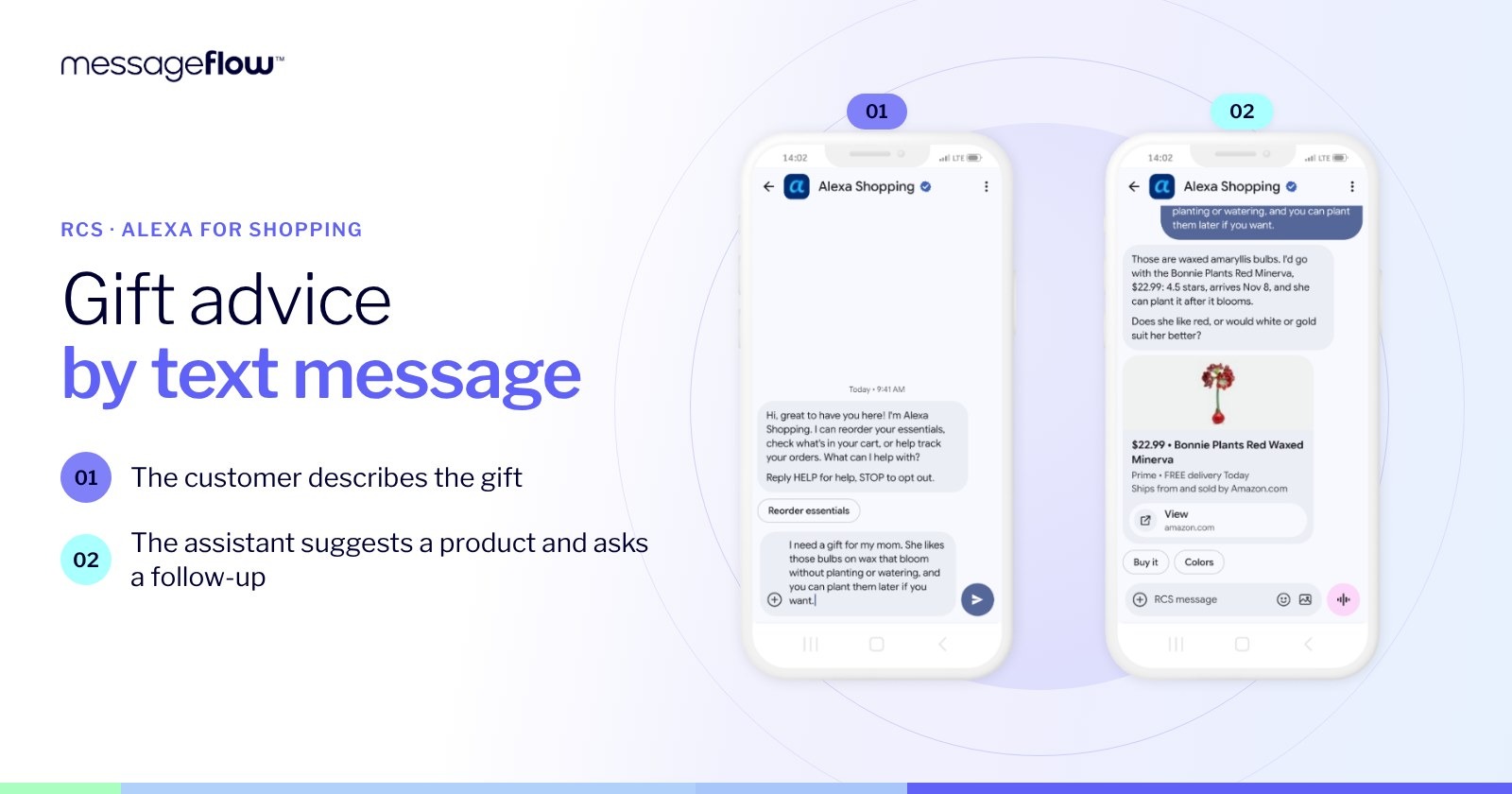
- A to-do list in one message. “We’re out of dog food, I need a present for my sister and we’re low on kitchen roll.” The assistant handles all three at once and replies with suggestions as it finds them.
- A recipe turned into a basket. You send a photo of a recipe, and the assistant adds every ingredient to your basket.
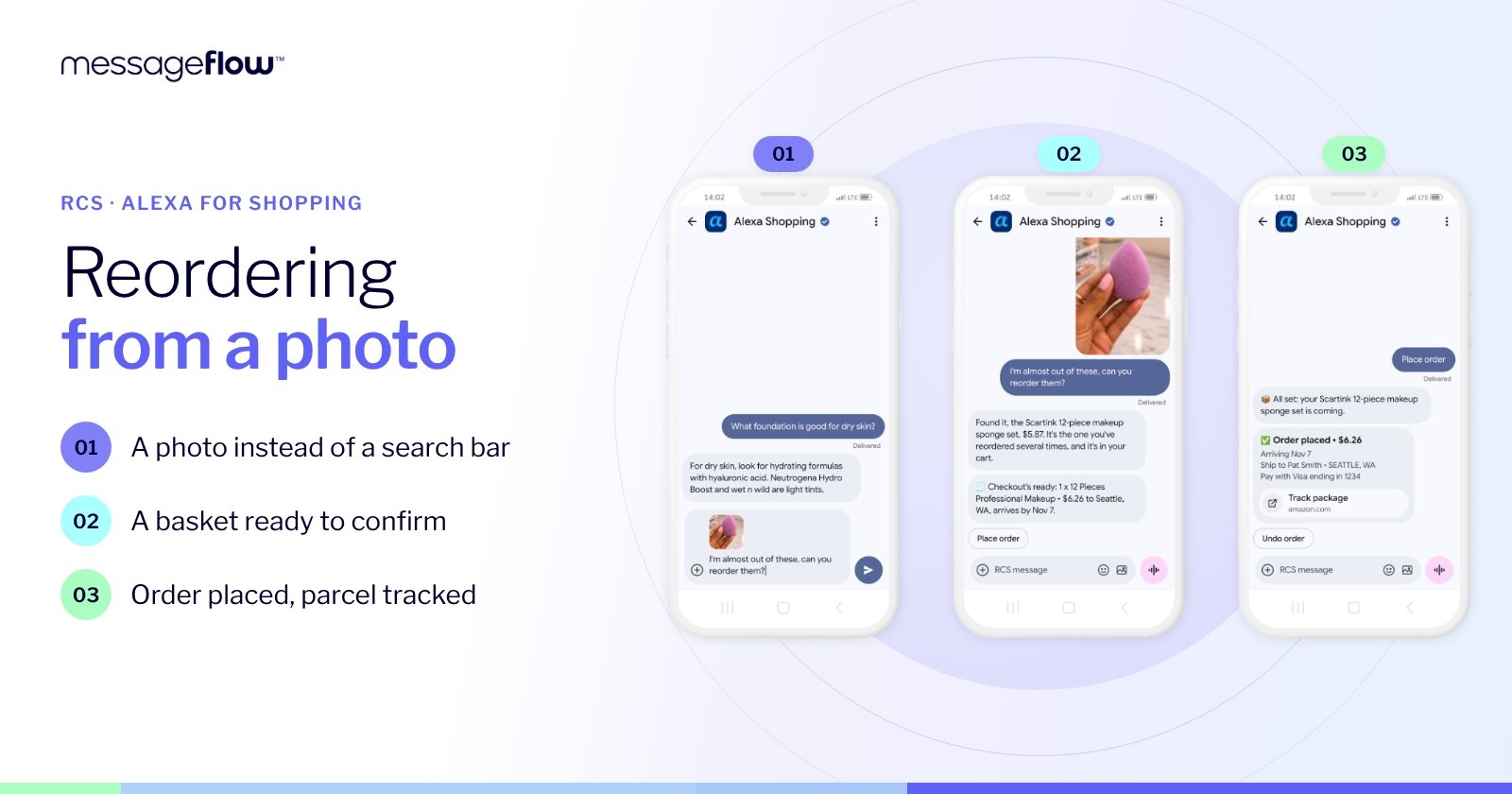
- Reordering. “Order that washing liquid I bought last month again.” The assistant finds it and buys it once you approve.
- A photo instead of a search bar. You spot something while scrolling or out on the street, take a photo, send it and get similar products back.
- Price watching. “Let me know when AirPods go on sale” – and the assistant messages you when the price drops. On request, it also shows up to a year of price history.
- Parcel tracking. “Where’s my parcel?” – and the answer arrives without opening an app.
On top of that, Amazon’s AI assistant remembers wider context. Mention once that you only buy vegan products or that you’re training for a marathon, and it factors that into future recommendations. The longer you use it, the better it knows your habits.
Continuity matters too. A conversation started in Messages can be finished in the app, on the website or on an Alexa device – and the other way round. Amazon also says that order updates, delivery notifications and deals will appear in the same thread over time. One contact on the phone brings together sales, customer service and transactional messaging.
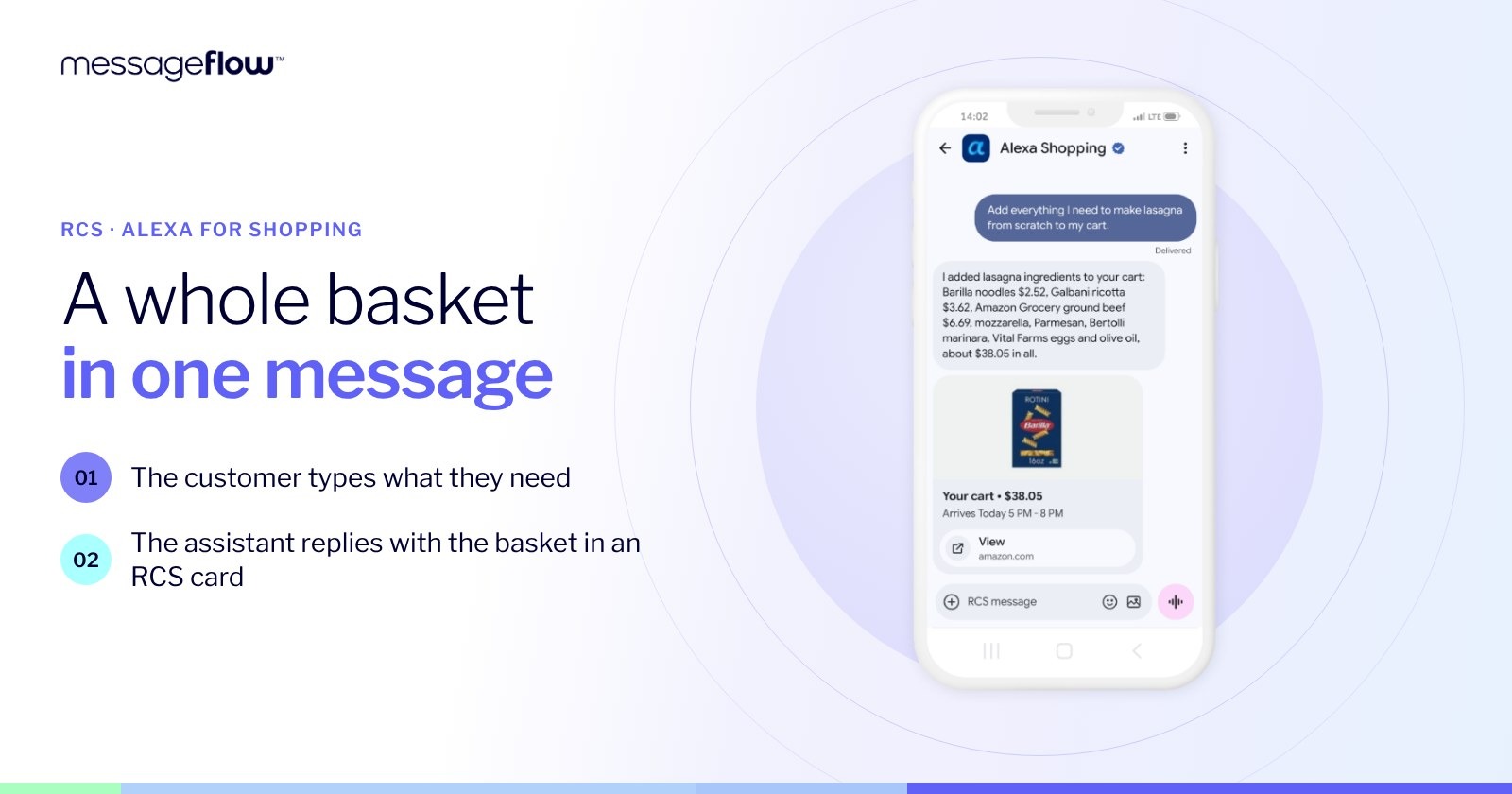
Here’s what it looks like in practice. The customer writes: “Add everything I need to make lasagne from scratch to my basket.” In reply, they get a list of ingredients with prices, a product carousel (the first of eight items is Barilla pasta), a basket summary of $38.05 with same-day delivery between 5 and 8 pm, and a “View” button. Text, a card carousel and a button are standard RCS building blocks. The customer never leaves Messages.
An assistant where the customer already is
An assistant inside a retailer’s app is one thing. To use it, the customer has to have that app installed, be logged in and remember to open it. Everyone has a Messages app on their phone.
Amazon spotted something important. People already jot down what they need in notes apps and text it to the people close to them. They do it the moment they remember something has run out or think of a gift idea. So Amazon isn’t building a new habit – it’s using one that already exists. Now that shopping list can go straight to an assistant that can complete the purchase almost instantly and send back a confirmation.
The direction of the conversation changes too. In an app, the customer has to come to the assistant. In messaging, the assistant can speak first: to say a price has dropped, a parcel is on its way or an item the customer was waiting for is back in stock. And the customer replies in the same thread.
The technical limits of SMS could never support a journey like this. RCS handles it natively, in the Messages app. The customer sees a verified brand, product images (for example in a carousel), prices and buttons. These are all formats they know well, so making a purchase decision doesn’t mean grappling with anything unfamiliar.
Why the US, and why now?
Amazon could bet on this channel because RCS reach in the US jumped at the end of 2025. Before iOS 18, RCS in practice worked only on Android and reached about 40% of smartphone users. Everything changed when Apple added RCS support to the iPhone.
According to Juniper Research, the share of US mobile subscribers whose devices and services could receive business RCS rose from 36.7% in 2024 to more than 86% by the end of 2025. Google says more than a billion RCS messages are sent every day in the US alone.
For a company like Amazon, universal access is what matters. A channel used by many millions of customers makes it possible to roll out a shopping assistant at scale.
RCS in Europe: a growing opportunity for e-commerce
In several European countries, RCS reach is already higher than in the US. In Germany, Spain, the UK and France, business RCS is supported by all the major mobile operators. Other large markets are further behind.
| Country | RCS operator coverage | RCS on iPhone |
|---|---|---|
| Germany | 92.6% | Yes |
| Spain | 86.6% | Yes |
| United Kingdom | 85.6% | Yes |
| France | 85.0% | Yes |
| Italy | 59.1% | Not yet |
| Netherlands | 48.4% | Not yet |
| USA (for comparison) | 83.9% | Yes |
Sources: CM.com – RCS Coverage (updated 10 November 2026); Apple – Wireless carrier support and features for iPhone in Europe
Operator coverage shows how many users on each network can be reached via RCS. It doesn’t show whether each of them has RCS switched on, so the real reach of a campaign may be lower – which is why SMS fallback matters.
The iPhone matters too. According to Apple’s carrier list, iPhone users can already get RCS on at least one network in 11 European countries: Austria, Belgium, Czechia, France, Germany, Greece, Hungary, Slovakia, Spain, Sweden and the UK.
Technically, then, a European retailer could do what Amazon has done today. The question is who will seize the opportunity first – and in which markets.
Where Europe still lags: the iPhone gap
Italy, the Netherlands, Switzerland and Poland are still waiting for iPhone RCS. Poland shows what that gap looks like in practice. Business RCS there works on Android today; on iPhones, it doesn’t yet.
The US shows how much Apple support matters: RCS reach rose from around 40% to more than 86% once iPhones came on board.
In Poland, the signals of change are already there:
- April 2026: Deputy Digital Affairs Minister Michał Gramatyka wrote to the country’s four largest operators, asking why they did not support RCS on iPhones.
- September 2026: Orange Polska confirmed it is working on RCS for iPhones and is expected to be the first Polish operator to offer it. No launch date has been given.
- Play has announced a move from Mavenir to Google RBM. No date has been given yet.
The direction is clear. RCS reach in Europe’s lagging markets will keep growing, closing the gap with Western Europe and the US. For businesses, this is a good moment to build a presence in the channel: test new scenarios, explore ideas and run first deployments. Once operators catch up, RCS could become a core part of how brands communicate with customers.
European players: AI assistants are here, but inside apps
AI shopping assistants are gaining ground in Europe too. Some of the region’s biggest e-commerce and logistics players have already launched their own.
Zalando Assistant
Since October 2024, the Zalando Assistant has been available to logged-in customers in all of Zalando’s markets, giving fashion advice in local languages. Zalando says around 22 million people have used it in 2026. On 3 November 2026, the company also launched its first AI shopping agent, which lets customers buy from other online shops without leaving the Zalando app.
InPost and Von Halsky
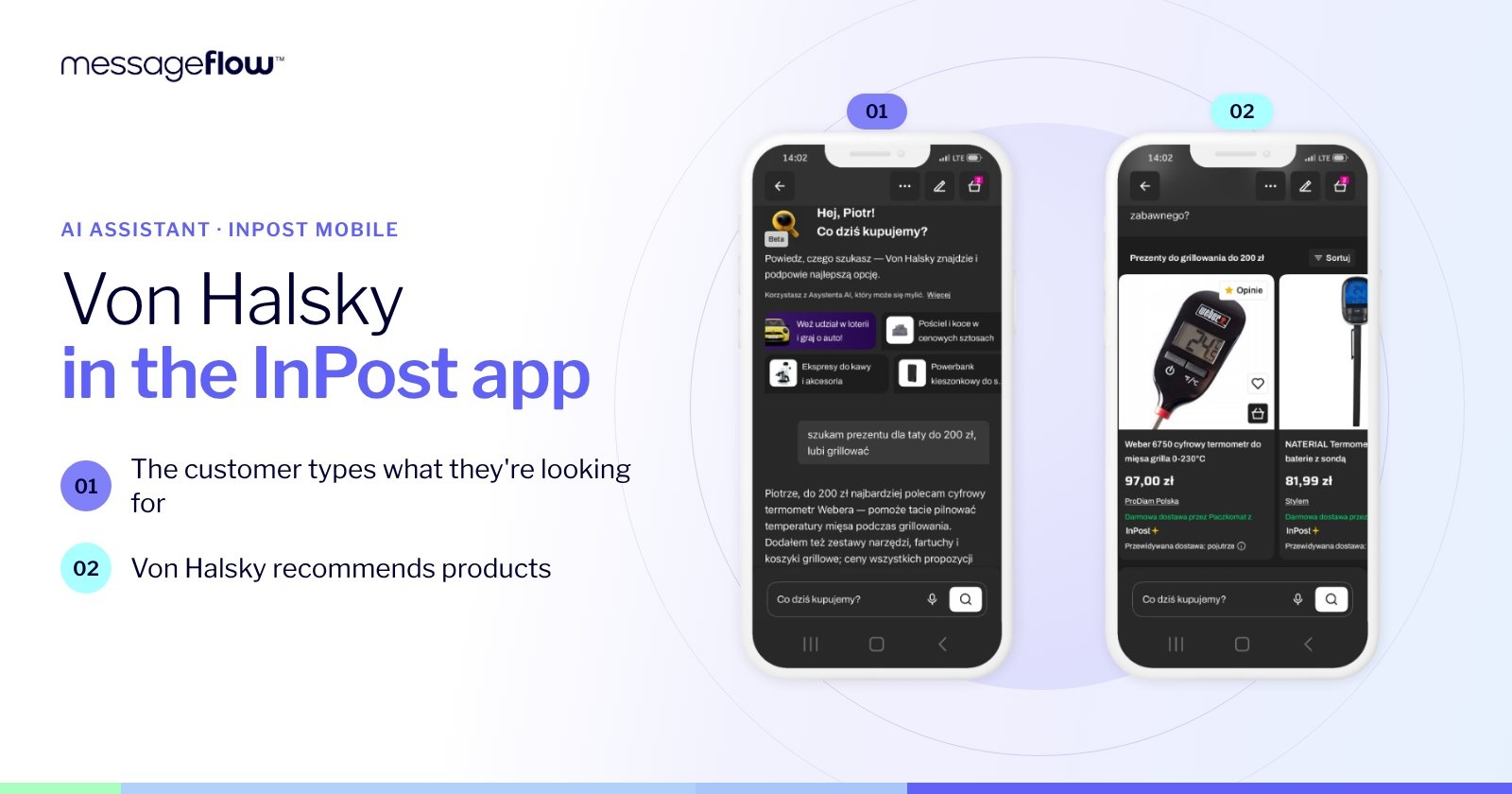
InPost’s assistant lives in the InPost Mobile app in Poland. Since June 2026, InPost has been gradually rolling it out to more users, with a potential reach of around 17 million people. The beta phase is now complete.
Customers can talk to Von Halsky by voice or text. The assistant browses offers from InPost’s partner shops, compares products and shows results in a carousel. It also lets customers complete the purchase without leaving the app.
Allegro Assistant
Since May 2026, Allegro’s assistant has been available to all users of the Allegro mobile app. During testing, more than 600,000 active users tried it. It helps customers search for products, compare specifications and match offers to a specific need.
These are good first steps. But all three share one trait: they work where the customer has to come to them. You talk to the Zalando Assistant in the Zalando app, to Von Halsky in InPost Mobile, and to Allegro’s assistant in the Allegro app.
Moving beyond your own app could significantly widen an assistant’s reach. This is where RCS for business comes in. Customers use the Messages app they already have on their phone, with no extra retailer app to install – provided their device and mobile operator support business RCS.
Picture a simple scenario. I message a shop: “I’m looking for a present for my dad, under €50. He loves barbecuing.” The assistant takes my criteria into account and picks matching products from the catalogue. Then it shows a carousel of suggestions with images and prices.
How do you connect an AI shopping assistant to RCS via API?
An AI shopping assistant on RCS isn’t a campaign you send once a week. It’s many conversations running at the same time, each at a different stage of the purchase – and during peaks such as Black Friday and Cyber Week, traffic is far higher than usual. The customer is waiting for a reply mid-conversation, so any delay is noticed immediately.
Then there’s integration. During the conversation, the assistant has to connect to an AI model, the product catalogue, the basket and the order management system. Marketing, transactional and service messages all flow through the same thread. And underneath it all sits customer data: purchase history, addresses and preferences. All of it has to be secure and GDPR-compliant.
The answer is to run the agent on a high-performance API that can handle that volume of conversations. A company that already has its own AI agent connects it through the MessageFlow API, while the conversation logic stays on its side. Direct connections with mobile operators and Google RBM partner status keep the channel secure, and MessageFlow’s enterprise-grade infrastructure lets you scale messaging to very high volumes.
Who will launch the first AI shopping assistant on RCS in their market?
Amazon has shown that a shopping assistant doesn’t have to be confined to a retailer’s app or website. It can be a contact on your phone, sitting between conversations with family and friends. In the US and much of Western Europe, RCS reach is already high enough to treat it as a native communication channel.
The rest of Europe is heading the same way. Markets such as Poland have a track record of catching up quickly with new technology, and often overtaking Western Europe – there is every chance that history repeats itself here.
An RCS assistant won’t replace the app. It will be an additional sales channel that also reaches customers who don’t have the app or rarely open it.
So the question is: which European brand will be first to launch its own AI shopping assistant on RCS?