
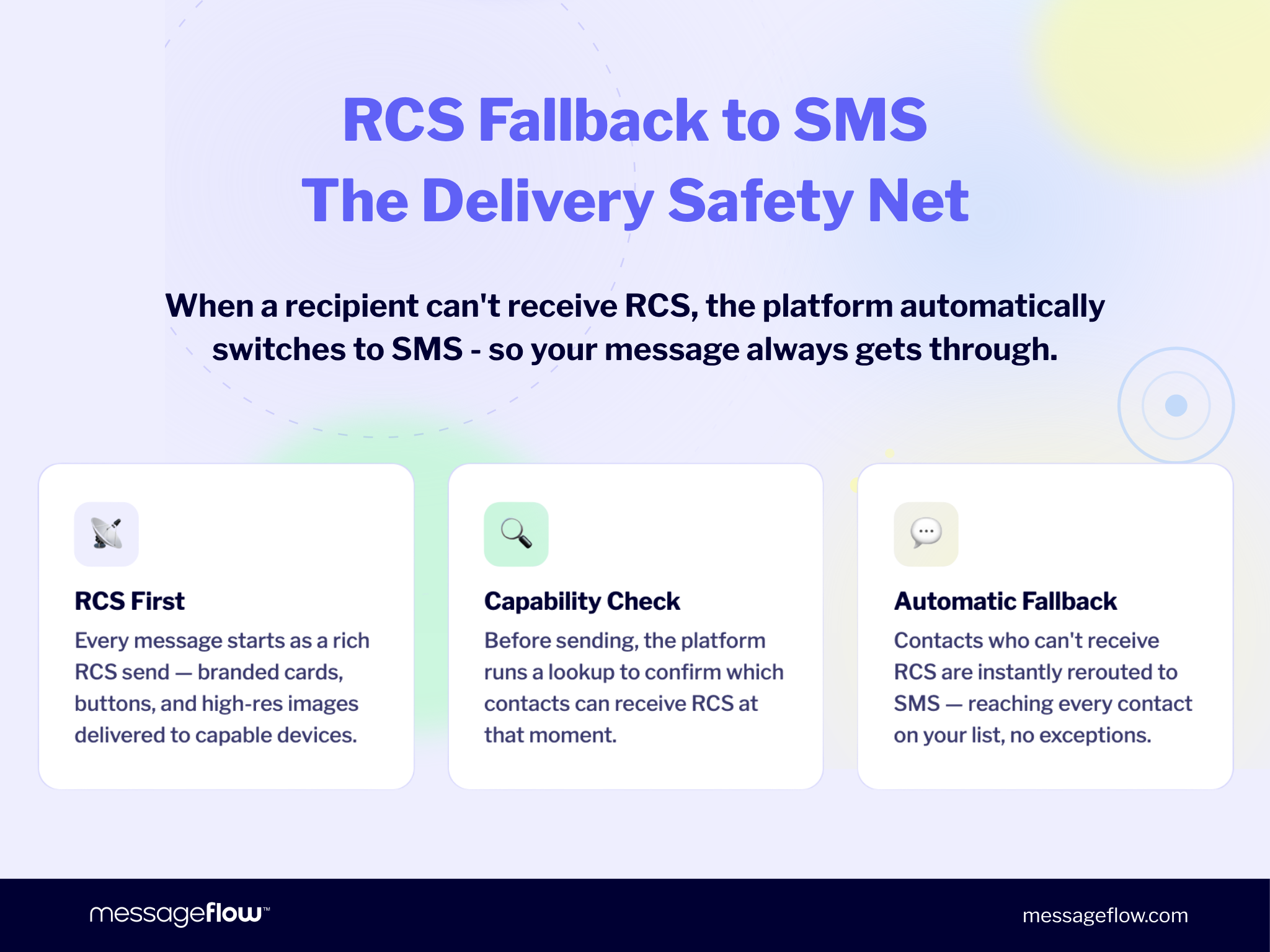
TL;DR: RCS fallback to SMS is a delivery safety net built into modern messaging platforms. When a recipient can’t receive RCS, the platform automatically switches the message to SMS so it still gets through. It triggers when the device, carrier, or connection doesn’t support RCS. Most serious CPaaS platforms, including MessageFlow, support it natively. Used correctly, it means your RCS campaign reaches every contact on your list, not just the ones with RCS-capable devices.
You’ve invested in a rich RCS campaign: branded cards, interactive buttons, high-res product images. You hit send. But here’s the question that keeps marketers up at night: what happens to recipients who can’t receive RCS yet?
The answer is RCS fallback, also known as RCS SMS fallback or RCS MMS fallback. This mechanism ensures your message doesn’t disappear into a void. It lands as a standard SMS instead, reaching every contact your RCS message can’t.
In the US, roughly 70% of smartphones are now RCS-capable and the figure keeps growing. Across Europe, adoption is accelerating fast, with major markets like the UK, Germany, and France already well covered by carrier support. But a significant portion of any contact list still needs SMS. RCS fallback isn’t a workaround. It’s a core part of any serious RCS strategy.
This article explains exactly how RCS fallback to SMS/ MMS works, what triggers it, and which platforms support it today.
What is RCS fallback?
RCS fallback to SMS conditions/ MMS are the exact situations that cause your platform to stop trying RCS and switch to SMS or MMS instead. Understanding them helps you plan campaigns, set the right timeout, and prepare your fallback content properly.
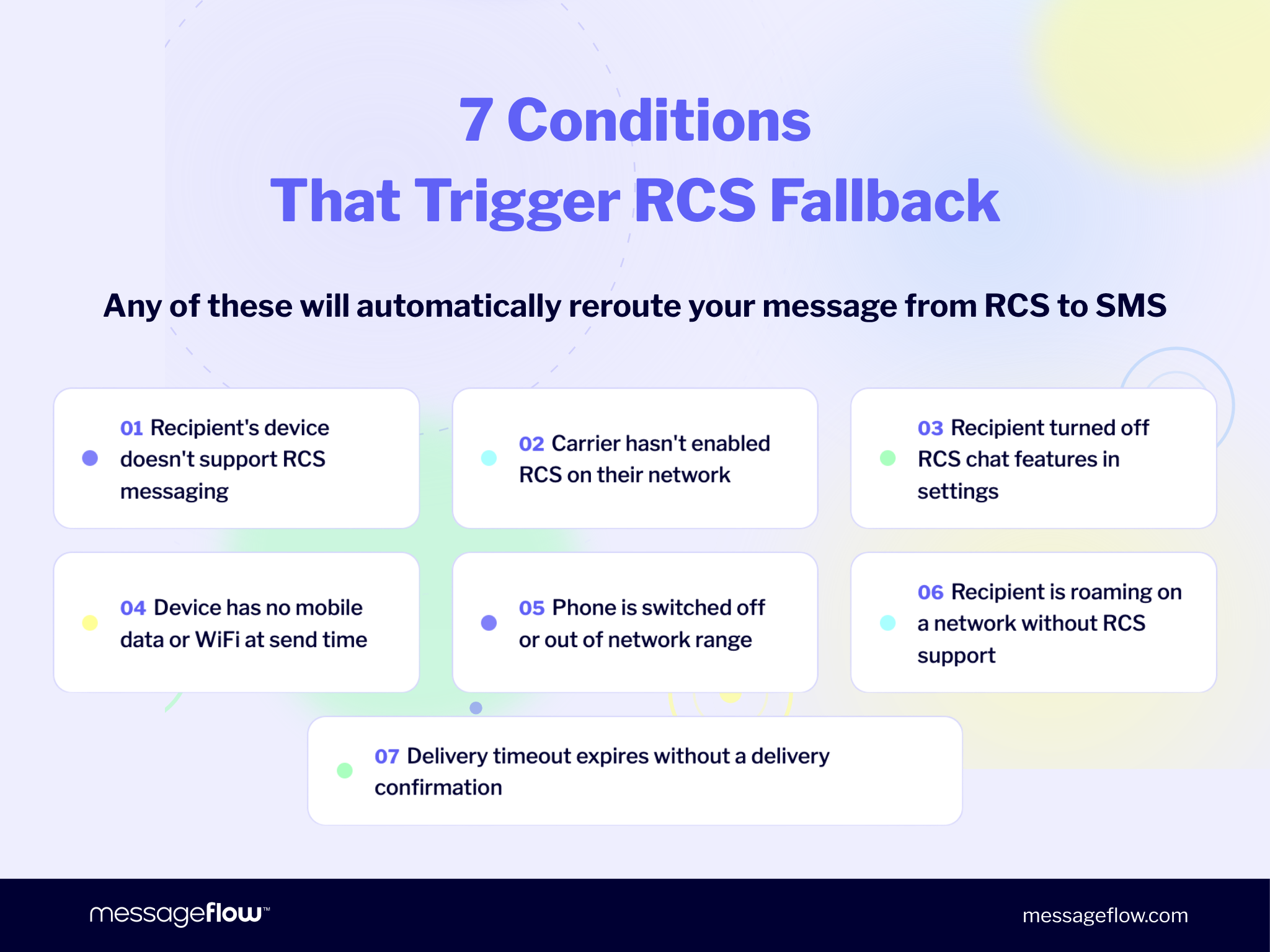
RCS fallback to SMS (or MMS) triggers automatically whenever the platform can’t confirm delivery. The most common conditions are:
- The recipient’s device doesn’t support RCS messaging,
- The carrier hasn’t enabled RCS on their network,
- The recipient has turned off RCS chat features in their messaging app settings,
- The device has no mobile data or WiFi connection at send time,
- The phone is switched off or out of network range,
- The recipient is roaming on a network that doesn’t support RCS,
- The delivery timeout expires without a delivery confirmation.
Most platforms run a lookup before the actual send. This checks whether each number in your list is RCS-capable at that moment. Numbers that pass get RCS. Numbers that fail go straight to SMS/MMS, before the campaign even fires.
However, a small percentage of numbers may pass the lookup but still fail at delivery time. This can happen if a phone goes offline after the lookup runs, or if a network issue blocks delivery. This is where RCS failover steps in – a separate real-time recovery layer that we cover in the next section.
💡 You can also turn RCS on or off at the device level, which affects whether individual users receive RCS from any sender. A recipient who manually disables RCS will receive SMS fallback, regardless of their device or carrier.
RCS failover vs. RCS SMS fallback: what’s the difference?
RCS SMS fallback and RCS failover are often used interchangeably, but they describe two different mechanisms. Understanding the distinction matters when you’re evaluating platforms or diagnosing delivery gaps.
RCS SMS fallback is a pre-planned, pre-configured route. Before your campaign sends, the platform runs a capability lookup against your contact list. Numbers that aren’t RCS-capable are flagged upfront and routed directly to SMS. The fallback is decided before a single message leaves the platform.
RCS failover is a real-time recovery mechanism. It handles the numbers that passed the initial lookup but still failed to receive RCS at send time. This happens when a phone goes offline between the lookup and the actual delivery attempt, or when a temporary network condition blocks an otherwise eligible recipient. When the platform receives an “undelivered” status, RCS failover kicks in immediately and reroutes that specific message to SMS/MMS.
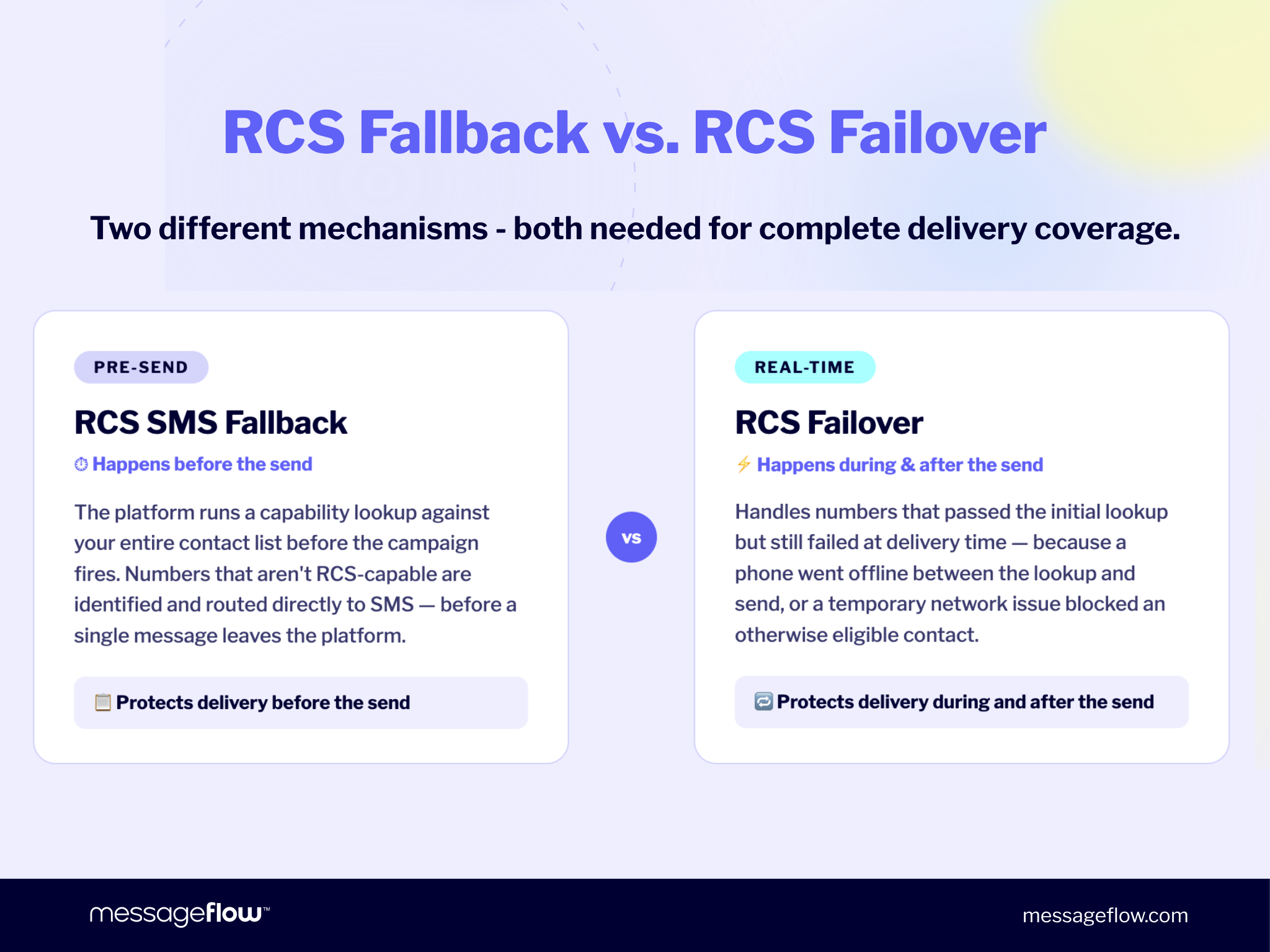
In short: RCS SMS fallback protects delivery before the send. RCS failover protects delivery during and after it.
Both mechanisms are needed for truly complete coverage. A platform that only does pre-send fallback still misses the small percentage of contacts who drop out at delivery time. A platform with both layers ensures every recipient gets something, regardless of when their device or network becomes unavailable.
💡 If a brand wants an honest assessment of RCS performance, it can’t look at the rich channel metrics alone. You need to analyze the full mix: RCS coverage, fallback share, CTR by channel, and final conversion – only then do you get a true picture of the campaign.
Piotr Kudzior, Product Manager – Conversational Messaging, MessageFlow
RCS fallback to SMS vs. MMS: what’s the difference?
Fallback to SMS delivers plain text only. It strips all rich content: no images, no buttons, no carousels. What the recipient gets is the text portion of your message, plus any links you’ve included. Standard SMS also carries a 160-character limit, and messages that exceed it split into multiple segments, which can increase sending costs.
Fallback to MMS goes one step further. MMS supports both text and images, so your fallback message can include a visual even when RCS isn’t available. This makes MMS fallback a closer match to the original RCS experience and is a useful option when visuals carry your message, such as product launches or seasonal promotions.
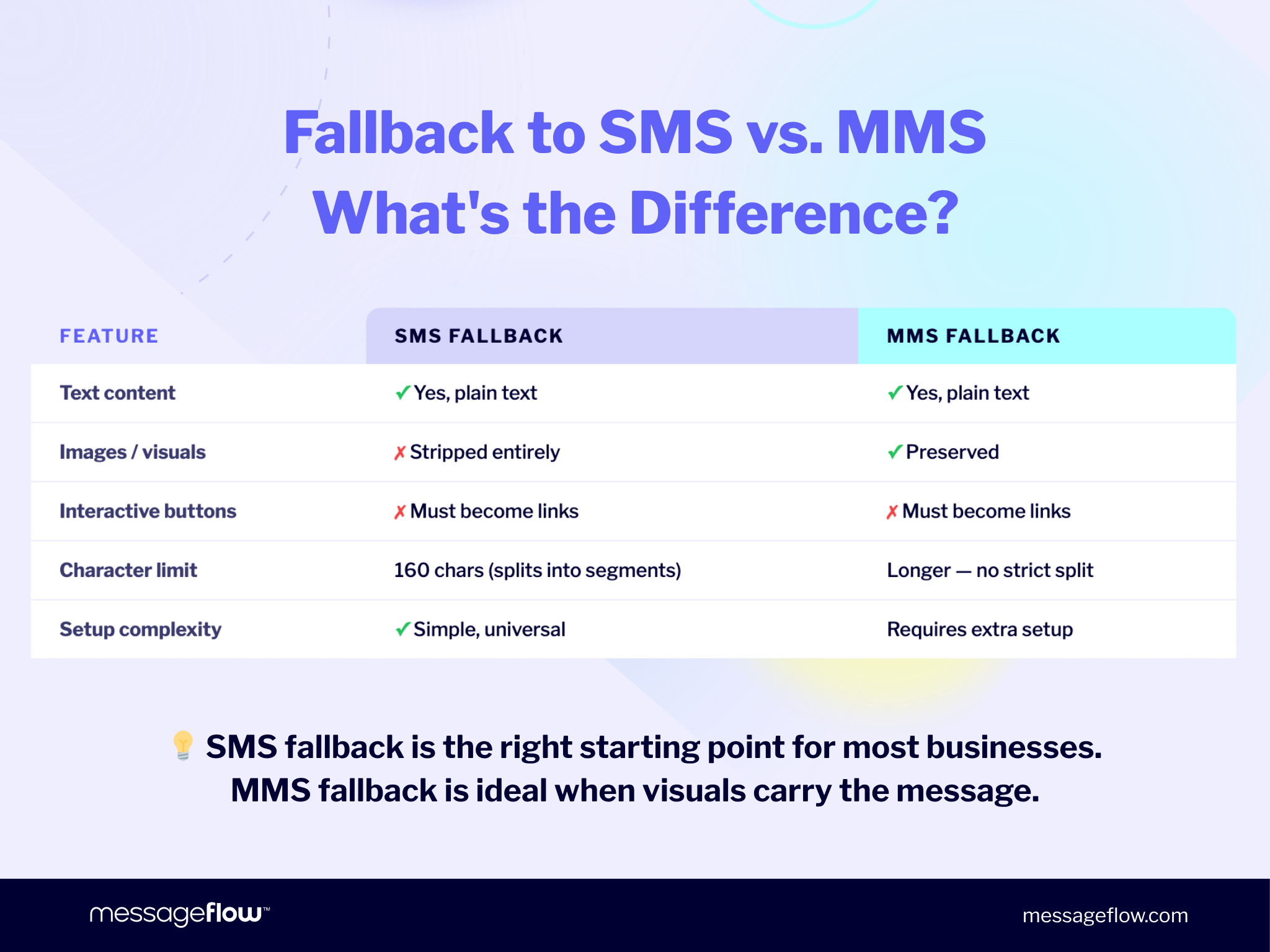
The tradeoff: MMS requires more setup. Not every platform supports it out of the box, and it still can’t carry interactive buttons, so CTAs need to become plain links either way.
For most businesses, RCS fallback to SMS is the right starting point. It’s simpler, universally supported, and covers every device and carrier combination.
What happens to your rich content during fallback?
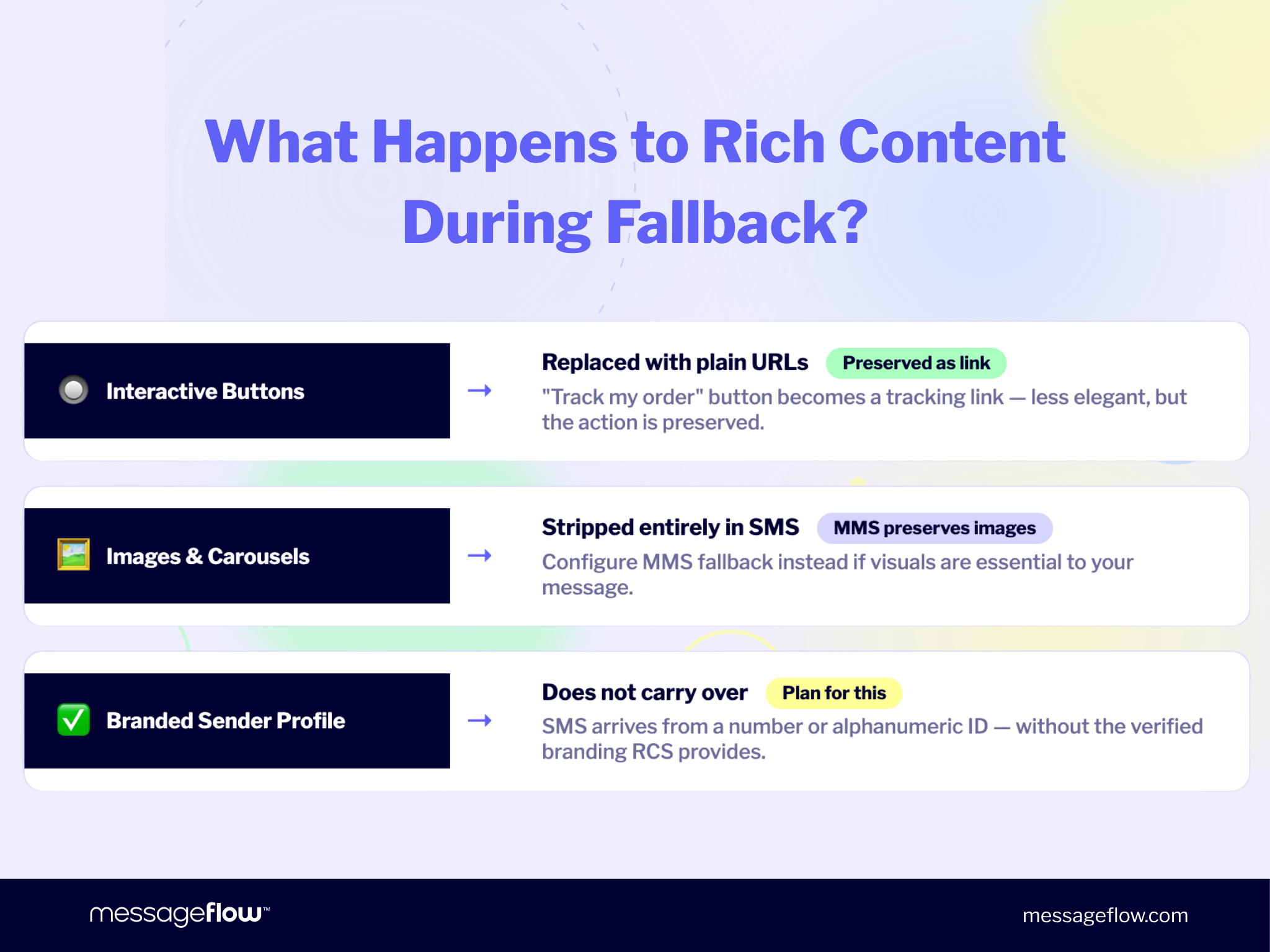
This is the part most marketers overlook until it’s too late. When your RCS message falls back to SMS, rich content doesn’t downgrade automatically. It disappears.
Interactive buttons can’t be sent via SMS. Replace them with URLs in your fallback version. A “Track my order” button in RCS becomes a tracking link in SMS. Less elegant, but the action is preserved.
Images and carousels are stripped entirely in SMS. They can be preserved if you configure MMS fallback instead.
Branded sender profiles don’t carry over. SMS arrives from an alphanumeric sender ID, without the verified branding that RCS provides.
This is why every RCS campaign needs two content versions built in advance:
- The RCS version: full rich experience with buttons, visuals, and interactive elements
- The fallback version: leaner text (and optionally an image for MMS) carrying the same core message and call to action.
💡 When working with our clients on their first campaigns, we kept encountering the same issue: planning RCS and SMS separately required extra time and resources. To simplify and speed up the process, we introduced a solution that lets you create both versions at once. Now, within a single campaign, two content variants are produced – a rich RCS message and a simplified, text-only SMS carrying an alternative version of the message.
Piotr Kudzior, Product Manager – Conversational Messaging, MessageFlow
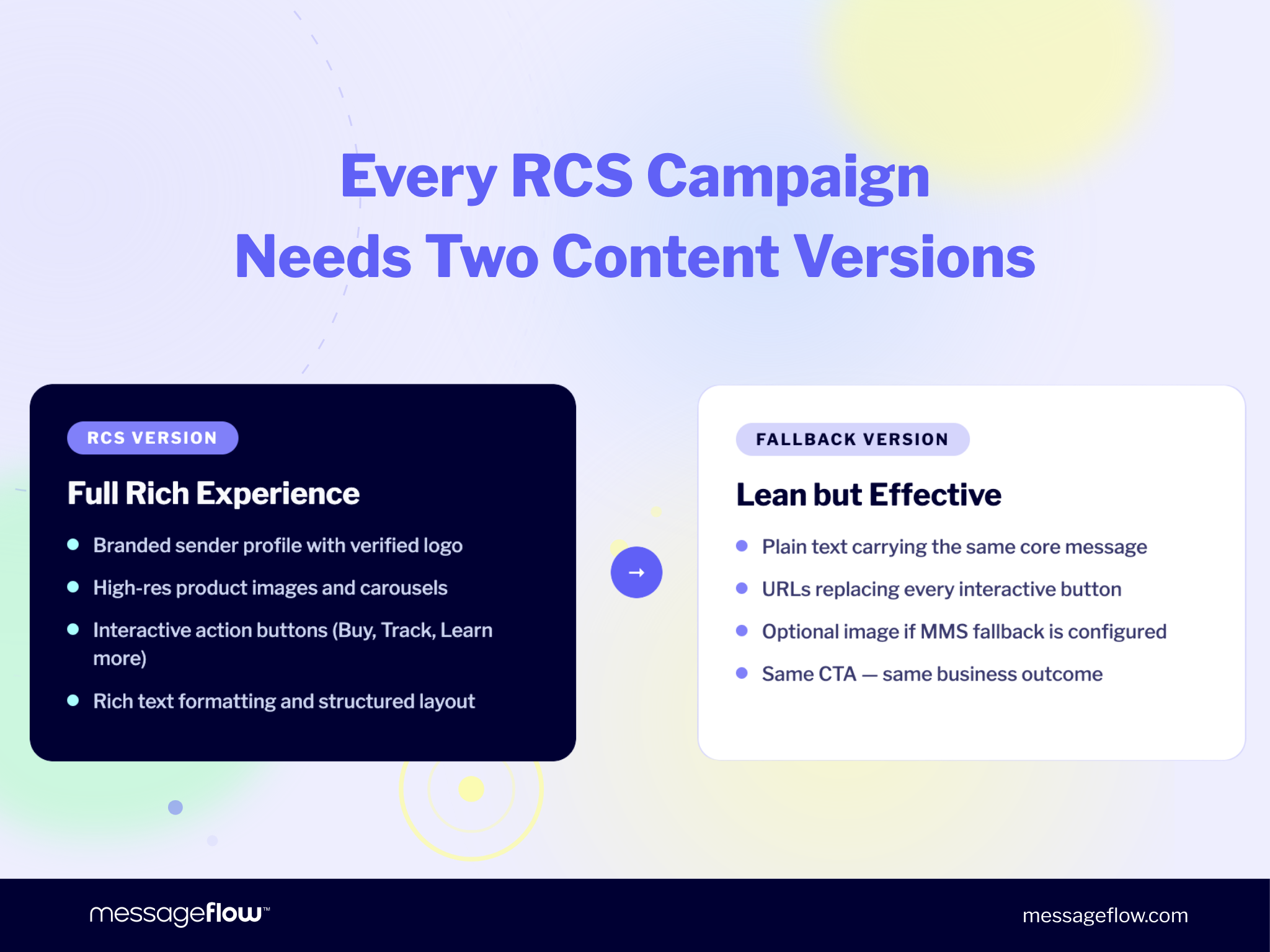
Both versions should deliver the same business outcome: a click, a confirmation, a purchase. Designing RCS business messages with fallback in mind from the start saves significant rework later.
Which platform supports RCS fallback to SMS?
This is one of the most searched questions for any marketer or CRM team evaluating RCS today. The short answer: most major CPaaS platforms support RCS fallback to SMS. But the implementation, carrier coverage, and configuration options vary. Here’s a breakdown of the key RCS fallback to SMS supported platforms.
MessageFlow
MessageFlow supports RCS SMS fallback through a dedicated section in the campaign panel, making it straightforward to configure without any development work.
Before a campaign fires, the platform runs a capability check against every number in your list. This lookup, built in cooperation with mobile operators and the RCS Business Messaging infrastructure, determines in real time which numbers can currently receive RCS. Numbers that qualify get RCS. Numbers that don’t are routed straight to SMS, before a single message leaves the platform.
The deduplication logic matters here. The platform first confirms that an RCS message was not delivered before triggering the SMS fallback. This is a critical step that lower-quality implementations skip: if you send the SMS without confirming RCS failure, a recipient can end up with both versions. MessageFlow’s system always attempts to revoke the original RCS message before the SMS fallback sends, closing that window.
Beyond the pre-send layer, MessageFlow also runs a real-time RCS failover mechanism. If a number passes the capability check but fails to receive RCS at send time (a phone went offline between the lookup and the delivery attempt, for example), the platform catches the “undelivered” status and immediately reroutes that specific message to SMS. This two-layer approach – RCS SMS fallback before the send, RCS failover during it – ensures every contact receives your message through one channel only.
MessageFlow operates as a direct partner of major mobile operators across Europe. Direct carrier connections mean more accurate capability detection and better overall delivery rates compared to platforms that route through intermediaries.
RCS to MMS fallback is also available on request for campaigns where preserving a visual in the fallback message matters.
Twilio
RCS fallback to SMS on Twilio is automatic, with no additional configuration required.
The platform detects when RCS is unavailable and routes to SMS instantly. Twilio also supports a FallbackFrom parameter, giving senders control over which SMS number handles the fallback.
Twilio’s RCS fallback is available across 22+ countries and 55+ carriers. Existing customers can add RCS without any code changes. The platform handles carrier onboarding and device capability checks automatically.
Infobip
Infobip supports RCS fallback to SMS through its Moments and Conversations APIs. The platform allows both automatic fallback (where it generates SMS content from your RCS message) and custom fallback (where you define the exact SMS text independently). This flexibility matters when the fallback message needs to differ from the auto-converted RCS content.
Sinch
Sinch offers RCS fallback to SMS through its Conversation API, which unifies RCS, SMS, WhatsApp, and other channels in a single interface. When RCS delivery fails, Sinch routes the message to SMS automatically, with no manual intervention required.
Sinch is built for enterprise-scale delivery and has a strong track record in regulated industries where deliverability is non-negotiable. Its platform covers key markets across Europe and North America and supports custom fallback content, so the SMS version doesn’t have to be a stripped-down auto-conversion of your RCS message.
Billing and duplication: what you actually pay for
Two questions come up every time marketers consider RCS fallback.
Do I pay for both RCS and SMS if fallback fires?
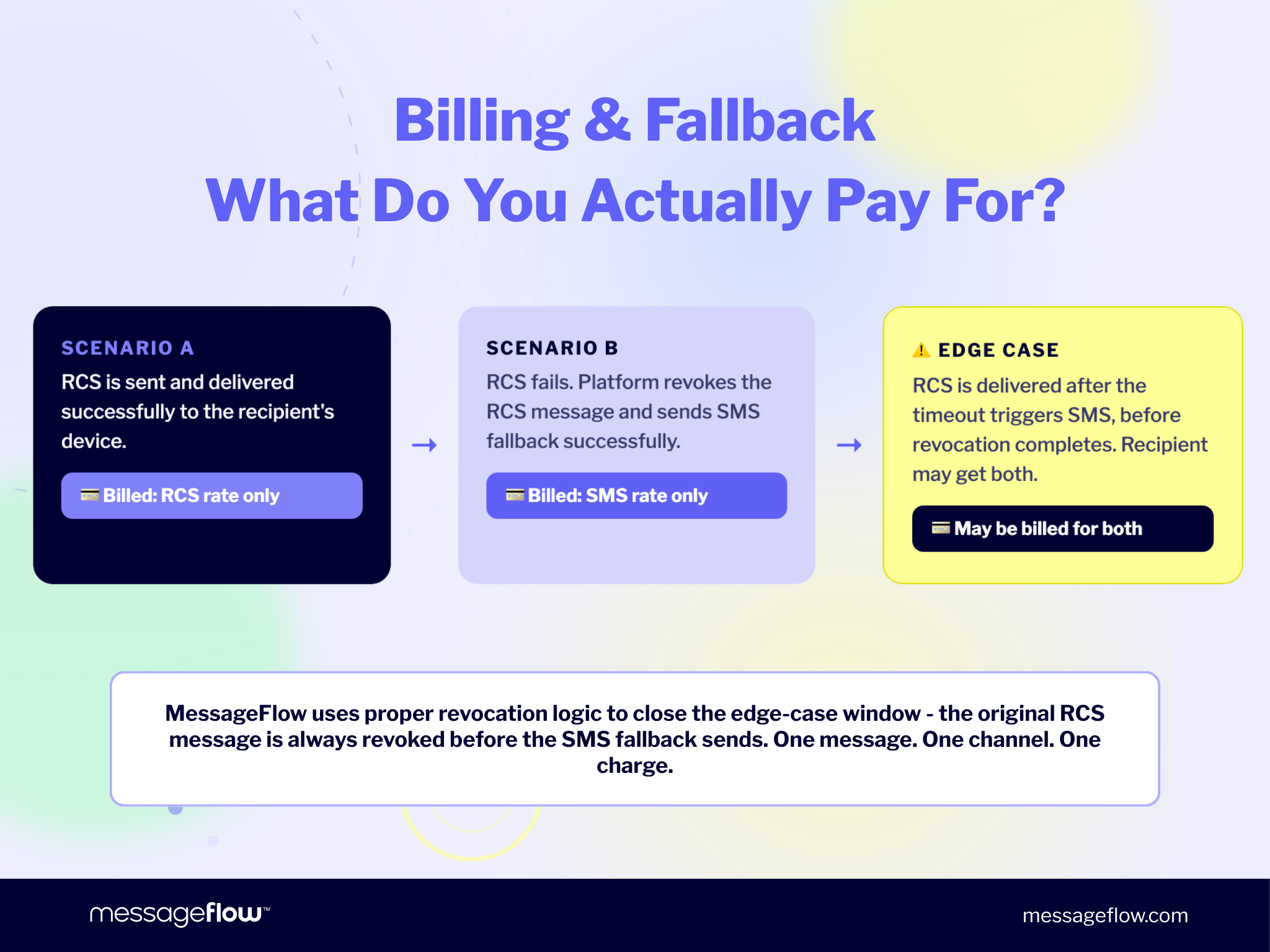
No, in the standard case. At MessageFlow, you’re billed for the channel that successfully delivers the message. If RCS delivers, you pay the RCS rate. If SMS delivers after RCS fallback, you pay the SMS rate. There’s no double charge on the same message.
There is one edge case worth knowing. In rare scenarios, the RCS message is delivered after the platform has already timed out and triggered the SMS fallback, but before the revocation of the original RCS message completes. In those cases, the recipient receives both the RCS and the SMS, and you may be billed for both deliveries. This is uncommon with well-implemented platforms such as MessageFlow, since proper revocation logic closes the window, but it’s worth confirming your provider handles revocation before fallback sends.
Can a recipient get both the RCS and the SMS?
Not when RCS SMS fallback is set up correctly with revocation in place. Once RCS delivery is confirmed, the platform stops. No SMS is sent. RCS fallback only fires when RCS definitively fails. Every recipient should get one message through one channel.
After each send, a detailed delivery report shows exactly which contacts received RCS and which received SMS (or MMS). That data is useful for understanding your audience’s device and carrier profile, and for tracking how RCS adoption grows across your list over time.
How to test RCS SMS fallback before you go live
Testing RCS fallback before your first real campaign is the step most teams skip. It shouldn’t be. A fallback that hasn’t been verified can silently fail, meaning contacts without RCS support receive nothing.
There are two approaches, depending on what you have set up.
Basic test (no approved SMS number required). This confirms the fallback mechanism is triggering correctly, even if you can’t verify the final SMS arrives yet.
- Take a test device offline: disable mobile data, WiFi, or enable airplane mode
- Send an RCS message to that device through your platform
- Check the delivery event log in your platform or API response
- You should see a failed RCS delivery event followed by an attempted SMS fallback
If the event log shows an SMS fallback attempt, the routing logic is working. The SMS itself won’t arrive since there’s no approved number in place yet, but you’ve confirmed the trigger fires correctly.
End-to-end test (with an approved SMS number). This verifies the complete chain: RCS fails, SMS fallback sends, message arrives.
- Make sure your campaign or messaging pool contains both your RCS sender and an approved SMS number
- Take your test device offline
- Send a message through the platform
- Bring the device back online and confirm the SMS arrived
- Check the delivery receipt to confirm it shows SMS as the delivery channel, not RCS
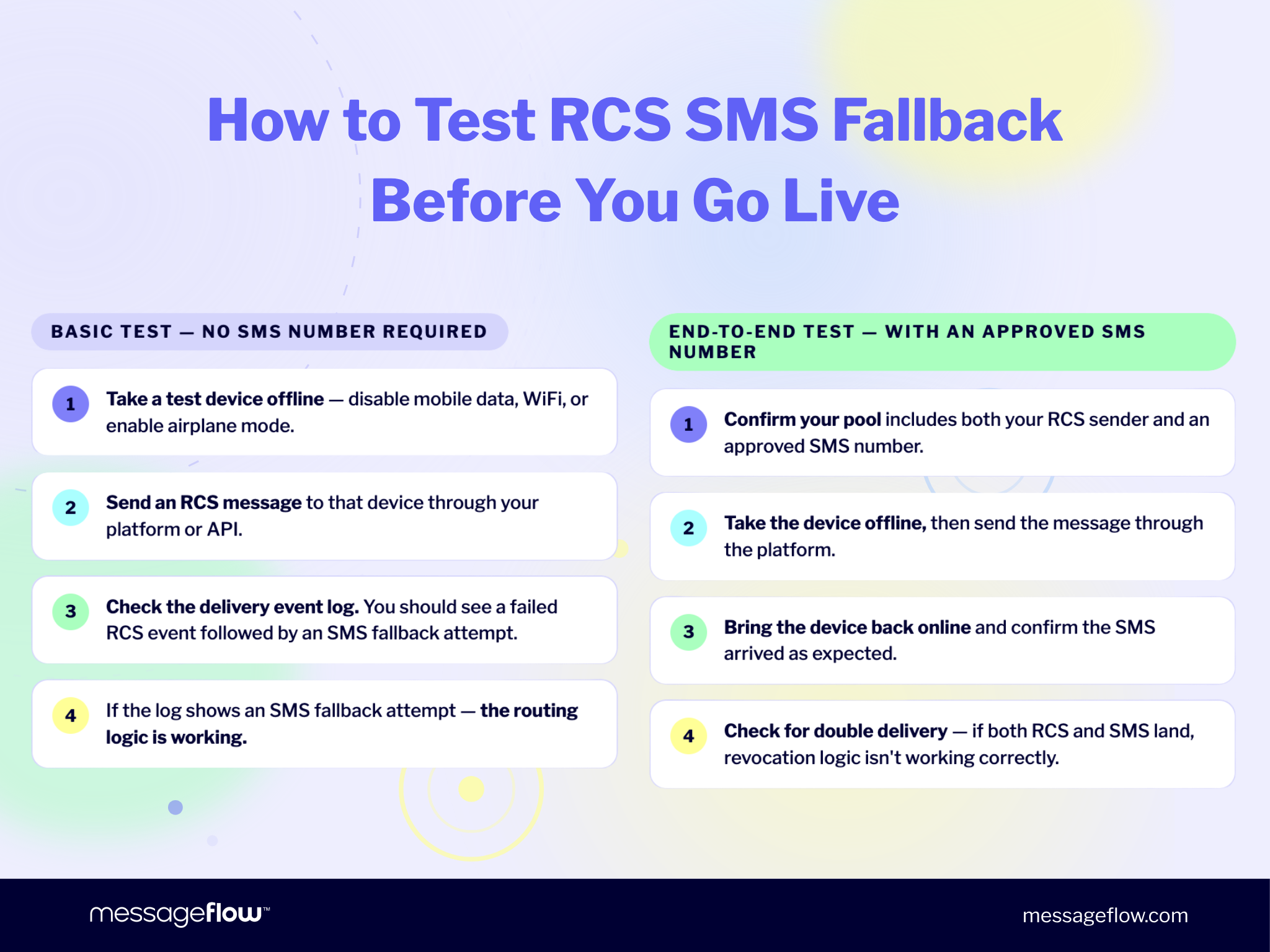
One important thing to verify during testing: confirm that the platform revokes the original RCS message before the SMS fallback sends. Bring the test device back online immediately after triggering fallback and check whether two messages arrive.
If both an RCS and an SMS version land, the revocation logic isn’t working correctly and you risk double-sending to real recipients.
Also worth checking: what happens to the message content during fallback. Buttons and images won’t appear in the SMS version. Make sure your fallback content version is configured and that URLs replace any interactive elements cleanly.
Conclusion: RCS fallback to SMS & MMS
RCS fallback to SMS is the answer to the question every marketer should ask before their first RCS campaign: “What happens to the people who can’t receive it?”
They still get your message. Via SMS (or MMS, if you configure it). With the same core information, the same call to action, and no extra cost.
💡 RCS is a technology that offers far more capabilities than traditional SMS. However, whether a message actually reaches its recipient depends on many different factors. The more elements involved in deliverability, the greater the risk that something along the way disrupts delivery.
We can’t afford that – these are often critical transactional messages, such as OTP codes, that recipients need right now. That’s why fallback acts as a safety guarantee: even when something unexpected goes wrong, the message will still get through.
Piotr Kudzior, Product Manager – Conversational Messaging, MessageFlow
Three things to remember:
- Fallback is not optional. RCS coverage is still growing. SMS is still where a meaningful portion of your audience lives. Build your RCS SMS fallback strategy from day one.
- You need two content versions. One rich, one lean. Both focused on the same outcome.
- Platform choice matters. Not all providers have the same carrier depth or configuration options. Direct carrier relationships and a real-time RCS failover layer give you better reach and fewer missed deliveries.
MessageFlow makes this straightforward. RCS campaigns with automatic RCS SMS fallback are ready to configure directly in the platform. You prepare your two content versions, set up RCS for your business, and the routing is handled automatically from there.Explore how RCS fits into a broader mobile messaging strategy and see how to bring all your channels together under one platform.
Frequently asked questions: RCS fallback to SMS
RCS fallback to SMS is a delivery mechanism that automatically sends your message as a standard SMS when RCS delivery isn’t possible. It fires when the recipient’s device doesn’t support RCS, their carrier hasn’t enabled it, or there’s no internet connection at the time of delivery. The result: every contact on your list receives your message, even if they can’t receive the full RCS experience.
Most major CPaaS platforms support RCS fallback to SMS. For person-to-person messaging, Google Messages RCS fallback to SMS is built in automatically. For business messaging, CPaaS such as MessageFlow usually offer automatic SMS fallback with varying levels of configuration, carrier coverage, and reporting. The right choice depends on your region, integration requirements, and whether you need a no-code panel or a developer API.
RCS fallback to SMS conditions include: the recipient’s device doesn’t support RCS, the carrier hasn’t enabled RCS, RCS chat is turned off in the device settings, there’s no mobile data or WiFi connection, the phone is off or out of range, or the delivery timeout expires. Most platforms run a pre-send lookup to identify which numbers are RCS-capable and route the rest directly to SMS.
Yes – the same “if it didn’t reach them, try a different way” logic is offered by the Message Booster feature available in MessageFlow for email, SMS, and push campaigns. Just like RCS fallback automatically switches a message to SMS when the rich channel isn’t available, Message Booster automatically triggers a follow-up when a recipient hasn’t engaged with the first message.
The difference lies in the condition: with RCS, it’s the device’s technical capabilities that decide; with Booster, it’s the recipient’s actual behaviour (no open, no click). The outcome is similar either way: communication reaches the recipient even when the first touchpoint didn’t work – without manually building segments or any technical integration required.
Example scenario: an email campaign with a limited-time offer → recipient hasn’t opened it within 24 hours → automatic SMS reminder sent exclusively to unengaged contacts.
No. Billing follows the channel that successfully delivers the message. If RCS delivers, you pay the RCS rate. If SMS delivers, you pay the SMS rate. There’s no double charge. A delivery report after each send shows which contacts received which channel.
Interactive buttons and images can’t be included in standard SMS. When a message falls back, rich elements are stripped. Buttons should be replaced with URLs in the SMS fallback version. Images can be preserved if you configure MMS fallback instead of SMS.
It’s essential to prepare two content versions for every RCS campaign: one rich version for RCS and one simplified version for SMS or MMS, both pointing toward the same business outcome.
RCS SMS fallback is a pre-send mechanism: before your campaign fires, the platform runs a lookup to identify which numbers can’t receive RCS and routes them directly to SMS. RCS failover is a real-time mechanism: it catches the small percentage of numbers that passed the lookup but still failed to receive RCS at delivery time, because a phone went offline or a network issue occurred. Fallback protects delivery before the send. Failover protects it during and after. You need both for complete coverage.