
When choosing an RCS platform for your business, start by checking whether it can reach recipients in your target markets and how it handles messages that cannot be delivered via RCS. These two factors determine who your campaign can reach and when SMS fallback will be needed. Then compare campaign builders, automation features, and messaging billing models.
Differences between providers also affect your team’s day-to-day work. Marketers need a tool to create content, plan campaigns, and evaluate results. Your IT team may primarily be looking for an RCS API that connects messaging with the systems already in use. More broadly, businesses need ways to incorporate RCS into their existing communication workflows and make use of the customer data they already hold.
In this comparison, we assess seven providers based on RCS availability, SMS fallback support, campaign creation, integrations, reporting, and costs. We consider the needs of businesses operating in Poland and other European markets. For each platform, we highlight its strongest use cases and identify limitations worth checking before implementation.
Our assessment is based on the platforms’ documented capabilities. Where availability depends on the country, selected product, or contract terms, we make that clear.
What is RCS Business Messaging?
RCS Business Messaging (RBM) allows businesses to send multimedia and interactive messages to customers in the same native messaging app they use for SMS. Brands use a verified sender profile featuring their name, logo, and other details, and can include images, GIFs, product cards, carousels, and action buttons in their messages. Recipients can browse offers and reply without installing an additional app.
For example, a retailer can display several products in a single carousel, add a button to each product that takes customers to the purchase page, and use suggested replies to ask which category they prefer.
However, the scope of such a campaign depends on the features available from the provider. Offering RCS does not necessarily mean the platform lets marketers build an entire communication flow themselves through its interface.
RCS vs. SMS: What changes for your business?
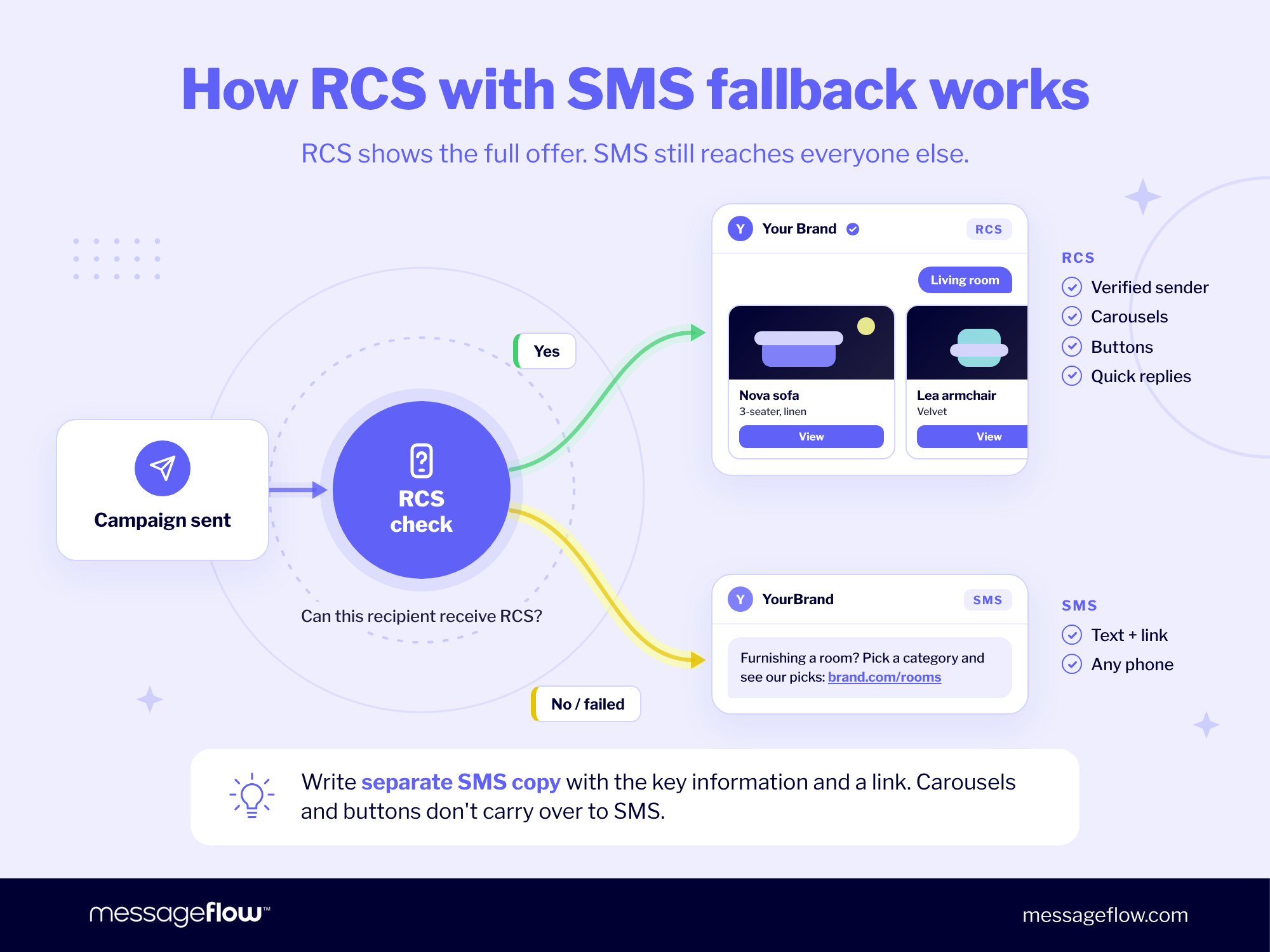
SMS supports text and links, works on any mobile phone, and does not require an internet connection. RCS offers more ways to showcase your products and engage customers, but requires internet access and support from the recipient’s device, messaging app, and mobile carrier. RCS availability therefore needs to be assessed for specific audiences and markets.
The two channels can complement each other within a campaign. RCS presents your offer in a richer format, while SMS fallback provides another way to attempt delivery to recipients whose RCS messages could not be delivered. The fallback SMS needs its own carefully prepared copy that preserves the message’s meaning without multimedia.
We explain the differences in detail in our RCS vs. SMS comparison.
What should you look for when choosing an RCS provider?
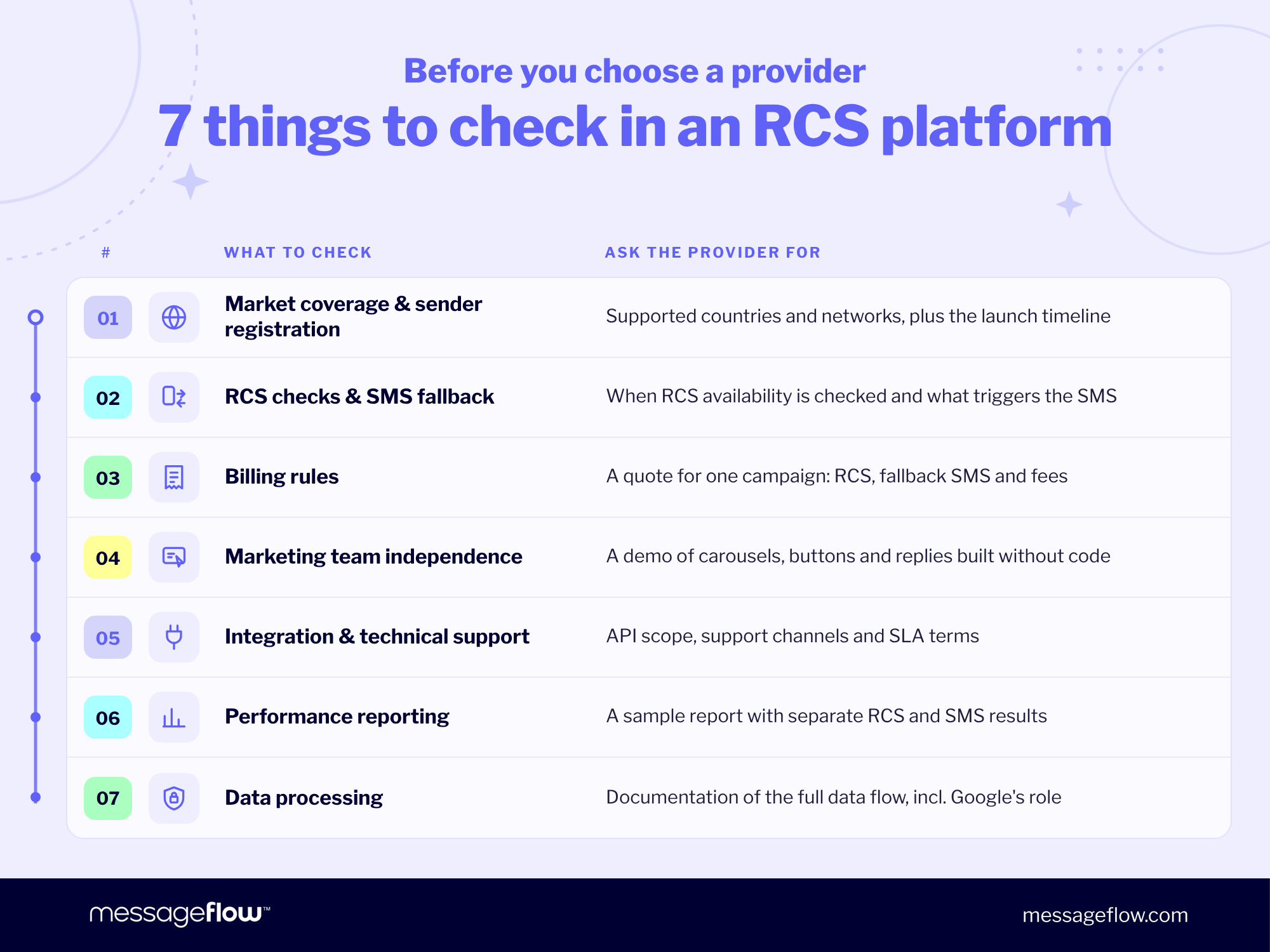
Compare providers using a campaign you actually intend to run. Ask each one to demonstrate the same workflow: preparing a message, sending it via RCS with SMS fallback, and reporting on the results. This will show you which tasks your marketing team can handle independently, where IT support is needed, and what comes at an additional cost.
1. Availability in your target markets and sender registration. Check which countries, networks, and devices each provider supports. Clarify who handles verification of your brand profile, what materials you need to supply, and which factors affect the launch timeline.
2. RCS capability checks and SMS fallback. Ask whether the platform can check recipients’ ability to receive RCS before a campaign is sent, and how it handles delivery failures. Confirm whether it checks RCS availability for each recipient before sending or attempts delivery first and only triggers SMS fallback if that attempt fails. Checking RCS availability in advance also helps you estimate the campaign budget more accurately: you can forecast the proportion of RCS messages and fallback SMS messages, then calculate their costs using the agreed rates.
3. Billing rules. Request a quote for a single campaign scenario covering messages delivered via RCS, messages sent via SMS fallback, and undelivered messages. The RCS platform provider should clearly explain which events incur charges and whether there are additional fees for a subscription, sender activation, or access to the campaign builder.
4. Marketing team independence. Check how the platform handles the creation of carousels, buttons, personalized content, and replies. “No-code tools” can mean very different things: anything from a simple editor for individual messages to an advanced RCS campaign builder that lets you plan subsequent communication steps based on the recipient’s response.
5. Integration and technical support. Verify whether the API lets you launch campaigns and pass message statuses and recipient responses back to your system. Clarify the scope of implementation support, available support channels, and service-level agreement (SLA) terms.
6. Performance reporting. Ask for a sample report with separate breakdowns for RCS and SMS. Check whether you can distinguish between deliveries, reads, and interactions, and export the data for your own analysis. Confirm whether each metric is calculated using sent, delivered, or read messages as its base. Compare results calculated on the same basis.
7. Data processing. Check where and by whom data is processed within the specific RCS service. In solutions based on RCS Business Messaging, Google participates in message transmission and processing, so the location of the provider’s servers alone does not give you the full picture. Request documentation covering the entire data flow, including the involvement of Google and other parties, processing locations, and retention periods.
RCS platforms for business compared
The table below will help you shortlist providers for further discussion. It outlines use cases, campaign creation tools, and fallback support. Product names matter: a provider’s campaign builder, API, and automation features may be offered as separate products. Check which features are included in the offering you are considering.
As of October 2026. Feature availability depends on the market, configuration, and selected plan.
| Platform | Who should consider it | SMS fallback | Message and campaign creation | Other channels offered* |
|---|---|---|---|---|
| MessageFlow | Businesses looking for an RCS campaign interface, coverage in Poland and international markets, and multichannel integration | Built into RCS Flow Studio | No-code RCS Flow Studio; RCS API available separately | SMS, email, mobile push, WhatsApp, Viber |
| Infobip | Organizations communicating with customers across multiple markets | Available in Broadcast, Moments, and other products | Broadcast for campaigns, Moments for workflows, Answers for conversations | SMS, email, WhatsApp, Viber, push |
| Sinch | Businesses that need to run campaigns through a platform interface or integrate multiple channels | Available in Engage and Conversation API | Campaign builder in Engage; integrations through Conversation API | SMS, WhatsApp, Viber, email through Mailgun and Mailjet |
| Twilio | Teams building messaging capabilities into their own systems | Automatic once Messaging Service is configured | Content Template Builder, visual workflows in Studio, and APIs | SMS, WhatsApp, email through SendGrid |
| Vonage | Businesses integrating RCS into their existing environment through an API | Configurable in Messages API | Messages API; additional tools depend on the solution | SMS, WhatsApp, Viber, Messenger |
| Braze | Brands using customer data in advanced marketing workflows | Available for RCS | Message editor and Canvas workflows | SMS, email, push, in-app, WhatsApp |
| LINK Mobility | Businesses looking to reach European markets through a platform interface or API | Available in MyLINK Studio and other products | MyLINK Studio visual builder and APIs | SMS, email, WhatsApp, Viber |
Other channels may require separate activation, products, or contracts. Their availability does not imply a shared builder or unified reporting.
💡 Planning your first RCS campaign? Talk to us about preparing your message content and setting up fallback in case delivery fails.
7 RCS providers: Capabilities, use cases, and limitations
At a glance: Consider MessageFlow if your marketing team wants to create campaigns in RCS Flow Studio and use SMS fallback. For API-based implementations, also compare Twilio, Sinch, and Infobip. Businesses already using Braze or LINK Mobility should check RCS availability within their current plan and target markets. Base your final choice on supported countries, campaign creation tools, fallback rules, and total cost.
1. MessageFlow: RCS campaigns for businesses operating in Poland and Europe
Consider MessageFlow if your marketing team wants to create interactive RCS campaigns independently and use SMS as a fallback channel. RCS Flow Studio lets you visually arrange messages and conversation steps, reducing the need for developer involvement when changing content or campaign flows.
What does it offer your marketing team?
- No-code workflow creation. The builder lets you combine product cards, carousels, and action buttons, then tailor subsequent messages to the customer’s choices. You can also send a test message to review the content before launching your campaign.
- RCS → SMS fallback. If an RCS message cannot be delivered, the system can send a fallback SMS. This allows your marketing team to also prepare a message for recipients who cannot receive the multimedia version.
- Sender registration support. MessageFlow helps you register your brand and configure the verified sender profile you will use to communicate with customers.
Example use case: A home furnishings retailer starts a campaign by asking which room the customer wants to furnish. After selecting “Living room,” the recipient receives a carousel of relevant products with buttons linking to the store. If the first RCS message cannot be delivered, they receive an SMS linking to a page where they can choose the category they are interested in.
What should you consider before choosing? Fallback is built into RCS Flow Studio and can be enabled with one click. For messages sent through the API, delivery failure handling needs to be agreed separately. Access to a dedicated account manager and technical support by phone depends on the selected plan.
Best fit: A business that wants to manage RCS campaigns and conversations through a platform interface while also using other channels from the same provider.
Explore RCS capabilities and request a Flow Studio demo based on your own campaign.
2. Infobip: RCS for international customer communications
Consider Infobip if you want to use RCS for marketing campaigns, automated notifications, and customer conversations across several markets. The provider offers APIs and tools for business teams, allowing you to tailor the implementation to your specific use case.
What does it offer your marketing team?
- Campaigns through a platform interface. Broadcast lets you prepare one-off campaigns with product cards, carousels, and buttons, and configure a fallback SMS message.
- Automation and conversation management. Moments is used to build communication workflows, while Answers lets you create no-code chatbots. This allows you to move from a standalone campaign to interactions shaped by the customer’s responses.
- Integration with your own systems. The API lets you connect messaging with processes in your app or online store. This is useful when a message needs to be triggered by a specific event, such as an order status change.
Example use case: A travel agency sends a carousel of holiday destinations. Once the customer selects an offer, it guides them through questions about travel dates and the number of travelers. This workflow requires a tool that supports conversations; a Broadcast campaign is sufficient if the goal is simply to showcase offers.
What should you consider before choosing? RCS features vary across Infobip modules, markets, and carriers. Identify the formats and workflows you need in advance, then confirm their availability and the total cost of the required services. Access to the RCS API does not automatically include access to all marketing tools.
Best fit: An organization with several RCS use cases and the resources to connect messaging with its business data and processes.
3. Sinch: Campaigns through a platform interface or messaging via API
Sinch offers two approaches to implementing RCS: campaigns created in Sinch Engage and integration through Conversation API. The choice depends on whether messaging is primarily managed by your marketing team or driven by your own business systems.
What does it offer your marketing team?
- Campaign builder in Engage. Create an RCS message with cards, carousels, and buttons, alongside an SMS or MMS version for fallback.
- Use of product data. With a suitable e-commerce integration, such as Shopify or BigCommerce, products from your store can be used to populate carousels.
- Flexible integration. Conversation API supports RCS and other channels and lets you configure the order in which delivery is attempted across them. This allows your technical team to adapt messaging to your business processes.
Example use case: A retailer creates a campaign in Engage featuring a carousel of new arrivals drawn from its product catalog. For recipients who cannot receive RCS, it configures an SMS linking to the collection.
What should you consider before choosing? Engage and Conversation API have separate feature sets and terms of use. Engage currently supports RCS agents billed per message, including for two-way communication. You should therefore not assume that an entire customer conversation will be covered by a single session fee.
Best fit: A business that wants to match its approach to RCS to its team’s capabilities, either using a ready-made interface or building an API integration.
4. Twilio: RCS for teams building their own solutions
Twilio suits businesses that want to add RCS to messaging managed through their own application or system. The channel is available within Programmable Messaging, making it easier to add for organizations already using this API to send SMS.
What does it offer your marketing team?
- Visual content creation. Content Template Builder lets you create message templates, including RCS cards and carousels, so preparing content does not require writing code every time.
- Workflow creation in Studio. The visual editor helps you arrange communication steps. Connecting them to your business data and processes still requires the appropriate configuration.
- RCS capability checks and fallback. Once Messaging Service is configured, the platform checks the recipient’s messaging capabilities and handles SMS or MMS fallback. You can also prepare separate content for the fallback channel.
Example use case: A logistics company sends a shipment notification from its own system. The RCS message includes a tracking button, while the SMS version provides the status and a text link.
What should you consider before choosing? Visual editors do not eliminate the work involved in integration, event handling, and ongoing maintenance. Studio is also billed separately, so the cost of a workflow includes both messaging and use of the tool.
Best fit: A business with its own technical team, particularly one already using Twilio that wants to extend its existing messaging with RCS.
5. Vonage: RCS within existing customer service processes
Consider Vonage if you want RCS messages to be triggered by events in your business systems, such as an appointment booking, an order change, or a service request. Messages API supports RCS alongside SMS, WhatsApp, and Viber, which may be particularly useful for organizations already using this provider’s services.
What does it offer your marketing and customer service teams?
- Messaging connected to business processes. Once integrated, your system can send messages in response to events without requiring each send to be prepared manually.
- Configurable fallback channel sequence. Messages API lets you configure successive delivery attempts, such as sending an SMS after an RCS delivery failure, and prepare separate content for each channel.
- Delivery status updates. The API provides statuses for successive attempts, allowing your system to record which channel ultimately delivered the message.
Example use case: An automotive service chain sends an appointment confirmation with a button linking to the booking details. If RCS delivery fails, the system sends an SMS with the appointment date, time, and relevant link.
What should you consider before choosing? Implementing Messages API requires planning the integration and message status handling. If your marketing team needs to plan campaigns independently, confirm separately whether the proposed solution includes a campaign interface and workflow creation tools.
Best fit: A business that wants to expand messaging from its own systems and has a team responsible for the integration.
6. Braze: RCS workflows powered by customer data
Consider Braze if you want to tailor RCS messaging to customer behavior, preferences, and interaction history. The channel forms part of a broader marketing platform, making it particularly relevant to organizations already using Braze for segmentation and automation.
What does it offer your marketing team?
- Personalization based on customer data. Messages can include product recommendations, promotional offers, or loyalty points balances, provided the relevant data is available in the platform.
- Conversation design in Canvas. The visual builder lets you arrange messages and replies based on recipients’ choices and incorporate RCS into broader communication workflows.
- Engagement measurement. Read and click data helps you assess which content prompts recipients to act. SMS fallback is also available.
Example use case: A brand running a loyalty program sends customers in Germany a personalized message about an available reward. The recipient selects their preferred option, and subsequent messaging reflects that response.
What should you consider before choosing? As of September 2026, Poland is not listed among the countries where Braze offers RCS. Activating the channel also requires the appropriate contractual coverage and credits. For a business that only needs standalone campaigns, purchasing the entire platform may involve a broader implementation than the task requires.
Best fit: A brand already using Braze that wants to extend its automation workflows with RCS in supported international markets.
7. LINK Mobility: RCS across European markets
Consider LINK Mobility if you are looking for an RCS provider serving European countries. Its offering includes API integrations and visual tools, including MyLINK Studio for creating messages and managing sends.
What does it offer your marketing team?
- No-code campaign creation. MyLINK Studio lets you design messages, save templates, and schedule sends, allowing your team to reuse existing content.
- Connecting content with your CRM. Templates can support both regular campaigns and messaging triggered by connected systems. The scope of integration depends on the solution used.
- Fallback and reporting. Studio lets you configure a fallback channel and track delivery and engagement at both campaign and message level.
Implementation example: According to LINK Mobility, DHL Express launched RCS in Germany with the provider. The messages use a verified brand profile and interactive delivery options. This illustrates how RCS can support shipment management while making it easier for recipients to recognize the sender.
What should you consider before choosing? Confirm which LINK Mobility product is available in each country and which features the offering includes. MyLINK Studio’s availability in one market does not mean the same service scope is available in all others.
Best fit: A business communicating across several European markets that needs both campaign tools and integrations with its own systems.
Which campaigns can benefit from RCS?
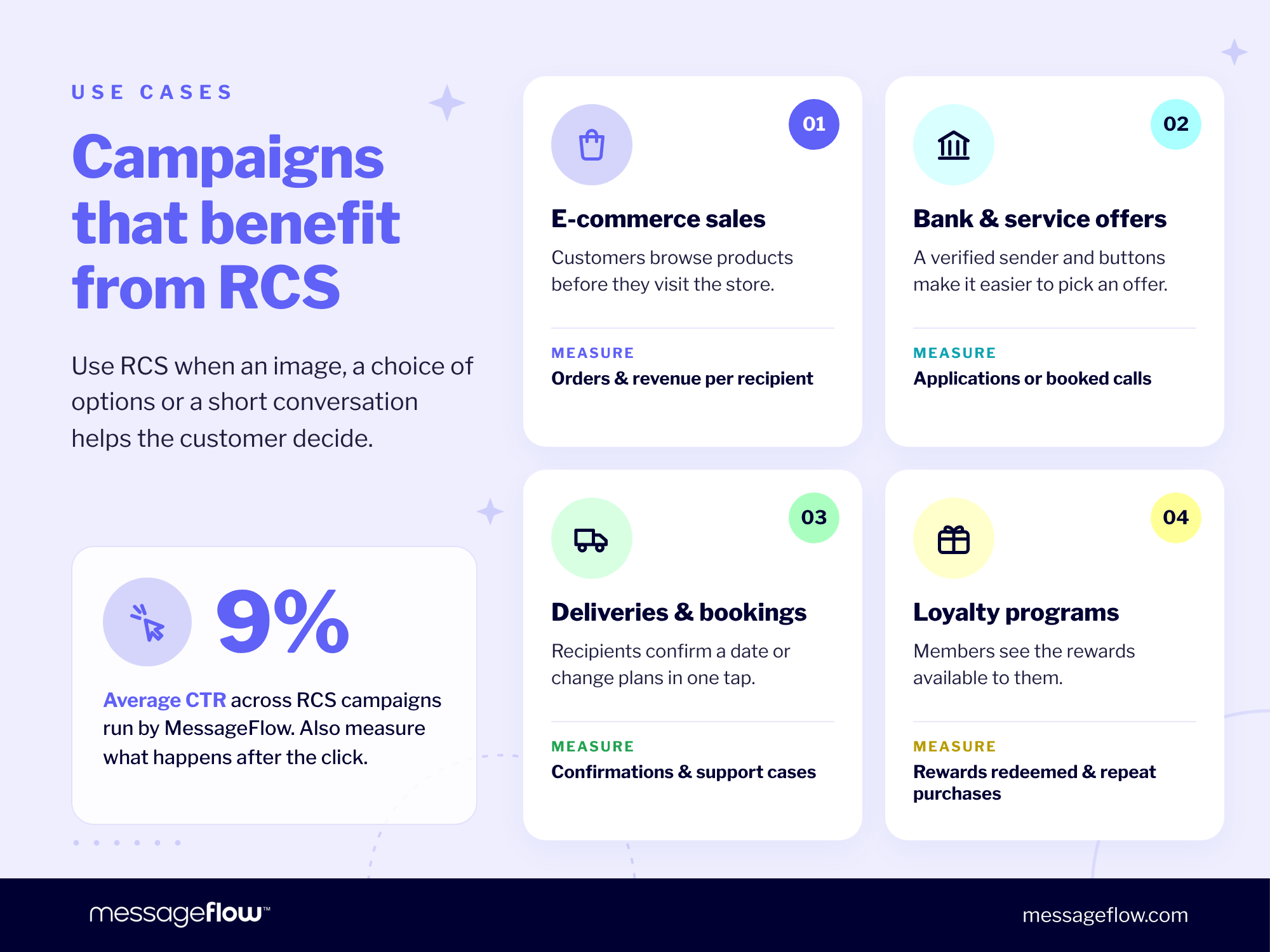
Choose RCS when an image, a choice of options, or a short conversation helps the customer make a decision. A well-designed workflow gives recipients a tangible benefit: easier product comparisons, a more relevant offer, or a way to resolve an issue in just a few steps. That goal determines which features you should look for in a provider.
| Use case | What does RCS add? | Which features do you need? | What should you measure? |
|---|---|---|---|
| E-commerce sales | Lets customers browse products before visiting the store | Carousels, personalization, and links to specific products | Orders and revenue per recipient |
| Offers for existing customers of banks or service providers | Makes it easier to recognize the sender and select a relevant offer | Verified profile, buttons, and reply handling | Completed applications or scheduled calls |
| Deliveries and bookings | Helps recipients confirm a date or access options to change arrangements | Integration with operational systems, buttons, and fallback | Confirmations and the number of cases requiring customer support |
| Loyalty programs | Shows available benefits based on member data | Personalization, integration with the loyalty program database, and up-to-date data | Rewards redeemed and repeat purchases |
Across RCS campaigns run by MessageFlow, we observed an average CTR of 9%. This can serve as a benchmark, but your pilot evaluation should also consider what happens after the click. A sales campaign should lead to orders, while an appointment reminder should lead to confirmations.
How do you choose a platform for RCS campaigns?
Narrow your shortlist to two or three providers that support your market and suit the way your team works. Then plan a pilot with a single objective, a defined budget, and a measurable outcome. This test will reveal both how recipients respond and how much work future campaigns will require.
If you already use a marketing platform that offers RCS, check the cost of adding it to your existing setup. If your messaging will mainly be triggered by events in your own systems, such as a CRM, API integration will matter more. A team running campaigns independently should test the entire process through the platform interface, from content creation to results analysis.
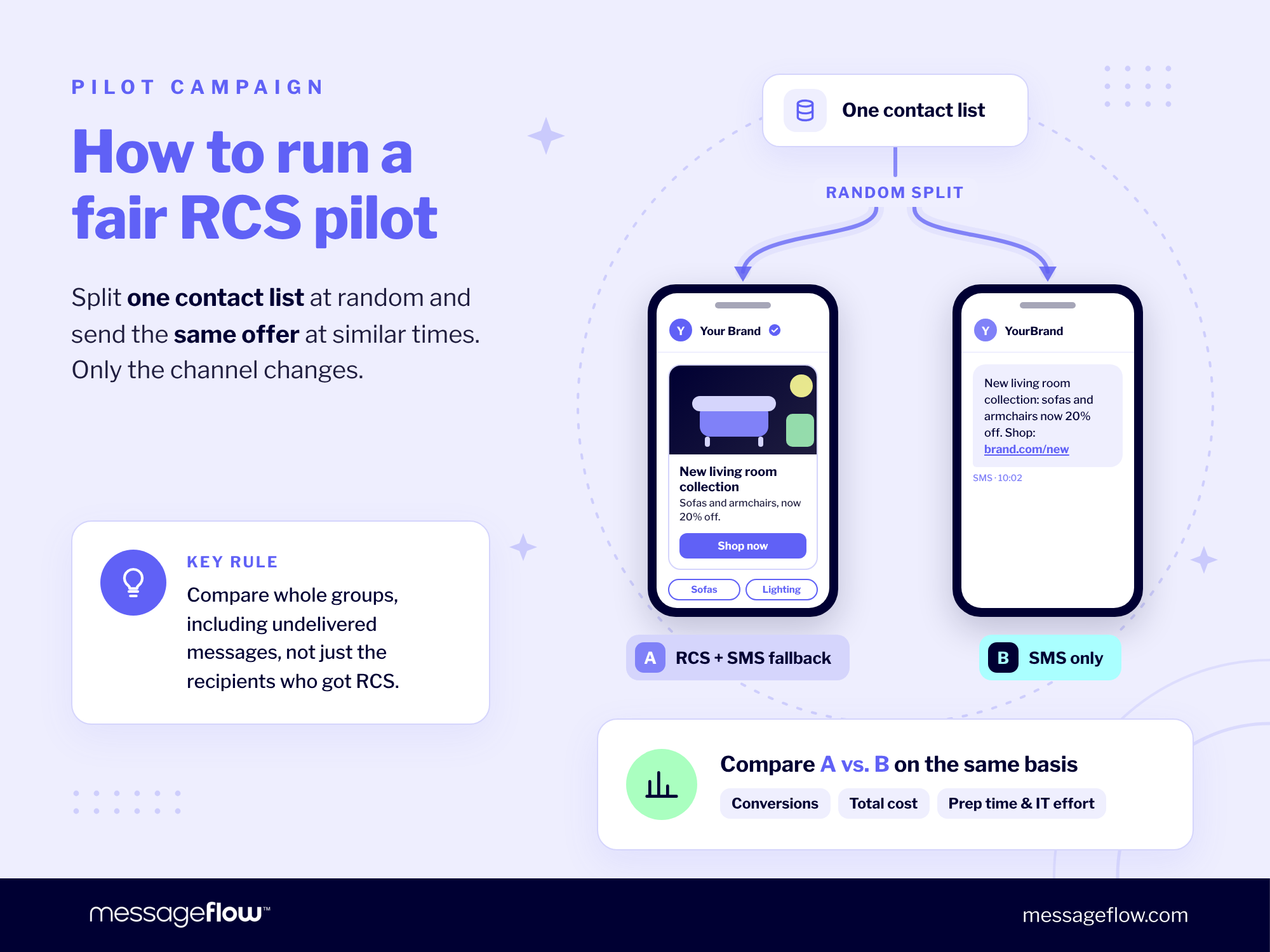
Design your pilot so you can meaningfully compare results. Randomly divide recipients from the same contact database into two groups: send RCS with SMS fallback to one and SMS to the other. Use the same offer and similar send times. Compare results across the entire groups, including recipients whose messages were not delivered. Comparing only those who received RCS with the remaining SMS recipients could reflect differences between the groups rather than the effect of the channel.
Alongside conversions and costs, record the time spent preparing the campaign, the level of IT involvement, and any issues that required the provider’s support. This will help you assess whether your team can use the chosen solution regularly.
Want to test RCS with MessageFlow? RCS Flow Studio’s drag-and-drop builder lets you create advanced workflows, connect them to your CRM or product feed, and incorporate other channels, such as email. Bring your campaign objective, target market, and an example offer. We will use these to demonstrate the builder’s capabilities and discuss SMS fallback and launch requirements. Plan your pilot.
RCS for business: Frequently asked questions
An RCS provider is a company that enables brands to send RCS Business Messaging messages through a platform interface or API. Depending on its offering, it may also help with brand verification, sender registration, campaign creation, and results analysis.
RCS is available to Play, T-Mobile, and Orange subscribers, although availability still depends on the device and service configuration. Support for RCS chat does not automatically mean a user can receive your brand’s campaign. Before sending, ask your provider to confirm RCS Business Messaging availability on the relevant networks and that your sender has been activated on each one.
The message can be sent via SMS if fallback is configured for the campaign. Prepare a separate text version with the key information and a link, since SMS cannot retain RCS carousels or interactive buttons. Also confirm what triggers fallback, how long it takes to activate, and how it is billed.
There is no single rate shared by all providers. Costs depend on factors such as the recipients’ country, message type, volume, and billing model. Include any platform and implementation fees, as well as charges for fallback SMS messages. Compare quotes for the same campaign scenario and the same number of recipients.
The timeline depends on brand verification, sender approval in your chosen markets, and the scope of implementation work. Preparing content in the builder is only part of the process: messages and sending configurations also need to be tested before launch. Ask your RCS provider for a timeline that separately accounts for sender approval, integration, and testing the first campaign.