
Black Friday rewards scale, but email deliverability punishes careless changes in scale. When sending volume and frequency rise within days, weaknesses that barely affect routine campaigns can quickly damage email sender reputation and push time-sensitive offers away from the inbox.
Peak season rarely creates these problems from thin air. It exposes what was already there: dormant contacts brought back for one more promotion, an IP address or domain with no history at the planned volume, incomplete authentication, excessive campaign frequency, or performance reports that hide problems at individual mailbox providers.
Mailbox providers do not make exceptions because a campaign is commercially important. They continue evaluating sending patterns, list quality, and recipient responses while inboxes become more crowded and marketers take greater risks to extend their reach.
In this playbook on Black Friday email deliverability, I explain how to prepare for the peak seaoson and protect holiday email deliverability without sacrificing the reputation built throughout the year. I covers the four risks most likely to surface under peak volume, the warning signs worth monitoring daily, and the actions to take before, during, and after the busiest campaigns.
Why Black Friday puts email deliverability under pressure
A typical Black Friday email campaign changes several parts of a sender’s behaviour at once:
- Volume rises sharply. A domain or IP address may send several times its usual daily volume.
- The audience expands. Teams often reach beyond recently active subscribers to maximise the campaign’s potential.
- Frequency increases. Recipients who normally hear from a brand once a week may receive several messages within a few days.
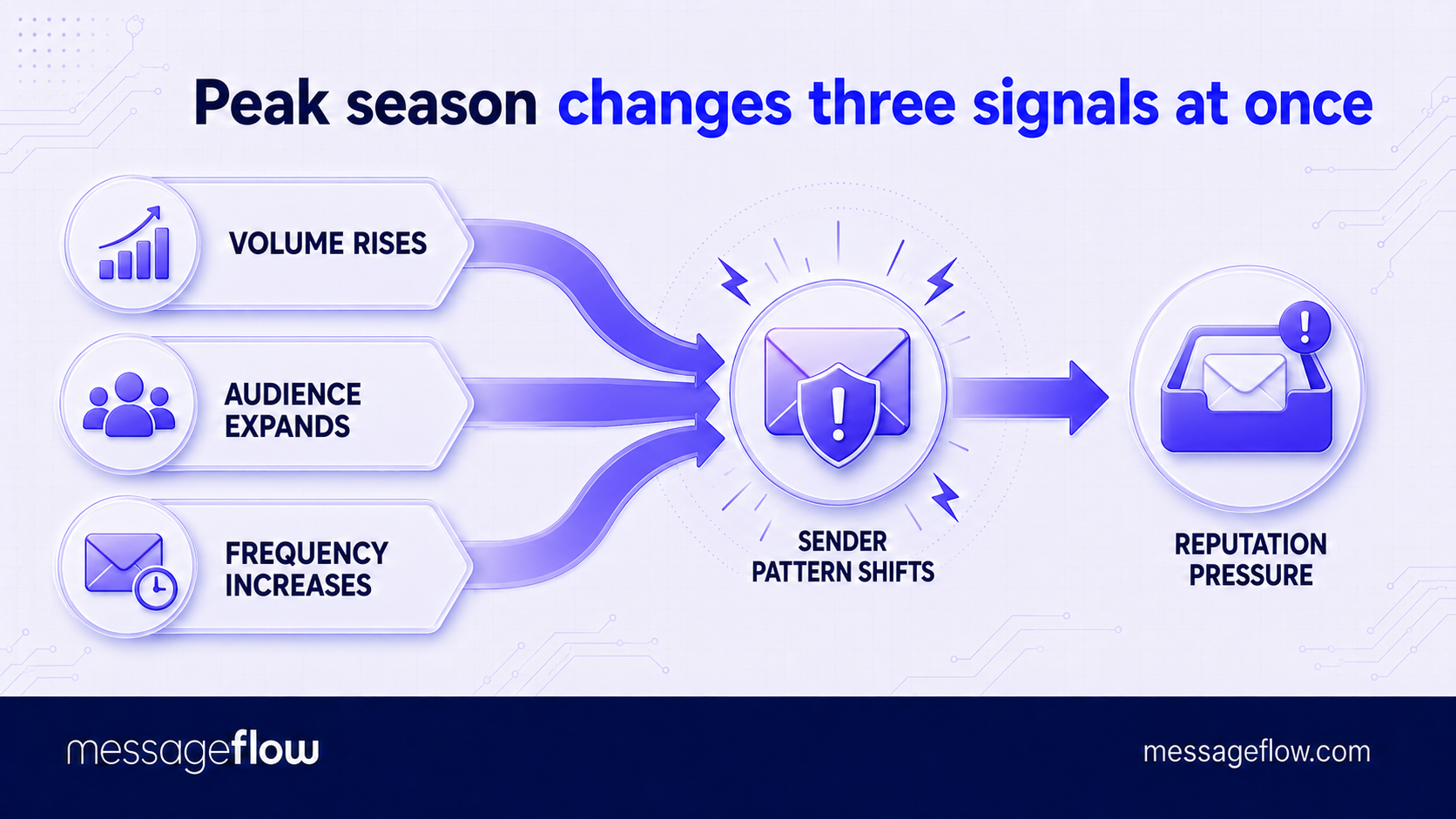
Mailbox providers do not see the commercial reasoning behind these decisions. They see a sender departing from its established pattern and measure how recipients respond. If the larger audience produces more bounces, spam complaints or disengagement, those signals can affect subsequent messages while the campaign is still running.
💡 This does not necessarily mean that mailbox providers manually tighten their filters for Black Friday. The pressure comes from the combination of unusual sending behaviour and a less receptive audience. Inboxes are crowded, subscribers receive more promotions than usual, and campaigns have less room for weak targeting or excessive frequency.
The scale also makes small weaknesses consequential. A slightly outdated list might produce an acceptable number of bounces during an ordinary week but generate hundreds or thousands when campaign volume multiplies. The same applies to complaints: a modest increase in the rate can create a large amount of negative feedback within hours.
What an ESP can see that an individual sender cannot
A company can analyse its own campaigns, but an email service provider sees recurring patterns across many senders and mailing streams. This broader view shows how peak-season problems tend to develop:
- Dormant or poorly verified contacts generate disproportionate numbers of hard bounces, complaints, and spam-trap hits.
- Sudden increases from IP addresses or domains without comparable sending history are more likely to encounter throttling or delayed delivery.
- A reputation decline early in the promotional period can continue affecting inbox placement during later, more valuable campaigns.
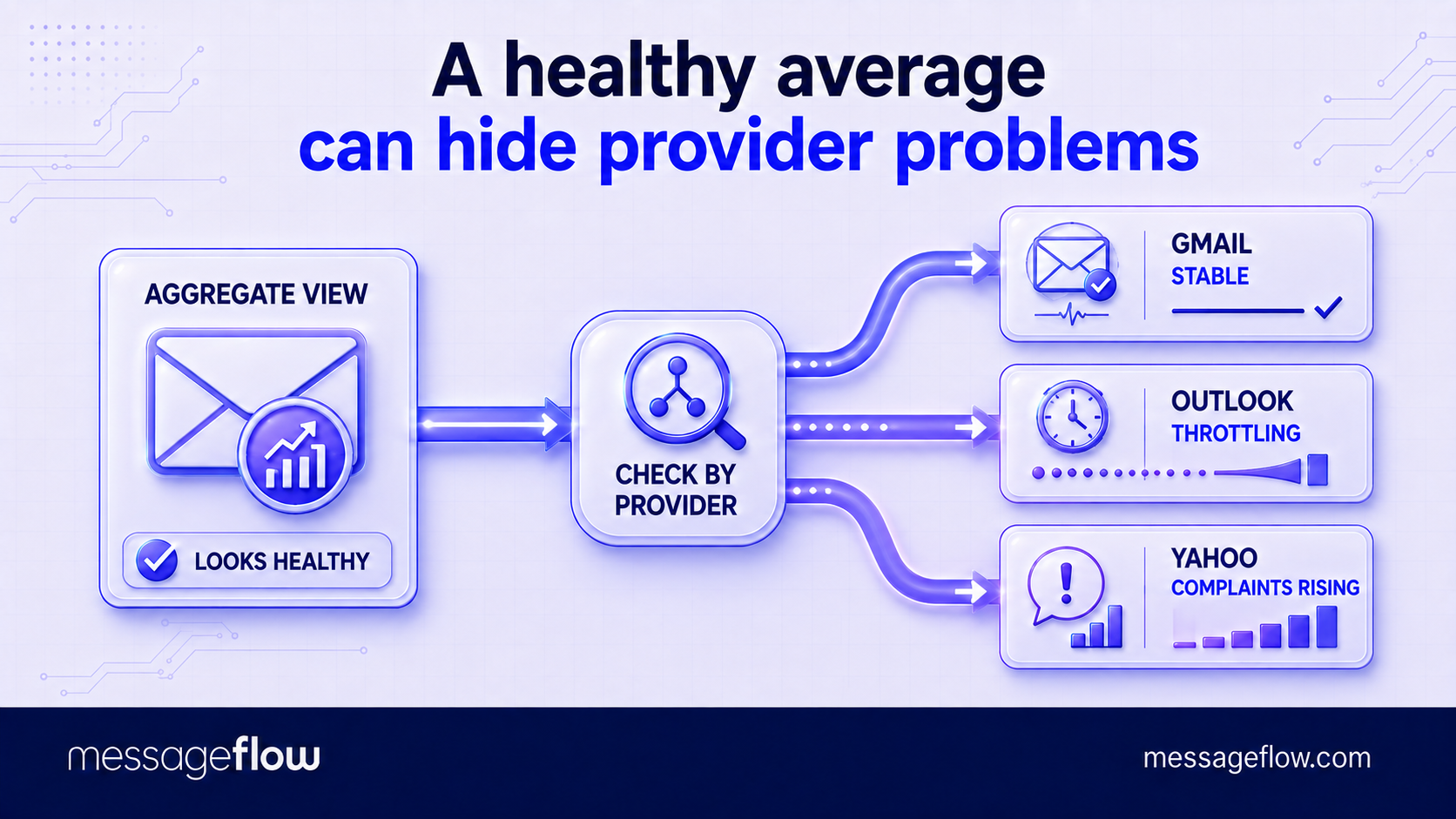
- Provider-specific problems can disappear inside a healthy aggregate delivery rate. Strong Gmail performance, for example, may conceal deteriorating results at Outlook or Yahoo.
💡 The main risk is therefore not one isolated mistake, but rather several manageable weaknesses surfacing together, at a volume that leaves little time to diagnose and correct them.
Four Black Friday email deliverability risks to address early
The highest-risk Black Friday decisions may look fairly reasonable from a campaign perspective: send more, reach further, and create more opportunities to convert. Deliverability deteriorates when you make those changes without accounting for sender history, audience quality, and infrastructure.
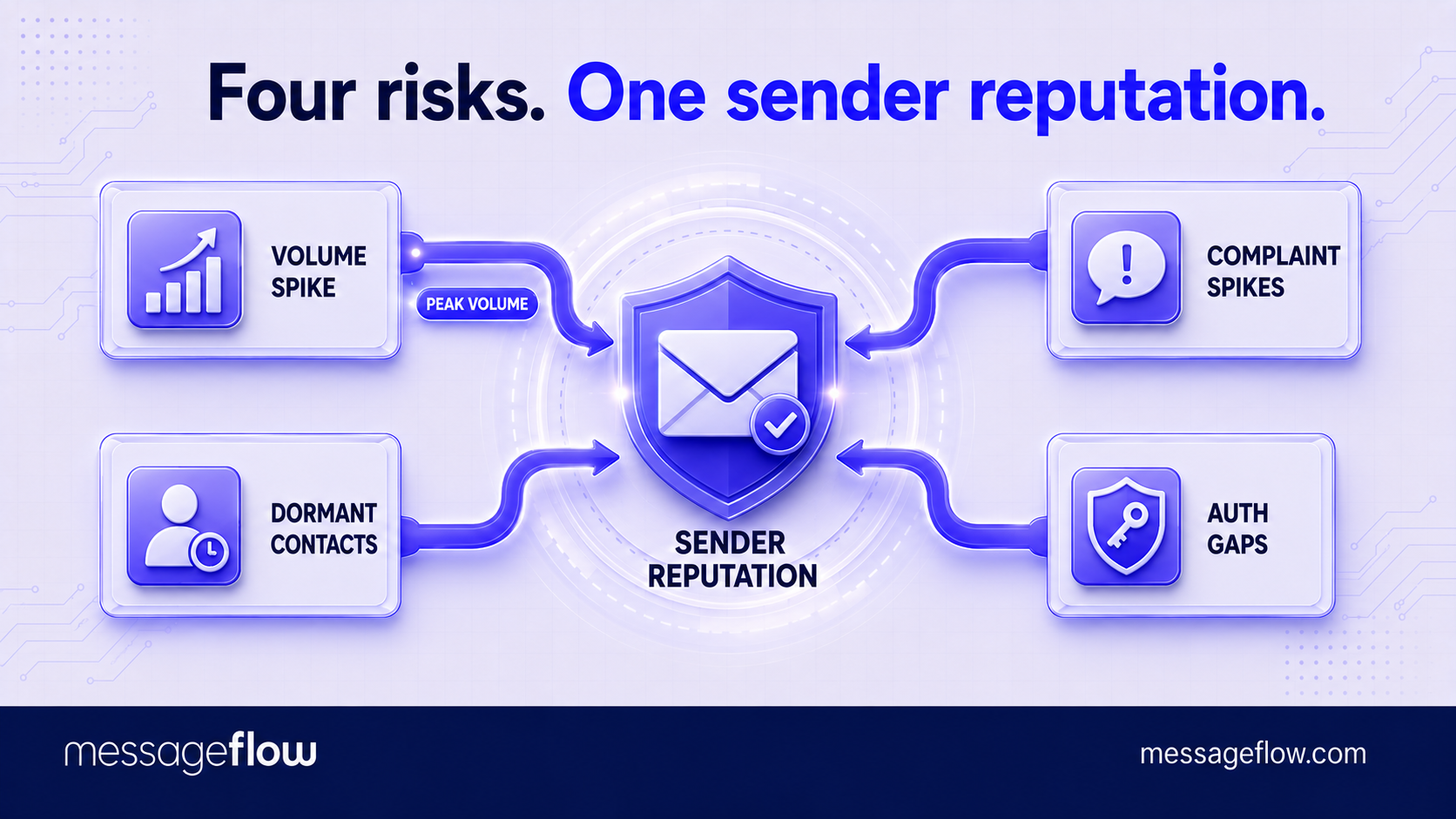
1. Sudden volume spikes
Mailbox providers build a picture of how each domain and IP address normally behaves. Moving from a stable daily volume to several times that amount overnight creates a pattern with little or no history behind it.
➡️ Plan expected volumes by day rather than estimating one total for the entire promotional period. If the campaign requires a substantial increase, raise volume gradually in the preceding weeks and begin with recently engaged subscribers. New domains and IP addresses need a deliberate email warm-up before Black Friday. The busiest week of the year is a poor time to establish their reputation.
Share the forecast with your ESP as well. This gives the provider time to confirm sending capacity, recommend an appropriate ramp-up schedule, and identify infrastructure changes before they become urgent.
2. Dormant and risky contacts
A large database is not automatically a large reachable audience. Addresses that have not opened, clicked or purchased for a long time are more likely to be abandoned, invalid or converted into spam traps. Their owners may also have forgotten subscribing, which increases the chance of a complaint.
➡️ Segment contacts by engagement recency well before the holiday season. If dormant email subscribers are worth recovering, run a separate re-engagement campaign before promotional volume begins. Contacts who do not respond should remain outside the main Black Friday audience.
Email validation can identify many invalid or high-risk addresses, but it cannot prove that a person still wants the messages. It also cannot turn a purchased or rented contact into a permission-based subscriber. Email list hygiene must account for both address validity and genuine recipient interest.
3. Higher frequency and complaint spikes
Black Friday email marketing often relies on higher sending frequency to generate additional revenue, but returns diminish once subscribers begin to feel overwhelmed. Generic promotions sent repeatedly to the full database make that point arrive sooner.
➡️ Set frequency limits at subscriber level, including campaigns triggered by different workflows. Adjust cadence according to engagement instead of exposing every segment to the same schedule. Preference options that let subscribers reduce or pause promotional emails can preserve the relationship without forcing them to choose between receiving everything and unsubscribing completely.
Content still matters, but checking for a list of supposed “spam-trigger words” is not a deliverability strategy. Mailbox providers evaluate a much broader set of technical, behavioural and reputation signals. Focus on accurate subject lines, recognisable sender identity, relevant offers, and a clear unsubscribe route – factors that directly influence how recipients respond.
4. Authentication and infrastructure gaps
Peak volume leaves little tolerance for a missing DNS record, failed domain alignment or an overlooked sending limit. SPF, DKIM ,and DMARC should therefore be configured, aligned, and tested through the actual production sending path, not merely present somewhere in DNS.
➡️ Authentication is now a baseline requirement for high-volume traffic. Current guidance from Gmail, Yahoo and Outlook also places clear emphasis on complaint control, sender identity, and accessible unsubscribing.
Teams should review throughput limits, queue and retry behaviour, domain alignment, feedback-loop access, and the reputation of their sending IPs with their ESP. They should also decide between shared and dedicated infrastructure early. A dedicated IP provides greater control, but it needs sufficient, consistent volume and active reputation management. A well-managed shared pool may be the better option for senders whose normal traffic cannot sustain that history.
What to monitor as Black Friday volume grows
Monitoring peak-season email deliverability requires answers to two separate questions: are receiving servers accepting the messages, and where do those messages go after acceptance? A high delivery rate answers only the first. It does not prove that emails reached the inbox rather than the spam folder.
Monitor the following signals at least daily during the highest-volume period:
| Signal | What it tells you | What should trigger investigation |
|---|---|---|
| Delivery & deferral rates | Whether receiving servers accept, temporarily delay or reject messages. | More temporary failures, slower delivery or a sudden increase in provider-specific rejections. |
| Inbox placement | Whether accepted emails reach the inbox or spam folder. | A decline for one mailbox provider, domain or campaign segment. |
| Email bounce rate | Whether messages are being rejected and whether hard bounces expose invalid, abandoned or poorly collected addresses. | A rise in hard bounces after adding older contacts or expanding the campaign audience. |
| Email complaint rate | How often recipients actively mark messages as spam. | Any sustained increase, especially as frequency rises. |
| Engagement | Whether recipients continue responding positively to the campaign. | Clicks and conversions falling below the sender’s usual baseline. |
| Spam-trap & blocklist alerts | Whether list acquisition, hygiene or sender reputation may require immediate attention. | A new trap hit or relevant listing during an active campaign. |
Open rates can provide directional information, but privacy features, image blocking, and automatic image loading make them less reliable in isolation. Combine them with clicks, conversions, unsubscribes, and complaint data.
Read trends by mailbox provider, not only in aggregate
Gmail, Outlook, and Yahoo assess traffic independently. Strong performance at one provider can therefore conceal throttling, spam placement or complaints at another. Break the results down by recipient domain and investigate changes against that provider’s normal baseline.
Provider-operated tools can add evidence that an ESP dashboard may not contain. Google Postmaster Tools reports data such as spam rate, domain reputation, and delivery errors for eligible traffic. Yahoo Sender Hub provides Yahoo-specific complaint and delivery information, while Microsoft’s SNDS helps senders examine reputation signals associated with traffic to Outlook.com services.
Published limits should be treated as boundaries, not performance targets. Google advises senders to keep the spam rate reported in Postmaster Tools below 0.1% and avoid ever reaching 0.3%. Yahoo requires bulk senders to remain below a 0.3% complaint rate. Because providers may calculate these figures differently, compare each metric within the same reporting system rather than treating the percentages as directly interchangeable.
Compare with your own baseline
Industry averages can help with context, but they cannot show whether a campaign has departed from its established behaviour. Compare each day with recent campaigns sent through the same domain, infrastructure, and audience type.
The direction of travel matters more than one isolated reading. A small simultaneous rise in complaints, deferrals, and hard bounces deserves attention even when each metric remains below an alert threshold. During Black Friday, waiting for a weekly report can allow a correctable decline to affect several more campaigns.
Black Friday email deliverability checklist
Deliverability work becomes harder once promotional traffic is already at its peak. Use the checklist below to complete the most consequential decisions early and define how the team will respond if performance changes during the campaign.
Deliverability work becomes harder once promotional traffic is already at its peak. Use this Black Friday email checklist to complete the most consequential decisions early and define how the team will respond if performance changes during the campaign.
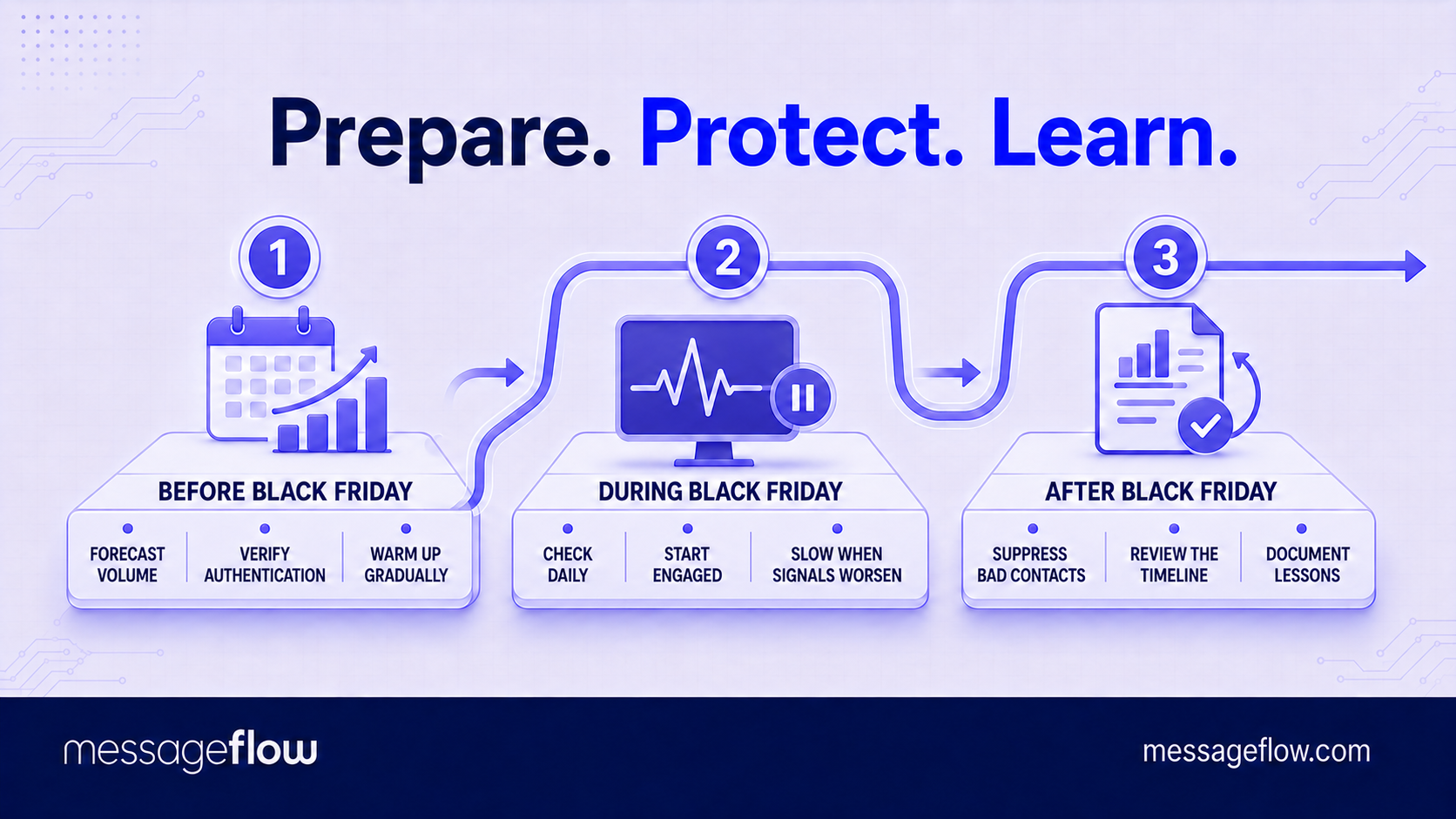
Before Black Friday
Crucially, start several weeks before the planned volume increase. New sending infrastructure may require an even longer runway.
- Build a daily sending forecast. Estimate volume by campaign, sending domain, and audience segment. Include transactional traffic so the forecast reflects the complete load.
- Share the plan with your ESP. Confirm throughput limits, expected queue behaviour, available monitoring, and the recommended warm-up schedule.
- Test authentication through the production path. Send representative messages and inspect their headers to confirm that SPF, DKIM, and DMARC pass and align correctly.
- Separate contacts by engagement. Define active, declining, and dormant segments using behaviour relevant to the business, not an arbitrary database-wide cutoff.
- Finish re-engagement early. Give less active subscribers a chance to confirm their interest before the main promotional period. Suppress those who do not respond.
- Remove invalid and unverified addresses. Apply existing bounce and complaint suppressions, review acquisition sources and verify questionable data before it enters a campaign.
- Increase volume gradually. Direct early sends to engaged contacts and expand only while delivery, complaint and engagement signals remain stable.
- Prepare provider-level dashboards. Make Gmail, Outlook, Yahoo and other important recipient domains visible separately.
- Assign decision owners. Specify who checks the data, who can pause a campaign and which changes require escalation to the ESP.
Agreeing on response thresholds in advance prevents a commercial deadline from overruling clear warning signs.
During Black Friday
Peak-period monitoring should inform the next send instead of just documenting the previous one.
- Review performance every day. Check delivery, deferrals, hard bounces, complaints and engagement before releasing the next large campaign.
- Start with the most engaged audience. Positive early response gives the campaign a stronger foundation before it reaches broader segments.
- Watch each mailbox provider separately. If one provider deteriorates, adjust the affected traffic instead of changing the entire programme without evidence.
- Slow down when signals worsen. Reducing volume or pausing one segment is usually less costly than allowing a reputation problem to spread across later campaigns.
- Do not add last-minute contacts. New event leads, partner data or old exports should not enter high-volume sends without validation, permission checks, and appropriate segmentation.
- Keep unsubscribing easy. A recipient who cannot leave quickly may use the spam button instead.
- Avoid improvised infrastructure changes. Moving traffic to an unfamiliar IP address or domain can create another reputation variable and make the original problem harder to diagnose.
- Record every intervention. Note changes to volume, cadence, targeting and infrastructure so that later analysis can connect actions with outcomes.
If performance declines, isolate the affected provider, segment or campaign before assuming that the entire sending programme has failed.
After Black Friday
The final promotional send does not end the deliverability work. Reputation changes and delayed feedback may remain visible during subsequent holiday campaigns.
- Review the full timeline. Examine how provider-level delivery, placement, complaints, and engagement changed as volume increased, not just the final campaign totals.
- Process peak-season feedback. Suppress hard bounces and complaints promptly, and investigate addresses associated with spam traps or unusual failure patterns.
- Audit newly acquired contacts. Check holiday sign-up sources, form validation and early engagement before treating new subscribers as established recipients.
- Return to the normal cadence deliberately. There is no need to preserve peak volume, but continue monitoring while the programme settles back into its regular pattern.
- Document causes and responses. Record what changed, which warning signs appeared, and whether each intervention improved the result.
- Turn the findings into next year’s starting point. Retain the volume plan, provider breakdowns and effective thresholds so the next peak-season strategy begins with evidence rather than estimates.
💡 The most useful post-campaign report explains both what happened and which decisions the team should repeat, change or make earlier next time.
Protect your sender reputation beyond Black Friday
Strong Black Friday email deliverability depends less on last-minute optimisation than on decisions made before volume rises. Teams that enter peak season with a verified audience, established sending history, tested authentication and clear response thresholds can adjust without losing control of the campaign.
Deliverability should therefore be treated as a shared operational responsibility. Marketing controls targeting and frequency, technical teams manage authentication and integrations, while the ESP provides infrastructure visibility and experience drawn from other high-volume sending programmes. Your plan is strongest when those responsibilities are clear before the first major promotion goes out.
MessageFlow supports high-volume email campaigns with scalable sending infrastructure, audience segmentation, domain-level reporting, and detailed delivery data. Our experts can also help teams review authentication, IP strategy, expected volumes, and monitoring plans before peak traffic begins.
If your Black Friday forecast involves a substantial increase in volume, a new sending setup or contacts that have not been reached recently, speak to a MessageFlow email deliverability expert before starting the ramp-up. An early review costs far less than trying to recover sender reputation during the most valuable campaigns of the year.