During Black Friday, the winning brand isn’t necessarily the one that sends messages most frequently or starts earliest. What matters most is reaching the right recipient at the right moment, especially when offers are time-sensitive. This requires both sound, data-driven decisions and infrastructure capable of reliably handling delivery during peak traffic. So how should you approach campaigns during one of the busiest sales periods of the year?
This article was developed jointly by MessageFlow and Manago AI. It combines MessageFlow’s infrastructure-level traffic data with proprietary, aggregated campaign-performance data provided by Manago AI.
TL;DR
- Sending earlier or more frequently does not automatically improve Black Friday SMS performance. Prioritize relevant audiences, offers and timing.
- MessageFlow data shows a four-week seasonal traffic peak, with Black Week volume 57% above the baseline so prepare your campaigns and delivery infrastructure in advance.
- Manago AI manages segmentation, workflows and send timing, while MessageFlow provides the infrastructure needed to deliver messages while the offer is still relevant.
Why do Black Friday SMS campaigns require extra planning?
In e-commerce, Black Friday rarely means a single campaign launched on Friday morning. Early access to promotions, discount and back-in-stock notifications, abandoned cart reminders, and dedicated workflows for VIP customers may all run simultaneously.
Crucially, the same person may qualify for several of these at once. For example, they might belong to an active customer segment, receive early access to a promotion, and then add a product to their cart without completing the purchase. Without the right rules in place, they could receive several similar messages in quick succession, including after making a purchase or when the offer is no longer available.
During peak season, the scale of this challenge increases significantly.
During Black Week 2025, SMS traffic through MessageFlow’s infrastructure was 57% above the average weekly level recorded from 6 October to 10 November. The increase formed part of a broader four-week seasonal peak, rather than a single isolated spike.
However, message volume alone does not determine a campaign’s success. Contact database quality, audience segmentation, the order in which workflows are triggered, contact frequency, and send timing all matter too. For short-lived promotions, efficient campaign delivery is another key factor. An SMS delivered after an offer expires or stock runs out can no longer serve its purpose.
💡 Manago AI and MessageFlow handle two complementary layers of this process. Manago AI uses customer data and behaviour to manage audiences, workflows, and communication timing. MessageFlow provides the infrastructure for reliable SMS delivery. Together, these two layers allow you to move from deciding who should receive a message and when to actually delivering it.
How should you prepare your contact database and SMS campaign rules?
Start preparing early to reduce the risk of multiple workflows competing for the same recipient’s attention, or database and configuration issues only coming to light during peak traffic.
Prepare your contact database
Start with an up-to-date database of recipients who have given prior consent to receive commercial communications, including direct marketing, via SMS.
Providing a phone number for order fulfilment or transactional notifications should not, in itself, be treated as consent to receive marketing communications. Before launching your campaign, remove invalid numbers, check that consent records are up to date, and make sure you have the data needed for segmentation.
Collect opt-ins in advance, for example by offering early access to promotions. You can then segment these contacts by their activity and relationship with your brand, distinguishing between groups such as VIP customers, active shoppers, and people who have not engaged with your communications for some time. This means you do not have to send the same offer to every recipient at the same time.
Define your communication rules
Before Black Week begins, decide which campaigns and automations take priority. An abandoned cart message may be more relevant than a general promotional campaign, but only if the purchase has not already been completed.
Your rules should cover:
- Contact frequency limits
- Excluding customers who have already made a purchase
- Priorities for campaigns and automated workflows
- Stopping messages that are no longer relevant
- Defining the roles of SMS, email, mobile push, and other channels
SMS should not repeat every message sent through other channels. Its direct nature makes it best suited to messages that are urgent, particularly relevant to an individual recipient, or only valuable for a short period.
In Manago AI, you can build audiences using segments based on factors such as purchase data, consent status, and engagement with previous messages. The SMS settings also allow you to limit the number of messages sent to each contact.
Check that you are ready to send
The final preparation stage focuses on campaign delivery. Estimate your sending volume, test the configuration and integration, and check your sender ID, shortened links, and message content.
Each SMS should direct recipients to one main offer and include a clear call to action. Check its length and encoding, as these can affect the number of message segments and, consequently, sending costs and delivery.
If you want to measure the click-through rate (CTR) of messages sent through Manago AI workflows, enable link shortening. Without this feature, clicks will not be included in the automation’s CTR statistics.
Set up delivery status monitoring before launching the campaign. This will allow your team to quickly check whether messages have been accepted for processing and delivered, and respond appropriately if any issues arise.
When should you start your Black Friday SMS campaign?
In 2026, Black Friday falls on 27 November and Cyber Monday on 30 November. Prepare your campaign in advance, but that does not mean sending the same offer to your entire database at the start of the month. Send timing should depend on the recipient, the nature of the message, and how long the offer remains valid.
Timeline: Before Black Week, Black Friday, and Cyber Monday
- Before 23 November: clean up your database, prepare audience segments, set contact frequency limits, and test your workflows and integration. Offer early access to selected recipients who will genuinely benefit from it.
- 23–26 November: gradually launch campaigns previewing your offers and automations based on customer behaviour. Monitor whether multiple workflows are targeting the same people.
- 27 November: focus the bulk of your sends on the live Black Friday offer, allowing sufficient time for delivery before it ends.
- 28–30 November: send reminders about ongoing promotions, abandoned carts, and the last chance to buy before Cyber Monday ends.
- From 1 December: stop workflows that are no longer relevant. Base further communications on new offers, delivery deadlines, product availability, or order support.
When does traffic start to rise?
MessageFlow’s data shows that the seasonal increase was not limited to Black Week, but extended across four weeks.
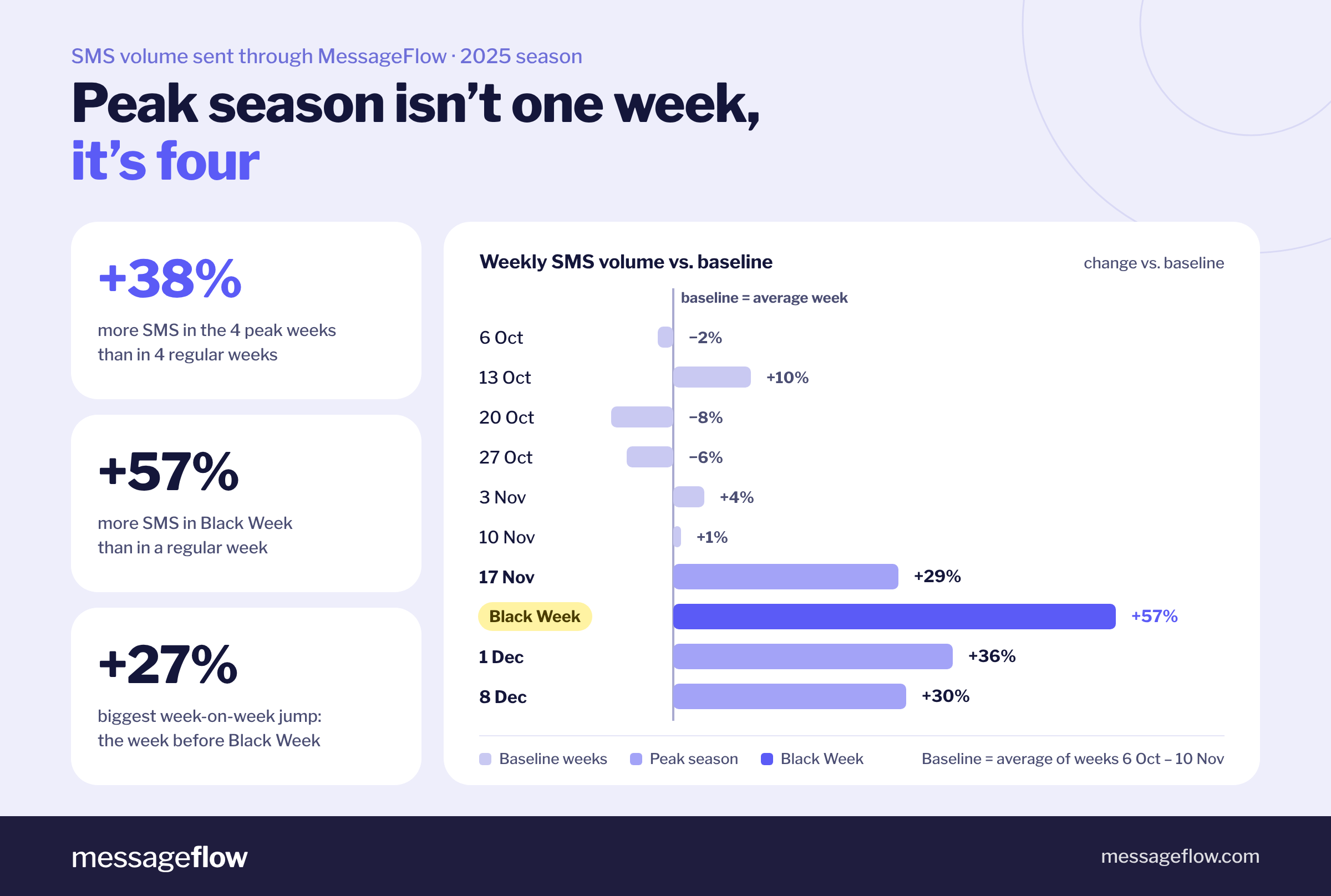
Compared with average weekly traffic from 6 October to 10 November, SMS volume was 29% higher in the week beginning 17 November and 57% higher during Black Week. It remained 36% and 30% above the baseline in the weeks beginning 1 and 8 December, respectively.
Across these four peak weeks, average weekly traffic was 38% above the baseline. The largest week-over-week increase – 27% – occurred in the week beginning 17 November, before Black Week itself.
Do earlier SMS campaigns perform worse?
Volume alone cannot tell us whether sending earlier delivers better results. We therefore compared message volumes with CTR and revenue per SMS.
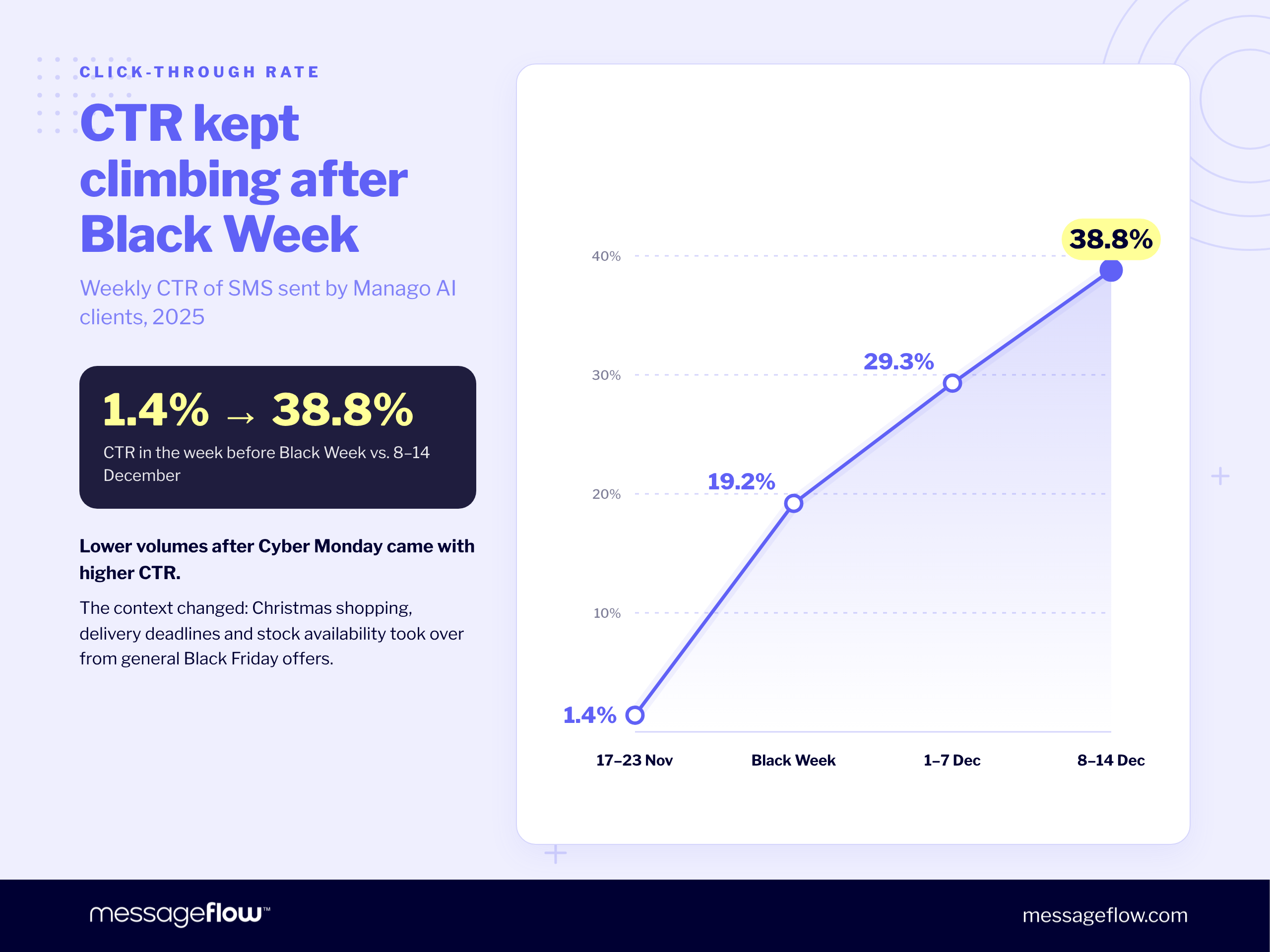
In the two weeks preceding Black Week, from 10 to 23 November 2025, Manago AI clients sent more than 2 million SMS messages in total. However, the higher volume did not translate into proportionally better results. Revenue per message during this period was PLN 1.70, compared with PLN 3.85 in October, while CTR fell to 1.4% in the week of 17–23 November.
During Black Week, Manago AI clients sent nearly 1.27 million SMS messages. CTR rose to 19.2%, and revenue per message increased to PLN 2.17. Average order value also grew, from PLN 77 in October to PLN 136 during Black Week.
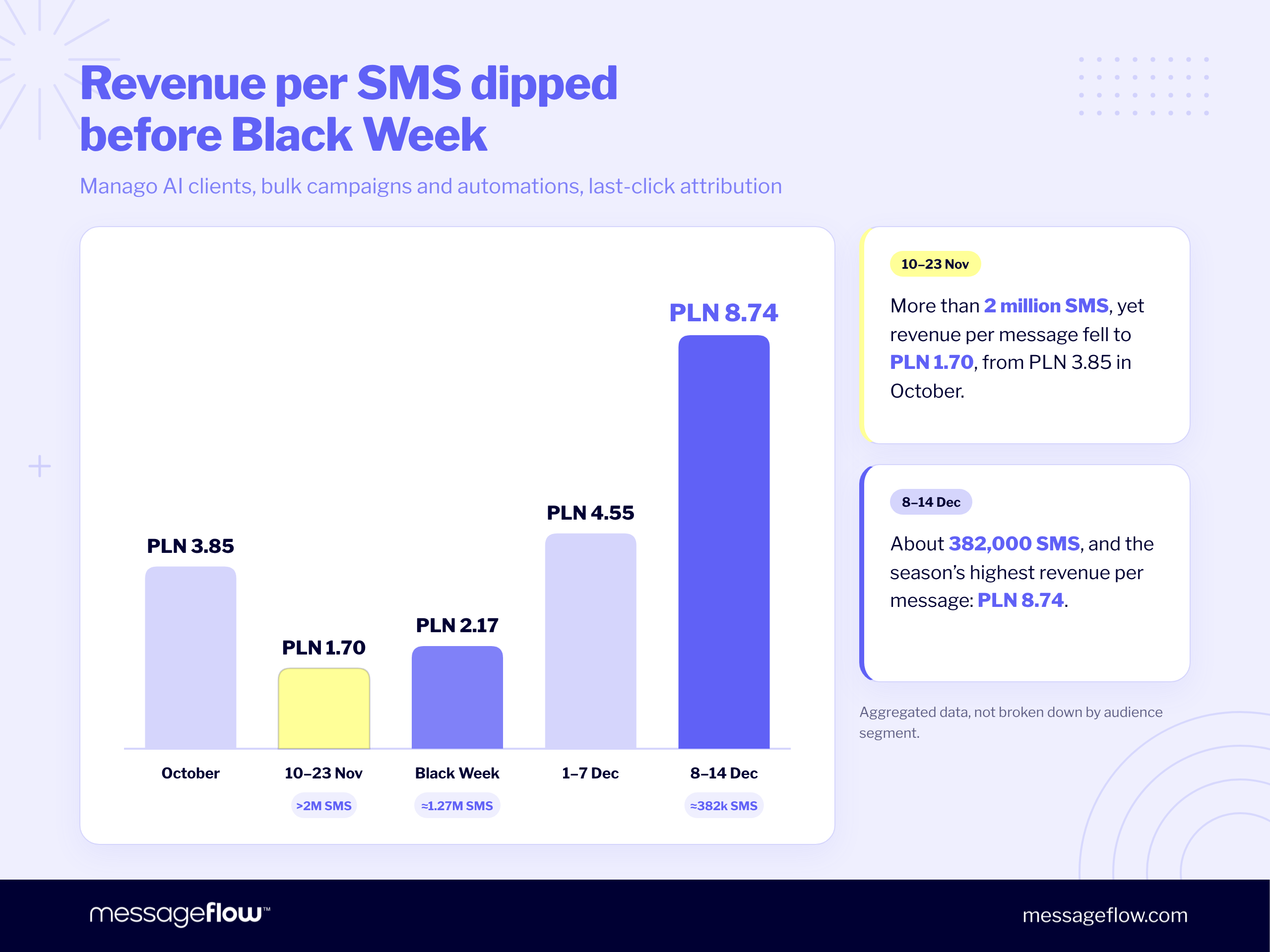
These results combine bulk campaigns and automations across all Manago AI clients included in the analysis. Revenue was attributed using last-click attribution, and the data is not broken down by audience segment. It therefore does not establish that earlier sends always perform worse. It does, however, show that shifting a large sending volume to the period before Black Week does not guarantee better performance.
Who should receive messages earlier?
Earlier communications should primarily target recipients who gain a specific benefit, such as early access to promotions, an offer exclusive to a selected group, or the opportunity to buy a product before it sells out.
Manago AI’s 2025 data indicates that sending more SMS messages before Black Week did not translate into higher revenue per message. It is therefore better to limit earlier communications to carefully selected audiences and reserve the bulk of your sends for when the main offer is live.
How should you prioritise SMS campaigns and automations?
If a customer could receive several messages, decide in advance which workflow takes priority and when the others should stop. Qualifying for a campaign should not automatically trigger a send.
Before sending a message, check that the customer has not already made a purchase or recently received a similar message, and can still take advantage of the offer. Frequency limits help prevent excessive messaging, but they do not replace rules tailored to each workflow.
SMS examples: Early access, abandoned cart, and last chance
The examples below use a fictional brand and URLs. In the Polish originals, we omitted Polish diacritics to reduce the risk of switching to Unicode encoding. Always check the final message length, including the link, before sending.
1. Early access for VIP customers
Recipient: a VIP customer or an active loyalty programme member.
Trigger: the start of an exclusive promotional period before the offer opens to the full contact database.
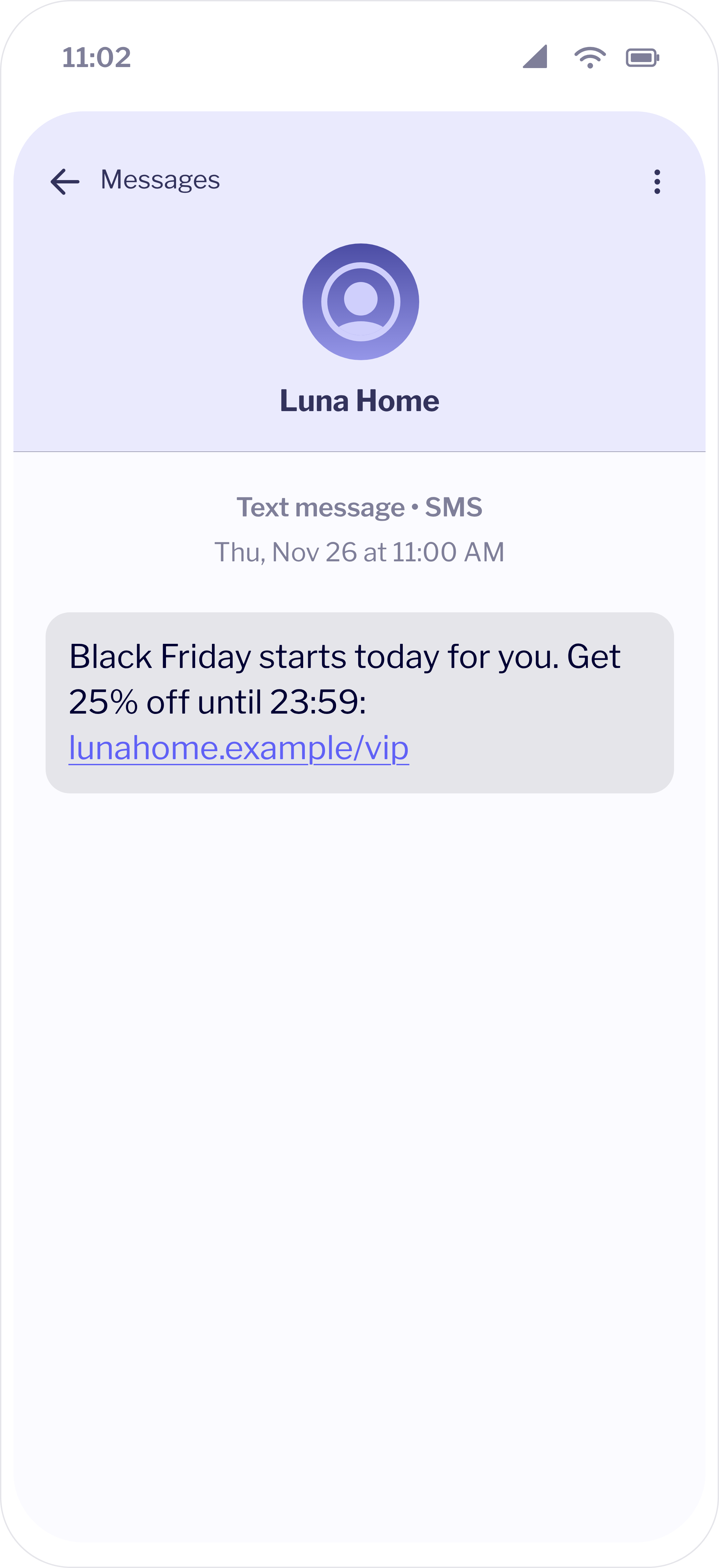
Stop condition: a purchase is made or the early access period ends.
2. Abandoned cart reminder
Recipient: a customer who added a product to their cart but did not complete the purchase.
Trigger: a specified amount of time has passed since cart abandonment, provided the product and offer are still available.
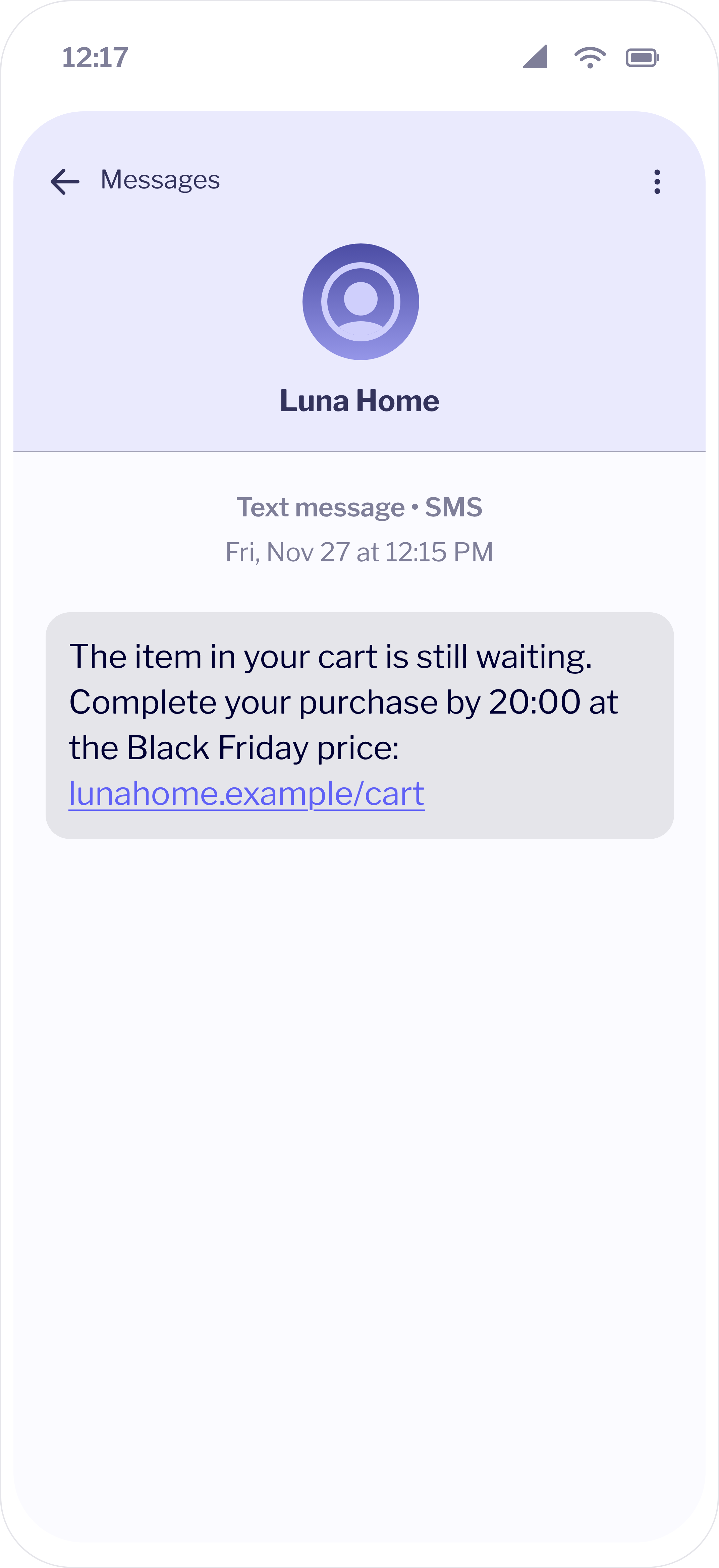
Stop condition: a purchase is made, the product sells out, or the promotion ends.
3. Last chance before the promotion ends
Recipient: an active customer who has not yet taken advantage of the offer.
Trigger: the promotion enters its final hours.
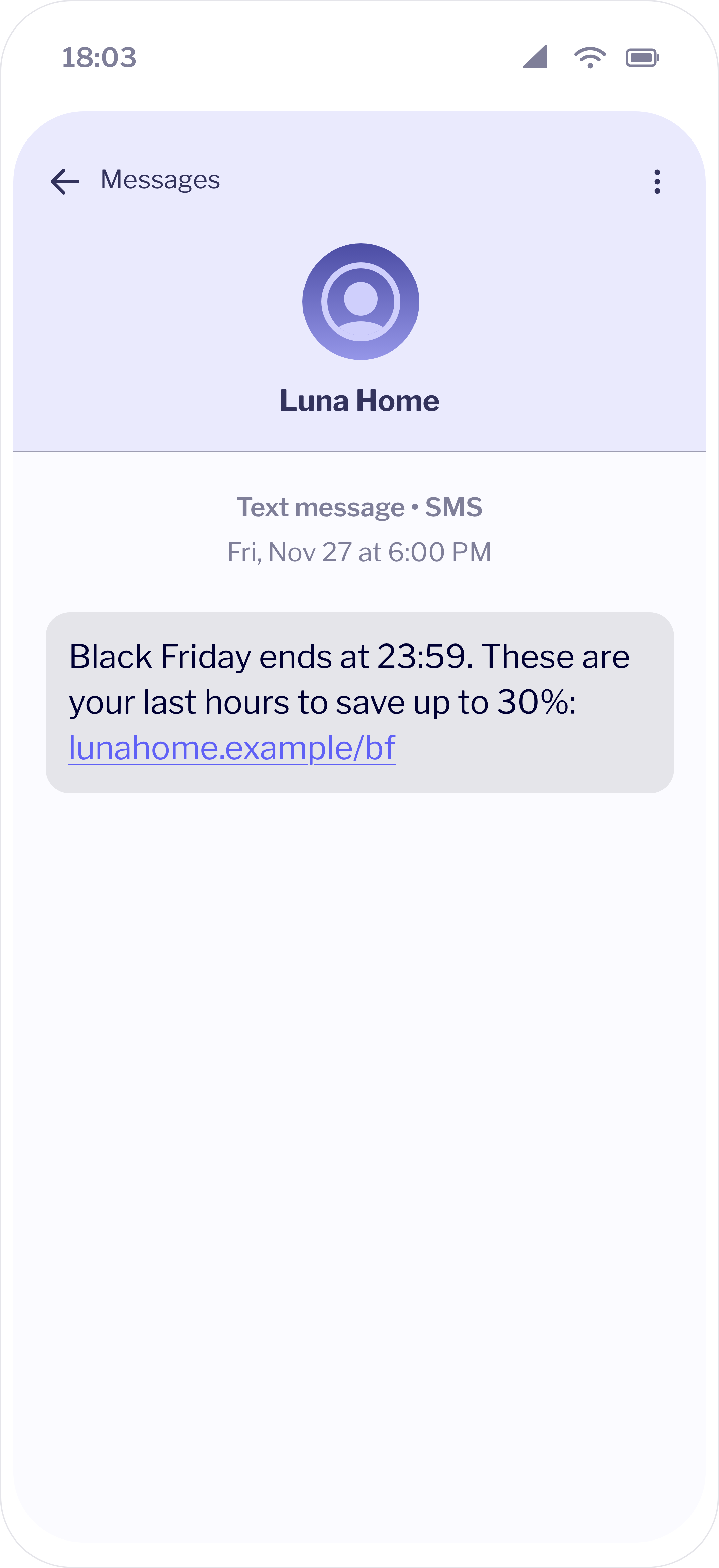
Stop condition: a purchase is made or the promotion reaches its end time.
In Manago AI, a message triggered by a Workflow can have a specified delay and an allowed sending window. If a contact reaches the relevant step outside that window, the send is postponed until the earliest permitted time the following day. For a last-chance workflow, the settings must therefore prevent the SMS from being delivered after the promotion ends. Once triggered, the message is passed through the integration to MessageFlow, which handles the technical delivery process.
What time should you send SMS messages during Black Week, and how often?
At the height of campaign activity, message content and the offer matter just as much as send timing, contact frequency, and delivery time. Each element should be tailored to the audience segment and the nature of the offer.
What time should you send SMS messages?
There is no single best time for every campaign. Early access for VIP customers requires a different approach from an abandoned cart reminder or a notification about a promotion ending in a few hours. Send timing should reflect the segment’s behaviour and how long the offer remains relevant.
Manago AI’s data shows how bulk SMS campaigns were distributed throughout the day during the 2025 season. Between 09:00 and 11:00, clients sent 45% of all messages analysed, with CTR ranging from 11.5% to 14.2%. Sends between 11:00 and 13:00 accounted for just 9% of the volume but achieved CTRs of 21.7% to 27.9%.
Messages sent between 17:00 and 21:00 performed considerably worse. They accounted for 22% of the volume, with CTR no higher than 0.9%.
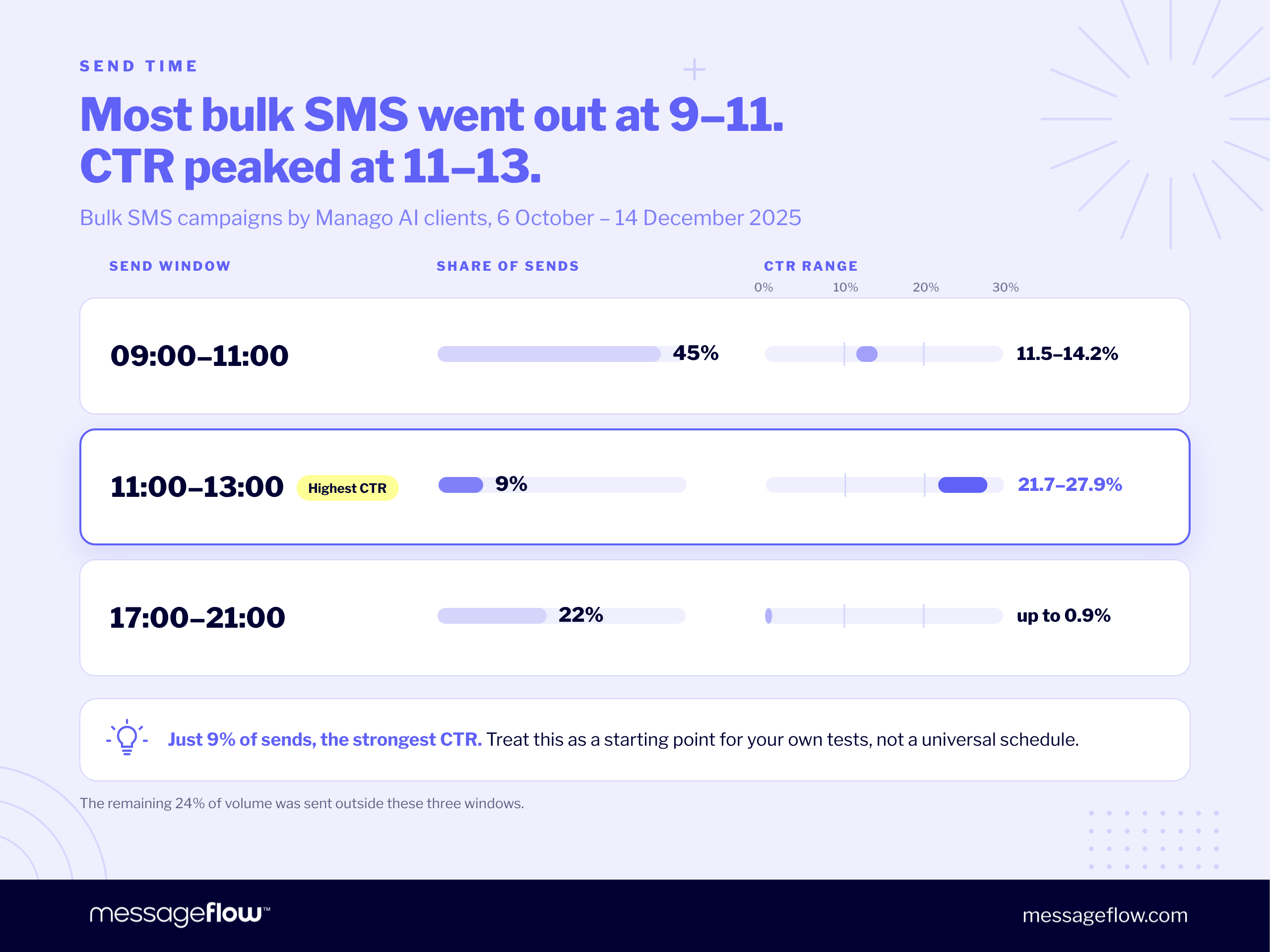
This does not mean that 11:00–13:00 will be the best window for every brand. The analysis covers bulk campaigns across all Manago AI clients included in the study from 6 October to 14 December, rather than Black Friday and Cyber Monday alone. Results were also influenced by the type of offer, audience selection, and the use of shortened links that enabled click tracking.
Treat this data as a starting point for testing, rather than a universal schedule. Schedule campaigns with a fixed end time sufficiently in advance, and send behaviour-triggered messages as close to the relevant event as possible, within your defined sending window.
For a broader perspective beyond the seasonal peak, see how to choose the best time to send an SMS campaign.
How many SMS messages should you send each customer?
Not every recipient should receive the same number of messages. More frequent contact may be justified for active customers and people waiting for a specific offer. For inactive recipients, however, additional campaigns may increase message fatigue without a proportional improvement in results.
Industry recommendations for retail and e-commerce typically suggest 2–6 SMS messages per month, including 2–4 promotional messages. Recipients may accept a higher frequency during seasonal sales, but there is no single safe limit that applies to every brand, segment, and workflow.
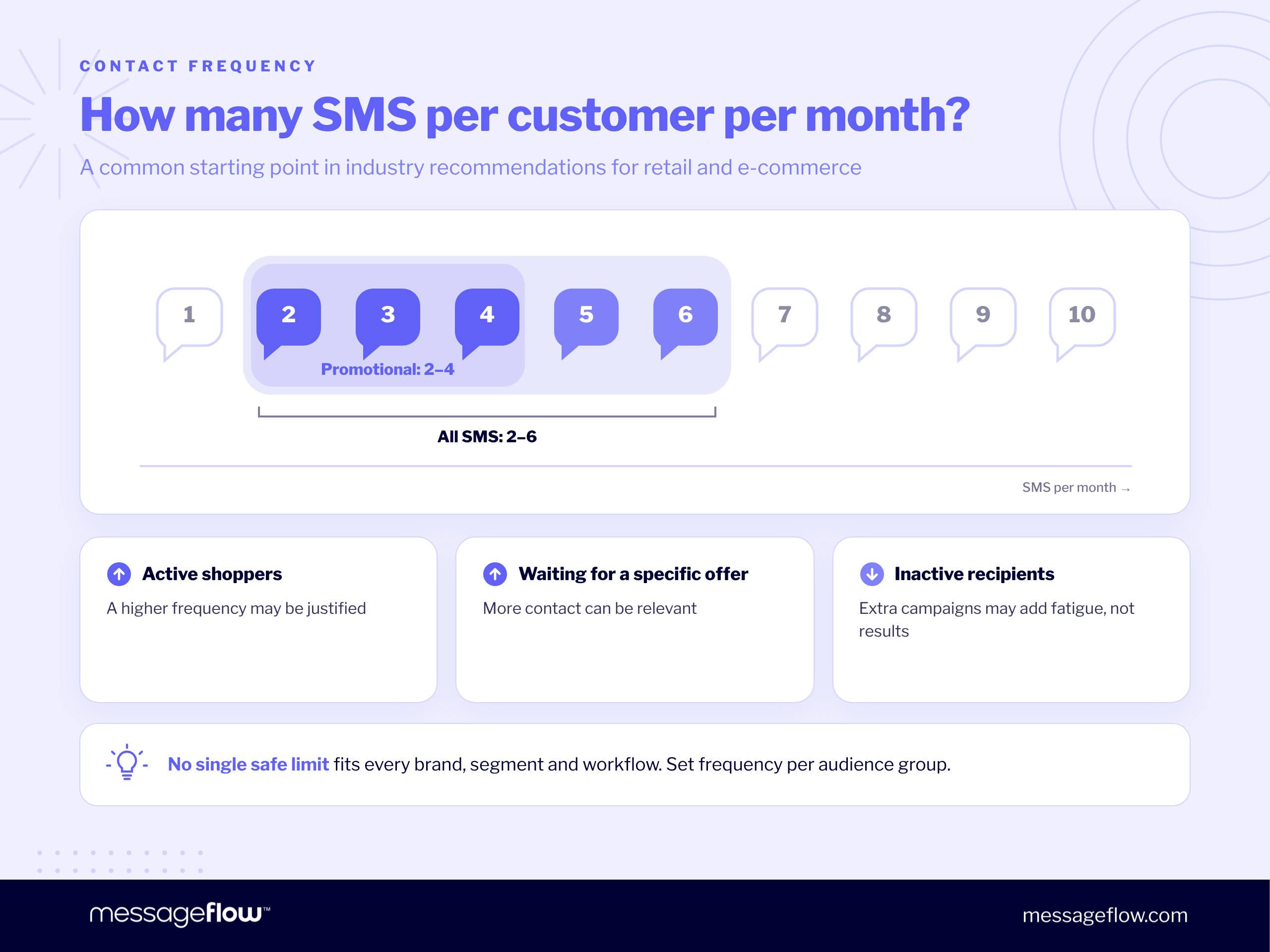
Set contact frequency separately for each audience group, taking into account their activity, previous engagement, and the type of message. In Manago AI, you can set a per-contact message limit to reduce the risk of excessive messaging.
Alongside bulk campaigns, use workflows based on customers’ current behaviour. Exclude people who have already purchased, stop messages that are no longer relevant, and prioritise the message that best matches each recipient’s current situation.
How can you ensure timely SMS delivery?
A message being accepted for processing is not the same as it actually reaching the recipient’s phone. Between these stages lie the provider’s infrastructure, routing, and mobile operators’ networks, which also handle increased message volumes during peak traffic.
Estimate your sending volume before the campaign and monitor message statuses while it runs. Infrastructure throughput and how traffic is routed to mobile operators also matter. Monitoring these factors helps you spot issues early and assess whether messages are reaching recipients as planned.
Before the seasonal peak, it is also worth running scalability tests on your API and messaging infrastructure.
For time-sensitive communications, delivery after a promotion ends can mean more than a lost sale. A late message leading to an outdated price or an unavailable product also harms the customer experience. Assess delivery performance not only by the number of SMS messages accepted for processing, but also by whether they arrived in time to influence a purchase decision.
Is it worth sending SMS messages after Cyber Monday?
Cyber Monday does not have to mark an immediate end to seasonal communications. The context changes, however: general Black Friday campaigns lose relevance, while Christmas shopping, delivery deadlines, product availability, and support for existing orders become more important.
What happens to traffic after Black Week?
Across MessageFlow’s infrastructure, traffic remained elevated after Black Week. Compared with the baseline average, SMS volume was 36% higher in the week beginning 1 December and 30% higher the following week, versus 57% above the baseline during Black Week.
This confirms that the seasonal peak did not end abruptly with Cyber Monday. Brands continued to communicate frequently with customers, although the subject matter of their messages changed.
How do results change?
Among Manago AI clients, lower SMS volumes were accompanied by better performance in terms of CTR and revenue per message.
In the week of 1–7 December, CTR reached 29.3%, and revenue per SMS was PLN 4.55. Between 8 and 14 December, these figures rose to 38.8% and PLN 8.74, respectively. By comparison, Black Week recorded a CTR of 19.2% and revenue per message of PLN 2.17.
The week of 8–14 December generated the highest weekly revenue attributed to SMS across the entire period analysed – approximately PLN 3.34 million – even though Manago AI clients sent around 382,000 messages, less than a third of the Black Week volume. Average order value fell from PLN 136 to PLN 64, but purchases occurred more frequently.
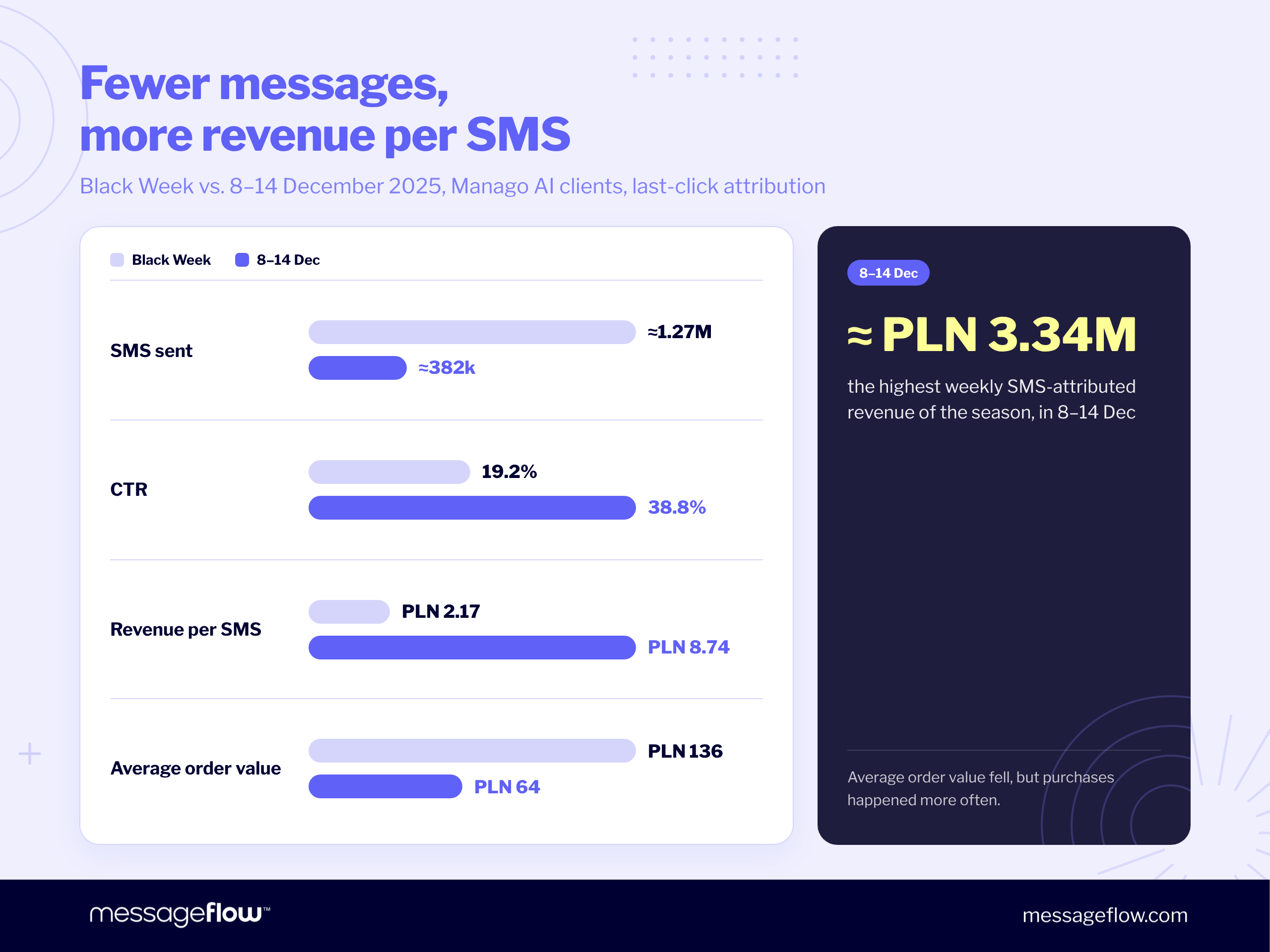
These results reflect aggregated data from Manago AI clients, with revenue assigned using last-click attribution. They do not mean that every brand should increase its December sending volume. They do, however, show that effective SMS communication need not end with Cyber Monday.
When does continued communication make sense?
After Cyber Monday, do not automatically extend the same campaigns. Each subsequent message should convey new information that is still relevant.
Further communications may cover:
- The last date to order for delivery before Christmas
- A justified extension of a promotion
- The status of an existing order
- A product coming back into stock
- A workflow triggered by the customer’s current behaviour
Stop sending sales messages to people who have already taken advantage of the offer, and disable workflows tied to promotions that have ended. After Cyber Monday, matching the message to the recipient’s new needs becomes more important than maintaining a high contact frequency.
How should you measure Black Friday SMS campaign performance?
The number of messages sent alone does not tell you whether a campaign achieved its goal. The data from the period before Black Week illustrates this too: higher volume did not automatically translate into higher revenue per SMS.
Connect CTR with business results
CTR shows the proportion of recipients who clicked a link, but it does not tell you how many made a purchase or how much value the campaign generated. Assess it alongside conversion rate, revenue per message, and average order value. If the data is available, also track opt-outs to assess the cost of excessive messaging.
None of these metrics should be interpreted in isolation. A high CTR may not lead to sales, while sending fewer messages may generate more revenue per SMS.
For definitions of these metrics and broader guidance on interpreting them, see our guide to SMS campaign performance and benchmarks.
Check delivery performance
Campaign results also depend on whether messages arrived while the offer was still valid. Monitor not only the number of SMS messages submitted for processing, but also their statuses and delivery times.
This is particularly important for time-limited promotions. A message may be sent correctly yet still fail to achieve its business objective if it arrives after the offer ends.
Use a consistent methodology
When comparing results, use consistent definitions, reporting periods, and sales attribution methods. In Manago AI’s data, revenue was assigned using last-click attribution, while measuring CTR for messages sent through workflows requires link shortening to be enabled.
Without accounting for these differences, it is easy to attribute a change in performance to send timing or campaign frequency when it may actually reflect the measurement method or a different audience mix. Conclusions should therefore draw on several metrics and account for the context of each campaign.
How does SMS automation with Manago AI and MessageFlow work?
An effective SMS campaign requires both sound communication decisions and efficient execution. In the Manago AI and MessageFlow integration, two complementary layers handle these tasks.
Manago AI: Audiences, workflows, and send timing
In Manago AI, marketers can create Segments based on factors such as purchase data, consent status, and engagement with previous communications. SMS campaigns in Manago AI can run through the Mobile Marketing module or be triggered using Workflows and Automation Rules.
Within a Workflow, the “Send a text message to a contact” action allows users to specify a delay and a sending window. Users can also set a per-contact message limit. This links SMS to a chosen stage of communication and provides control over when it is sent.
MessageFlow: Messaging infrastructure
Once a campaign or the relevant Workflow action is triggered, the message is passed to MessageFlow through the configured integration. The platform provides the infrastructure for SMS delivery, including support for increased sending volumes, routing, and delivery status monitoring.
This is particularly important during Black Week, when many campaigns run simultaneously and some offers remain valid for only a short time. Decisions about recipients and send timing must therefore be backed by efficient delivery.
The integration: From decision to send
The integration is configured in Manago AI by setting up MessageFlow as an external SMS provider, using API keys from the MessageFlow panel. The sender ID used in messages must first be registered and approved in MessageFlow.
In practice, Manago AI manages the communication context – the audience, content, workflow, and trigger timing – while MessageFlow provides the infrastructure needed to send the messages. Together, these elements turn communication decisions into action while the offer is still relevant to the customer.
Relevance and timing matter on Black Friday
Sending earlier does not always produce better results, just as higher volume does not guarantee more sales. As campaign activity increases, segmentation, contact frequency limits, exclusions, and priorities become more important in determining which message should reach the customer first.
Automation helps reduce poorly targeted communications and connect SMS with the recipient’s current behaviour. Its effectiveness, however, depends on the data behind each workflow and the infrastructure responsible for delivery.
The winning brand on Black Friday is therefore not necessarily the one that sends the most messages or starts earliest. The advantage goes to the brand that knows whom to contact and when, and can deliver the message before the offer loses its value.
Prepare your SMS campaigns for Black Friday
Combine Manago AI’s data and automation capabilities with MessageFlow’s messaging infrastructure. Explore SMS marketing with MessageFlow, learn about the MessageFlow and Manago AI integration, and speak to an expert to prepare your audience segments, workflows, and delivery setup ahead of the next seasonal peak.
FAQ: Black Friday SMS campaigns
Start preparing before Black Week, which begins on 23 November. Target earlier messages at selected recipients and schedule the bulk of your sends for when the offer is live. In 2026, Black Friday falls on 27 November.
There is no single safe limit for every brand and audience. As a starting point, consider 2–6 SMS messages per month, including 2–4 promotional messages, then adjust the frequency to each segment’s activity and the type of campaign.
Yes. Recipients must give prior consent to receive commercial communications, including direct marketing, via SMS. Providing a phone number when placing an order does not, in itself, constitute consent to receive marketing communications.
Estimate your sending volume, test the integration and sender ID, and allow sufficient time for delivery when scheduling your sends. Monitor message statuses throughout the campaign – acceptance for processing does not yet confirm delivery.