

TL;DR: SMS spoofing is a phishing attack carried out over text message, also known as smishing. Scammers impersonate a courier, a bank, an online store, or a government office to steal card details, account logins, or one-time passcodes. Attacks are climbing year over year, and the damage doesn’t stop with the person who gets scammed. It also lands on the brand the fraudster hijacked. This article walks through how to spot a fake SMS, what defenses a business should put in place, and why a verified RCS sender shuts down impersonation far more effectively than an anonymous SMS number ever could.
Picture one of your customers getting a text: “Your package is on hold, pay a $1 customs fee to release it.” The sender name looks familiar. The message even lands in a thread that looks like it’s from your company. Your customer taps the link, enters their card details or account login, and loses money. Then they lose trust in your brand.
Even if your company never sent that message, the problem starts with your name the moment the customer opens it. That’s what makes smishing dangerous not just for consumers, but for the businesses being impersonated. Smishing, short for “SMS phishing,” is an attack where a scammer uses a text message to pose as a trusted company and push the recipient into clicking a malicious link, handing over personal data, or making a payment.
In 2025 alone, mobile carriers blocked close to 2 million malicious SMS messages.
The scale keeps growing. The brands most often impersonated are couriers, banks, and online retailers, the exact companies whose customers already expect routine texts about deliveries, login attempts, one-time codes, and payment confirmations.
This article breaks down how to recognize an SMS spoofing attempt, how to build organizational defenses against it, and which technologies genuinely reduce the risk of someone hijacking your sender identity. We’ll also cover why a verified RCS sender gives brands far more control over their identity than a standard SMS ever can.
What Is Smishing and How Is It Different From Phishing?
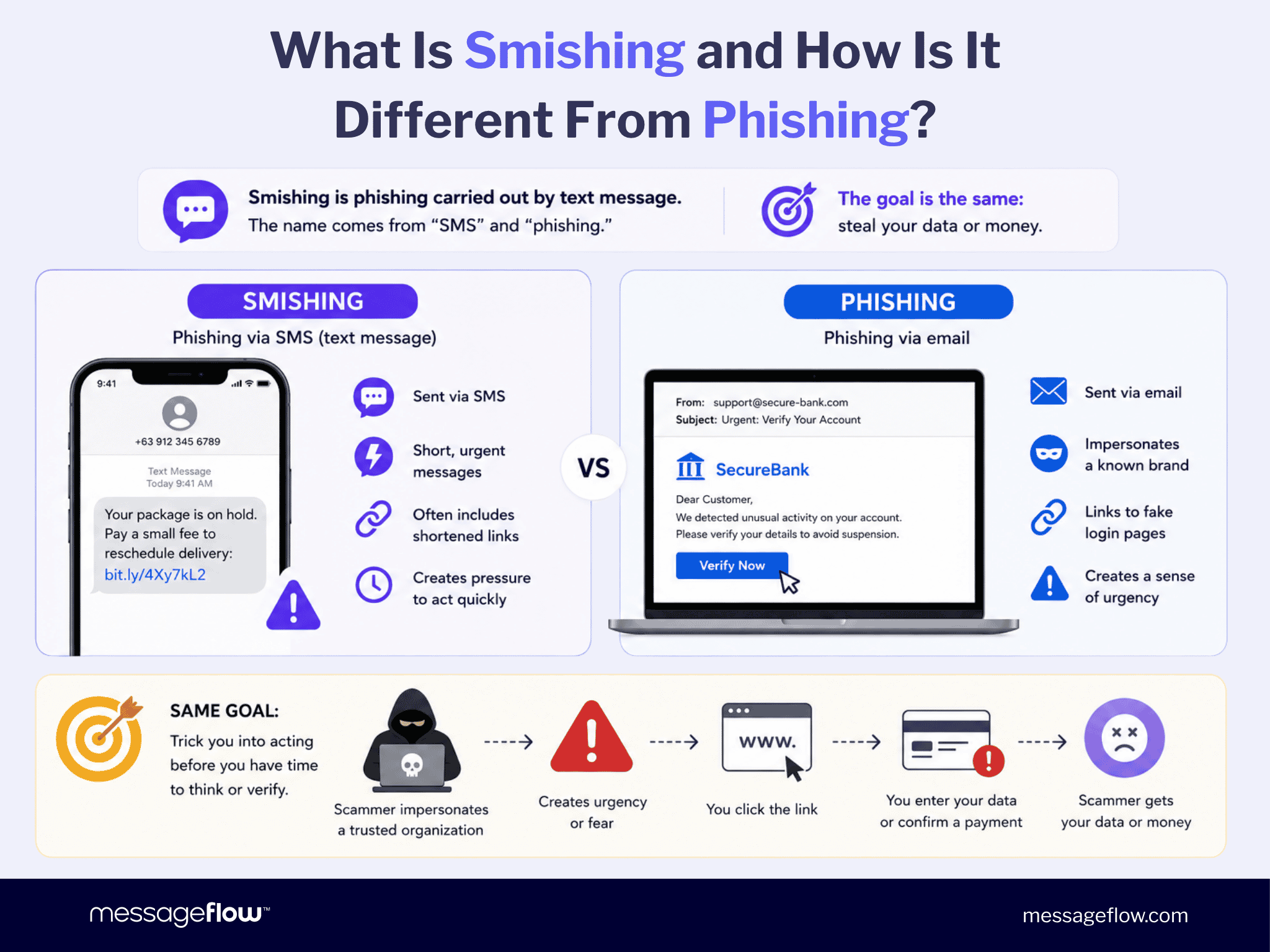
Smishing is phishing carried out by text message. A scammer impersonates a trusted company, bank, courier, or public institution to steal login credentials, card numbers, or authentication codes. The name itself is a blend of “SMS” and “phishing.”
The goal is identical to classic phishing: get the recipient to act on impulse before they stop to verify who’s really texting them. What changes is the channel, and the way pressure gets applied.
In email phishing, attackers usually impersonate a known brand and steer the victim toward a fake login page. In smishing, they use SMS, a channel people associate with short, urgent messages: a delivery code, a payment confirmation, a bank alert, or a notice from a government agency.
That’s exactly why smishing works so well. The message lands directly on the phone, it’s brief, it reads like urgent business, and it often hides behind a shortened link that masks the real destination.
The recipient has almost no time to think it through, and the scammer is counting on a fast reaction: a tap, a few typed digits, a confirmed transaction.
How Does a Smishing Attack Actually Work?
Most attacks start with a phone number. Scammers can pull numbers from a data breach, an old contact list, or a service the victim signed up for years ago.
From there, they launch a mass SMS campaign impersonating a recognizable brand. Many rely on spoofing, swapping out the sender name displayed on the recipient’s screen. This can make the message appear to come from a courier, a bank, an online store, or a public agency.
The text contains a link to a fake website. These fake pages are often near-perfect copies of the real thing, complete with the brand’s logo, a matching layout, and a payment or login form.
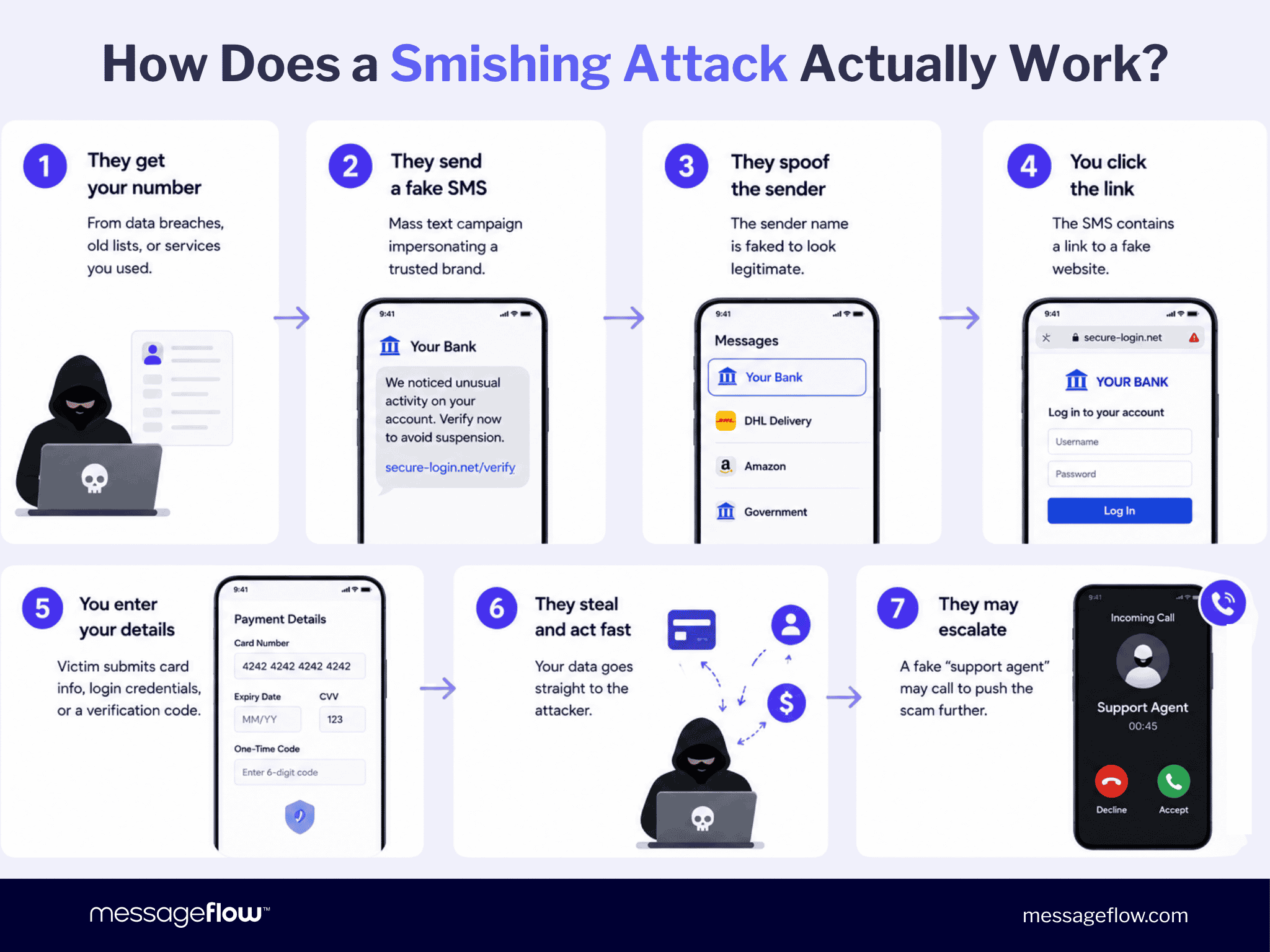
The victim types in their card number, username, password, or a code from their banking app. That information goes straight to the attacker, who can act on it within minutes, running a transaction, hijacking an account, or launching a follow-up scam.
Increasingly, the attack doesn’t stop at the text message. A common escalation is a hybrid scenario: after the SMS, a fake “support agent” calls, using the pretext of technical help to walk the victim through the next stage of the scam.
That multi-channel approach makes the whole thing feel more credible. The recipient sees a text, picks up a call from a “consultant,” and has even less time to calmly check what’s actually going on.
The Most Common Fake SMS Scenarios
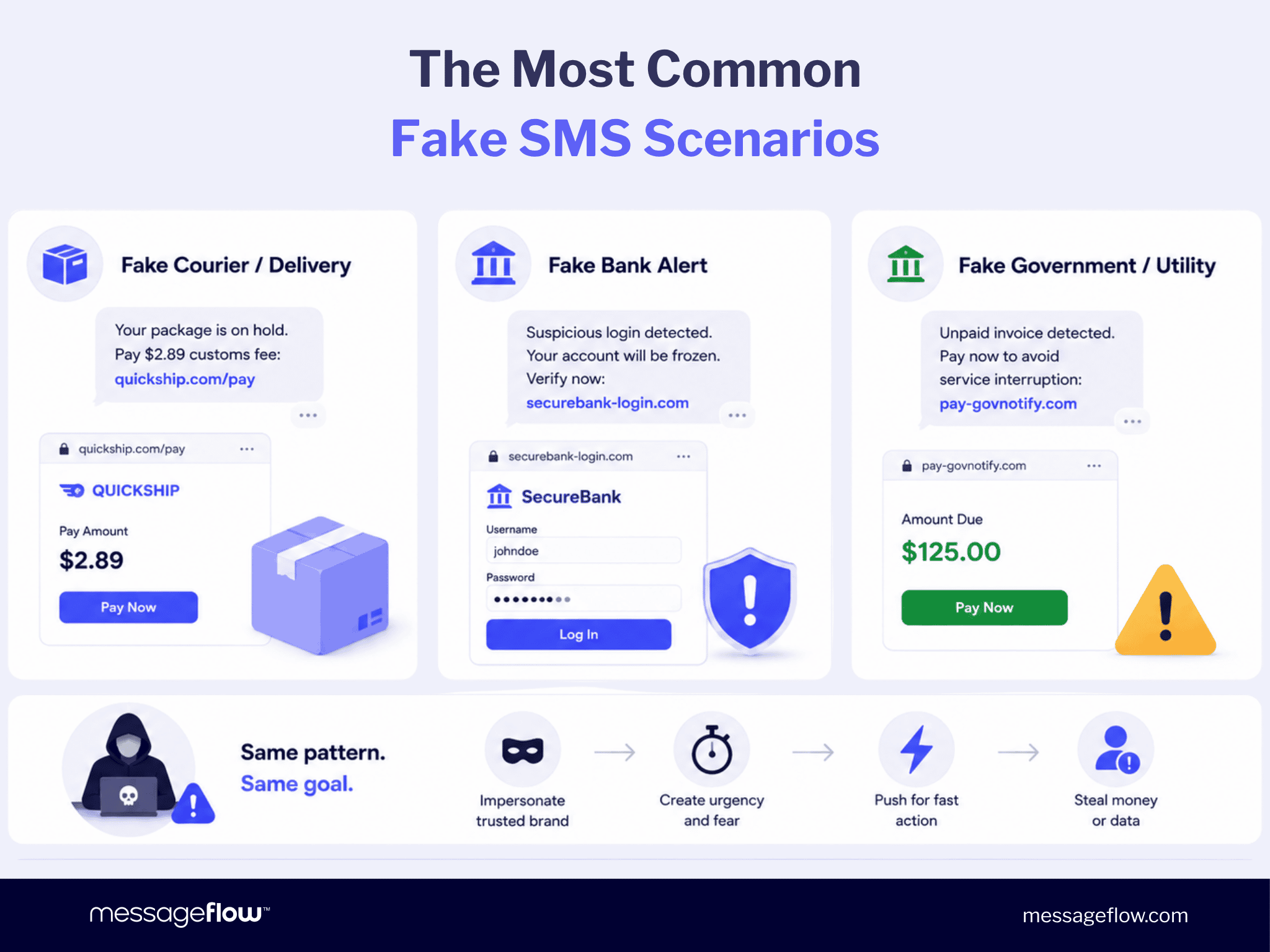
One of the most widespread schemes is a fake courier text claiming a small customs or delivery fee is due. The message might impersonate any major carrier, and the link leads to a page designed to look exactly like that carrier’s real payment portal. The recipient thinks they’re paying a few dollars to release a package. In reality, they’re handing over card details or account access.
A second common variant impersonates a bank. The message warns of a suspicious login, a frozen account, or a need to “confirm identity.” The link leads to a fake login page where the victim types in their credentials.
A third scenario plays on trust in government agencies and utility providers, impersonating tax offices, social security administrations, energy providers, or telecom operators. These messages lean on fear: a fine, a service cutoff, a lost account.
Every one of these scenarios follows the same pattern: the scammer borrows a brand the recipient already trusts, manufactures time pressure, and pushes for a fast reaction before anyone stops to verify the sender.
How to Spot a Fake SMS: 7 Warning Signs
A fake SMS usually gives itself away through a handful of repeating signals: urgency, a suspicious link, an unusual request for data, or a message that comes out of nowhere. Learning to spot these patterns is enough to dodge most smishing attempts.
The core rule is simple: if a message pressures you to act fast and points you to a link, verify the sender somewhere else first, on the official website, in the app, or by phone.
1. Time pressure
Phrases like “last chance,” “your account will be locked in 24 hours,” or “pay now or the package gets returned” are classic manipulation tactics. Scammers want to shrink your thinking time. The more rushed you feel, the more likely you are to tap without checking where the link actually goes.
2. A suspicious domain
Fake SMS links often use a domain that closely mimics the real brand, with one small tweak. Instead of the real courier domain, you might see a version with an extra word, a swapped letter, or an unusual extension like “.xyz.” Before entering any information, check the address carefully. One character or an odd extra term can be the entire difference between a real site and a fake one.
3. A request for a one-time code
No legitimate bank or service provider should ever ask you to enter a one-time passcode after clicking a link from a text message. If a page demands a banking app code, an SMS code, or card details, treat it as a red flag.
4. Unusually small amounts
Symbolic fees, a couple of dollars for a package, a delivery, or “reactivating” a service, are designed to lower your guard. The recipient thinks, “it’s only a dollar,” and clicks through the payment form without much thought. The real target was never the amount. It’s the card data or account access behind it.
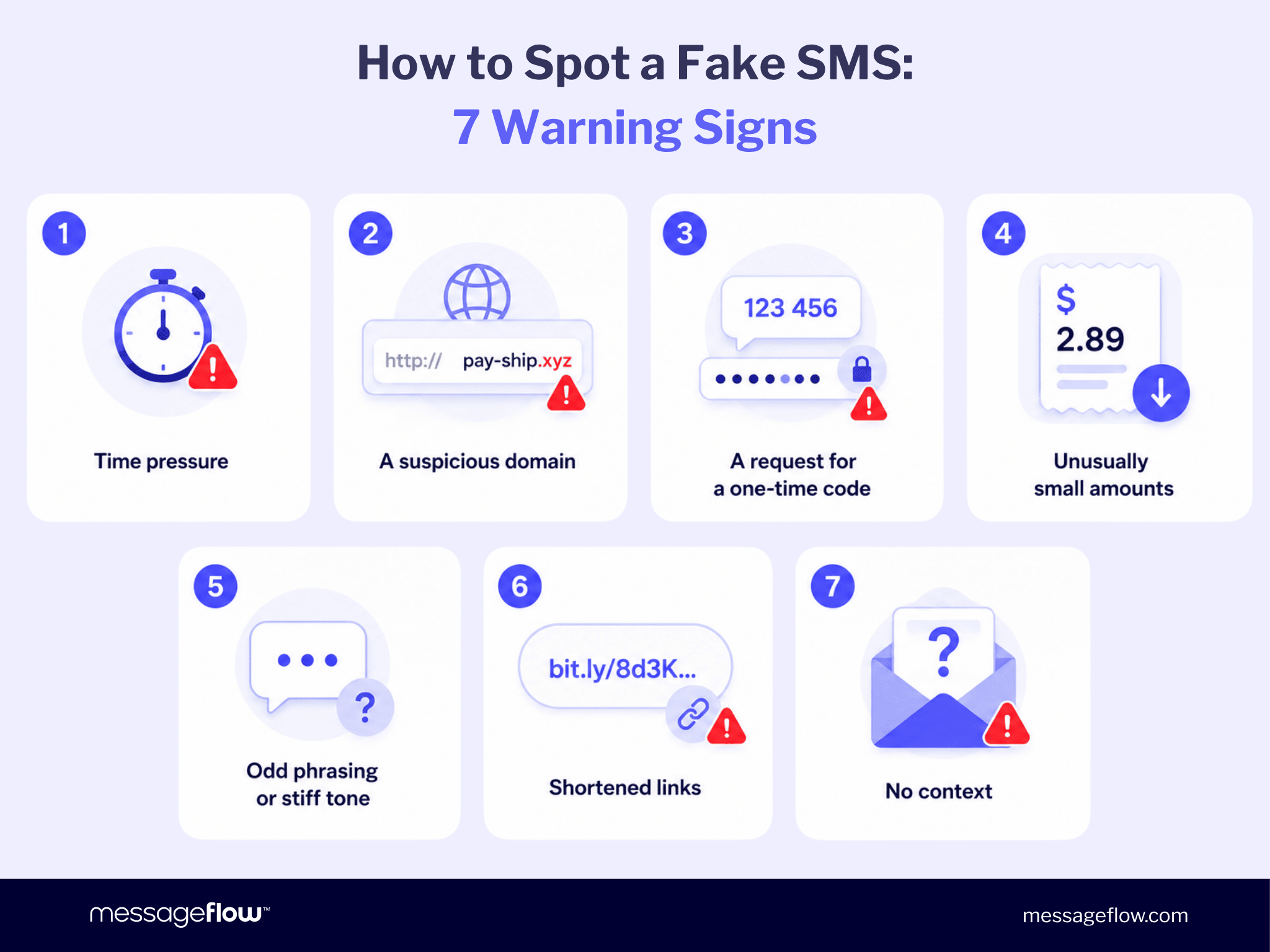
5. Odd phrasing or stiff tone
Typos and awkward wording still show up in some scam texts, but they’re no longer a reliable tell. Modern smishing campaigns are frequently well written, with no obvious errors. Clean copy doesn’t mean a safe message.
6. Shortened links
A shortened URL hides the real destination. The recipient sees a short string of characters with no way to tell whether it leads to an official page, a fake payment form, or a malicious site. This is exactlyhow legitimate branded short links are built to work differently: the domain itself is part of the trust signal, not something hidden behind it.
For transactional messages, link shortening without a recognizable brand behind it can actually work against trust rather than for it. If a link looks unclear, don’t tap it, and go to the company’s site directly instead.
💡 Want to build trust in your SMS communication and boost campaign CTR at the same time? Learn more about branded short links and why they lift click-through rates, or see best practices for using short links in SMS campaigns.
7. No context
Fake texts usually reference a delivery, a payment, a frozen account, or a refund the recipient never initiated. If you’re not expecting a package, didn’t make a payment, or never filed anything with a government office, treat the message with suspicion. A missing context is one of the simplest warning signs there is.
What to Do When an SMS Looks Suspicious
If any of these signals show up, the safest move is to not click the link and not reply to the message.
Instead:
- Go to the sender’s official website directly, by typing the address yourself.
- Check the status in the official app.
- Call the company’s support line.
- Report the suspicious message to the relevant authority or your carrier.
In smishing, timing matters, just not in the recipient’s favor. The scammer is the one who needs you to react instantly.
Why Smishing Is a Problem for Brands, Not Just Consumers
Every impersonation attempt chips away at trust in every future message sent under that same name. A customer who lost money to a fake “courier” text may start ignoring genuine delivery updates too. They might flag legitimate messages as spam, contact support to double-check every notification, or stop trusting SMS from that brand entirely.
That’s especially costly for companies where SMS is core to customer service, including:
- courier and parcel-locker operators
- banks
- insurers
- e-commerce businesses
- utility and subscription service providers
At the same time, falling trust in the SMS channel drags down the performance of every future message, transactional, informational, and promotional alike.
💡 It’s one more reason it’s worth understanding how transactional, informational, and promotional SMS differ and treating each category with the sender discipline it needs.
How to Build Smishing Protection Into Your Business
Effective protection against smishing works on three levels:
- technical sender authentication
- real-time monitoring of SMS traffic
- customer education
None of these layers is enough on its own. Together, they cut the risk of brand impersonation, catch suspicious messages before they cause damage, and reduce the number of customers left wondering whether a text is genuine.
Lock down your sender name
On the technical side, the foundation is registering and verifying your sender name, known as a Sender ID, with your SMS provider. This limits the chance that an unauthorized party can use your exact name, or something close enough to fool a customer, in a fraudulent campaign.
This matters most if you regularly send transactional texts: codes, alerts, order statuses, or payment notifications. Recipients should be able to tell at a glance that a message comes from a legitimate source, not an anonymous, random number.
Monitor links and SMS traffic in real time
The second layer is monitoring message content, links, and SMS traffic as it flows.
The system should flag campaigns matching known fraud patterns before they ever reach recipients: suspicious domains, shortened links, brand impersonation attempts, unusual sending patterns, and messages that resemble smishing.
💡 At MessageFlow, this protection is built into our anti-phishing Shield 360. It actively monitors and blocks smishing attempts, malicious links, and brand impersonation in real time, working directly with GSM carriers.
That means protection doesn’t stop once a message is sent. It also covers threats that pop up around your brand’s communication more broadly.
Teach customers what real communication looks like
Technology reduces risk, but it doesn’t replace customer education.
It’s worth regularly reminding customers:
- which sender name your messages come from
- what kind of links you actually use
- what information you will never ask for by SMS
- where they can check a delivery, payment, or request status
- how to report a suspicious message
The better a customer understands your communication patterns, the easier it becomes for them to spot an impersonation attempt.
💡 Clear, consistent opt-in and opt-out practices help here too, since a well-implemented SMS opt-out link reinforces that your messages are transparent and easy to control, unlike a scam text.
Secure SMS sending means controlling the whole pipeline
Protection against smishing shouldn’t stop at a single safeguard. Direct connections with GSM carriers, protection against grey routing, control over sender identity, and traffic quality monitoring all matter just as much.
💡 You can find the full set of protections available on the MessageFlow platform on our SMS marketing page, a good starting point if you’re figuring out what secure, large-scale SMS sending looks like in practice.
RCS as the Answer to Smishing
The biggest weakness of a classic SMS is that a phone number alone isn’t a strong identifier of who’s actually sending the message.
The recipient has no real way to confirm a text genuinely comes from the brand it claims to represent. That leaves two bad outcomes: ignoring a real message out of distrust, or worse, trusting a fake one that’s impersonating a real company.
RCS Business Messaging solves this problem at the source. Before a brand can send RCS messages, it goes through a multi-step identity verification process run by the mobile carrier and the messaging integrator.
That means every conversation can carry a full brand profile:
- logo
- full company name
- a verified sender profile
- a badge confirming authenticity
The recipient sees right away they’re talking to a real, verified company, not an anonymous number that’s trivially easy to fake. That significantly shrinks the space available for brand impersonation and helps rebuild trust in mobile communication.
💡 We break down the verification process and the full list of channel safeguards in more detail in our guide to RCS vs. SMS, including how RCS’s security features compare to standard SMS.
MessageFlow: An Official RCS Business Messaging Partner
MessageFlow is an official RCS Business Messaging partner. That means companies using MessageFlow get access to branded rich cards, a verified sender profile, and high-resolution media, without having to build a partnership with Google from scratch.
In practice, a business can launch a safer, more recognizable communication channel within weeks by tapping into infrastructure that’s already in place. There’s no need to go through certification independently or build the technical backend from zero.
💡 Still weighing which channel fits your use case? Start with a plain-language breakdown of what RCS actually is and how businesses can implement it with a verified sender.
SMS Spoofing and Phishing: Recognizing and Preventing Smishing Attacks
Smishing keeps climbing year over year. Couriers, banks, and online retailers are among the most frequently impersonated brands in these attacks, simply because their customers already expect a steady stream of texts about deliveries, payments, codes, order statuses, or account changes.
This isn’t just a problem for a consumer’s wallet. It also hits the reputation of whichever brand the scammer decided to wear as a disguise.
Every fake SMS raises the odds that a customer starts ignoring your legitimate messages, flags them as spam, or contacts support just to confirm whether a text is real. That’s why defending against smishing shouldn’t be treated purely as an IT security issue. It’s also about protecting trust in the SMS channel and in your brand’s communication as a whole.
MessageFlow supports some of the largest SMS senders in the market, across both transactional and marketing communication. We support high-volume sending while keeping security, deliverability, regulatory compliance, and sender reputation front and center.
💡 If SMS is a critical channel for your organization, it’s worth building it on a partner who understands the risks, the carrier processes, and what large brands actually need. Talk to a MessageFlow expert and see how to run secure SMS and RCS communication at scale.
Frequently Asked Questions About Smishing
Phishing is the broad category of scams where someone impersonates a trusted company, institution, or person to steal data. Smishing is the version carried out over SMS. The attacker leans on the short format, time pressure, and the built-in trust people place in mobile texts to get a recipient to click a link, hand over login details, a card number, or a one-time code.
The safest approach is to never click the link in the message. Instead, go directly to the carrier’s official website or use their tracking app, and type in the tracking number yourself rather than following a link from the text. A legitimate courier should never ask for card details by SMS in exchange for a small delivery fee. If a message pushes you to pay quickly, treat it as a warning sign.
Don’t enter any information on the page the link leads to. If you already typed in card details, a login, a password, or a one-time code, contact your bank’s support line immediately. Block your card, account, or online banking access first, then report the incident to the police.