TL;DR: SMS is a text-only format capped at 160 characters per segment. MMS extends it with images, GIFs, video, and longer text, but costs roughly 3x more and requires mobile data on the recipient’s device. SMS wins on reach, reliability, and cost. MMS wins on engagement and brand impact. This guide gives you the technical specs, the numbers, and a decision framework to pick the right format every time.
MMS campaigns generate 52% higher click-through rates than SMS. They also cost about three times as much per message. That gap is exactly where most mobile marketing decisions go wrong.
Some brands overspend on MMS for campaigns where a plain text alert would convert just as well. Others stick with SMS for product launches where a single image would do all the heavy lifting. Both mistakes are avoidable.
This guide covers the technical differences between SMS and MMS, the real cost and deliverability tradeoffs, and a practical decision framework so you can make the right call for your next campaign in under two minutes.
SMS and MMS: Technical Specs at a Glance
What is SMS?
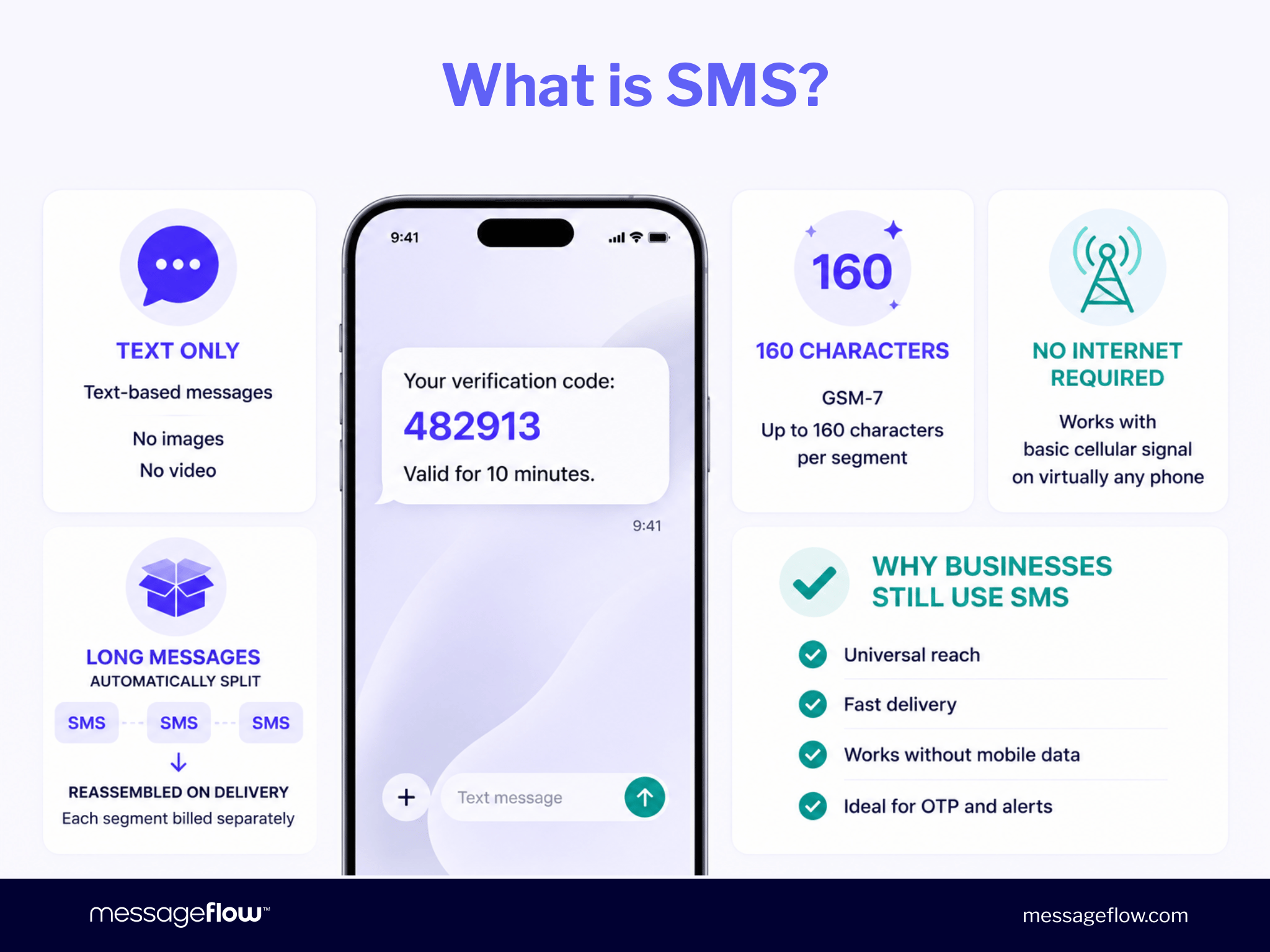
SMS (Short Message Service) is the text-only messaging protocol that’s powered mobile communication for decades. Each message supports up to 160 characters using GSM-7 encoding (the standard Latin alphabet). If your message includes emoji, accented letters, or special symbols, it switches to Unicode encoding and drops to 70 characters per segment.
Longer messages are automatically split into multiple segments and reassembled on delivery. Each segment is billed separately.
SMS requires only a basic cellular signal. No mobile data, no internet connection, no app. That’s what makes it the most universally reliable messaging format available.
💡 For a detailed breakdown of how SMS message categories work (transactional, promotional, conversational), see types of SMS messages.
What is MMS?
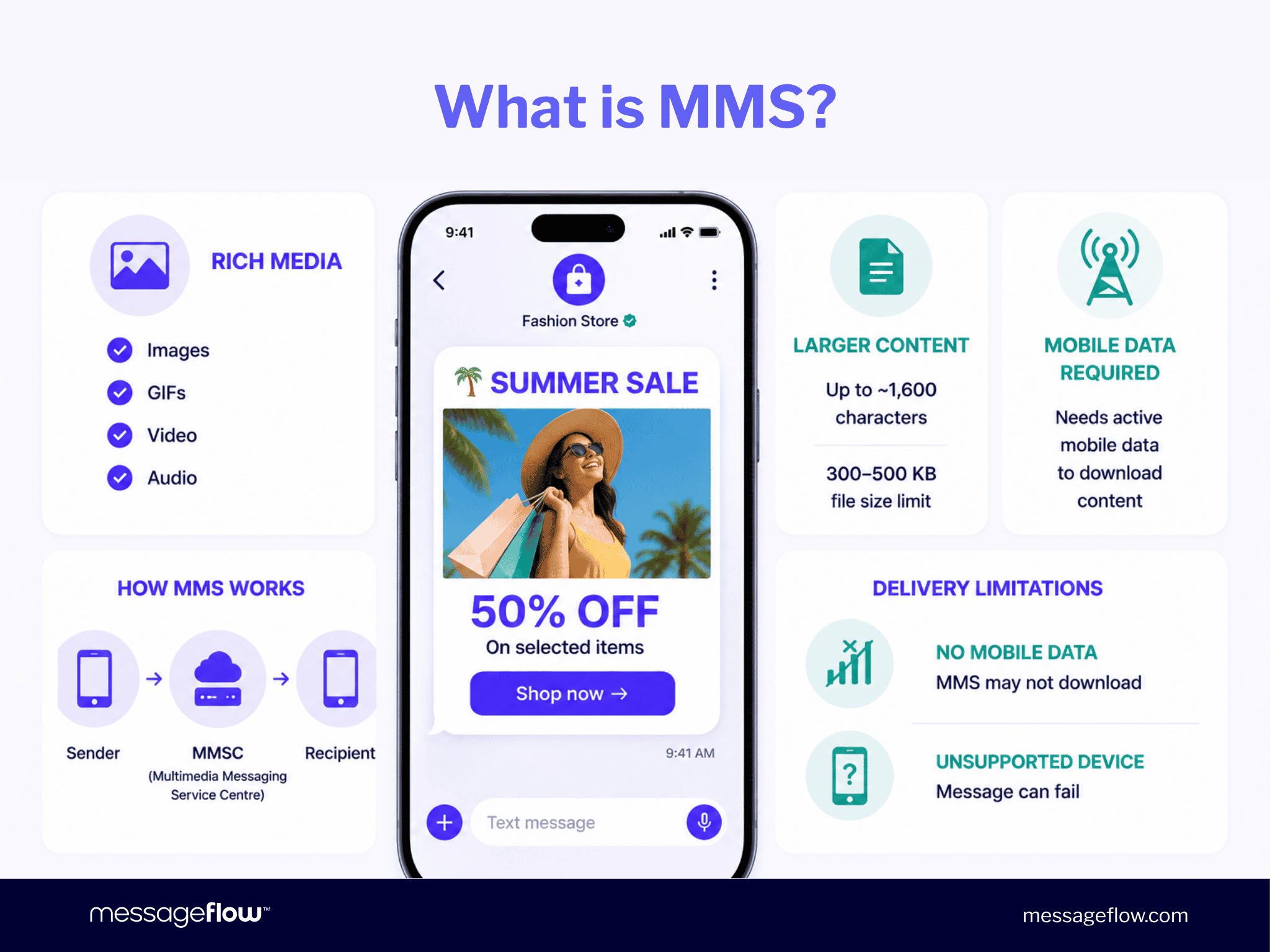
MMS (Multimedia Messaging Service) extends SMS to support images (JPEG, PNG, animated GIF), video (MP4, short clips), audio, and longer text, up to around 1,600 characters. Maximum file size is 300-500 KB depending on the carrier and recipient device.
Unlike SMS, MMS requires active mobile data to download the content. Messages are routed through an MMSC (Multimedia Messaging Service Centre), the relay infrastructure that handles delivery across networks. If the recipient’s device lacks data or isn’t MMS-capable, the message can fail silently.
SMS vs MMS: Side-by-Side Comparison
| Feature | SMS | MMS |
|---|---|---|
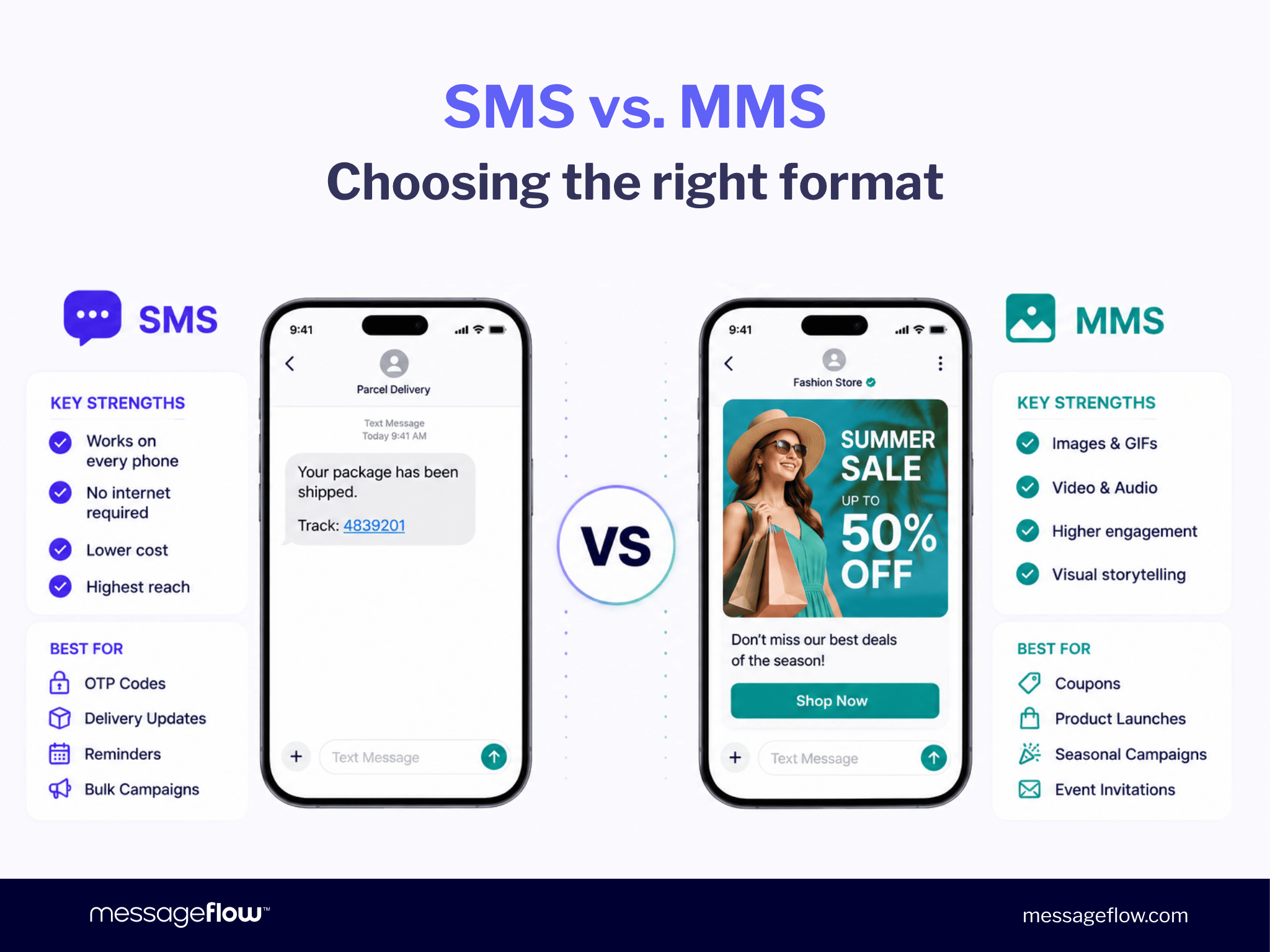
| Character limit | 160 (GSM-7) / 70 (Unicode) | Up to ~1,600 |
| Multimedia support | Text only | Images, GIFs, video, audio |
| Max file size | N/A | 300-500 KB (carrier-dependent) |
| Requires mobile data | No | Yes |
| Relative cost per message | Lower (baseline) | ~3x higher |
| Deliverability | Higher, works on all devices | Slightly lower, needs data and MMS-capable device |
| A2P registration (US) | Required (10DLC) | Required (10DLC) |
| Best for | Alerts, OTP, reminders, bulk | Visual promos, coupons, launches |
| Engagement vs SMS baseline | Baseline | +52% CTR, +20% opt-in |
Cost breakdown: when MMS spend is justified
MMS costs roughly 3x more per message than SMS. For a bulk campaign of 100,000 messages, that difference adds up fast.
The math works in MMS’s favor when the campaign goal depends on engagement rather than pure reach. MMS opt-in rates run 20% higher than SMS-only campaigns, and MMS content gets shared on social media at 8x the rate of SMS text. For a visual product launch or seasonal promotion, the higher cost per send often produces a lower cost per conversion.
For transactional messages, OTPs, or high-volume alerts where the content is operational rather than persuasive, SMS consistently delivers better cost-per-result.
Deliverability differences: why MMS can fail silently
SMS deliverability is near-universal. Any device with a cellular signal can receive an SMS, regardless of data plan or handset age.
MMS is more fragile. Delivery depends on the recipient having active mobile data, an MMS-capable device, and a carrier that supports MMS routing. When any of those conditions aren’t met, the message often fails without generating an obvious error in your reporting dashboard. That’s called a silent failure and it’s harder to detect than a hard bounce.
To catch it, track your MMS-specific delivery rates separately from SMS. A meaningful gap between send volume and confirmed deliveries usually points to a data or device compatibility issue in that segment.
When to Use SMS: Campaign Types That Work Best
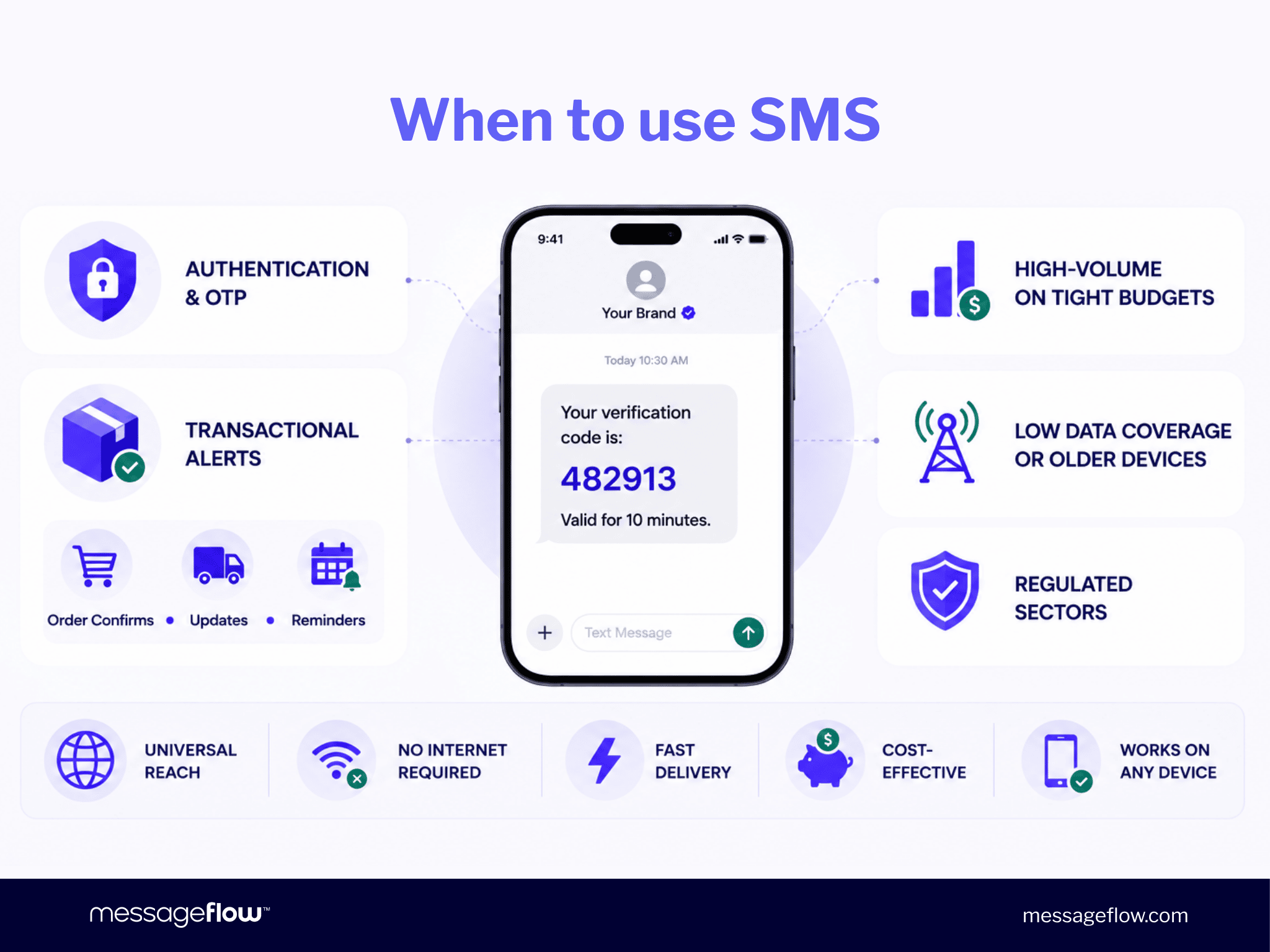
SMS is the right format when reliability and reach matter more than visual impact.
Authentication and OTP
One-time passwords and verification codes need to arrive fast and on every device. SMS works without data, which means it reaches users even in low-coverage areas or on older handsets. Speed and universality outweigh the need for visuals here.
Transactional alerts
Order confirmations, shipping updates, and appointment reminders carry information that customers expect quickly. The message content is what matters, not how it looks. SMS delivers that information on any device, without requiring the recipient to have mobile data enabled.
High-volume campaigns on tight budgets
If you’re sending to 500,000 contacts and the message is a short discount code or a flash sale alert, the 3x cost difference for MMS adds up significantly. When the copy can do the job alone, SMS delivers a better cost-per-result.
Low data coverage or older device segments
If your audience skews older or operates in regions with patchy mobile data, SMS is the safer format. MMS simply won’t reach these recipients reliably.
Regulated sectors
Finance, healthcare, and pharma campaigns often benefit from simpler message formats. Shorter, text-only content is easier to review, approve, and document for compliance purposes.
💡 For how these SMS notifications perform across specific industries, see SMS marketing benchmarks by industry.
When to Use MMS: Campaign Types That Work Best
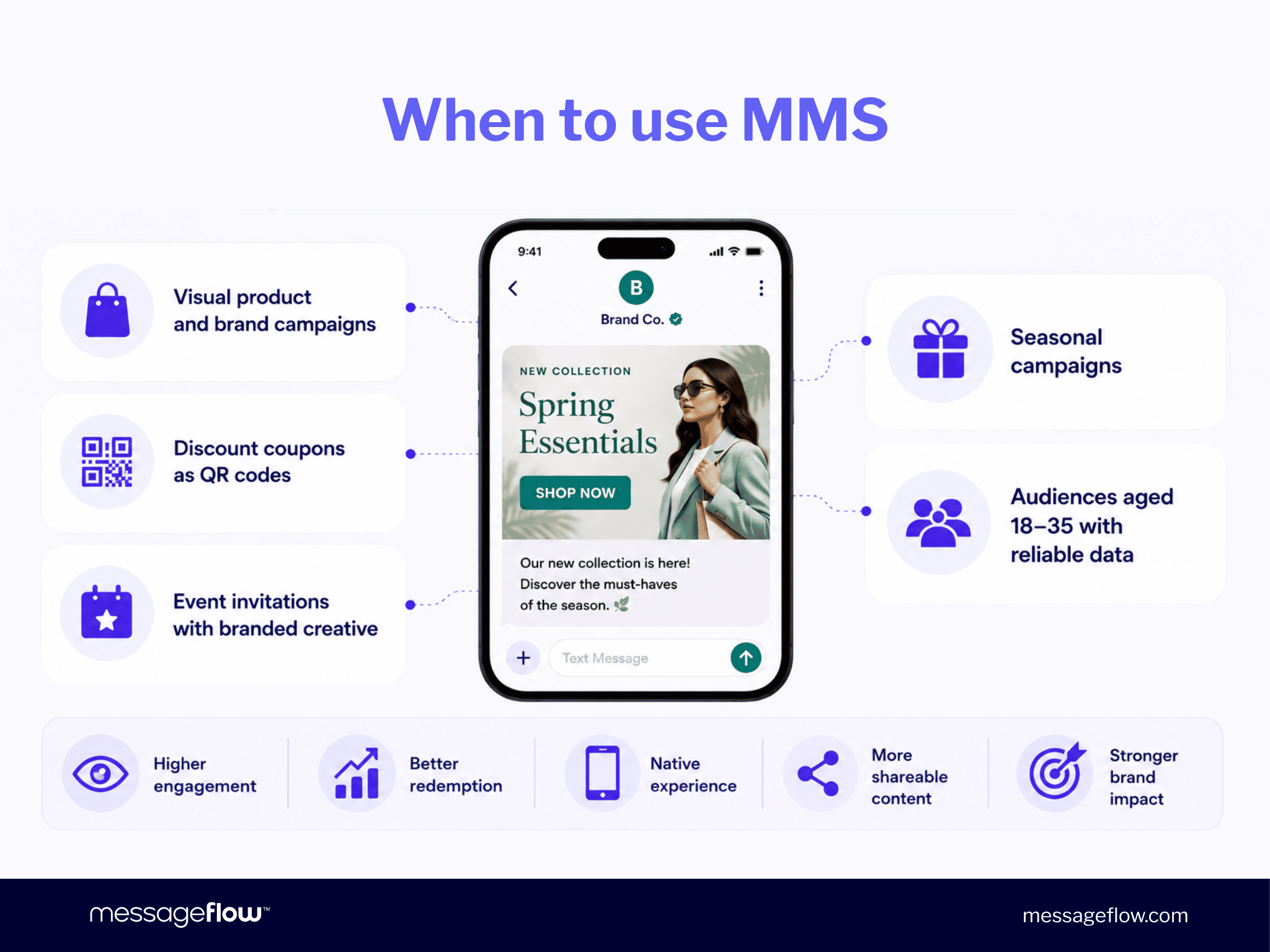
MMS is the right format when the visual is the message, not just decoration.
Visual product and brand campaigns
If you’re promoting a new collection, a limited edition product, or a brand refresh, an image communicates in one second what a sentence can’t. MMS delivers that image directly to the native messaging app, no app required.
Discount coupons as QR codes
A single MMS image carrying a scannable QR code replaces a URL, an instruction, and a tap. It’s a cleaner user experience and tends to generate higher redemption rates than a text-only code.
Event invitations with branded creative
When the visual identity of your event is part of the draw, MMS puts that creative directly in front of the recipient. A concert, brand event, or launch party invitation lands differently as a designed visual than as plain text.
Seasonal campaigns
Black Friday, holiday promotions, and back-to-school pushes benefit from the emotional impact that visuals create. A well-composed image with a single CTA often outperforms the equivalent text message for these high-competition windows.
Audiences aged 18-35 with reliable mobile data
Younger audiences on modern handsets with consistent data access are the sweet spot for MMS. They’re more likely to have data enabled, more likely to engage with visual content, and more likely to share it.
💡 For specific MMS campaign tactics and revenue benchmarks, see how to increase sales with MMS.
SMS vs MMS for Marketing: The Numbers
MMS engagement lift
MMS consistently outperforms SMS on engagement metrics when the format is matched to the right campaign type.
MMS generates 52% higher CTR than SMS in direct campaign comparisons. Opt-in rates for MMS campaigns run 20% higher than SMS-only strategies. And MMS content is shared on social platforms 8x more often than SMS text messages.
The average MMS CTR sits around 15% in active marketing campaigns, according to SignalWire internal data.
SMS baseline
SMS isn’t weak on engagement either. 98% of SMS messages are opened, with 95% read within three minutes of delivery. CTR across industries ranges from 19% to 36%, with most businesses reporting 21-35%.
SMS ROI benchmarks run $21 to $41 per dollar spent, with peak seasonal campaigns reaching up to $71.
When MMS engagement does not justify the cost
MMS lift is real, but it’s conditional. For transactional sends, OTPs, and operational alerts, the visual doesn’t change the conversion action. A shipping notification doesn’t need an image. An appointment reminder doesn’t benefit from a GIF. In these cases, MMS adds cost without adding results.
The decision rule is simple: if removing the visual from your message doesn’t reduce its effectiveness, use SMS.
SMS vs MMS: Decision Framework
SMS is best for reach, reliability, and cost efficiency. Use it for operational updates, urgent notifications, and high-volume communications where getting the message delivered quickly matters most.
MMS is best for engagement, brand impact, and visual storytelling. Use it when images, graphics, or rich media are essential to communicating your message and capturing attention.
When in doubt, ask yourself one question: what happens if you remove the image?
If the message still delivers its value and makes complete sense, choose SMS. If the image is central to the message and removing it would significantly reduce its impact, choose MMS.
💡 MessageFlow supports both SMS and MMS campaigns from one platform, with direct-to-operator routing for better deliverability and unified reporting across formats. Explore MessageFlow SMS and MMS.
RCS: The Format That Comes After Both
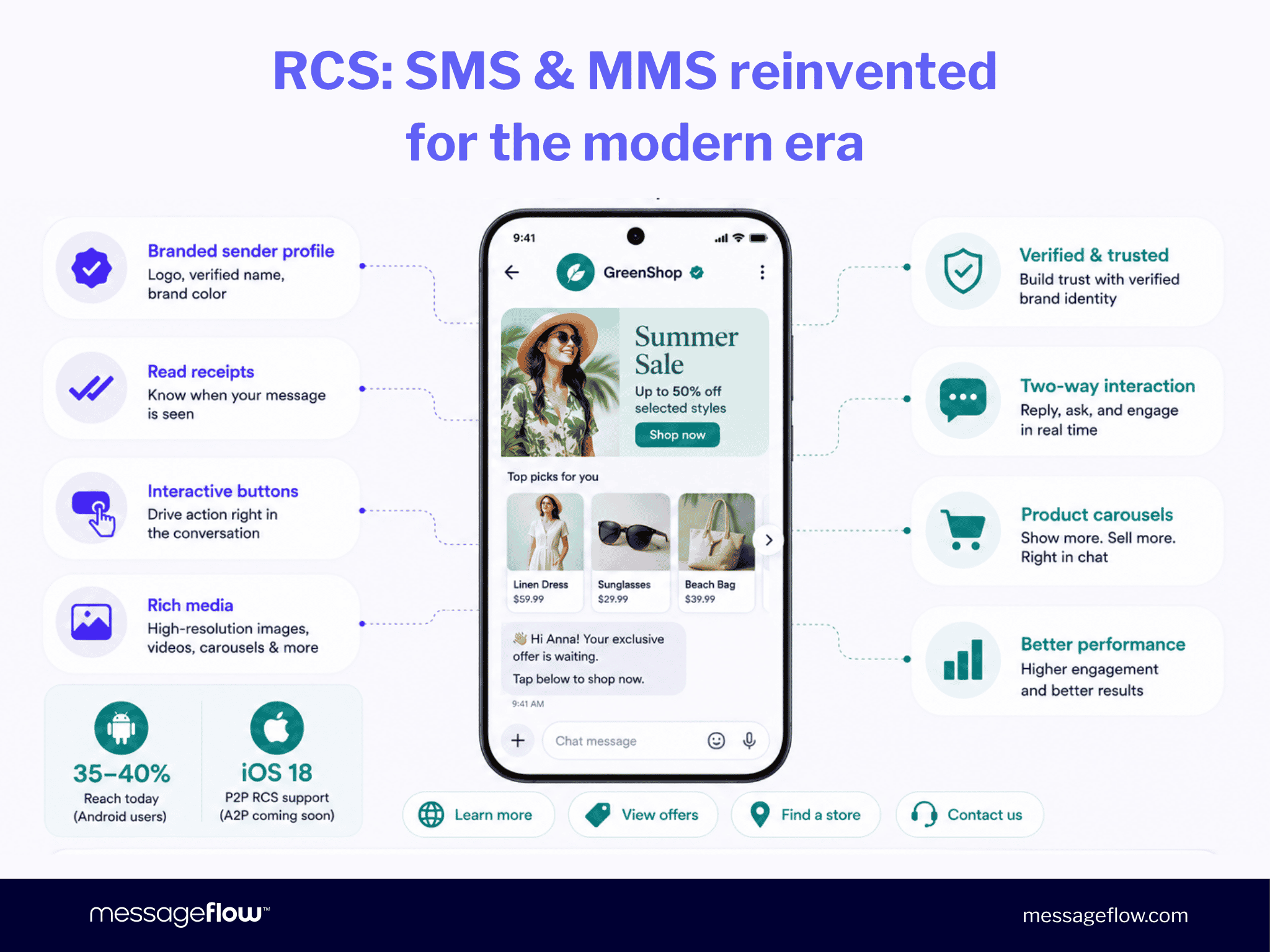
MMS solved the “no visuals in SMS” problem, but it didn’t solve the interactivity problem. File size limits, no read receipts, no branded sender profile, no buttons. These are the limitations that RCS (Rich Communication Services) addresses.
RCS supports branded sender profiles (logo, verified name, brand color), read receipts, interactive buttons, product carousels, and higher-resolution media. It delivers all of this inside the phone’s native messaging app, the same place SMS and MMS land.
As of 2025, Android fully supports RCS Business Messaging through Google Messages. iOS 18 added P2P RCS support between individuals, but RCS A2P campaigns (business-to-consumer) are not yet available to iPhone users in most markets. Real-world campaign reach for RCS currently sits at roughly 35-40% of a typical contact list, with SMS fallback handling the rest automatically.
If you’re running MMS campaigns now and seeing strong engagement, RCS is the natural upgrade path. Start planning when you want higher-resolution media, two-way interaction, or verified branding.
💡 Learn more in RCS vs SMS and RCS with SMS fallback.
Frequently Asked Questions about SMS vs MMS
SMS (Short Message Service) is a text-only format limited to 160 characters per segment, delivered over a cellular signal without internet. MMS (Multimedia Messaging Service) extends SMS to support images, GIFs, video, and audio, with text up to around 1,600 characters and files up to 300-500 KB. MMS requires mobile data to receive. SMS only needs a basic cellular connection.
Use MMS when the message’s value depends on a visual, such as product images, QR code coupons, seasonal creative, or event invitations. MMS generates 52% higher CTRs and 20% higher opt-in rates than SMS-only campaigns. For transactional messages, OTPs, and high-volume sends where budget matters, SMS delivers better cost-per-result.
Standard SMS supports 160 characters using GSM-7 encoding. Messages containing Unicode characters (emoji, accented letters, special symbols) drop to 70 characters per segment. Longer messages are automatically split into multiple 160-character segments, reassembled on delivery, and each segment is billed separately.
Yes. MMS requires active mobile data to download multimedia content. It does not work on Wi-Fi alone. The device must have mobile data enabled. SMS works on any cellular signal with no data plan required, making it more universally reliable across device types and coverage areas.
MMS typically costs approximately 3x more per message than SMS. The higher cost reflects the larger data payload and MMSC relay infrastructure. For visual promotional campaigns with high engagement, the cost difference is usually offset by higher CTR and opt-in rates. For transactional, bulk, or budget-sensitive campaigns, SMS delivers better cost-per-result.
MMS supports images (JPEG, PNG, animated GIF), video (MP4, short clips under around 30 seconds), audio (MP3, WAV), and contacts (vCard). Maximum file size is 300-500 KB depending on the carrier and recipient device. For larger files, link to hosted media via a short URL in an SMS instead.