


Choosing an enterprise URL shortener extends beyond a marketing tooling decision. When it comes to SMS, RCS, and other high-volume messaging channels, short links sit at the intersection of compliance, security, analytics, uptime, and customer trust.
A consumer-grade shortener may be enough for occasional campaign links. Enterprise messaging needs more though: branded or sender-dedicated domains, GDPR-ready data handling, redirect reliability, clean attribution, bot filtering, exportable logs, role-based access, and SLAs that hold up during peak traffic. If any of those fail, the campaign may still appear fine on the surface while clicks, conversions, or compliance controls break behind the scenes.
An RFP for a link shortener or CPaaS vendor should ask questions more nuanced than “Can this tool shorten URLs?”. The real evaluation is whether the vendor can support secure URL shortening for enterprise use cases: custom domains, privacy controls, analytics depth, throughput, and documented governance. Think of this article as your practical buying framework for marketing, IT/security, and procurement stakeholders evaluating vendors together.
The checklist covers the core areas that sift enterprise-grade platforms from generic tools: security and GDPR compliance, analytics and BI readiness, uptime and throughput, vendor red flags, and a fast acceptance test you can run before moving forward.
Security and GDPR compliance: The first RFP filter
Security and compliance should come before feature comparison. If a vendor cannot explain how it handles domain ownership, click data, access control, and privacy obligations, it is not ready for enterprise messaging.
For European buyers, URL shortener GDPR compliance is especially important because short links can generate personal data. A click log may include timestamps, IP addresses, user agents, device information, campaign IDs, and sometimes user-level tokens.
💡 Even when the visible link contains no name, phone number, or email address, the surrounding data can still identify or single out a person.
Ask these questions in the RFP:
| Area | RFP question |
|---|---|
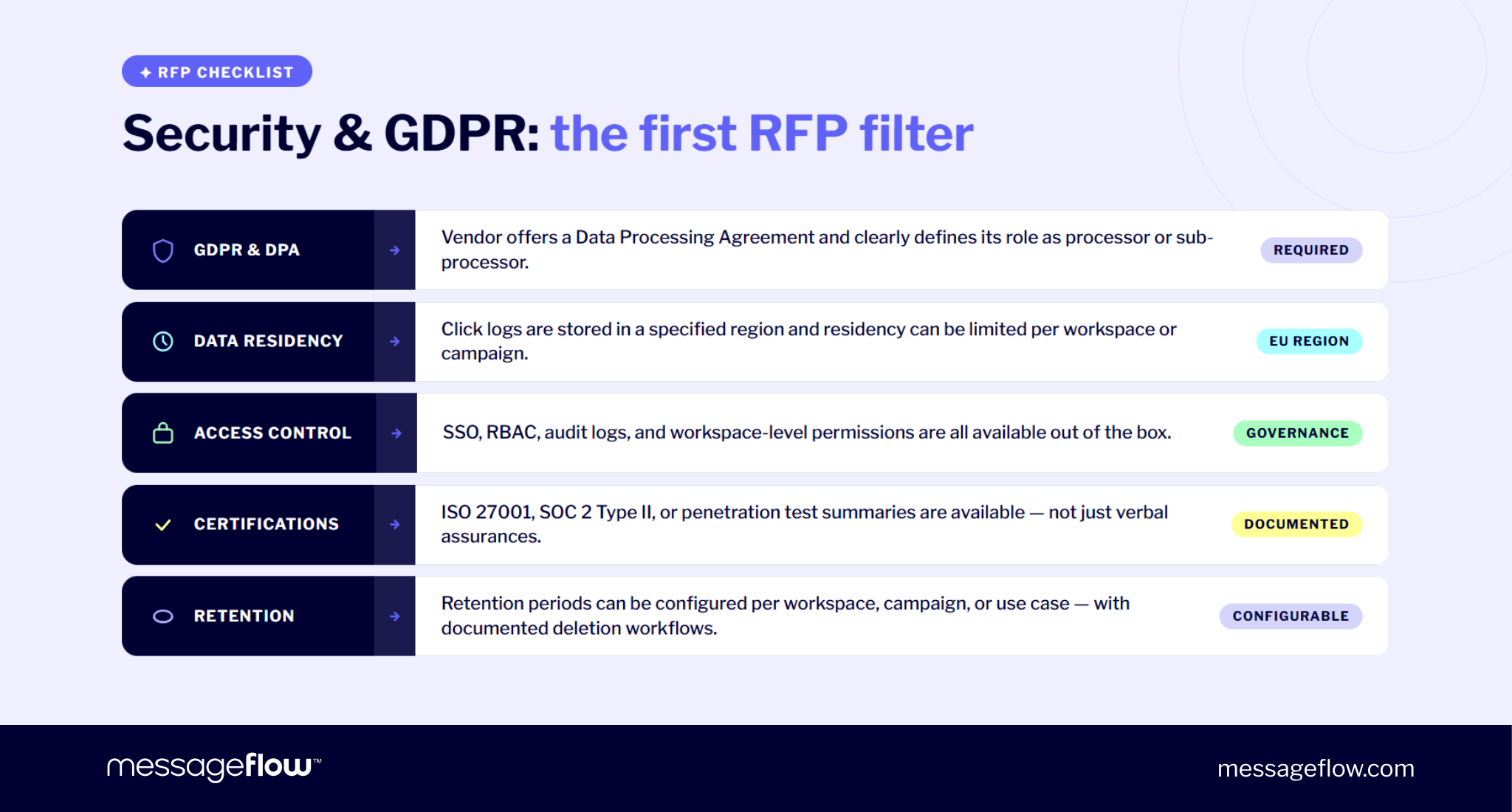
| GDPR and DPA | Do you offer a Data Processing Agreement for EU personal data, and what role do you take as processor or sub-processor? |
| Data residency | Where are click logs stored and can data residency be limited to a specific region? |
| Retention | Can we configure retention periods by workspace, campaign, or use case? |
| Domain model | Do you support brand-owned or sender-dedicated short domains end to end? |
| Access control | Do you support SSO, RBAC, audit logs, and workspace-level permissions? |
| Encryption | Is data encrypted in transit and at rest? Which TLS versions are supported? |
| Certifications | Can you provide ISO 27001, SOC 2 Type II, penetration test summaries, or equivalent evidence? |
| Privacy by design | How do you support consent, data minimization, purpose limitation, and deletion requests? |
The strongest vendors do not answer these with “yes” alone. They provide documentation, security summaries, sample DPA language, retention options, audit trails, and a clear explanation of how link-level data flows through their system.
This is also where a secure URL shortener for enterprise differs from a consumer one. The latter may focus on simple link creation, dashboards, and vanity domains. Enterprise use cases need governance: who can create links, who can edit destinations, who can export click logs, which domains are approved, and how suspicious or non-compliant usage is detected.
White label URL shortener capabilities can matter here as well, especially for agencies, resellers, and multi-brand organizations. The key question is whether each brand or business unit can operate with its own domain, permissions, analytics, and compliance boundaries.
🚩 A useful red flag: the vendor shows public shorteners such as bit.ly or tinyurl in enterprise messaging examples or cannot support your own custom domain.
For high-volume SMS marketing and regulated customer communication, that usually points to a mismatch between the tool’s design and the buyer’s risk profile.
The practical rule is simple: do not move to analytics, pricing, or UX until the vendor has proven that the link layer can pass security and compliance review. For enterprise messaging, URL shortener security compliance is the first gate.
Uptime, throughput, and support SLAs
Short links are small but they sit on a critical path. If the redirect process slows down or fails, the campaign goes down with it. The message may be delivered, the CTA may be visible, and the offer may be valid but the user cannot complete the action.
For enterprise messaging, especially during product drops, seasonal campaigns, payment reminders, ticket sales, or Black Friday traffic, the RFP should treat link infrastructure as production infrastructure.
Ask these questions:
| Area | RFP question |
|---|---|
| Uptime SLA | What uptime SLA applies to the short-link redirect infrastructure and how is downtime measured? |
| SLA credits | What credits or remedies apply if the SLA is missed? |
| Redirect performance | What are the median and 95th percentile redirect response times under load? |
| Burst capacity | How many redirects per second can one domain or workspace handle during traffic spikes? |
| Rate limits | Are there hard redirect limits, API limits, or throttling rules that could affect live campaigns? |
| Regional infrastructure | Do you use regional points of presence, CDN, or edge routing? |
| TLS automation | Who owns certificate issuance and renewal and what alerts prevent expiry incidents? |
| Incident support | What are the response and restore targets for P1 and P2 incidents? |
| Change control | How are maintenance windows, breaking changes, and platform incidents communicated? |
A weak answer here may sound like “best effort” which is not enough for enterprise messaging. A vendor should be able to describe uptime commitments, escalation paths, redirect capacity, certificate ownership, incident communication, and how the platform behaves during sudden traffic bursts.
The key risk is silent failure. A slow or unavailable short link may not break the very campaign so the platform can still show successful delivery. The problem appears down the line as lower CTR, poor conversion, customer complaints, or unexplained revenue loss. By then, the campaign window may already be shut.
Throughput matters for the same reason. Large messaging campaigns create concentrated click spikes. If a million messages go out in a short timeframe, the redirect mechanism may receive a sharp surge of traffic minutes after delivery. The vendor needs to prove that the link infrastructure can handle that pattern, not just average daily traffic.
This is where enterprise CPaaS platforms offer an advantage over lightweight tools. They are already designed around high-volume messaging flows, delivery peaks, campaign monitoring, and support escalation. A standalone shortener will create links alright, but the buyer still needs to verify whether its redirect infrastructure is built for messaging-scale pressure.
🚩 A simple red flag: the vendor can discuss link creation in detail but cannot provide concrete answers about redirect latency, burst behavior, certificate renewal, or P1 support. For revenue-critical campaigns, those are the difference between a link that looks fine in QA and a link that survives production traffic.
Vendor red flags that should stop the evaluation
A weak enterprise vendor usually reveals itself before the contract stage. The issue is that you may notice the warning signs too late because the first demo focuses on link creation, not governance, compliance, data quality, or scale.
Use these as early disqualifiers:
| Red flag | Why it matters |
|---|---|
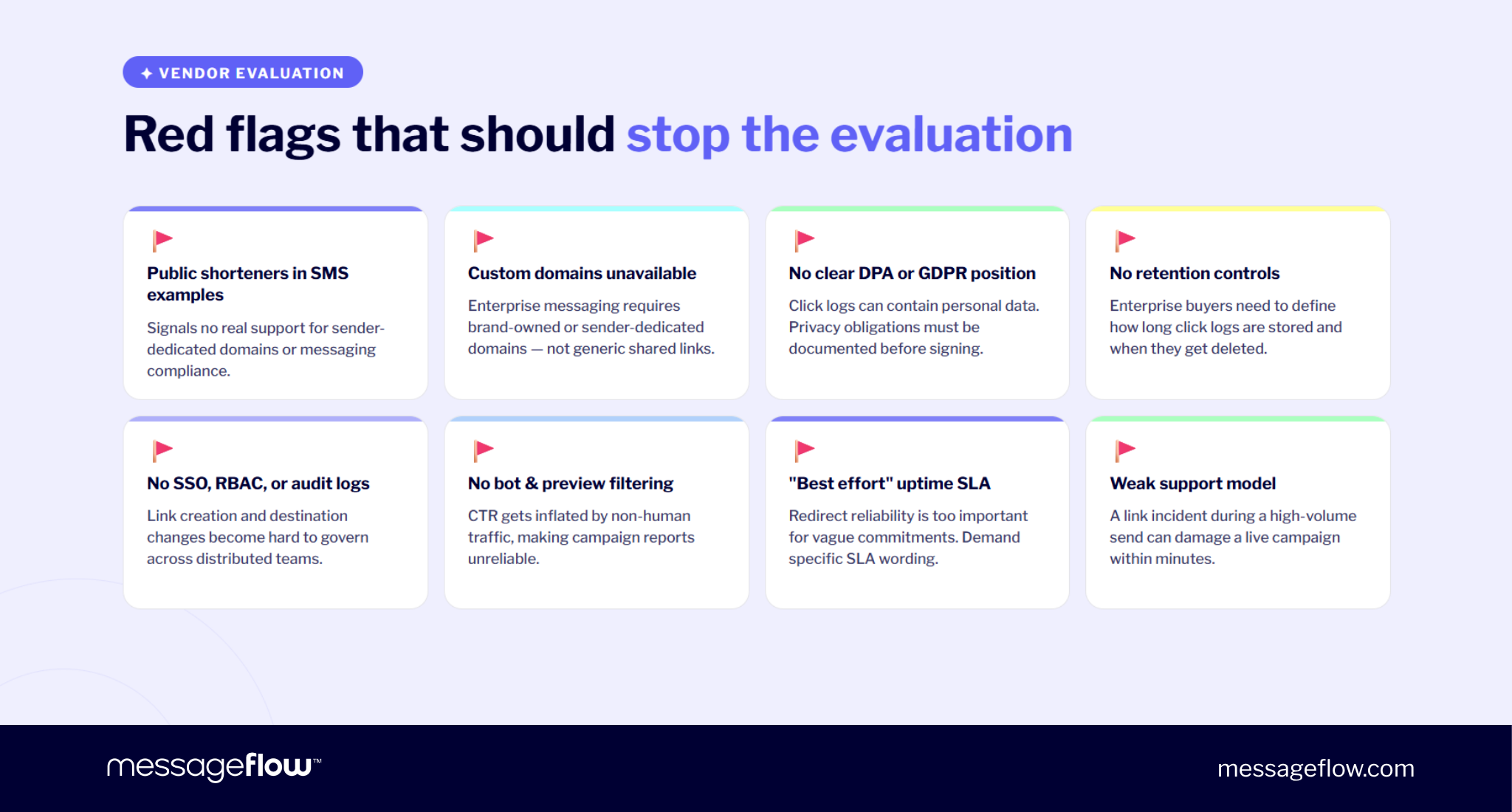
| The vendor uses public shorteners in enterprise SMS examples | It suggests the platform is not built around sender-dedicated domains or messaging compliance requirements |
| Custom domains are unavailable or treated as a workaround | Enterprise messaging needs brand-owned or sender-dedicated domains, not generic shared links |
| No clear DPA or GDPR processor position | Click logs can contain personal data, so privacy obligations must be documented |
| No retention controls | Enterprise buyers need to define how long click logs are stored and when they are deleted |
| No SSO, RBAC, or audit logs | Link creation and destination changes become hard to govern across teams |
| No explanation of bot and preview filtering | CTR may be inflated by non-human traffic, making reports unreliable |
| “Best effort” uptime | Redirect reliability is too important for vague commitments |
| No documented redirect behavior | Campaign links usually need 302 redirects, not permanent routing that may create caching problems |
| Weak support model | Link incidents can damage live campaigns quickly, especially during high-volume sends |
The most unreliable vendors are usually the ones that cannot explain how the system behaves under pressure: traffic spikes, expired certificates, bot traffic, broken destinations, privacy requests, routing changes, or suspicious link activity.
This is also why a CPaaS vendor comparison should not only compare channel coverage or pricing. For enterprise messaging, the link layer affects compliance, campaign performance, attribution, and customer trust. A vendor that looks cheaper at the URL-shortening level may become more expensive if it creates reporting gaps, manual governance work, or campaign risk.
💡 A useful procurement rule: ask every vendor to prove its claims with documentation or a controlled test. If the vendor says it supports GDPR compliance, ask for the DPA and retention controls. If it claims enterprise analytics, ask for schema documentation and raw export samples. If it claims high availability, ask for SLA wording and redirect performance data.
Your decision should rest on whether the vendor can operate that short URL as a controlled, measurable, compliant, and resilient part of the messaging infrastructure.
Fast acceptance test before signing
Before choosing an enterprise URL shortener or CPaaS vendor, run a small proof test that validates the claims made in the RFP response. The goal is to confirm that the vendor can handle the core workflow under realistic conditions.
A useful acceptance test should cover four essential things:
| Test area | What to validate |
|---|---|
| Custom domain | The branded domain works correctly and is not treated as an add-on workaround |
| SSL and redirects | HTTPS is active, certificates are valid, and campaign links use 302 redirects |
| UTM attribution | The short link redirects to the destination URL without dropping UTM parameters |
| Export readiness | Click data can be exported or streamed in a format your BI team can use |
A simple test setup could look like this:
- Configure a brand-owned short domain, such as go.brand.com
- Create two test links with different slugs and UTM-tagged destinations.
- Send a small controlled campaign to an internal or limited audience.
- Generate normal clicks from different devices.
- Trigger a few known preview or crawler-like requests.
- Compare shortener clicks, GA4 sessions, and conversion events.
- Export the raw click data and review the schema.
The vendor does not need perfect one-to-one reconciliation between every system. That is rarely realistic. But they should be able to explain why the numbers differ: duplicate clicks, blocked cookies, bot filtering, app previews, consent settings, or session attribution rules.
Include at least one destination change in the test. Update the landing page behind an existing short link and confirm that users are routed to the new target. This validates redirect behavior and helps confirm that the vendor understands how branded short links in SMS and other channels work in campaign conditions, especially the difference between temporary campaign routing and permanent URL changes.
The acceptance test should end with a short internal scorecard:
| Criterion | Pass / fail question |
|---|---|
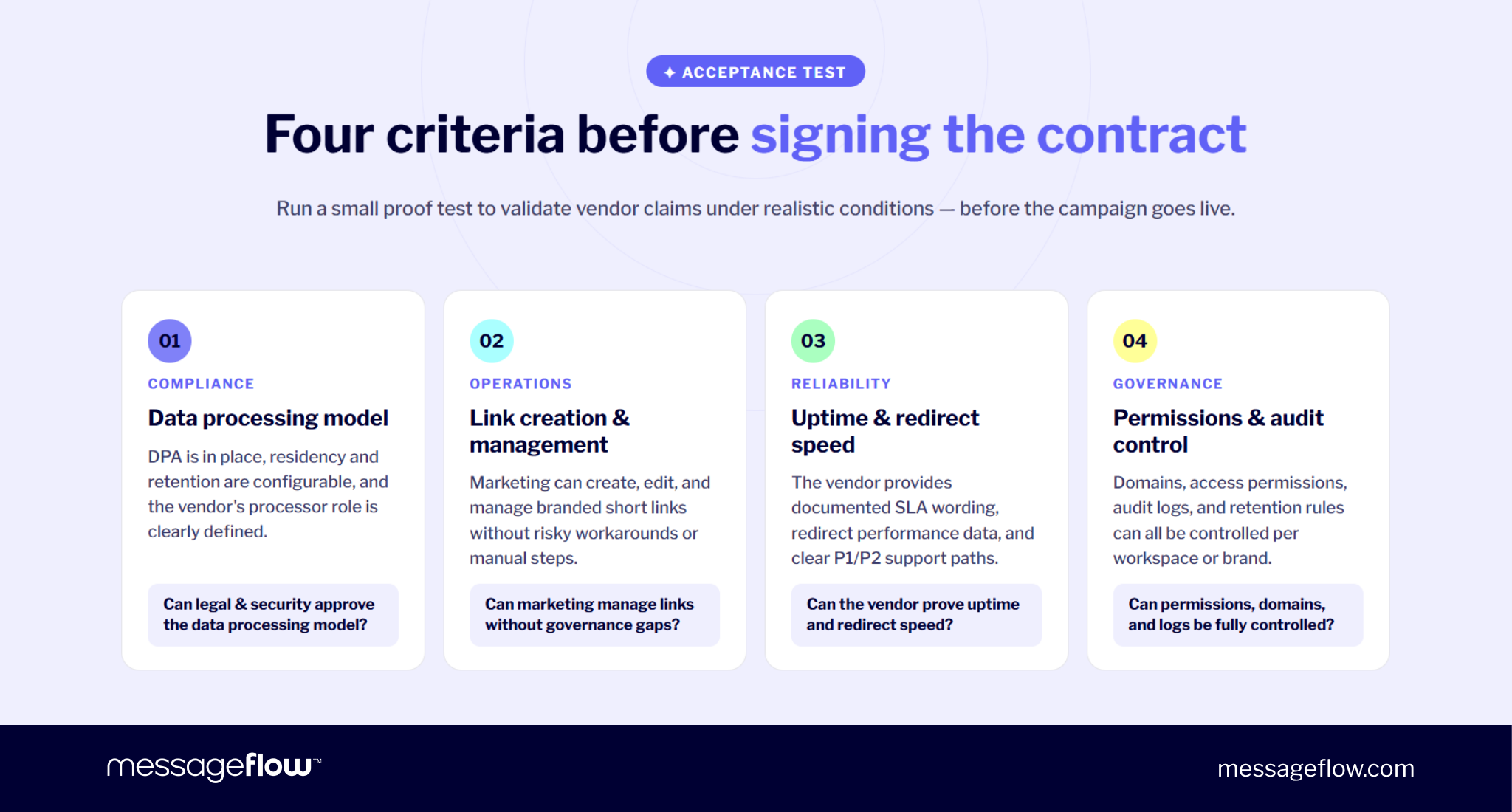
| Compliance | Can legal and security approve the data processing model? |
| Operations | Can marketing create and manage links without risky workarounds? |
| Reliability | Can the vendor prove uptime, redirect speed, and support coverage? |
| Governance | Can permissions, domains, logs, and retention be controlled? |
If the vendor cannot pass this small test, do not assume the issues will disappear at full scale. Enterprise link infrastructure should prove itself before it touches revenue-critical campaigns.
Why these criteria favor enterprise-grade CPaaS platforms
Generic shorteners are often built for convenience: create a short URL, share it, track clicks. That can work for low-risk use cases. Enterprise messaging needs a different standard because the short link is tied to regulated data, high-volume delivery, customer trust, and revenue-critical journeys.
Enterprise-grade CPaaS platforms offer an advantage there. They are already designed around messaging infrastructure, sender identity, traffic peaks, compliance controls, campaign analytics, and support processes.
💡 Link shortening becomes part of the communication stack instead of a separate tool bolted on after the campaign is built.
The difference usually shows up in four areas:
| Area | Generic shortener risk | Enterprise CPaaS advantage |
|---|---|---|
| Compliance | Limited control over data residency, retention, and processor terms | Stronger fit for GDPR review, DPA workflows, and enterprise governance |
| Messaging policy | May rely on shared public domains | Better support for brand-owned or sender-dedicated short domains |
| Scale and support | Uptime and burst behavior may be unclear | Stronger SLAs, escalation paths, and production monitoring |
The right choice for you depends on the use case. If the organization only needs occasional short links for social posts or QR codes, a dedicated shortener may be enough. If the links sit inside SMS, RCS, Viber, or other messaging flows, the requirements change.
For enterprise messaging, the strongest setup will be one where link creation, branded domains, delivery logic, analytics, and support live close together. That reduces operational gaps: fewer exports to reconcile, fewer manual steps, fewer unclear owners when something breaks, and fewer situations where marketing, IT, analytics, and security are each looking at a different piece of the workflow.
MessageFlow link shortener feature fits this type of evaluation when URLs are part of a broader messaging strategy. They support the practical goal behind the checklist: branded, trackable links managed inside a communication platform built for large-scale business messaging rather than one-off clipping.
❓ The final RFP question should be simple: can this vendor prove that short links will remain secure, measurable, compliant, and resilient once the campaign moves from test traffic to production scale? If the answer is not documented, tested, and understood by the buying committee, the risk is still open.
FAQ – Enterprise URL shortener
A consumer URL shortener is built mainly for convenience: shorten a link, share it, and see basic click data. An enterprise URL shortener has to support a broader operating model: branded or sender-dedicated domains, compliance controls, access governance, uptime commitments, and support processes.
The difference becomes especially important in enterprise messaging. SMS, RCS, and Viber campaigns often involve high-volume sends, regulated customer data, and revenue-critical links. In that environment, a shortener is not just a formatting tool. It becomes part of the campaign infrastructure.
Yes, if it processes personal data from EU users. Click logs can include IP addresses, timestamps, user agents, device data, campaign identifiers, and sometimes user-level tokens. Depending on the setup, those signals may qualify as personal data or contribute to user identification.
For URL shortener GDPR compliance, the RFP should ask about the vendor’s processor role, DPA availability, data residency, retention controls, deletion workflows, access permissions, and whether identifiers are minimized or pseudonymized where possible.
At minimum, the vendor should be able to provide credible evidence of security controls. Common signals include ISO 27001 certification, SOC 2 Type II reports, penetration test summaries, encryption in transit and at rest, SSO, RBAC, audit logs, and documented incident response processes.
Certifications do not replace technical review but they make security evaluation easier. A secure URL shortener for enterprise use should be able to show both formal controls and practical safeguards: who can create links, who can change destinations, how logs are protected, and how suspicious activity is detected.
A white label URL shortener lets an organization or agency offer short-link functionality under its own brand, interface, or domain structure. It can make sense for agencies, resellers, multi-brand groups, and enterprise organizations that need separate branded domains, reporting spaces, or permission models for different business units.
For enterprise messaging, white label functionality should not be judged only by branding. The more important question is whether each workspace or brand can operate with proper governance: domain control, access permissions, audit logs, analytics separation, retention rules, and compliance boundaries.