
A lot of email marketing strategy advice you see reads like it was written for someone who already has a functioning program – segment your list, optimize your subject lines, run A/B tests. Useful in isolation but not much help if you’re staring at a blank slate and trying to figure out where to actually begin.
A strategy isn’t a list of tactics. It’s more like logic that connects your audience, your message types, and your sending infrastructure into something that works consistently weeks and months later when the initial enthusiasm has worn off and you need the system to carry itself.
What follows is the sequence that works when you’re building from zero: list first, segmentation second, email types mapped to real customer moments, and measurement focused on the numbers that actually predict growth.
No step requires an enterprise budget or a dedicated email team but each one needs to be done in order, because skipping ahead is the moment your email campaign strategy starts leaking value.
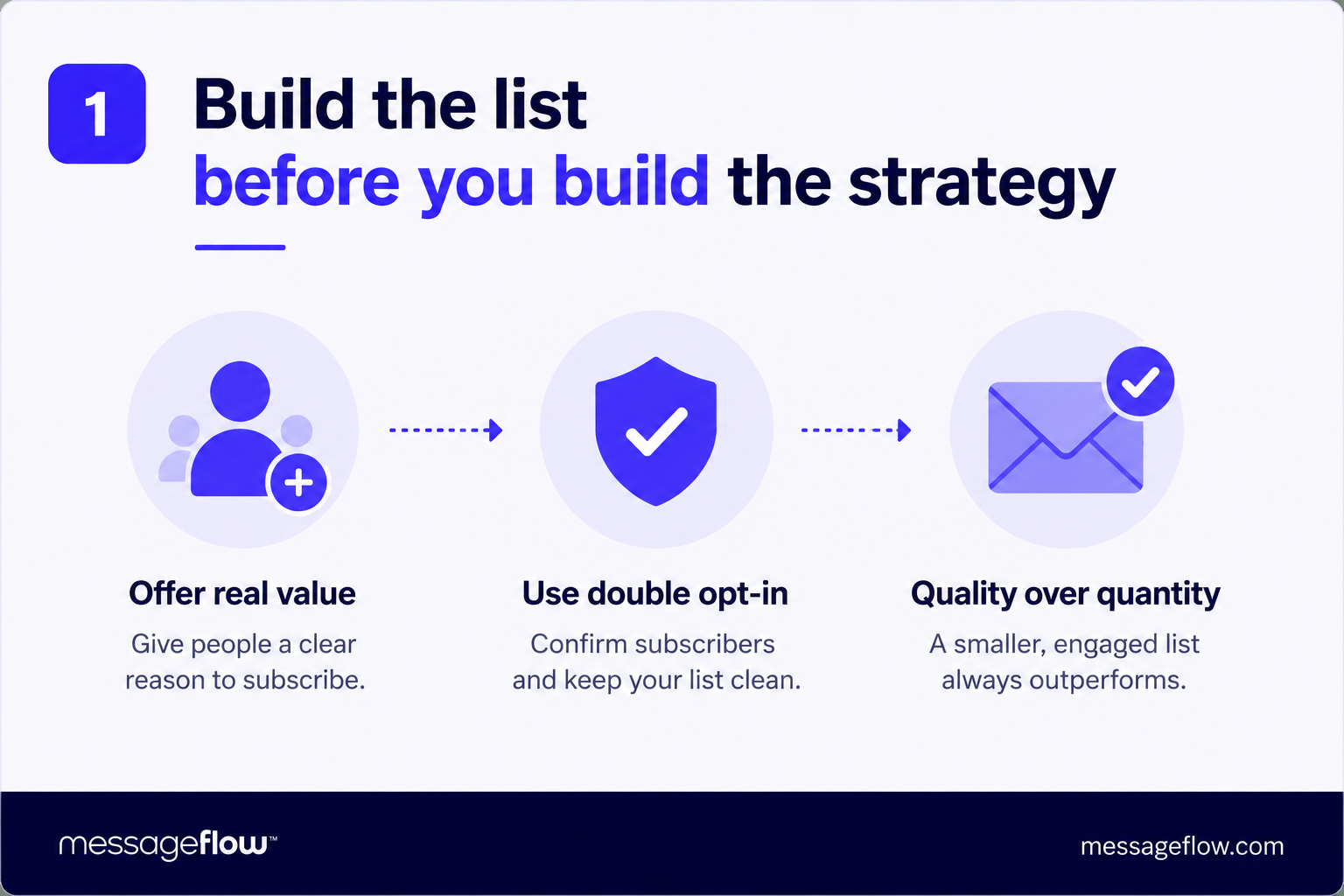
Build the list before you build the strategy
May sound obvious but a surprising number of companies jump straight to campaign planning with a list that’s either too small, too stale, or assembled from questionable sources. The list is your foundation. If the people on it didn’t actively choose to be there, nothing downstream – no clever subject line, no perfectly timed automation – will compensate.
Start with opt-in and make it worth opting into
A signup form on your website is the minimum. The question is what makes someone fill it in. “Subscribe to our newsletter” converts poorly because it promises nothing specific. A concrete value exchange works better: early access to something, a useful resource, a discount with a clear expiration. The offer doesn’t need to be elaborate but it has to be relevant to the audience you actually want on the list.
Use double opt-in
It adds one step to the signup process, asking the subscriber to confirm their address by clicking a link in a verification email. Double opt-in pays off by eliminating typos, blocking fake signups, and giving you a cleaner list from day one. It also provides a clear consent trail, which matters for GDPR compliance and increasingly for email deliverability: inbox providers treat confirmed lists more favorably because they generate fewer complaints.
Resist the temptation to prioritize list size over list quality
A list of 500 people who signed up because they genuinely care about what you send will outperform a list of 10,000 scraped contacts on every metric – opens, clicks, conversions, and sender reputation. Purchased or rented lists are particularly destructive: they spike your bounce rate, trigger spam complaints, and can get your sending domain blacklisted in ways that take months to repair.
Growth matters but it needs to be organic and intentional. Add signup opportunities where they make sense – checkout flows, content downloads, webinar registrations, support interactions – and let the list compound over time. A healthy list grows steadily. A vanity list grows fast and decays faster.
💡 Read more about how to build an email list from scratch.
Segment early, or every send is a guess
The default in an early-stage email marketing strategy is to send everything to everyone. It’s the path of least resistance and it works briefly, when your list is small and new most subscribers are still paying attention. But the window closes fast. The moment your audience starts to feel like they’re getting messages that aren’t meant for them, engagement drops and unsubscribes climb.
💡 Segmentation doesn’t require a data science team or a complex martech stack. What helps is knowing a few things about each subscriber and using that information to decide who gets what.
Start with what you already have
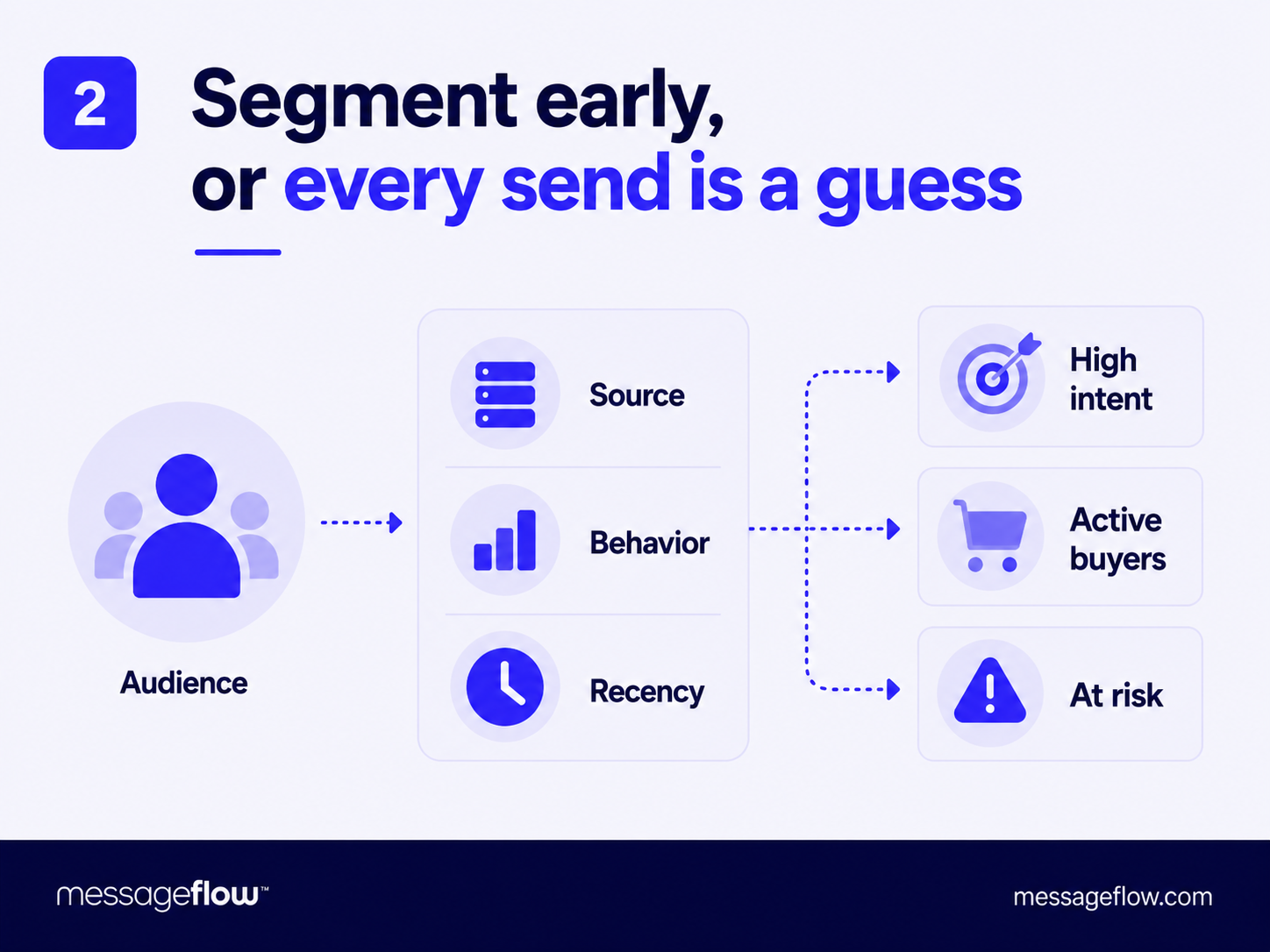
Most companies collect enough data at signup or purchase to power meaningful segments from the start. Where the subscriber came from (which form, which campaign, which product page), what they bought or browsed, and how recently they engaged. These three dimensions alone let you separate high-intent buyers from casual browsers, new subscribers from lapsed ones, and product-specific interest groups from general audiences.
Behavioral signals beat demographic ones
Job title or company size can inform your messaging but what someone does predicts what they want far more reliably than what they are. Someone who opened your last five emails and clicked through to a pricing page is in a fundamentally different place than someone who hasn’t opened anything in two months. Treating them the same wastes both their time and yours.
Keep your segments actionable
A common trap is building dozens of micro-segments that are technically precise but impossible to maintain, each one needing its own content, its own cadence, its own performance tracking.
Three to five well-defined segments that map to real differences in behavior or intent will outperform twenty that nobody has time to feed. You can always split further as volume grows and patterns become clearer.
The goal isn’t personalization for its own sake but rather sending fewer, more relevant emails which, counterintuitively, tends to produce more engagement than sending more emails to more people.
💡 Read more about email personalization and segmentation.
Match your email types to the customer journey
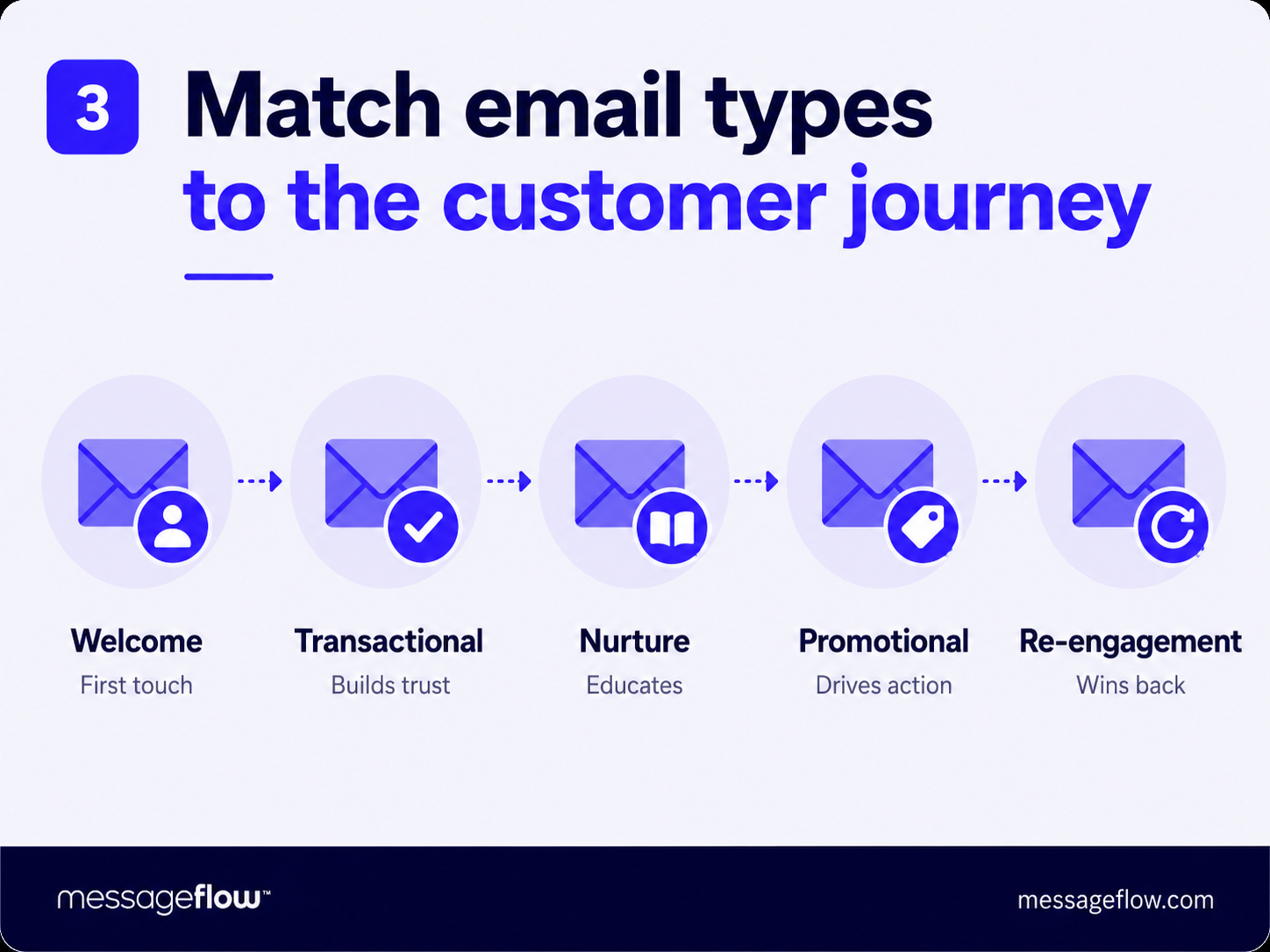
Not every email serves the same purpose, and treating them as interchangeable is a fast way to burn through a good list. Each type of email corresponds to a different moment in the relationship between your business and the person receiving it. Getting the mapping right means the subscriber hears from you when it’s useful instead of just when you have something to promote.
Welcome emails set the tone
The first message someone receives after signing up is the highest-engagement email you’ll ever send.
Open rates north of 50% are common. Use that attention wisely: deliver whatever you promised at signup, set expectations for what’s coming next, and give the subscriber a reason to look for your next message. A welcome email sequence of two to three messages over the first week works better than a single one because it builds a pattern of opening before the novelty fades.
Transactional emails are trust builders
Order confirmations, shipping updates, password resets, account notifications – these are triggered by something the recipient did, which means they’re expected and almost always opened. That makes them powerful. A well-designed order confirmation that’s clear, timely, and on-brand reinforces confidence in the purchase. A sloppy or delayed one does the opposite.
💡 Transactional emails aren’t the place for hard selling but they are the place to demonstrate that your operations work.
Nurture sequences move people toward a decision
Between the moment someone signs up and the moment they buy (or buy again), there’s a gap that companies fill with sporadic promotional blasts. A nurture sequence fills it intentionally using a planned series of emails that educates, builds credibility, and addresses objections over time.
💡 The cadence depends on your sales cycle: a SaaS product with a two-week trial might run a tight five-email sequence, an ecommerce brand with seasonal buying patterns might space touchpoints across months.
Campaigns and promotions are the most visible but least sustainable
Sales announcements, product launches, seasonal offers all drive short-term spikes but can’t be the backbone of your email marketing strategy. If the only time subscribers hear from you is when you want them to buy something, they’ll start tuning out.
The ratio varies by industry, but a useful benchmark is roughly two value-driven emails (educational content, useful updates, tips) for every one promotional send.
Re-engagement emails are your last line of defense
Subscribers going quiet is inevitable. A re-engagement sequence targeted at people who haven’t opened or clicked in 60-90 days gives them a reason to come back before you lose them entirely.
Keep it simple: acknowledge the silence, offer something relevant, and if they still don’t respond after two or three attempts, remove them. A smaller, active list beats a large, unresponsive one every time.
Test what matters, ignore what doesn’t
A/B testing is one of the most talked-about practices in an email marketing strategy and one of the most frequently wasted. Not because it doesn’t work but because people test the wrong things or draw conclusions from samples too small to mean anything.
Subject lines are worth testing
Most other copy tweaks aren’t, at least not early on. The subject line is the single biggest lever on open rate, and open rate determines how many people even see the rest of your email. Testing two subject lines against each other on a meaningful sample (at least a few hundred recipients per variant) will teach you more about your audience in one send than weeks of debating button colors.
💡 Once you have a feel for what language your subscribers respond to – direct vs. curious, short vs. specific, benefit-driven vs. urgency-driven – you can apply that pattern across campaigns instead of testing from zero every time.
Send time matters but less than you think
There’s an entire cottage industry around “the best time to send email,” and the honest answer is that it depends on your audience and their habits. Tuesday at 10am is a fine starting point. But the difference between a good send time and a great one is usually a few percentage points – nowhere near the impact of sending a relevant message to the right segment.
💡 Test it, find your baseline, and move on to higher-leverage questions.
Focus on metrics that connect to outcomes
Open rate tells you whether your subject line and sender name are working. Click-through rate tells you whether the content delivered on the promise. Conversion rate tells you whether the right people are clicking. Revenue per email tells you whether the whole chain is functioning. Track all four, but optimize in that order because a problem at the top of the funnel masks everything below it.
💡 A low click rate might not mean your email content is weak. It might mean your subject line attracted the wrong audience.
Watch unsubscribe rate and complaint rate as guardrails, not goals
You can’t optimize for zero unsubscribes without becoming so bland that nobody engages at all. But a sustained complaint rate above 0.1% is a real problem. Inbox providers use it as a signal to throttle or filter your domain, and once that reputation damage sets in, it’s slow to reverse.
Mistakes that keep email programs stuck
Email marketing plans rarely see dramatic falls. They stall and the reasons tend to be structural rather than creative.
Sending without a calendar
When you have no plan for what goes out and when, email becomes reactive: someone in marketing remembers it’s been a while, throws together a campaign, and hits send. The result is inconsistent frequency, inconsistent quality, and subscribers who never develop the habit of opening.
A simple content calendar – even a spreadsheet with dates, email types, and audience segments – creates enough structure to prevent the feast-or-famine cycle.
Over-mailing the full list
This is the flip side of having no calendar: compensating for past silence with a burst of activity. Five emails in a week to your entire list after a month of nothing will spike unsubscribes and complaints faster than almost any other mistake. If you’ve been quiet and want to ramp up, increase frequency gradually and start with your most engaged segment.
Treating deliverability as someone else’s problem
A strategy can be brilliant on paper and still underperform if the messages end up in spam. Deliverability isn’t based on set-and-forget technicals. It’s an ongoing function that depends on list hygiene, authentication records, complaint rates, and sending patterns. Ignoring it until open rates collapse means you’re already months behind on the fix.
Never pruning the list
Every list accumulates dead weight: addresses that bounce, subscribers who stopped opening, people who signed up for a one-time offer and were never going to engage again. Keeping them inflates your numbers but drags down every performance metric and ]erodes your sender reputation. A quarterly cleanup involving removing hard bounces, suppressing long-term inactives is one of the highest-ROI activities in email marketing strategy, and it takes an afternoon.
Where infrastructure meets strategy
A good strategy gets you to the right message, for the right person, at the right time. But the message still needs to arrive – reliably, at scale, and into the inbox rather than the spam folder.
That’s the infrastructure side of the equation and it’s where businesses quickly outgrow their initial setup. MessageFlow handles high-volume email delivery through API and SMTP, with built-in deliverability monitoring – and when you’re ready to add SMS, RCS, or push to the mix, it’s already there. If that’s where you’re headed, let’s talk.