
An email list is a database of people who have given you explicit permission to send them messages. Unlike your social media following which lives on rented land, subject to algorithm changes and platform decisions, your email list is an asset you own outright. No policy update can erase your audience overnight.
That ownership matters more than most marketers realize. Email marketing still returns an average of $36-42 for every $1 spent, making it the highest-ROI channel available to most businesses. And with 4.6 billion email users worldwide in 2025, the addressable audience isn’t shrinking anytime soon.
In this guide, you’ll learn what an email list actually is (and isn’t), how to build one from zero using proven methods, how to stay compliant with GDPR and other privacy regulations, as well as how to maintain list quality so your campaigns keep landing in inboxes.
What is an email list and why does it matter?
At its simplest, an email list is a collection of email addresses belonging to people who have opted in to hear from you – prospects, customers, readers, or anyone who raised their hand and said “yes, send me that”.
That distinction – permission-based contact – is what separates a real email list from a purchased database or a spreadsheet of scraped addresses. One is a relationship. The other is spam waiting to happen.
Owned vs. rented audiences
Every follower you have on Instagram, LinkedIn, or TikTok exists at the platform’s discretion. Organic reach on Facebook has declined steadily for over a decade. X’s algorithm changes can bury your content without warning. You don’t control the distribution.
Email is different. When someone joins your list, you have a direct line to their inbox. No pay-to-play model gating your reach. That’s why 4 out of 5 marketers say they’d rather give up social media than email marketing.
The numbers behind the channel
Email’s dominance isn’t anecdotal. The data is consistent across industries and company sizes:
- Email marketing generates $36-42 in revenue for every $1 spent, according to Litmus and HubSpot’s 2025 data. Nearly 1 in 5 companies report ROI exceeding 7,000% ($70 per $1).
- 81% of small businesses name email as their primary customer acquisition channel.
- Segmented email campaigns produce up to 30% more opens and 50% more clicks than non-segmented sends.
- 60% of consumers say email is their preferred channel for hearing from brands.
These aren’t niche findings. Email remains the #1 ROI channel for B2C brands according to HubSpot’s State of Marketing 2025 report, and with 376 billion emails sent daily, the channel is far from saturated for senders who earn attention rather than demand it.
If you’re serious about building an audience you actually control, and reaching them in a channel they already check three to five times a day, building an email list isn’t optional. It’s fundamental. Here’s how to go about it right.
What you need before you start building
Before you publish a single opt-in form, a few foundational pieces need to be in place. Skipping this step is how you end up with a list of random contacts and no strategy for what to do with them.
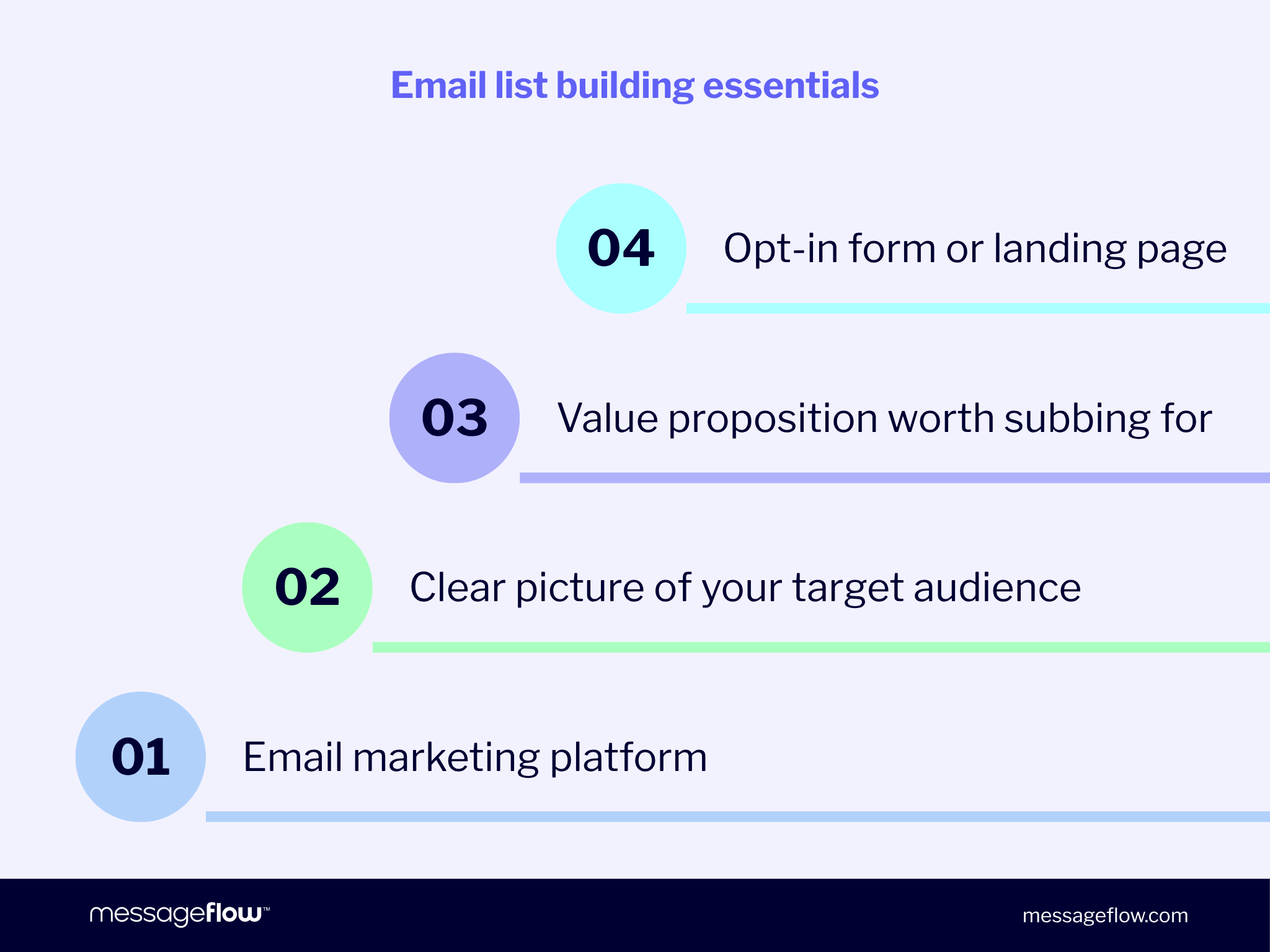
An email marketing platform
You need infrastructure – a platform that can store contacts, manage consent, segment your audience, and send campaigns with reliable, high deliverability. This is where your list lives and where every campaign originates, so the choice matters.
Look for a platform that gives you control over sender authentication (SPF, DKIM, DMARC), offers segmentation and automation, and maintains high inbox placement rates. If you’re evaluating options, MessageFlow’s email marketing platform is built for exactly this – secure, high-volume sending with 99% deliverability.
Don’t overthink this to the point of paralysis but don’t default to the first free tier you find either. Switching platforms later means migrating contacts, rebuilding automations, and re-warming your sender reputation. Get it right early.
A clear picture of your target audience
“Everyone” is not an audience. Before you start collecting email addresses, define who you actually want on your list. What role do they hold? What problems do they face? What kind of content would make them glad they subscribed?
The tighter your audience definition, the easier everything downstream becomes. Your lead magnet will be more compelling, your copy will be sharper, and your eventual campaigns will convert better because you built the list with intent, not just volume.
A value proposition worth subscribing for
People protect their inboxes. “Subscribe to our newsletter” is not a reason strong enough to hand over an email address – it’s a description of a format, not a promise of value.
You need a clear answer to the question every visitor silently asks: “What’s in it for me?” That might be exclusive insights they can’t find on your blog, early access to product launches, a weekly breakdown of industry data, or a one-time resource that solves an immediate problem. Whatever it is, make it specific and make it obvious.
An opt-in form or landing page
Finally, you need a mechanism to actually collect addresses. This can be as simple as an embedded form on your blog sidebar or as polished as a dedicated newsletter landing page built for paid traffic.
We’ll cover specific formats and tactics in the next section but the key principle is this: the form should appear where your target audience already spends attention, with copy that communicates your value proposition in one clear sentence.
Get these four elements in place and you’re building on solid ground. Skip them, and you’ll spend months collecting addresses that never convert into engaged subscribers.
How to build an email list – 6 proven methods
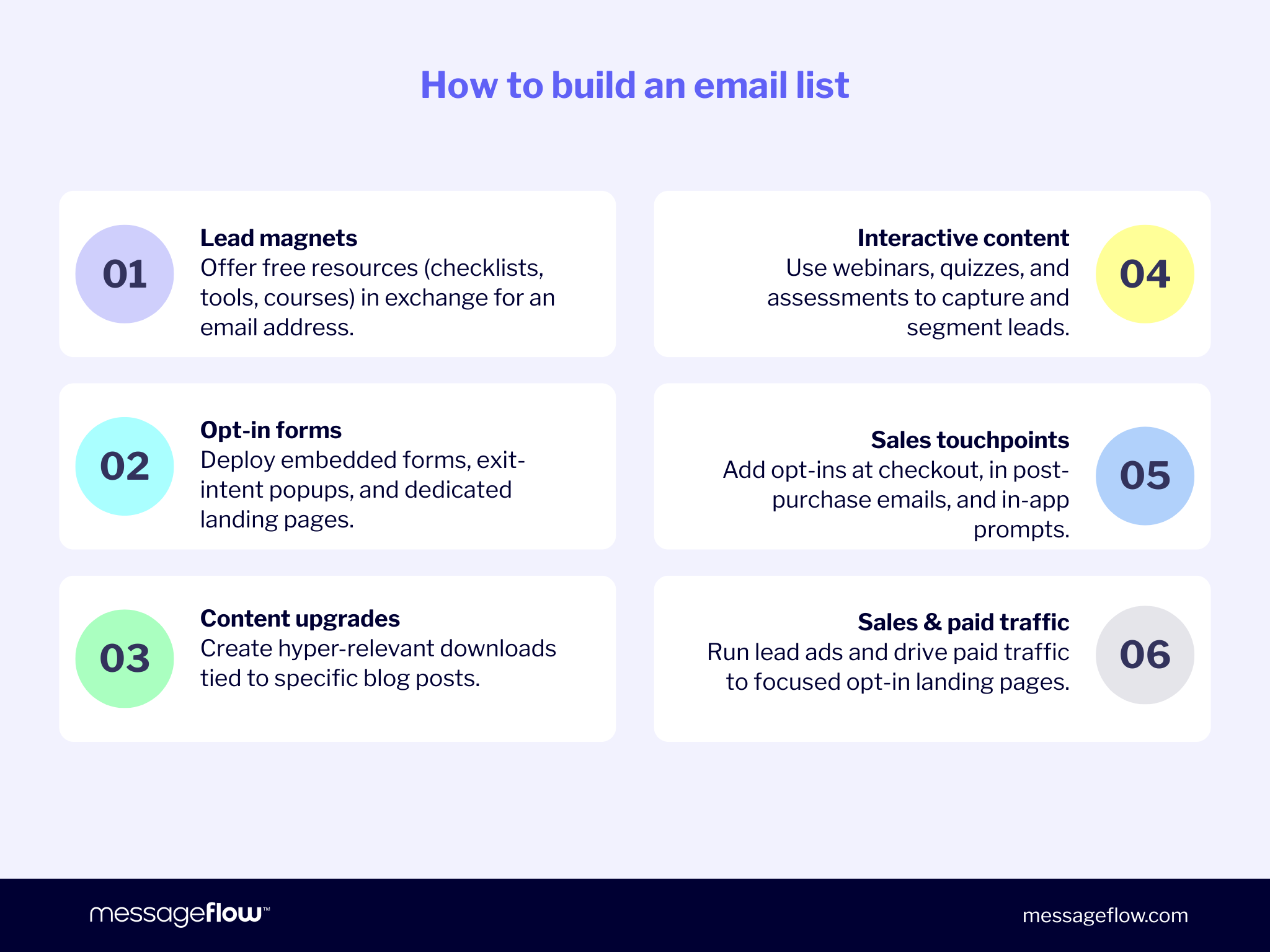
There’s no single tactic that builds a great email list. The strongest lists grow from multiple channels working together, each one reaching a different segment of your audience at a different stage of intent.
Here are six methods that consistently deliver, ranked roughly by how foundational they are.
Lead magnets
A lead magnet is a free resource you offer in exchange for an email address. It’s the most reliable list-building mechanism because the value exchange is explicit: you give something useful, the visitor gives you permission to follow up.
The best lead magnets share three traits: they solve one specific problem, they deliver value immediately (no “we’ll get back to you”), and they attract the right audience, not just anyone willing to click “download.”
Formats that perform well across industries:
- Checklists and templates – Low effort to create, high perceived value. A SaaS company might offer a campaign launch checklist, a B2B consultancy might share a vendor evaluation template.
- Email courses – A 5-day email sequence that teaches something specific. These are powerful because they train the subscriber to open your emails from day one.
- Discount codes – The default for ecommerce. Simple, effective, and easy to test. A 10-15% first-purchase discount in exchange for an email is a well-proven formula.
- Calculators and free tools – Interactive lead magnets like ROI calculators or audit tools tend to attract higher-intent leads, especially in B2B.
- Webinar access and on-demand recordings – Webinars convert exceptionally well as lead magnets. Data puts video-based lead magnet conversion rates at 70.2%, the highest of any format.
A realistic benchmark: Well-targeted lead magnets typically convert between 5-15% of visitors. Quizzes can push that significantly higher – some studies report conversion rates of 20-40%, with the best performers reaching 60%.
💡 The key is relevance. A generic “Ultimate Guide to Marketing” attracts everyone and qualifies no one. A “5-Point Deliverability Checklist for E-commerce Senders” attracts exactly the people you want on your list.
Opt-in forms and newsletter landing pages
A lead magnet is only as effective as the mechanism that delivers it. That means opt-in forms and where, when, and how you deploy them matters as much as what you’re offering.
Embedded forms work best in high-traffic, high-relevance locations: within blog posts (especially near the conclusion), on your homepage, and on your about page. These are low-friction – the visitor is already engaged with your content, and the form asks for one small next step.
Exit-intent popups trigger when a user’s cursor moves toward the browser’s close button. They’re a last chance to capture attention, and they work but only if the offer is compelling and the design isn’t obnoxious. More on this in a moment.
Dedicated newsletter landing pages are purpose-built pages with a single goal: get the signup. No navigation menu, no competing CTAs, no distractions. These are especially valuable when you’re driving paid traffic – sending ad clicks to a landing page with one clear action will always outperform sending them to a cluttered homepage.
💡 A note on popups: The data makes a strong case for them when done right. According to OptiMonk, gamified popups (think spin-the-wheel mechanics) convert at 13.23%, compared to 5.10% for standard popup forms.
That’s a significant gap. The caveat is that aggressive, poorly timed popups annoy visitors and increase bounce rates. The sweet spot: trigger popups after 30-60 seconds of engagement or on exit intent, limit frequency so returning visitors aren’t hit repeatedly, and always make the close button easy to find.
Content upgrades
A content upgrade is a lead magnet designed specifically for a single piece of content. Instead of offering a generic resource site-wide, you offer something hyper-relevant to the article the visitor is already reading.
Example: A blog post about email deliverability best practices could offer a downloadable “Pre-Send Deliverability Checklist” as a content upgrade. The visitor is already interested in the topic, the upgrade just packages the next logical step behind an email gate.
Content upgrades tend to outperform generic site-wide lead magnets because the relevance is near-perfect. The reader doesn’t need convincing that the resource is useful, they’re already deep into the subject matter.
The trade-off is production effort. Every content upgrade is a custom asset tied to a specific post, which means you can’t scale this approach across every page.
💡 The smart play: Identify your 5-10 highest-traffic blog posts, create tailored content upgrades for each, and embed the opt-in form directly within the post body. That targeted investment will likely outperform a single generic lead magnet spread thin across your entire site.
Webinars, quizzes, and interactive content
Registration-based content does double duty – it builds your list and it pre-qualifies subscribers by topic interest.
Webinars are one of the most effective list-building formats available. The registration itself is the opt-in. Attendees give you their email to secure a spot, and you get a contact who has already demonstrated strong interest in the topic. Post-event, you have a natural follow-up sequence – the recording, the slides, related resources, and eventually a product-relevant CTA. That sequence keeps new subscribers engaged instead of going cold after a single touchpoint.
Quizzes and assessments take a different approach. They offer personalized results in exchange for an email address – “What’s your email marketing maturity score?” or “Which campaign type fits your business?” The engagement is inherently high because people want to see their results. And unlike a static PDF, a quiz collects segmentation data at the point of signup: you know what the subscriber cares about before you send them a single email.
💡 As noted earlier, quiz-style lead magnets can convert at 20-40%, making them one of the highest-performing formats available. The added benefit is that the data you collect – answers, preferences, self-reported challenges – feeds directly into smarter segmentation from day one.
Surveys and polls work on a similar principle, though they tend to perform better with an existing audience than as cold acquisition tools. Run a survey through social media, gate the full results behind an email form, and you’ve built a micro-lead-magnet from your own original data.
Sales and checkout touchpoints
If you sell anything online, your checkout flow is a list-building opportunity you’re probably underusing.
Checkout opt-in is the simplest version. Add an unchecked checkbox (otherwise you violate GDPR) to your order form asking buyers if they’d like to receive marketing emails. These subscribers are high-value – they’ve already purchased, so you know the commercial intent is real. The key is keeping the box unchecked by default and making the value proposition clear: “Get early access to new drops and member-only discounts” is better than “Subscribe to our newsletter.”
Post-purchase email sequences offer a second chance. After someone buys, send a transactional confirmation, then follow up with an invitation to join your list for ongoing content. The timing works because the buyer is in a positive state – they just got something they wanted, and the goodwill is high.
In-app signups matter for SaaS and mobile products. If someone is using your free tier or trial, prompt them to subscribe to product tips, use-case guides, or feature updates. These subscribers already know your product, which makes them some of the easiest to retain and convert later.
💡 The unifying principle: People who are already transacting with your business are far more likely to subscribe than cold visitors. Meet them at the moment of highest engagement and the conversion happens naturally.
Social media and paid traffic
Social media can’t replace an email list but it’s one of the best channels for feeding one.
Lead ad formats on Facebook, Instagram, and LinkedIn let users submit their email without leaving the platform. The friction is extremely low – the form auto-fills from the user’s profile which drives high submission rates. The trade-off is lead quality. Since it’s so easy to submit, you’ll see more casual signups. Pairing lead ads with a double opt-in confirmation (covered in the next section) filters out the low-intent contacts.
Link-in-bio and organic posts work for creators and brands with engaged followings. Direct followers to a dedicated landing page, not your homepage, and give them a clear reason to subscribe. “New video every Tuesday” isn’t a reason. “Get the full framework behind every video, plus tools I don’t share publicly” is.
Paid traffic to opt-in pages is the most scalable approach. Run ads directly to a newsletter landing page with a strong lead magnet offer. The economics are straightforward: if your cost per lead is $2-4 and each subscriber generates $36+ over their lifetime (based on average email ROI), the math works in your favor quickly. The key is to send paid traffic to a focused landing page – one CTA, one form, zero distractions – not a general-purpose page with competing goals.
💡 One rule across all social-to-email tactics: Always move the relationship off-platform as quickly as possible. Social reach is volatile. The subscriber who’s on your email list is yours regardless of what any platform does next.
Single opt-in vs. double opt-in – which should you use?
When someone submits their email address through your form, what happens next depends on which opt-in method you’ve configured. The choice between single opt-in and double opt-in affects your list quality, deliverability, legal compliance, and ultimately how much value your email list generates.
Single opt-in means the subscriber enters their email and is immediately added to your list. No confirmation step, no verification. It’s fast and frictionless which sounds appealing until you realize what that friction was filtering out.
Double opt-in adds one step: after submitting the form, the subscriber receives a confirmation email and must click a verification link to finalize their subscription. Only confirmed contacts are added to the list.
That extra step costs you some conversions. Not everyone will open the confirmation email or click the link. But what you lose in raw numbers, you gain in list quality and the trade-off is almost always worth it.
Here’s how the two methods compare:
| Single opt-in | Double opt-in | |
|---|---|---|
| How it works | User submits email → added to list immediately | User submits email → receives confirmation email → clicks verification link → added to list |
| Signup friction | Minimal – one step | Moderate – requires opening a second email |
| List quality | Lower – includes typos, fake addresses, bots | Higher – every address is verified and active |
| Deliverability impact | Higher risk of bounces and spam traps | Cleaner list, fewer bounces, better sender reputation |
| Legal compliance (GDPR) | Acceptable in some cases, but harder to prove consent | Strongly recommended – provides documented proof of consent |
| Best for | Low-risk contexts, high-volume lead generation with aggressive list cleaning | EU audiences, quality-focused lists, long-term deliverability |
The recommendation is straightforward: use double opt-in as your default, especially if any portion of your audience is in the EU. It protects your sender reputation, keeps your bounce rate healthy, and gives you documented proof that every subscriber actually wanted to be on your list.
💡 The deliverability argument alone is compelling. Senders who maintain bounce rates below 1.5% see 10-12% higher inbox placement than those who don’t. Double opt-in eliminates invalid addresses before they ever enter your database, which keeps your bounce rate low without requiring constant manual cleanup.
There’s also a less obvious benefit. Subscribers who complete the double opt-in process are more engaged from the start. They’ve already opened one of your emails and taken action which sets a behavioral pattern. These contacts tend to produce higher open rates and click-through rates across subsequent campaigns.
If your entire audience is outside the EU and you’re optimizing purely for list growth speed, single opt-in with aggressive list hygiene can work. But for most businesses, double opt-in is the safer, more sustainable choice. The subscribers you lose to the confirmation step were unlikely to become engaged readers or buyers anyway.
For a deeper look at tactics that complement this approach, check out these email marketing best practices.
Email list building and GDPR / legal compliance
Building an email list without understanding the legal framework around consent is a liability not just in theory, but in practice. Fines, blocked domains, and destroyed sender reputations are real consequences that hit businesses every year.
This section isn’t legal advice (consult a qualified professional for your specific jurisdiction), but here are the principles every marketer should understand and follow.
GDPR: The baseline for EU audiences
If you collect email addresses from anyone in the European Union, the General Data Protection Regulation (GDPR) applies to you regardless of where your company is based. The core requirements for email consent under GDPR are clear:
- Freely given – The subscriber must have a genuine choice. Bundling email consent with terms of service or making it a condition of accessing unrelated content doesn’t qualify.
- Specific – The consent must state what the subscriber is agreeing to. “We may contact you” is too vague. “You’ll receive our weekly marketing email about [topic]” is specific.
- Informed – The subscriber must know who is collecting their data and how it will be used before they opt in.
- Unambiguous – Consent requires a clear affirmative action. Pre-checked boxes do not count. The subscriber must actively check the box, click the button, or take an equivalent deliberate step.
Additionally, every marketing email must include an easy way to withdraw consent – a working unsubscribe link in every message, with no hoops to jump through.
CAN-SPAM: The US framework
US-based senders operate under the CAN-SPAM Act, which is less restrictive than GDPR but still enforces key rules: you must include a physical mailing address, honor unsubscribe requests within 10 business days, and avoid deceptive subject lines or header information.
CAN-SPAM doesn’t require prior consent the way GDPR does, but that doesn’t mean sending to people who never asked to hear from you is a good idea. Your deliverability and reputation will suffer regardless of what the law allows.
If you operate internationally, and most online businesses do, whether they realize it or not, the safest approach is to treat GDPR as your baseline standard. If your consent practices pass GDPR requirements, they’ll satisfy CAN-SPAM and most other regional regulations as well.
What non-compliance actually costs
The consequences of ignoring consent requirements go beyond fines, though those can be severe. The more immediate damage is operational:
- Mailbox providers like Gmail and Yahoo require spam complaint rates below 0.3% (with a recommended target of 0.1% or less). Sending to people who didn’t consent drives complaints up fast.
- Roughly 1 in 6 marketing emails already fails to reach the inbox, with average inbox placement sitting around 83%. Sending without proper consent makes that number worse, not better.
- Domains with full SPF / DKIM / DMARC authentication are 2.7x more likely to land in the inbox but authentication alone won’t save you if the underlying list is built on shaky consent.
Never buy email lists
This deserves its own line because the temptation persists, especially for businesses trying to accelerate growth.
Buying a list is almost always illegal under GDPR (the contacts never consented to your communications), and even where it’s technically legal, the practical results are disastrous: sky-high bounce rates, spam complaints, blacklisted domains, and a sender reputation that takes months to rebuild.
❗ It’s not a shortcut. It’s the longest path to a working email program.
The bottom line
Build your list on explicit, documented, specific consent. Use double opt-in to create a clear audit trail. Make unsubscribing painless. And never import contacts who haven’t directly told you they want to hear from your brand.
These aren’t just legal requirements, they’re the foundation of a list that actually performs. If you want to understand what is email marketing done right, it starts with how you collect your first address.
How to maintain email list quality (list hygiene)
Building a list is only half the job. Without ongoing maintenance, even a well-built list degrades over time. Contacts abandon old email addresses, engagement drops, and inactive subscribers quietly drag down your deliverability metrics. List hygiene is what keeps your email program healthy after the initial growth phase.
Remove hard bounces immediately
A hard bounce means the email address is permanently undeliverable. The account doesn’t exist, the domain is dead, or the server has rejected your message outright. Every hard bounce hurts your sender reputation, and mailbox providers are paying attention.
The benchmark to keep in mind: the average email bounce rate sits at 2.33%, but senders who stay below 2% are considered safe. Push for below 1.5% if you can. Senders at that level see 10-12% higher inbox placement rates.
Your email platform should automatically suppress hard bounces after the first occurrence, but verify that this is actually happening. For more on how bounces affect your program, see this guide to hard and soft bounces.
Run re-engagement campaigns before you purge
Not every inactive subscriber is a lost cause. Before removing contacts who haven’t opened in six months or longer, give them one last chance through a re-engagement campaign – a short sequence (two to three emails) that directly asks whether they still want to hear from you. Something like: “We noticed you haven’t opened our emails recently. Want to stay on the list? Click here to confirm, otherwise, we’ll remove you in 7 days.”
This accomplishes two things: it recovers some genuinely interested subscribers who simply got busy, and it gives you clean justification to remove everyone who doesn’t respond. The result is a smaller but meaningfully more engaged list.
Segment by engagement, behavior, and lifecycle stage
A single, unsegmented email blast sent to your entire list is one of the fastest ways to erode performance. Subscribers who opened your last five emails and subscribers who haven’t clicked anything in four months are not the same audience. Treating them identically punishes your best contacts and annoys your least engaged ones.
This is where segmentation becomes essential. 78% of marketers say segmentation is their most effective email tactic. And the performance impact is measurable: segmented campaigns generate up to 30% more opens and 50% more clicks compared to non-segmented sends.
At minimum, segment by:
- Engagement level – Active (opened or clicked in the last 90 days), passive (90-180 days of inactivity), and dormant (180+ days).
- Behavioral triggers – What pages they visited, what they downloaded, what they purchased.
- Lifecycle stage – New subscriber, prospect, customer, repeat buyer. Each stage warrants different messaging.
Segmentation isn’t a one-time setup. Revisit and adjust your segments as your list grows and subscriber behavior shifts.
Monitor the right metrics
You can’t maintain what you don’t measure. Four metrics tell you most of what you need to know about list health:
- Open rate – Tracks how many recipients open your emails. A declining open rate across campaigns signals content fatigue, poor subject lines, or a growing segment of disengaged contacts.
- Click-through rate – Measures how many recipients clicked a link. This tells you whether your content and calls to action are relevant to the audience you’re reaching.
- Bounce rate – As discussed above, keep this below 2%. Rising bounces mean stale addresses are accumulating.
- Spam complaint rate – Gmail and Yahoo’s threshold is 0.3%, but aim for 0.1% or lower. Complaints above this level can trigger filtering or outright blocking of your domain.
Only 23.6% of marketers verify their email lists before sending campaigns which means the majority are flying blind on data quality. Don’t be in that majority. Regular verification before large sends catches invalid addresses before they damage your metrics.
Establish a cleaning cadence
Make list hygiene a scheduled operation, not something you do when deliverability has already cratered.
A good rhythm: review and clean your list every three to six months. Remove hard bounces, suppress chronic soft bounces, purge subscribers who didn’t respond to your re-engagement sequence, and verify list integrity before any high-volume send.
60% of email senders now clean their lists regularly and the performance gap between those who do and those who don’t is widening. Europe’s inbox placement rate of approximately 89% (compared to 85% in the US) is partly attributed to stricter consent standards under GDPR, which naturally produce cleaner, better-verified lists.
For a more technical deep dive on this topic, including sender authentication, warm-up strategies, and advanced diagnostics, see our email deliverability guide.
FAQ – Email list building questions
Start by choosing an email marketing platform that handles segmentation, automation, and deliverability. Then create a lead magnet – a free resource that solves a specific problem your target audience faces.
Add opt-in forms to your highest-traffic pages, promote your signup offer through social media and content, and use double opt-in to verify every subscription. The priority from day one should be list quality over raw volume.
Yes. Many email platforms offer free tiers for smaller lists, typically up to 500-2,500 subscribers. You can build opt-in forms, create landing pages, and run campaigns at no cost while getting started.
As your list grows, you’ll need a paid plan to access automation features, better segmentation, and the sending infrastructure needed to maintain strong deliverability at higher volumes.
Expect the first 100-500 subscribers within 4-12 weeks if you have a solid lead magnet, consistent content output, and active promotion channels. Growing beyond 1,000 subscribers typically takes 3-12 months, depending on your website traffic, the strength of your lead magnet, and whether you’re supplementing organic efforts with paid traffic. There are no real shortcuts. Purchased lists don’t count and will hurt you more than help.
Under GDPR, it’s effectively illegal for any EU audience. The contacts on a purchased list never gave consent to receive emails from your company specifically. Under CAN-SPAM in the US, buying a list isn’t explicitly banned, but sending to it without prior consent still triggers high spam complaint rates, destroys your sender reputation, and can result in your domain being blacklisted by major mailbox providers.
The legal risk and the practical damage make it a losing proposition regardless of jurisdiction. Always consult a legal professional for specifics, but the universal recommendation is clear: build your list organically.
The most effective lead magnet is one that solves a single, specific, urgent problem for your target audience and delivers the solution immediately. Formats that consistently perform well include checklists, templates, short email courses, discount codes, free tools or calculators, and webinar recordings.
The test is simple: would the subscriber feel they got a good deal just by sharing their email address? If yes, the lead magnet is doing its job.
Ready to send campaigns to your growing list with 99% deliverability? MessageFlow helps 79,000+ businesses run high-performance email campaigns. Get started today.