


TL;DR: The benefits of a WhatsApp Business account go far beyond adding a new contact channel. With a verified profile, automated messaging, rich interactive formats, and API-level CRM integration, WhatsApp Business turns a consumer app into a full-scale marketing, sales, and customer service channel. Here are 12 reasons businesses are making the switch.
More than 175 million people message a business on WhatsApp every single day. That number tells you something important: WhatsApp Business benefits aren’t theoretical. They’re driving real conversations, real sales, and real customer relationships right now.
The gap between a personal WhatsApp account and a WhatsApp Business account has never been wider. A standard account was built for private chats. A business account was built for scale: verified identity, automated replies, product catalogs, team inboxes, CRM integrations, and broadcast campaigns to thousands of contacts at once.
Whether you run a small shop or a large enterprise, the core question is the same. Can you afford to keep using a channel that wasn’t designed for business? In this article, we break down 10 key WhatsApp Business account benefits for marketing, sales, and customer service teams.
WhatsApp Business vs. WhatsApp: What’s the actual difference?
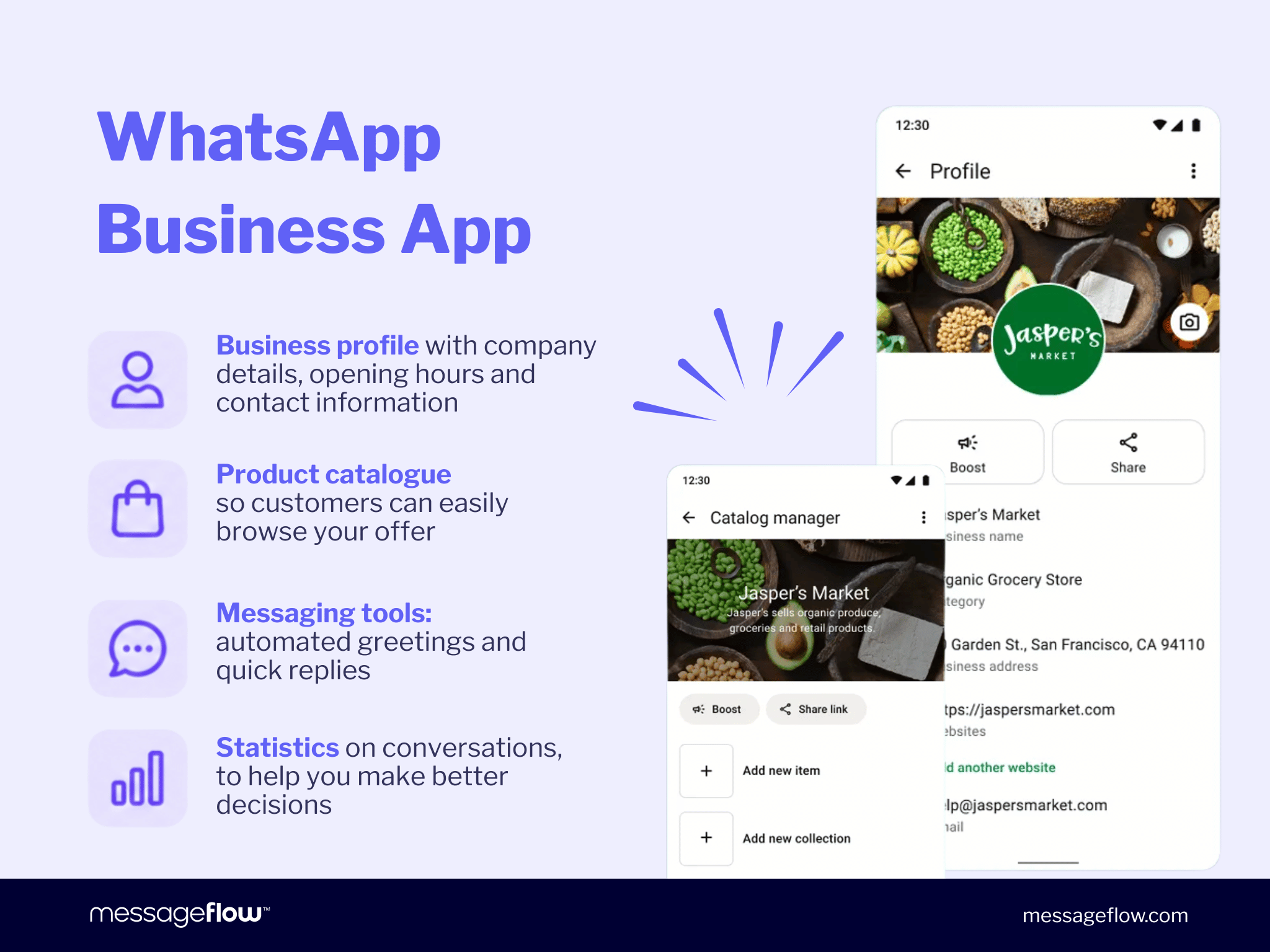
WhatsApp Business is a dedicated version of WhatsApp built for companies. Unlike a personal account, it lets you create a verified business profile, set business hours, publish a product catalog, send automated messages, and access communication analytics.
In practice, there are two versions, each suited to different needs.
WhatsApp Business App
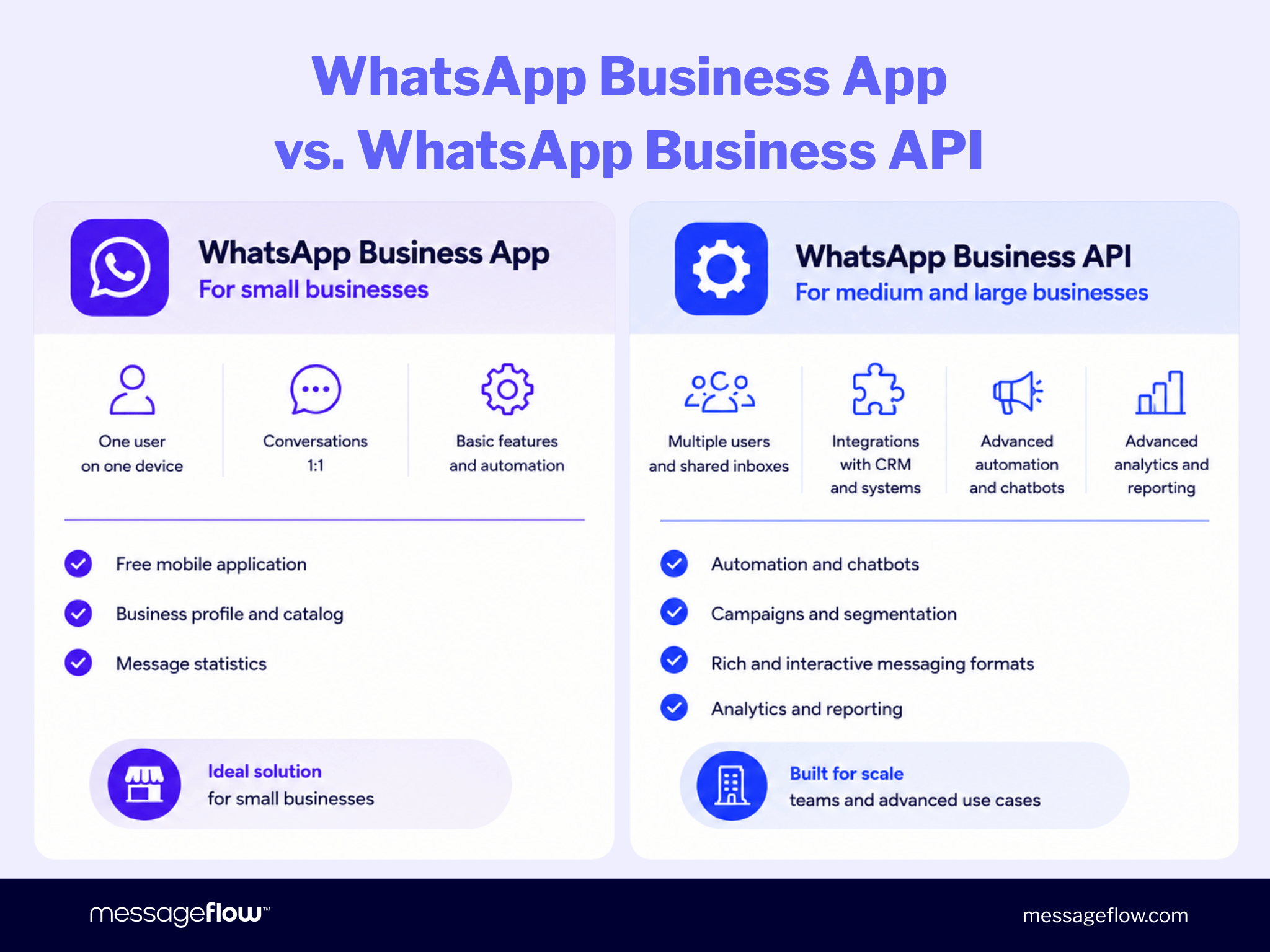
WhatsApp Business App is a free mobile app aimed at small businesses and sole traders. It supports one-to-one conversations, basic automation, and a public-facing business profile. It works well at low volume, but limits appear quickly as your team and contact list grow.
WhatsApp Business API
WhatsApp Business API is built for companies running high-volume customer communication. It requires integration with a Business Solution Provider like MessageFlow, which unlocks advanced features: automation workflows, bulk campaigns, CRM sync, multi-agent team inboxes, chatbots, and detailed analytics.
At the API level, WhatsApp becomes a proper channel in the same class as email or marketing automation. That’s where the most significant WhatsApp Business benefits for small businesses and enterprises alike start to appear.
WhatsApp is the world’s biggest messaging app
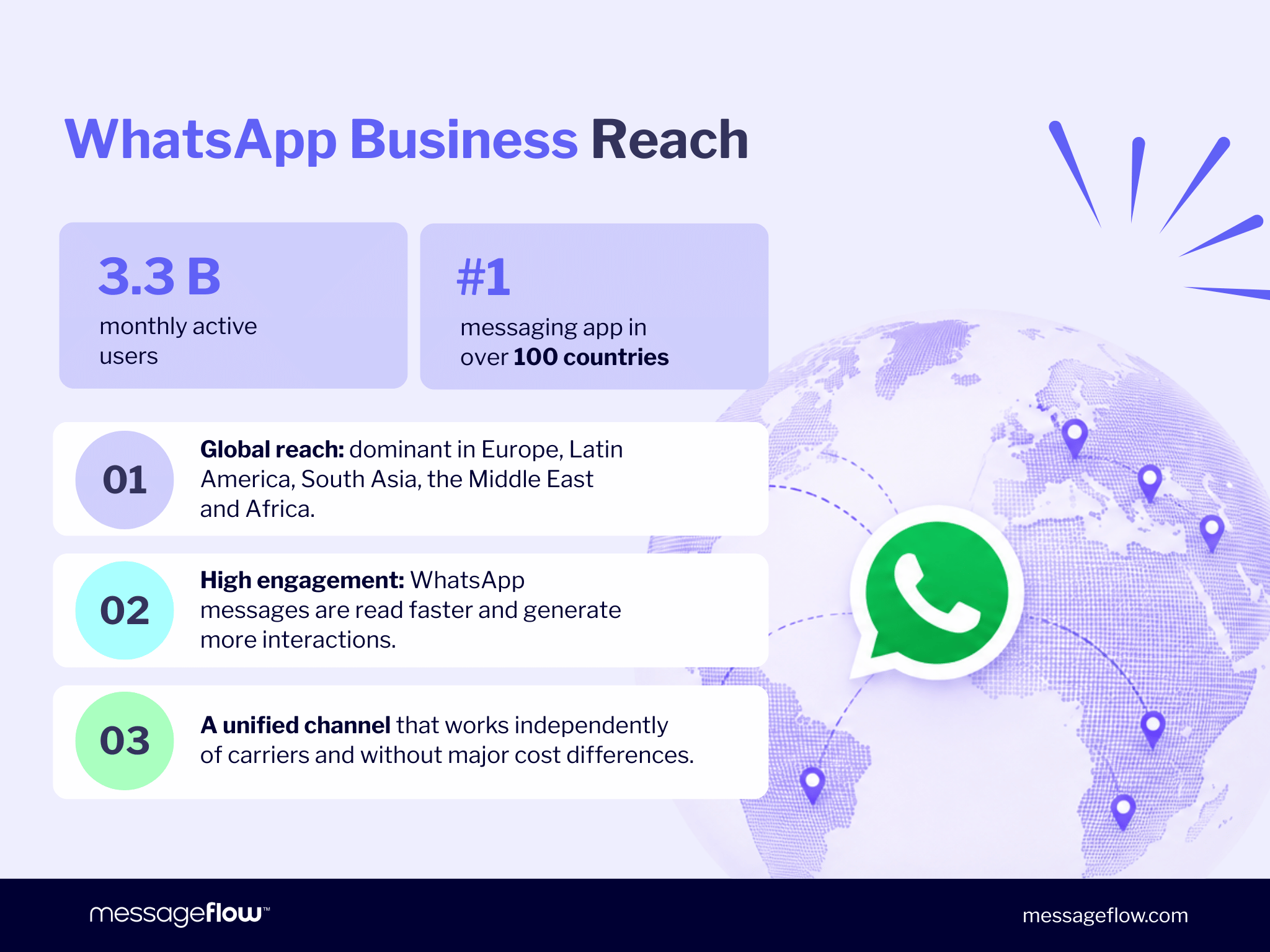
WhatsApp has over 3.3 billion monthly active users and is the leading messaging app in more than 100 countries. That’s the foundation of every other benefit on this list.
For businesses operating across multiple markets, this reach is hard to match. WhatsApp dominates in Europe, Latin America, South Asia, the Middle East, and across Africa. It gives you a single, consistent channel to reach customers on different continents, without dealing with local carrier dependencies, compatibility gaps, or wildly different per-country costs.
Email still reaches a larger raw audience (roughly 4 billion accounts worldwide), but WhatsApp users engage differently. They open it multiple times a day, they expect replies quickly, and they treat it as a personal communication channel, which means messages there get real attention.
💡 For a deeper channel comparison, read our guide on OTT messaging vs. SMS to see where WhatsApp fits into your overall channel mix.
Why WhatsApp business communication benefits outperform email: High open rate
WhatsApp Business messages are opened at rates that most marketers only dream about. More than 83% of WhatsApp users open the app every day, and most messages are read within minutes of delivery.
This isn’t just a “better channel” effect. It’s about behavior. WhatsApp is where people talk to friends and family. When a brand shows up there with something relevant, users pay attention. That attention translates directly into campaign performance, which is one of the strongest benefits of WhatsApp for business in terms of measurable ROI.
A verified profile that builds trust before you say a word
The first thing a customer sees isn’t your message. It’s who sent it.
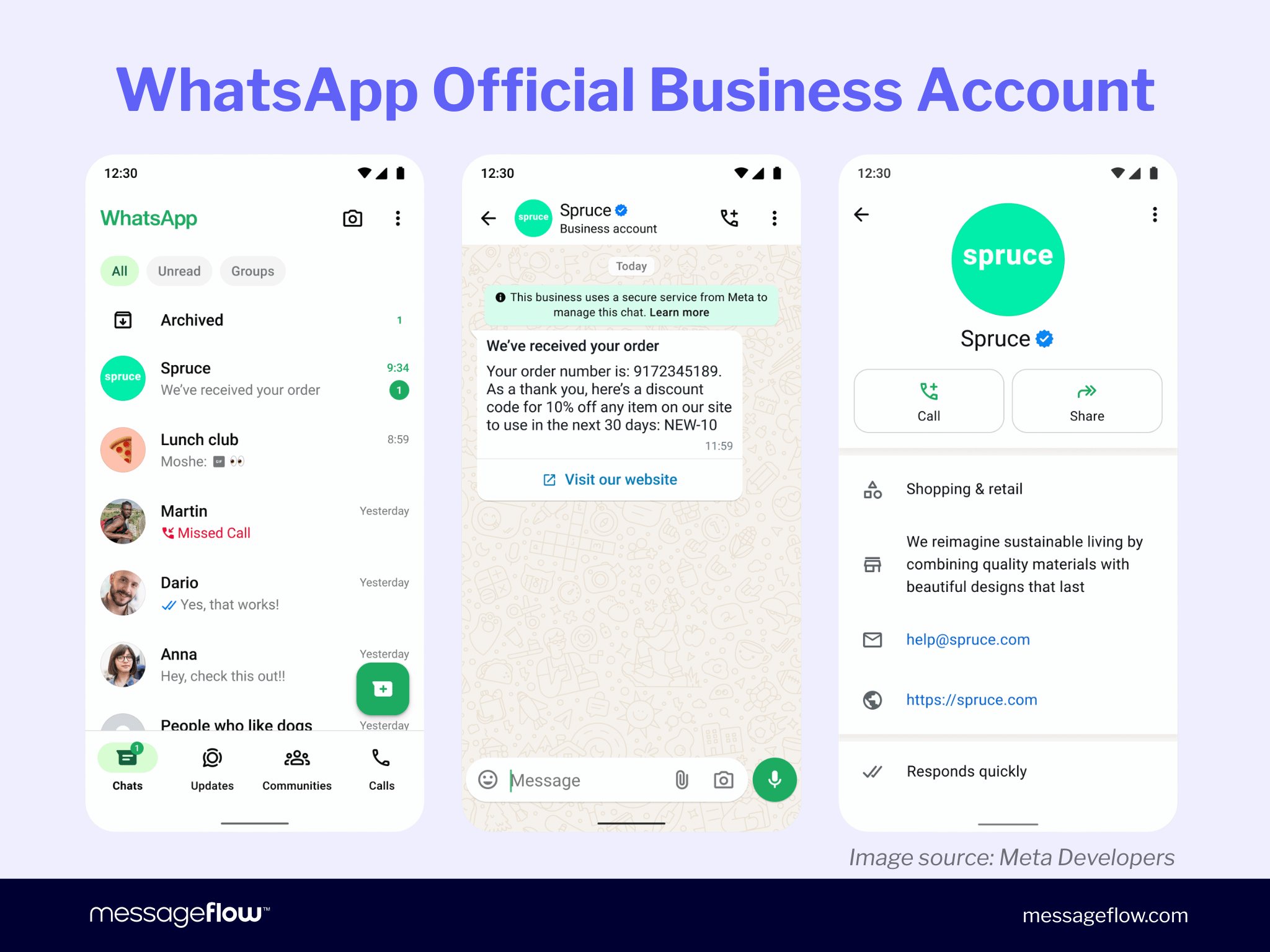
A WhatsApp Business account replaces an anonymous phone number with a complete brand identity: your company name, logo, business category, description, hours, email, and website. That shift from “unknown number” to recognizable brand makes a real difference in whether someone opens your message at all.
WhatsApp offers two levels of verification.
Official Business Account (OBA)
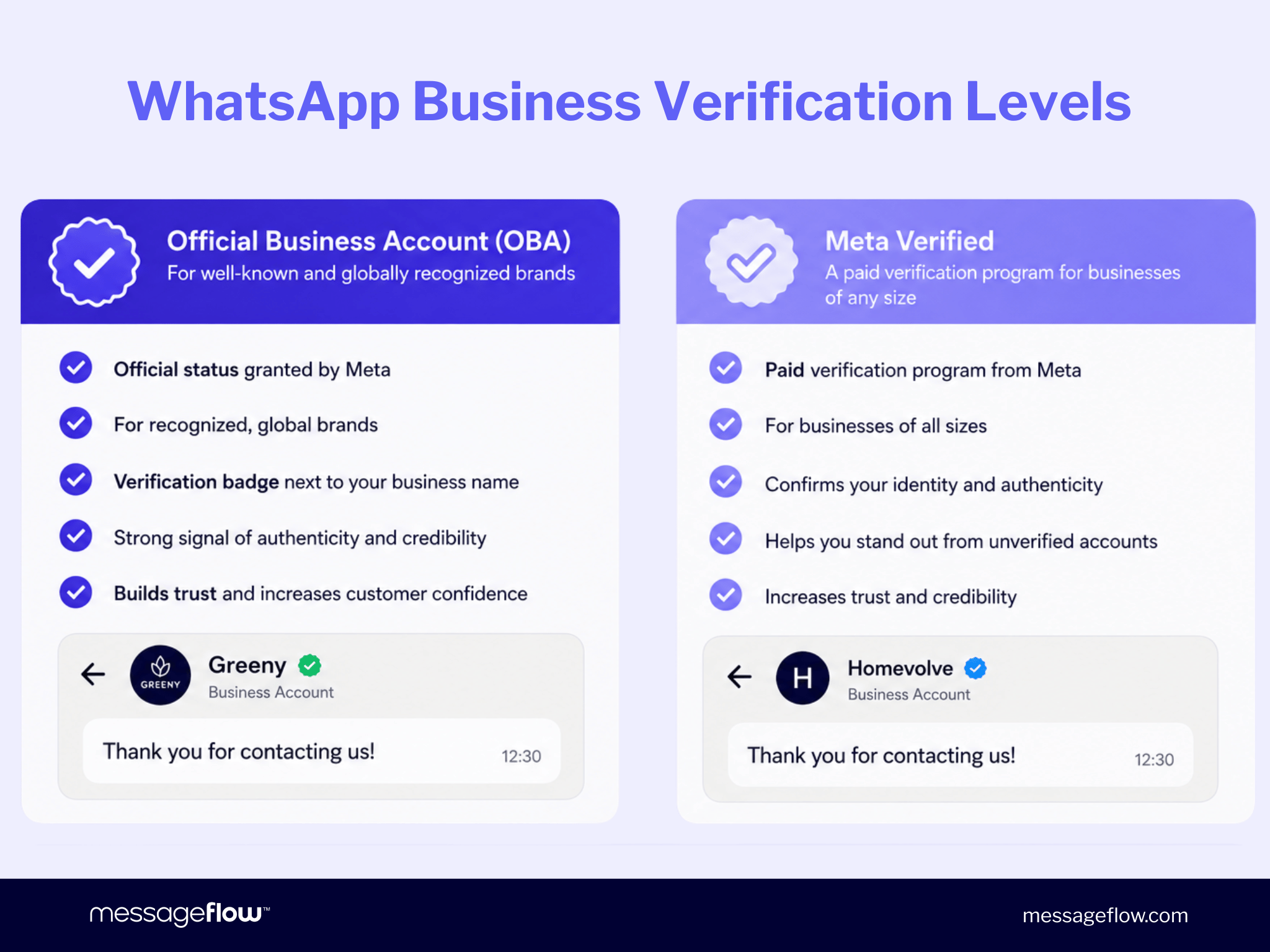
Official Business Account (OBA) is a status granted by Meta to well-known brands. It adds a visible verification badge next to your company name. A message from a verified brand carries far more weight than one from an unrecognized number. The badge acts as both a brand signal and a trust indicator.
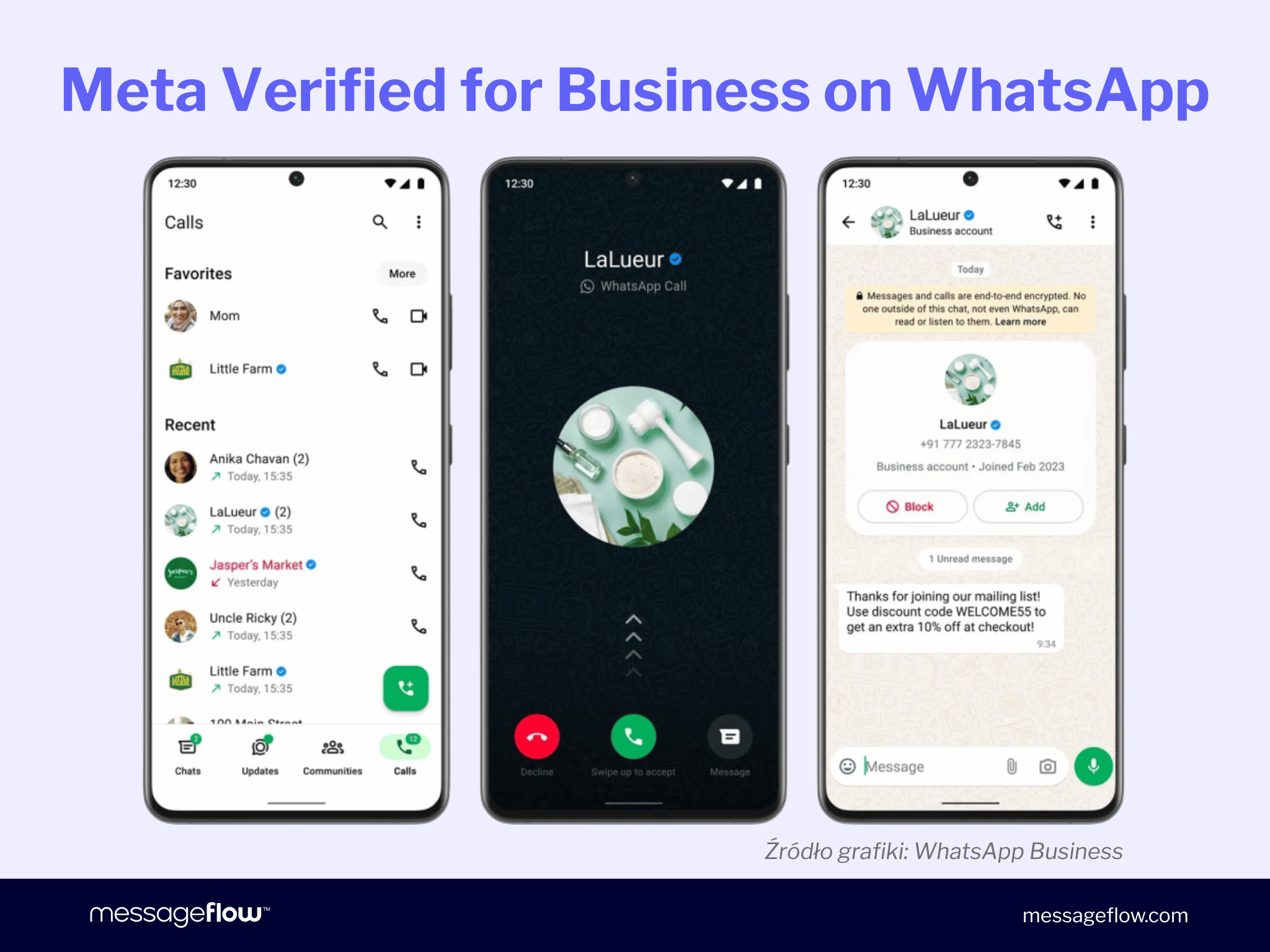
Meta Verified for Business on WhatsApp
Meta Verified is a paid verification program that Meta has been expanding since 2023. It lets smaller and growing businesses confirm their identity without needing global brand recognition. For many companies, it’s the fastest way to increase credibility and stand out from competitors still running unverified accounts.
In sectors where trust directly affects conversion, including e-commerce, finance, insurance, and premium services, a verified profile isn’t optional. It’s part of the conversion funnel.
A product carousel built into the chat
Around 40 million WhatsApp users browse business product carousels every month inside the app.
That’s a meaningful shift in the customer journey. Customers don’t need to visit your website, search for a product, or switch between apps. They open your WhatsApp profile, browse your catalog, and start a conversation, all without leaving the chat.
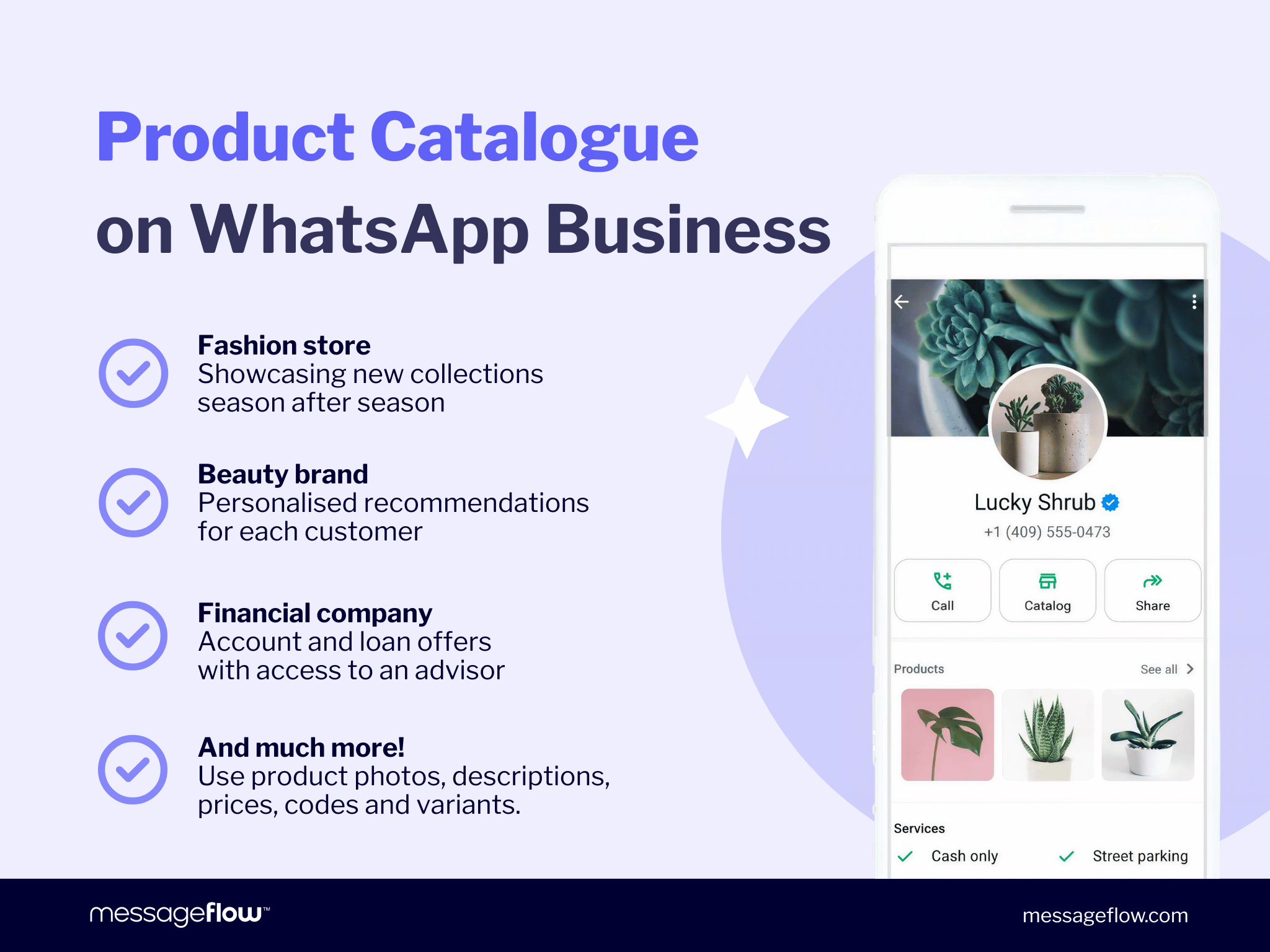
WhatsApp Business catalog features
WhatsApp Business catalog features include:
- Product photos
- Descriptions and prices
- Product codes and variants
- Shareable product links
- Direct chat initiation from a product page
This reduces friction in the buying process. A fashion retailer can showcase a new collection. A beauty brand can match products to individual customer needs. A financial services company can display account types or loan offers with a direct link to speak with an advisor.
The combination of catalog discovery and high daily app usage means customers encounter your products in a natural context, not a formal shopping interface. That changes how they engage.
One of the most effective ways to showcase products on WhatsApp is through product carousels – interactive messages that let customers scroll through your offer directly in the chat.
💡 Want to present your products or services right inside the conversation with your customer? Get in touch with our team and explore the possibilities of WhatsApp product carousels for your business.
Automated replies and instant first response
Even the free WhatsApp Business App includes basic automation: welcome messages for first-time contacts, away messages outside business hours, and quick replies for frequently asked questions. For many small businesses, that’s enough to deliver a consistent first response at any hour.
WhatsApp Business API goes further. Automation at the API level can include:
- Multi-step conversation flows
- Conditional chatbots that respond based on customer input
- Automatic lead qualification
- CRM-triggered messages
- Smooth handoffs to a human agent when needed
WhatsApp is also increasingly used for authentication, including OTP delivery with one-tap auto-fill, making the login experience faster and less friction-heavy than traditional SMS verification.
Chatbots that handle 60-80% of incoming queries
Well-designed WhatsApp chatbots can handle between 60% and 80% of incoming customer queries without a human agent. That includes the most common support questions: order status, delivery times, return policies, product availability, and basic service information.
From the customer’s perspective, the experience is seamless. They ask, they get an answer immediately, with no queue, no hold music, and no need to explain their issue to three different agents.
From a business perspective, the numbers are compelling. Companies using WhatsApp chatbots report customer service cost reductions of up to 30%, with no measurable drop in satisfaction scores.
Take a logistics company using WhatsApp Business API. A customer asks “Where is my package?” The chatbot queries the CRM or logistics system, retrieves the live shipment status, and responds within seconds. A human agent only steps in when the situation requires a judgment call.
CRM integration and personalized campaigns at scale
One of the most powerful WhatsApp Business API benefits is what happens when you connect it to your existing systems.
When WhatsApp Business API integrates with your CRM, e-commerce platform, or marketing automation tool, communication becomes event-driven. A customer action triggers a message automatically. No manual sending. No switching between tools.
The flow looks like this:
- Customer takes an action (abandons a cart, completes a purchase, ends a free trial)
- Your system detects it and fires the relevant scenario
- WhatsApp delivers a personalized message
- The customer’s reply is logged back in the contact history
Segmented bulk campaigns work the same way. Using opt-in data, dynamic CRM fields, and Meta-approved message templates, you can send campaigns to thousands of contacts at once, with each message automatically personalized. Instead of a generic blast, the customer receives a message with their name, order number, product name, delivery date, or an individual offer.
Cart abandonment campaigns are one of the most popular use cases. If a customer leaves before completing checkout, the system sends an automatic WhatsApp reminder, with a product image, a direct return link, and optionally a discount. That’s significantly more effective than a plain-text email follow-up.
The best thing? You can manage all of this from a single platform using MessageFlow’s CPaaS.
Rich message formats that drive higher engagement
What message formats does WhatsApp Business support?
WhatsApp Business supports images, videos, documents, voice messages, and location pins. At the API level, it also supports interactive message formats similar to those available in RCS and Viber.
Interactive formats include:
- Quick reply buttons
- List menus
- Product carousels
- CTA buttons linking to a website or checkout flow
These let customers take action without leaving the chat. An abandoned cart message with a product image and a “Return to cart” button consistently outperforms a plain-text reminder. A check-in notification from an airline with a boarding pass attachment and a one-tap online check-in button is more useful than an email with a PDF attached.
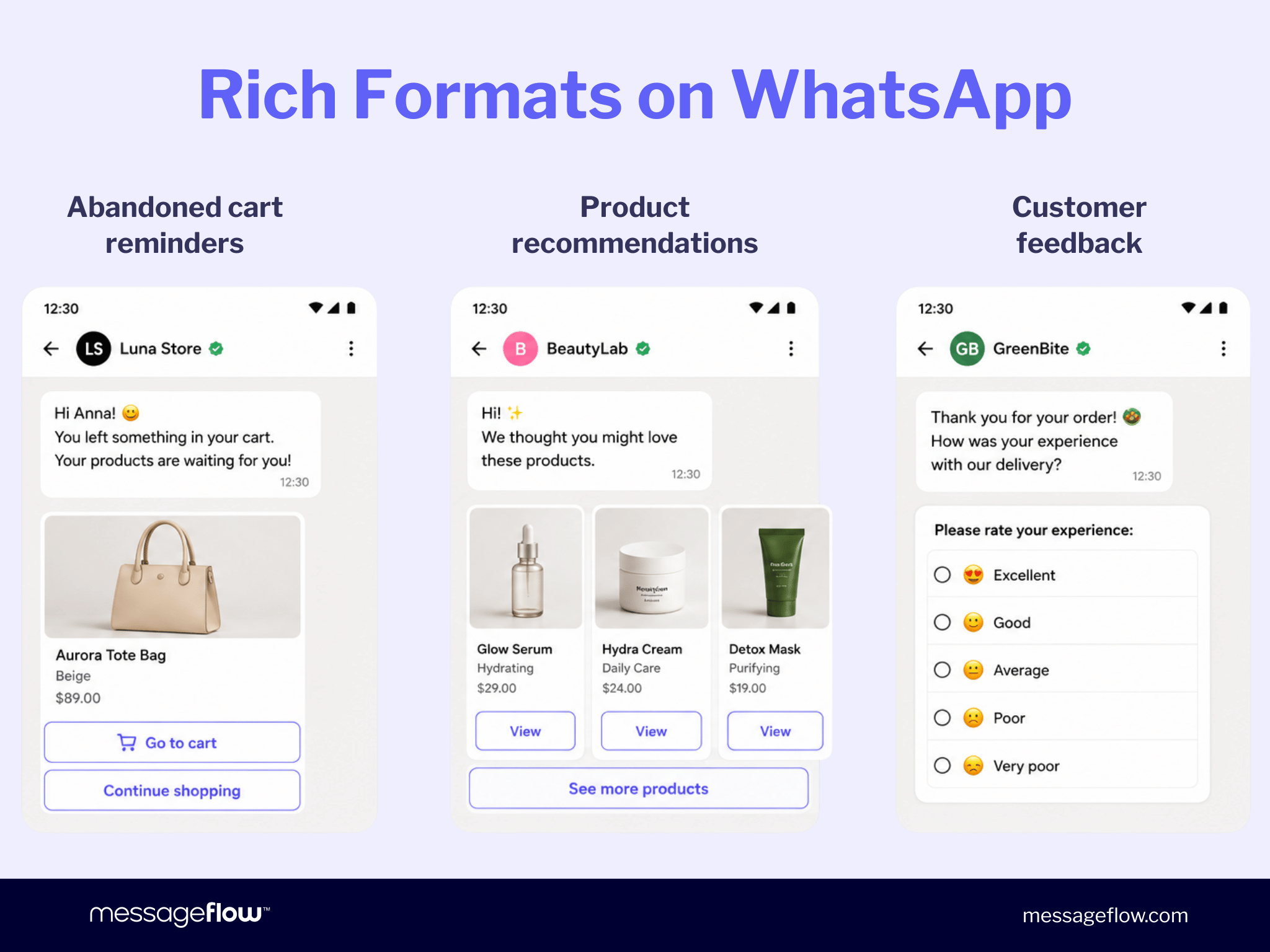
The practical applications are wide. An online retailer can display products in a scrollable carousel. A beauty brand can recommend products based on previous purchases. A travel company can send itinerary updates with direct booking links.
Richer messages mean more engaging communication, and more engaging communication means better campaign results across the board.
End-to-end encryption and secure business communication
WhatsApp Business and WhatsApp Business API use end-to-end encryption based on the Signal protocol. Messages are protected in transit between the user and the business.
It’s worth understanding how this works in practice. Once a message is received, how data is stored and processed depends on your company’s own systems and privacy policies. When a business integrates WhatsApp with a CRM, marketing platform, or customer service tool, those systems handle the data according to their own policies.
WhatsApp notifies users in the chat when a business uses additional services to store or process messages, including third-party platforms or AI-based tools. Transparency is built into the channel itself.
WhatsApp as part of an intelligent omnichannel strategy
The biggest results come when WhatsApp is part of a coordinated multi-channel strategy alongside email, SMS, push notifications, and RCS, not when it’s used in isolation.
Each channel has a different role. Email works well for longer content and formal confirmations. SMS acts as a fallback for time-sensitive alerts. WhatsApp performs best where speed and direct conversation matter most.
Leading e-commerce and retail brands are building communication exactly this way: one connected ecosystem, not a stack of separate tools. When all channels share the same customer data, you get:
- A complete view of the customer journey,
- Central communication management,
- Automatic cross-channel follow-ups,
- Smarter audience segmentation across every touchpoint.
In practice, a customer who doesn’t open an email gets a WhatsApp follow-up. A user who clicks a CTA automatically enters the right campaign segment. That’s the direction modern customer engagement is heading, from isolated campaigns to coordinated communication that moves with the customer
💡 MessageFlow lets you manage all channels from a single platform, including WhatsApp, email, SMS, Viber, RCS, and push. Get in touch with our team to find out how WhatsApp fits into your communication strategy.
Frequently Asked Questions about WhatsApp business benefits
A WhatsApp Business account gives you a verified brand profile, automated messaging, a product catalog and message statistics. All of these are absent from a personal account. For companies ready to operate at scale, WhatsApp Business API adds multi-agent team inboxes, CRM integration, bulk campaigns, chatbots, and detailed analytics, turning WhatsApp into a complete channel for sales, marketing, and customer support.
WhatsApp Business messages reach open rates of up to 98%. Click-through rates on WhatsApp promotional campaigns typically run between 45% and 60%. Most messages are read within minutes of delivery. This level of engagement makes it one of the highest-performing channels for time-sensitive offers, transactional notifications, and personalized campaigns.
The API unlocks communication at a scale the standard app can’t support. Key advantages include: automated conversation flows, chatbots that handle 60-80% of queries without human input, CRM and marketing automation integration, bulk segmented campaigns, interactive message formats, and full analytics. The API requires integration with a Business Solution Provider like MessageFlow.
Yes. The free WhatsApp Business App is built specifically for small businesses. It lets you create a professional business profile, set up automatic welcome and away messages, and organize conversations with labels. Many small shops, restaurants, and service businesses already use it as their primary customer contact channel. As your volume grows, you can move to WhatsApp Business API and expand with automation, integrations, and team collaboration features.
Meta Verified is a paid verification program that confirms your business identity on WhatsApp. Unlike the Official Business Account status (reserved for large, widely recognized brands), Meta Verified is available to growing and mid-size businesses. A verified badge increases message credibility and helps build customer trust from the very first interaction. It’s particularly valuable in industries where brand authenticity directly influences purchase decisions, such as finance, e-commerce, and professional services.