Picture Black Friday, 6 a.m. Several large senders launch their campaigns in the same minute, each hoping to have the morning to themselves. Server traffic jumps, and all the client sees is that the campaign went out and the emails landed in inboxes.
Everything else happens on our side, and that everything else is what this article is about.
Black Friday, Black Week, holiday shopping, a concert ticket sale going live. On days like these, companies send many times more emails than usual, often within a few hours. Last Black Friday (2025), the transactional email part of MessageFlow alone handled 91 million messages, more than twice as many as on a regular day.
Dariusz Sierka (MF / MTA Team Leader in Vercom IT) and Marcin Matyaszczyk (MF / Admin Team Leader in Vercom IT) told us how we prepare and secure our systems for bulk email sending in peak season.
Preparing for high volume email sending starts months ahead
We start preparing for Black Friday long before November. The team begins thinking about it in September, sometimes as early as August. Why so far ahead? Marcin, who looks after servers and network links, explains:
Servers, network equipment and network links don’t arrive overnight. It takes weeks, sometimes months: we have to choose the best offer, wait for delivery, and then install and configure the hardware or set up the link. That’s why we always have to think about where the company will be in a year or two. We watch sending trends and how clients use our platforms, and we try to expand the infrastructure so it’s ready before it’s needed.
Marcin Matyaszczyk, MF / Admin Team Leader in Vercom IT
That’s why we plan server purchases at the start of the year. We take last year’s traffic and add the growth forecast. Mid-year, we compare the forecast with what’s actually happening and buy more hardware if needed.
We also keep a reserve for what can’t be predicted. Sometimes a new client arrives and needs a lot of capacity right away. We can’t ask them to wait. So all year round we prepare for “rush hour”. Where it’s possible and makes sense cost-wise, we build our email infrastructure with enough headroom to handle up to ten times the traffic of a regular day.
The most important part of this work is invisible to the client. It comes down to several things at once:
The key is anticipating what might happen and preparing resources for it. Today’s level of service comes mainly from modern infrastructure, along with more network links with higher bandwidth. We can’t cut anything close. Everything needs a safety buffer that gives us peace of mind.
Marcin Matyaszczyk, MF / Admin Team Leader in Vercom IT
Peak day should look like any other day
What is all this work for? So that nothing out of the ordinary happens on a high-volume day. Such a day is special for the team, and everyone keeps a close eye on what’s happening. Still, the goal is a platform automated and monitored well enough that the day runs like any other. Instead of scrambling to save the situation, the team should be able to watch the systems and enjoy seeing how many emails go out.
So for that period, the team puts some development work on hold and focuses on what’s happening here and now. One metric gets most of the attention:
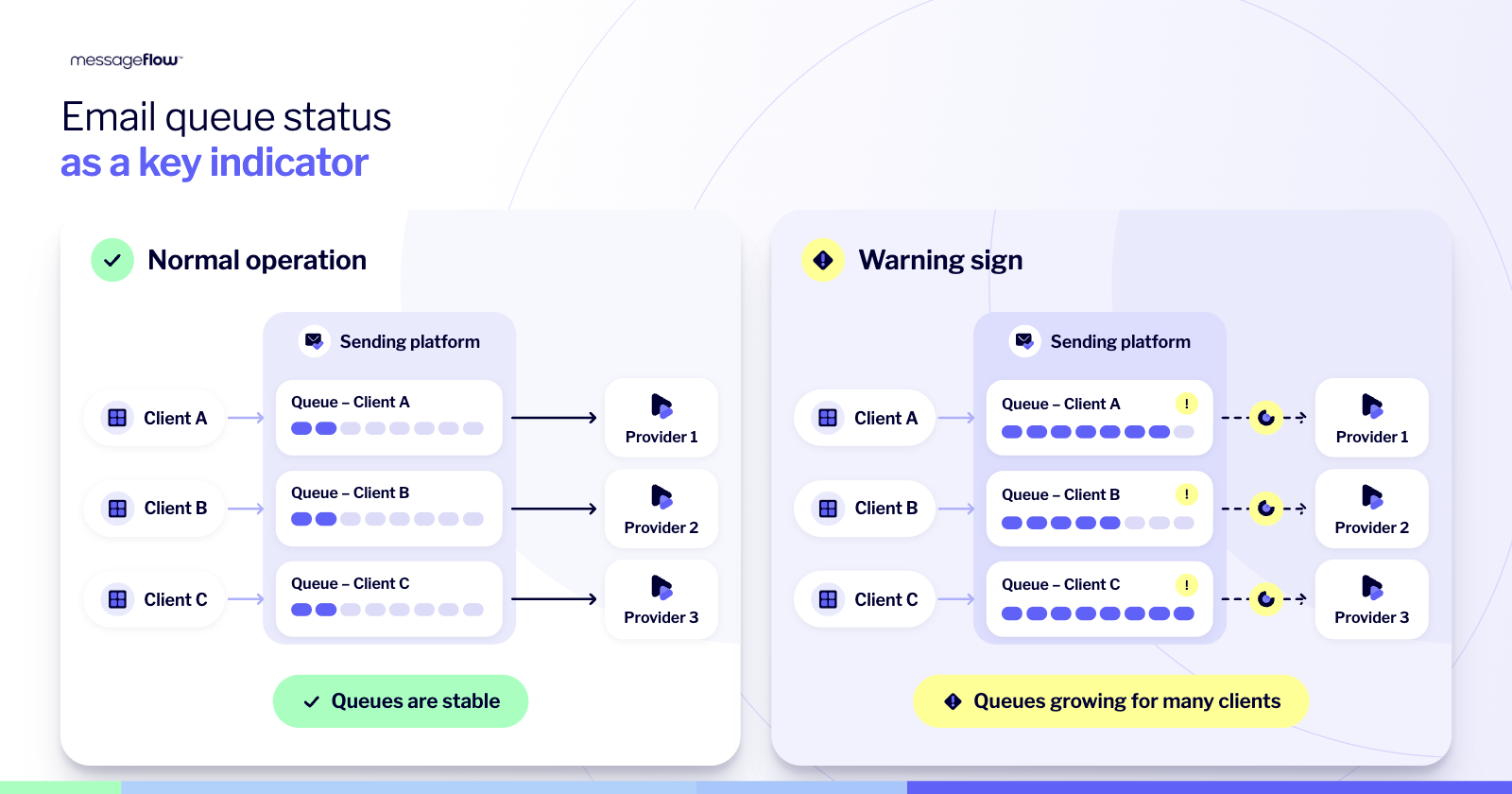
The key indicator of the system’s health is the state of the email queues. Messages handed over by clients should reach recipients right away instead of piling up on our servers. A single backlog doesn’t have to mean a failure: it can happen, for example, when a mailbox provider blocks a specific sender for spam. But if queues start building up for many clients at once, that’s a clear warning sign that something is wrong in the system.
Dariusz Sierka, MF / MTA Team Leader in Vercom IT
Queues and the whole platform are tracked by monitoring. It’s the first thing to show that something is going wrong, and it gives the team time to react. Today it’s much easier to build and maintain, largely thanks to AI.
Peak season also means more work for people. The Support team receives far more tickets, so the IT team helps handle them.
Email deliverability at high volume is a team effort
Fast sending isn’t everything. A message has to reach the inbox, and that depends largely on the reputation of the IP addresses it’s sent from. Our deliverability team looks after it. If you want to know what else keeps emails out of spam, see our guide Email deliverability in 2026.
Before peak season, the deliverability team and Customer Service ask our largest clients about their planned sending volume. This applies to clients whose package includes deliverability analysis. The team compares that data with their sending history and adds IP addresses where needed.
The way our email infrastructure is built helps too. Clients have their own IP addresses, so a sudden spike from one of them usually doesn’t affect the others.
On top of that, we have direct agreements with mailbox providers, including WP, Onet and Interia, the largest local providers in Poland. They let us use higher sending limits, which reduces the risk of delays at peak times.
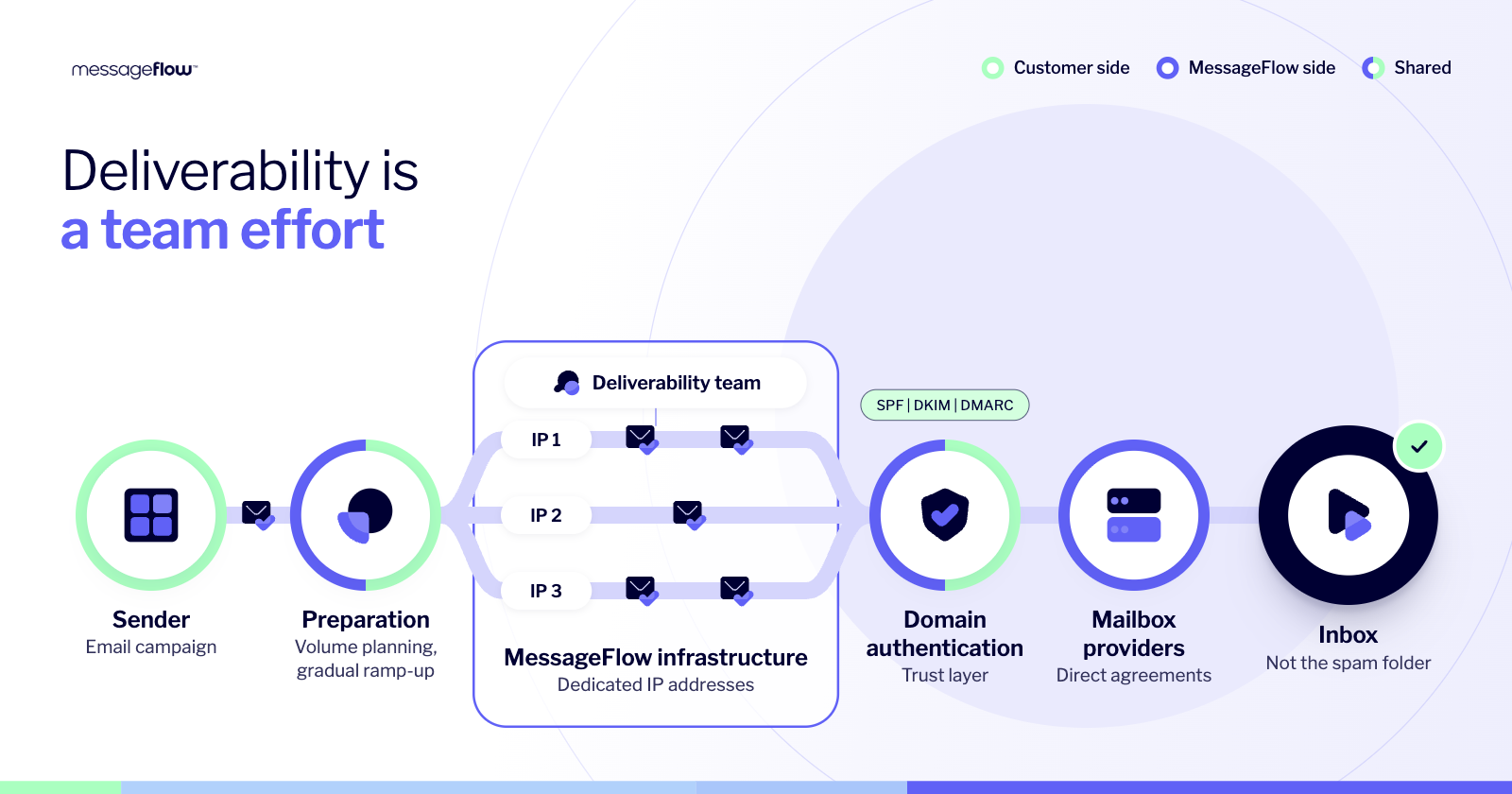
Clients play their part as well. IP reputation is built gradually over the whole year (that’s what IP warming is about), and a single oversized send on Black Friday can damage it. So if you’re planning a much bigger send than usual for peak season, let us know in advance and increase your volume gradually. For more tips, see our guide to Black Friday email deliverability.
Also check that your domain has SPF, DKIM and DMARC set up correctly. These records tell recipients’ servers that the message really comes from you, and they make it harder for fraudsters to impersonate your brand.
What unannounced peaks taught us
Not every peak can be planned. Sometimes all it takes is a ticket sale for a concert by a popular artist. When millions of fans clicked tracked links at the same time, every click went through our system and pushed it to the limit of its capacity. We didn’t expect that much interest.
A real-world stress test like this is often the best push for change. This one led us to rebuild our infrastructure from the ground up, to make it more resilient and easier to scale. Today clients give us a heads-up about events like this, and the infrastructure is ready for a sudden spike in traffic even when nobody announces it. That readiness comes from steady work all year round:
Designing this kind of infrastructure takes months. Ordering servers and network links takes time because it’s physical hardware, and every part of the system has to be carefully thought through before the next big load arrives.
Once that foundation is in place, handling more traffic gets much simpler. We can spin up additional virtual servers in five minutes. We also don’t have to keep excess capacity running all the time and waste resources, because the system scales to demand when traffic grows.
Dariusz Sierka, MF / MTA Team Leader in Vercom IT
Announced peaks didn’t always go smoothly either. Remember 6 a.m. on Black Friday from the beginning of this article? About four years ago, Dariusz was already on his way to work at that hour to keep an eye on the first sends. This is how he describes the difference between then and now:
Not so long ago, Black Friday meant extreme load for our servers and late-night shifts for the team, keeping a constant eye on system stability. Today the day looks completely different and comes down mostly to watching the charts. Even if a single warning light comes on, it goes off again shortly after: the system either fixes itself or needs only minimal intervention.
That kind of calm comes from steady work all year round, though. The platform keeps growing, and so do the demands on the infrastructure. A service that easily handled millions of messages stops being enough at a scale measured in billions, and it needs continuous improvement.
Dariusz Sierka, MF / MTA Team Leader in Vercom IT
That’s why we keep developing the platform. The team is currently designing a new email sending infrastructure that will also give clients new capabilities.
Email security all year round
Periods of heavy email traffic also attract cybercriminals. That’s why we make sure our clients’ communication is secure every single day. Here’s what we do.
We monitor our infrastructure around the clock, and early warning mechanisms let us respond quickly to threats. Incidents are handled by Vercom’s internal CERT, our security incident response team. If you notice anything suspicious, write directly to .
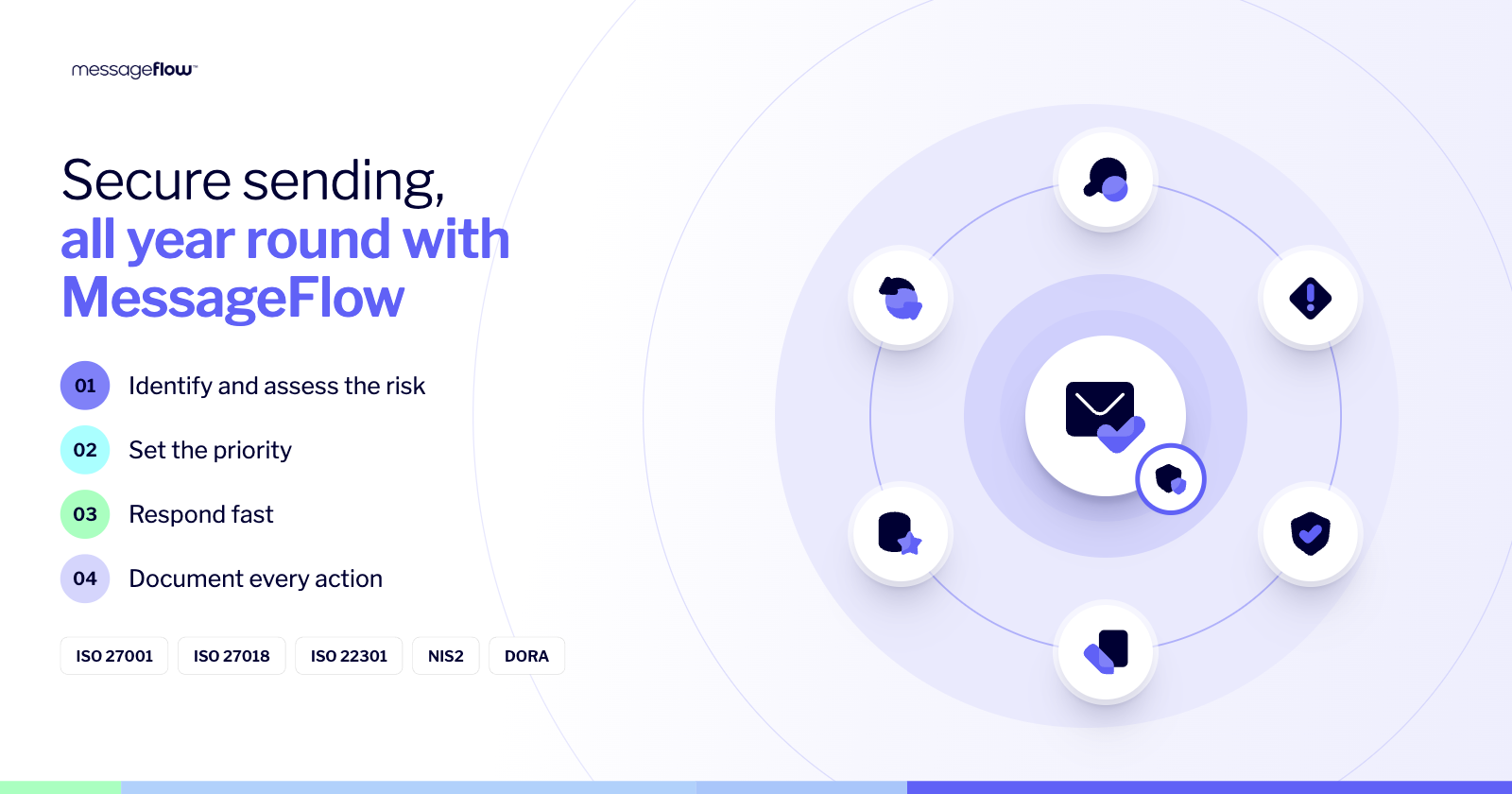
Clients often ask us about new software vulnerabilities making headlines in the industry. Every vulnerability follows the same path. First we identify it and assess the risk, then we set its priority and respond quickly, and finally we document what was done. We regularly test our security procedures and adapt them to new threats.
We also keep an eye on traffic quality and sender configurations. We help clients implement SPF, DKIM, DMARC and BIMI, which makes sender impersonation harder and reduces the risk of abuse.
Independent IT security firms have tested the platform in penetration tests, and our own team regularly runs internal tests as well. The application is protected by a Web Application Firewall.
We store client data exclusively in the European Economic Area and encrypt it in transit, as we do with backups. We hold ISO 27001, ISO 27018 and ISO 22301 certifications. The last one covers business continuity, which is why we regularly test our disaster recovery plans against different scenarios.
Security is a company-wide effort. Our cybersecurity and compliance experts run regular training and simulations for all teams. We designed the platform from the start with NIS2 and DORA requirements in mind, which independent ICT audits have confirmed, including audits commissioned by financial institutions.
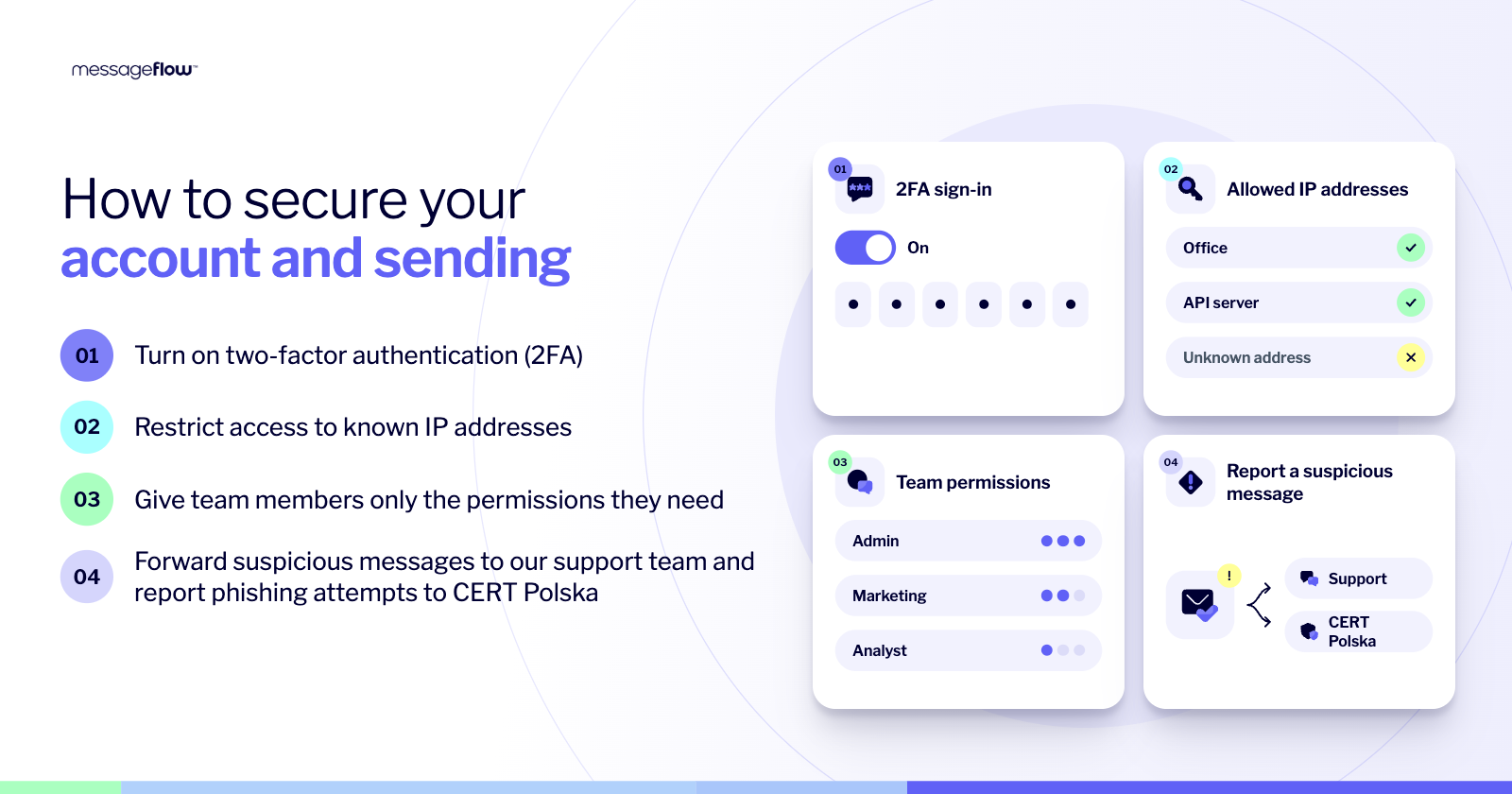
How to secure your account and sending on your side
Some of the security is in your hands. A few settings are enough:
- turn on two-factor authentication (2FA), which protects your account even if your password leaks,
- restrict access to the panel, API and SMTP to known IP addresses,
- give team members only the permissions they need,
- if you suspect your account has been compromised, change your password, review user activity and contact support immediately,
- forward suspicious messages sent from the platform to support, and report phishing attempts to your national CERT.
Find more details in our Trust Center.
Summary
Go back to 6 a.m. on Black Friday. Several campaigns start at once, and traffic grows minute by minute. All you see is that your emails got through, and that’s how it should be. Behind that calm are concrete processes and people: months of planning, spare capacity, security checked all year round, experience from previous years and a team watching the charts. The same goes for the holidays, Black Week and any other period of high-volume sending.
Looking for a partner to guide you through the busiest times of the year? Work with a company that takes care of both the security and the effectiveness of your sending. Book a 30-minute call with a MessageFlow expert at a time that works for you.
FAQ
Let your provider know your planned volume, increase sending gradually and check that your domain has SPF, DKIM and DMARC configured. Secure your account too: turn on 2FA and restrict panel, API and SMTP access to known IP addresses.
IP reputation is built over the whole year. A sudden spike in volume, for example on Black Friday, can damage it, and then more messages end up in spam.
Usually not. Clients have their own IP addresses at MessageFlow, so a peak for one sender typically affects only that sender’s emails.
We monitor traffic quality and sender configurations, and we help clients implement SPF, DKIM, DMARC and BIMI. Our infrastructure is monitored around the clock, and incidents are handled by Vercom’s internal CERT.
We identify each vulnerability, assess its risk and set its priority, then respond quickly and document the actions taken. Incidents are handled by Vercom’s internal CERT, and we regularly test and update our security procedures.