

TL;DR: SMS deliverability is not a single number. It is the ability of a communication system to successfully get text messages to recipients’ devices, shaped by infrastructure quality, sender reputation, message content, and regulatory compliance. Its measurable proxy is delivery rate, the percentage of messages a carrier confirms as delivered. In 2026, two new compliance layers changed the game: Texas SB 140 for SMS marketing, and Article 50 of the EU AI Act for AI-assisted communication. This guide covers how carriers score your messages, what grey routing actually is, and how to build infrastructure that holds up under both technical and legal scrutiny.
Your platform shows 97% delivered. Your campaign generated close to zero conversions. That gap, between a clean delivery report and a silent failure to actually reach the inbox, is what carrier filtering, grey routing, and sender reputation issues do quietly, long before anyone notices. By 2026, SMS deliverability has become nearly as layered as email deliverability, and most guides on the topic still explain it like it’s 2018.
SMS deliverability is the ability of a communication system to successfully deliver text messages to recipients’ devices. It depends on sender infrastructure quality, routing, phone number reputation, message content, and compliance with carrier and regulatory requirements. Its measure is delivery rate: the percentage of messages a carrier confirms as delivered. A healthy delivery rate typically falls between 90 and 98%. Anything below 90% usually points to unregistered numbers, poor list hygiene, or carrier filtering SMS that needs immediate attention.
What is SMS deliverability and why it’s more complex than you think
SMS deliverability is not one number sitting in a dashboard. It’s the outcome of several independent layers: whether the carrier accepts the message, whether it actually reaches the handset, and whether the content is even surfaced to the user in the messaging app. Getting these layers confused is the fastest way to misdiagnose a campaign that “should be working.”
Delivery rate vs. DLR vs. carrier-level filtering: Not the same thing
SMS delivery rate is the percentage of messages a carrier confirms as delivered. DLR (Delivery Report) is the technical confirmation of that fact, sent back from the mobile network to the sending platform. Unlike email, SMS doesn’t really have an intermediate “landed in a spam folder on the server” stage. A message either reaches the handset (status Delivered) or gets stopped at the carrier level (Undelivered/Rejected). Any further filtering, such as being flagged as suspicious or routed to a “Report as junk” thread, happens locally, inside the phone’s operating system and messaging app.
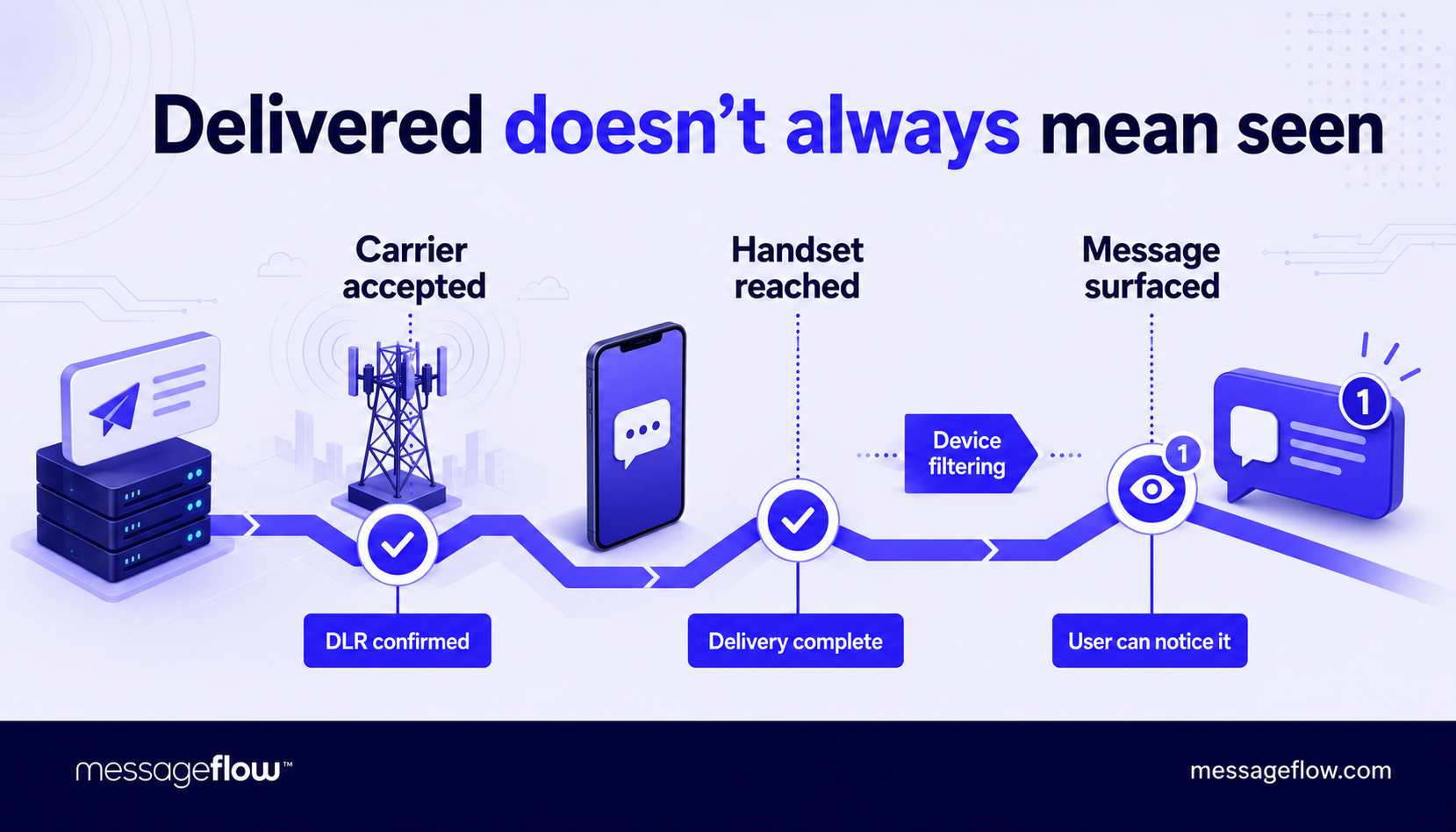
💡 That’s a meaningfully different mechanism from email’s inbox-versus-spam-folder placement, and it’s why SMS delivery status codes need to be read carefully rather than assumed to mean “the recipient saw it.”
Take a transactional example. An e-commerce brand sends a one-time password (OTP) at login. Delivery rate sits at 98%, which looks great in a monthly report. But if a portion of those codes arrive 90 seconds late instead of within a few seconds, the user has already clicked “resend” before the first message even displays. The report still says delivered. The customer experience says abandoned login.
Why a 95% delivery rate can still mean you have a problem
A high SMS delivery rate looks reassuring in a monthly report, but it can mask a deeper issue. If your DLRs confirm delivery while conversions drop to zero, the culprit is often not message content, it’s the route the message took. A message can sit in a network “limbo” at an intermediary before it ever reaches the SMS app on the handset, even while the dashboard shows “Delivered.”
A retail chain sending a weekend discount code might see 95% delivered and zero uplift in store traffic. The reason is often mundane: a chunk of messages arrived Monday morning, long after the promotion ended, because the intermediary route added hours of latency instead of seconds. Delivery rate alone won’t reveal that until you cross-reference it against actual delivery time and it’s the same underlying mechanism covered in more detail in why SMS messages are delayed.
Sender reputation in SMS: How carriers score your messages
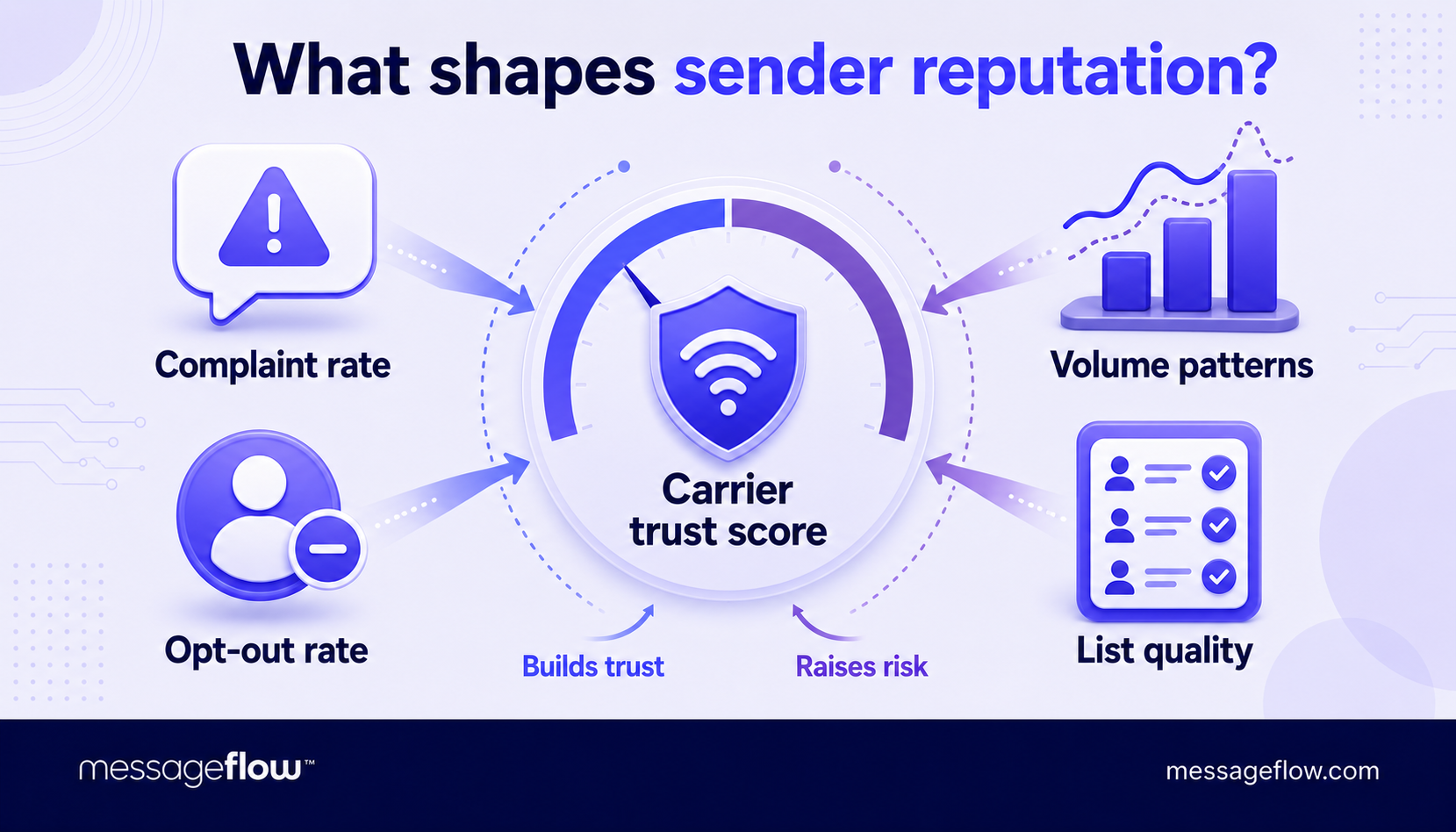
SMS sender reputation is a trust score carriers assign to a number or sender name, based on sending history. A number with a complaint history or high bounce rate gets flagged by carrier systems more often than a dedicated number with predictable volume and a low opt-out rate. Reputation builds over weeks. It can be damaged by a single badly planned campaign.
What signals build or destroy number reputation
The main inputs are complaint volume reported to the carrier, opt-out rate, how closely current sending volume matches historical patterns, and list cleanliness. A sudden jump from a few hundred messages a day to tens of thousands, from a number with no history of that volume, looks identical to a hijacked number being used for spam, as far as a carrier’s system is concerned.
If you’re planning a one-off high-volume push, such as a Black Friday send, from a number that normally carries light transactional traffic, ramp the volume up over a few days first rather than jumping straight to peak. It’s the same caution email marketers already apply when warming up a new sending domain, just applied to SMS.
Short code vs. 10DLC vs. alphanumeric sender ID: What each means for reputation
The sender format you choose has a direct effect on reputation and deliverability.
| Sender format | Characteristics | Reputation impact |
|---|---|---|
| Short code | Short number (usually 5-6 digits), typically dedicated to one brand | High throughput, but high cost of entry, and a longer certification process |
| 10DLC | Standard 10-digit long code registered in a campaign registry (US) | Trust score depends on registration quality, moderate throughput |
| Alphanumeric Sender ID | Brand name (up to 11 characters) instead of a number | Best brand recognition, but usually one-way communication |
In practice, an alphanumeric sender ID builds the highest recipient trust: the user sees a company name instead of an unfamiliar number, which reduces the association with phishing attempts. Registering your Sender ID also matters as a protection mechanism in its own right: in markets that require authorization of alphanumeric Sender IDs, that requirement exists specifically to stop bad actors from impersonating a known brand without passing verification first, not just as paperwork.
Grey routing: The hidden infrastructure risk that quietly kills deliverability
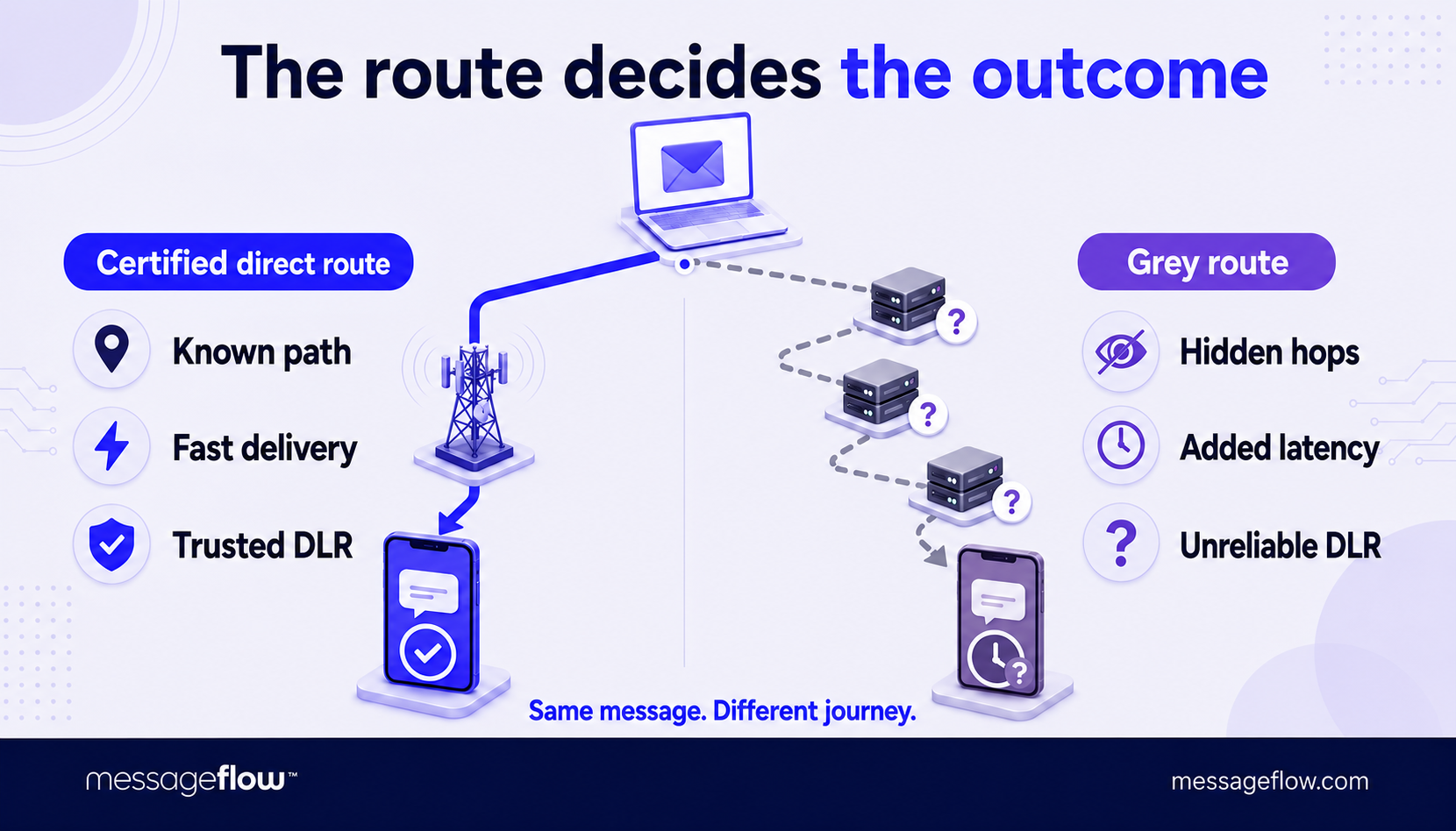
Grey routing is the practice of sending SMS traffic through unofficial, uncertified network paths to cut sending costs. Messages may still reach recipients, but with no quality guarantee: DLRs become unreliable, and carriers are getting increasingly effective at detecting and blocking this kind of traffic, which results in sudden, hard-to-explain drops in deliverability.
The most unsettling part of grey routing is that the problem tends to surface with a delay: a campaign runs fine for weeks, until a carrier updates its filtering rules and the entire route gets cut off overnight.
Carrier filtering mechanisms: Content, behavior, and pattern signals
Carrier-level spam filtering relies on heuristic systems that simultaneously analyze message content, sender reputation, routing origin, and traffic volume patterns. These filtering rules can shift without warning, which means a campaign that ran cleanly a month ago can start getting blocked with no change on your end.
How carrier heuristic engines actually work
Content scoring looks at keywords, message structure, and the presence of links. Behavioral signals look at how a sender’s entire recipient population behaves: how many people unsubscribe, how many report the message as spam, how fast sending volume is growing. None of these signals means much on its own, but combined they build a risk profile that determines whether a carrier lets a message through, delays it, or blocks it outright.
In practice, this means two messages with identical content can have completely different fates depending on who’s sending them. A promotional message with a discount and a link, sent from a number with a clean history and a low opt-out rate, goes through without issue. The exact same content, sent from a number that saw a spike in complaints the week before, may get delayed or blocked entirely, even though the content itself breaks no rules.
URL shorteners: Why AT&T blocks them outright and T-Mobile flags cycling
Public link shorteners are explicitly blocked by some US carriers. AT&T outright blocks messages using public URL shorteners, and T-Mobile prohibits cycling the same shortened link through multiple destination redirects. The reason is straightforward: the same tools are heavily used in phishing campaigns, so carriers treat them as a red flag regardless of the sender’s actual intent.
The fix is to shorten links within a domain you control instead of a public shortener. Short links in texts built on a branded domain remove that red flag while also making the message look more trustworthy, and pairing that with secure links in SMS campaigns practices closes off one of the most common ways legitimate campaigns accidentally look like phishing to a carrier’s filter.
Early warning signals: Opt-out spike, DLR drop, complaint rate increase
Three metrics deserve daily attention, not a monthly glance: a sudden increase in unsubscribes, a drop in DLR confirmation rate, and a rise in complaints. An error rate of 0 to 6% is considered healthy. Crossing 10% triggers an automatic 24-hour sending block on most platforms while the cause gets investigated (HighLevel Support). That’s a short window, which is exactly why reacting to a warning sign needs to happen faster than a monthly campaign review.
New regulations changing the rules: Texas SB 140 and the EU AI Act
Technical filtering challenges now sit alongside a regulatory layer that applies regardless of where the sender is headquartered, as long as messages reach recipients in a covered jurisdiction.
Texas SB 140: What changed on September 1, 2025, and who it applies to globally
SB 140, signed June 20, 2025, and effective September 1, 2025, extends Texas telemarketing law to cover SMS and MMS (Godfrey & Kahn). The definition of “telephone solicitation” now covers text or image transmissions intended to induce a purchase, rental, or use of a service. The law applies to any business sending such messages to Texas residents, regardless of where that business is based.
Violations carry fines of up to $5,000 per message, and the Texas Deceptive Trade Practices Act allows for double or treble damages, plus repeated claims from the same person for successive violations. That’s real financial exposure even for companies outside the US, if their SMS campaigns reach Texas numbers.
💡 There’s meaningful relief, though. Following a November 2025 settlement, the Texas Attorney General confirmed that businesses sending exclusively to recipients with documented, opt-in consent are exempt from the registration and bonding requirements (Consumer Financial Services Law Monitor).
In other words, if your US contact list is built on clear, documented consent, your registration exposure under SB 140 is considerably smaller than early legal commentary suggested right after the law took effect.
TCPA and state mini-TCPAs: The expanding US compliance patchwork
SB 140 doesn’t exist in isolation. The federal Telephone Consumer Protection Act (TCPA) has governed SMS marketing consent for years, and several other US states have introduced or expanded their own telemarketing statutes to explicitly cover text messages, following the same pattern Texas set.
For a business sending SMS across multiple US states, that means compliance can no longer be a single national checklist. It increasingly requires tracking state-by-state consent, registration, and disclosure rules the same way telemarketing compliance teams already track state-level calling regulations. Consult a legal professional familiar with the specific states you send to before assuming a single national policy covers you everywhere.
EU AI Act article 50: What actually triggers the transparency obligation
Article 50 of the EU AI Act is primarily about transparency when a user directly interacts with an AI system, for example an SMS chatbot or AI-driven customer service. In that scenario, the recipient must be clearly informed they’re talking to a machine, unless that’s obvious from context. The provision becomes enforceable on August 2, 2026, and non-compliance can cost up to €15 million or 3% of a company’s global annual turnover, whichever is higher (William Fry).
It’s worth drawing a distinction that’s easy to blur. Using an LLM as an internal copywriting tool to help draft a static marketing campaign that’s later sent out as an ordinary SMS does not trigger this obligation: your team, not an AI system, is conducting the conversation with the recipient. The transparency duty kicks in specifically where the recipient is actually interacting with an AI system in real time, for example, replying to an SMS handled by a bot.
A separate, narrower obligation covers machine-readable marking of content produced by generative AI systems (Article 50(2)), and disclosure for AI-generated text published to inform the public, where that text hasn’t undergone genuine human editorial review. Per a provisional agreement between the Council and Parliament reached May 7, 2026, the marking obligation for generative systems already on the market before August 2, 2026 has been pushed to December 2, 2026 (Data Matters Privacy Blog).
Interpretation of this provision is still being refined, so consult a lawyer familiar with your jurisdiction about your specific AI use case rather than assuming every use of AI in marketing content automatically requires disclosure to the recipient.
10DLC, campaign registry, and the future of sender verification
10DLC (10-Digit Long Code) is the US standard where every A2P (Application-to-Person) SMS campaign, meaning messages sent automatically by a system to an individual recipient, gets registered in a central registry before it can send.
How TCR trust scores work and why they directly affect delivery rates
Since August 31, 2023, US carriers have blocked SMS from unregistered 10DLC numbers, and enforcement got even stricter through 2025 and 2026 (Nextiva). The Campaign Registry assigns every registered campaign a trust score: the higher the score, the higher the throughput and the better the delivery.
No registration means filtering or an outright block on traffic, regardless of how clean the message content is. The consequences of skipping registration aren’t limited to blocked messages either. As per Telnyx, carriers can also impose higher fees and penalties on numbers operating outside the registry
What European senders can learn from the 10DLC model
Europe has no single equivalent to TCR, but the underlying logic is the same: a carrier trusts a sender more the more it knows about that sender’s identity, purpose, and campaign history before the first message goes out, not after a block has already happened. Registering a sender name ahead of time, rather than reacting to blocks after the fact, is the simplest way to bring 10DLC-style thinking to a European rollout.
Sender ID registration by country: Key markets
In markets like Germany, the UK, and Singapore, alphanumeric Sender ID registration rules differ in the details. Some require country-level pre-registration before a name is cleared to send at all. In the US, that pre-registration takes the form of 10DLC/TCR.
In Poland, alphanumeric Sender IDs go through a verification step with the provider, typically completed within one business day. If you’re running multi-market campaigns, plan for registration lead time of at least a few business days per market rather than assuming it can happen the day you launch.
SMS deliverability audit: A practical checklist
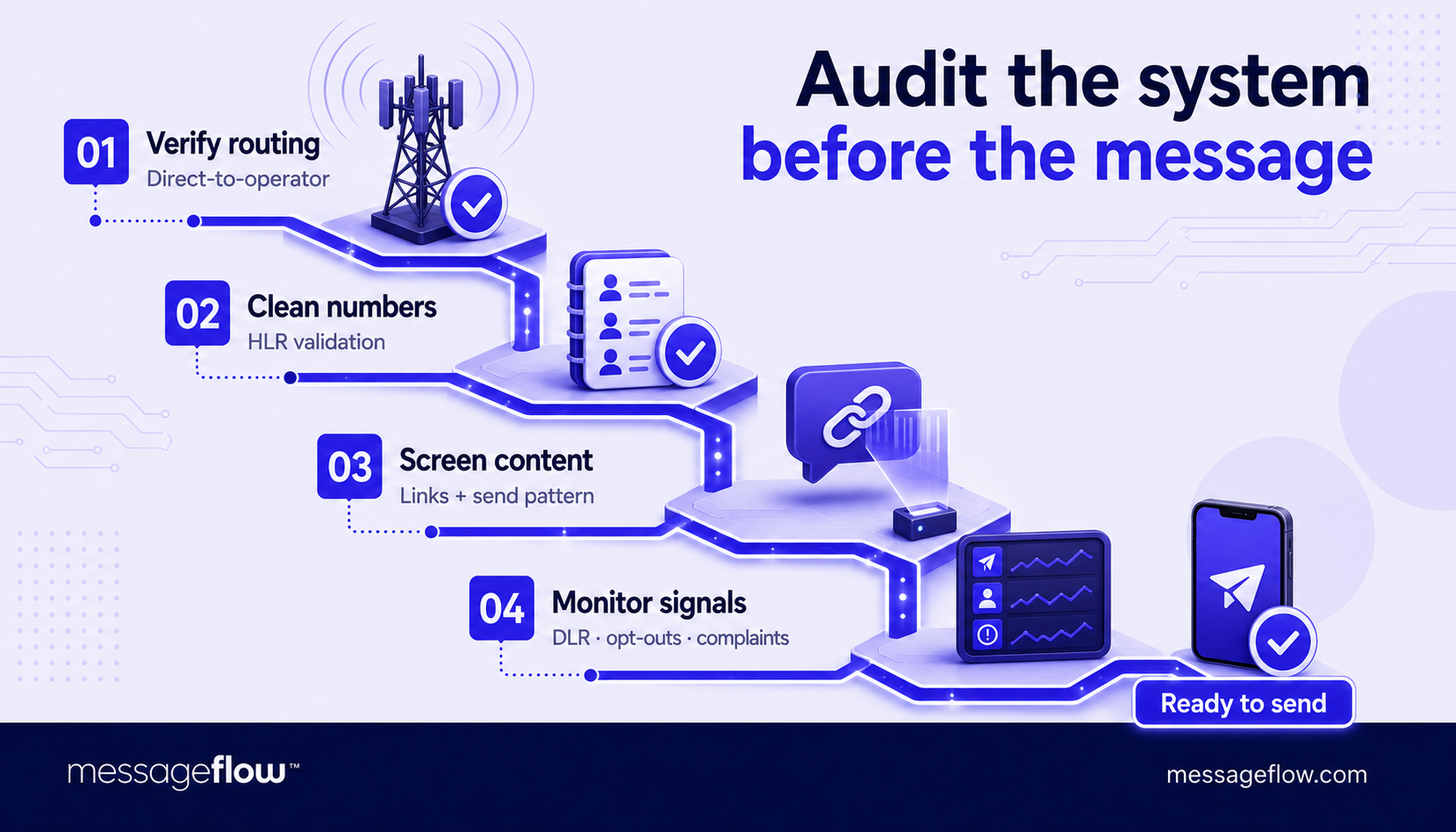
Improving SMS deliverability starts with an audit, not a content rewrite. Marketing teams often rewrite campaign copy first, while the real cause of a deliverability drop sits a layer lower: the infrastructure, the contact list, or the absence of monitoring. The order below is the sequence worth checking, before you touch the message content at all.
Infrastructure audit: Direct-to-operator vs. grey routes
Check whether your provider connects directly to mobile carriers or through intermediaries. Ask for documentation of certified direct-to-operator connections, ideally naming the specific carriers the provider has a direct agreement with. If a provider can’t clearly confirm the route, some of your traffic is probably going through a grey route, even if the official answer says otherwise.
Number hygiene: HLR lookup, validation, removing inactive numbers
Regular number validation (HLR lookup) surfaces inactive, ported, or non-existent numbers before they end up in a campaign. Cleaning these records out of your list lowers bounce rate, which feeds directly back into number reputation.
Content pre-screening: What to test before you send
Test message content on a small sample before a large send, and check the DLRs along with any suspicious-content flags. Classic advice about avoiding all-caps or single trigger words has lost most of its relevance: modern anti-smishing defenses rarely rely on simple keyword analysis anymore. The bigger risks now are public link shorteners, a sudden volume spike from a number with no sending history, and missing sender 10DLC registration compliance in the US market.
Daily KPI monitoring: Which metrics actually matter
A monthly campaign report isn’t enough to catch a problem before it damages a reputation for a long time. The metrics below deserve daily or weekly monitoring, ideally as an automated alert rather than a manual review.
- Delivery rate, broken down by carrier and country
- DLR error rate (target: below 6%)
- Opt-out rate (healthy below 3.5%, well-managed programs stay below 1.5%)
- Complaint rate and spam-report volume
- CTR on link-based campaigns, as an indirect signal that a message actually reached the handset rather than sitting in a queue
Keeping opt-out best practices in place, such as a clear SMS opt-out link in every marketing message, is itself part of the reputation signal carriers watch: low, predictable opt-out rates protect the sender score that everything else in this checklist depends on.
How MessageFlow supports deliverability 2.0
Deliverability 2.0 means infrastructure, monitoring, and regulatory compliance are designed together from the start, not patched in after deliverability already drops. MessageFlow connects all three layers covered in this guide.
Sending runs through direct, certified connections with carriers, both in Poland and through global certified partners, with no intermediaries and no grey-routing exposure. Active traffic protection is handled by Shield 360, a system that monitors sending patterns and sender reputation in real time and helps detect smishing and impersonation attempts before they reach recipients.
The platform holds ISO 27001, ISO 27018, and ISO 22301 certifications, plus SOC 2, and supports EEA data residency, which matters for security audits and cross-border sends where a regulator or business partner may ask for proof of compliance.
Real-time DLR monitoring and campaign-level alerts catch a drop in deliverability or a rise in opt-out rate before it turns into a real conversion loss, instead of waiting for a monthly report after the campaign has already ended and the damage to number reputation is done. See how MessageFlow ensures deliverability at scale, and talk to the team about auditing your current setup for routing, reputation, and regulatory readiness.
FAQ: SMS deliverability
SMS deliverability is the ability of a communication system to successfully deliver text messages to recipients’ devices. It depends on infrastructure and routing quality, sender reputation, message content, and compliance with carrier requirements. Its measure is delivery rate, the percentage of messages confirmed as delivered by the carrier. A healthy rate falls between 90 and 98%.
Modern carrier filters rarely rely anymore on simple signals like all-caps text or a single trigger word. They’re more likely to block messages using public link shorteners, traffic showing a sudden volume spike from a number with no sending history, numbers with a complaint history, or missing sender registration in markets that require it, such as 10DLC in the US. Heuristic systems analyze this alongside number reputation, similar to how an email spam filter works.
SMS sender reputation is a carrier-assigned trust score for your sending number, based on sending history: complaint volume, opt-out rate, delivery consistency, and traffic patterns. Build it gradually through opt-in consent, sending at a consistent and predictable volume, keeping lists clean, and avoiding content patterns that resemble spam. Reputation damage is hard to reverse.
Grey routing is sending SMS traffic through unofficial, uncertified network paths to lower cost. Messages may still reach recipients, but with no quality guarantee: DLRs become unreliable, and carriers are increasingly effective at detecting and blocking this traffic, which causes sudden drops in deliverability.
Texas SB 140, effective September 1, 2025, extends telemarketing regulation to SMS and MMS, and applies to any business texting Texas residents regardless of where that business is located. Businesses relying exclusively on documented opt-in consent are exempt from the registration and bonding requirements, following a November 2025 settlement. Consult a legal professional familiar with your specific jurisdiction.
Article 50, enforceable from August 2, 2026, mainly concerns situations where a recipient directly interacts with an AI system, such as an SMS chatbot or automated customer service. In that case, the recipient must be informed they’re talking to a machine. Using AI as an internal tool to draft a static marketing campaign, later sent as an ordinary SMS, does not trigger this obligation.
A separate, narrower rule covers machine-readable marking of generative AI content. Part of that obligation for existing systems was pushed to December 2026. Non-compliance with Article 50 can cost up to €15 million or 3% of global turnover.