
Reducing customer communication costs starts with deciding which messages still need to be sent. A cart reminder scheduled after the customer has purchased adds expense without helping recover that sale. Sending the same promotion across several channels without checking the response can create similar waste.
Lower per-message prices help, but the larger question is what you spend to achieve a useful outcome: a completed purchase, a renewed subscription or an appointment attended. A cheaper message offers little value if it misses the people who need it. A more expensive channel can justify its cost when it reaches customers in time to act.
The right combination of email, SMS, RCS and mobile push depends on your audience, the purpose of the message and your provider’s billing model. It also depends on what happens between sends: whether you check delivery, allow time for a response and stop reminders once the customer completes the action.
💡 Treat the full sequence as the unit of analysis. That gives you a clearer basis for deciding where to cut volume, where to change channels and where additional spending earns its place.
Calculate the full cost of a communication sequence
Start with one recurring use case, such as cart recovery or an appointment reminder, and account for everything you spend to run it. This makes costs easier to trace than a single monthly total covering campaigns, transactional messages and unrelated customer journeys.
Group the costs into three categories:
| Cost category | What to include | Why it matters |
|---|---|---|
| Sending costs | Billable messages or segments across the initial send, retries, follow-ups and fallback channels | A low-cost first message can still lead to an expensive sequence |
| Platform costs | Subscription fees, contact or active-user tiers, channel add-ons and usage overages | Sending fewer messages may leave the subscription bill unchanged |
| Operating costs | Integration, workflow maintenance, content production and monitoring | A routing change may reduce delivery charges while adding work elsewhere |
Use your invoices and contract terms to establish what counts as a billable event. Keep one-time implementation costs separate from recurring expenses so you can see both the initial investment and the ongoing cost.
Then distinguish costs you can avoid from costs you allocate. If a proposed change removes 10,000 billable sends, their charges belong in the savings calculation. If those sends sit within an allowance you will continue paying for, removing them creates spare capacity but may produce no immediate cash saving.
For shared platform and operating costs, use a consistent allocation method across the scenarios you compare. You might allocate a subscription by usage and staff time by hours spent. State the method rather than treating the allocation as an exact cost attached to each message.
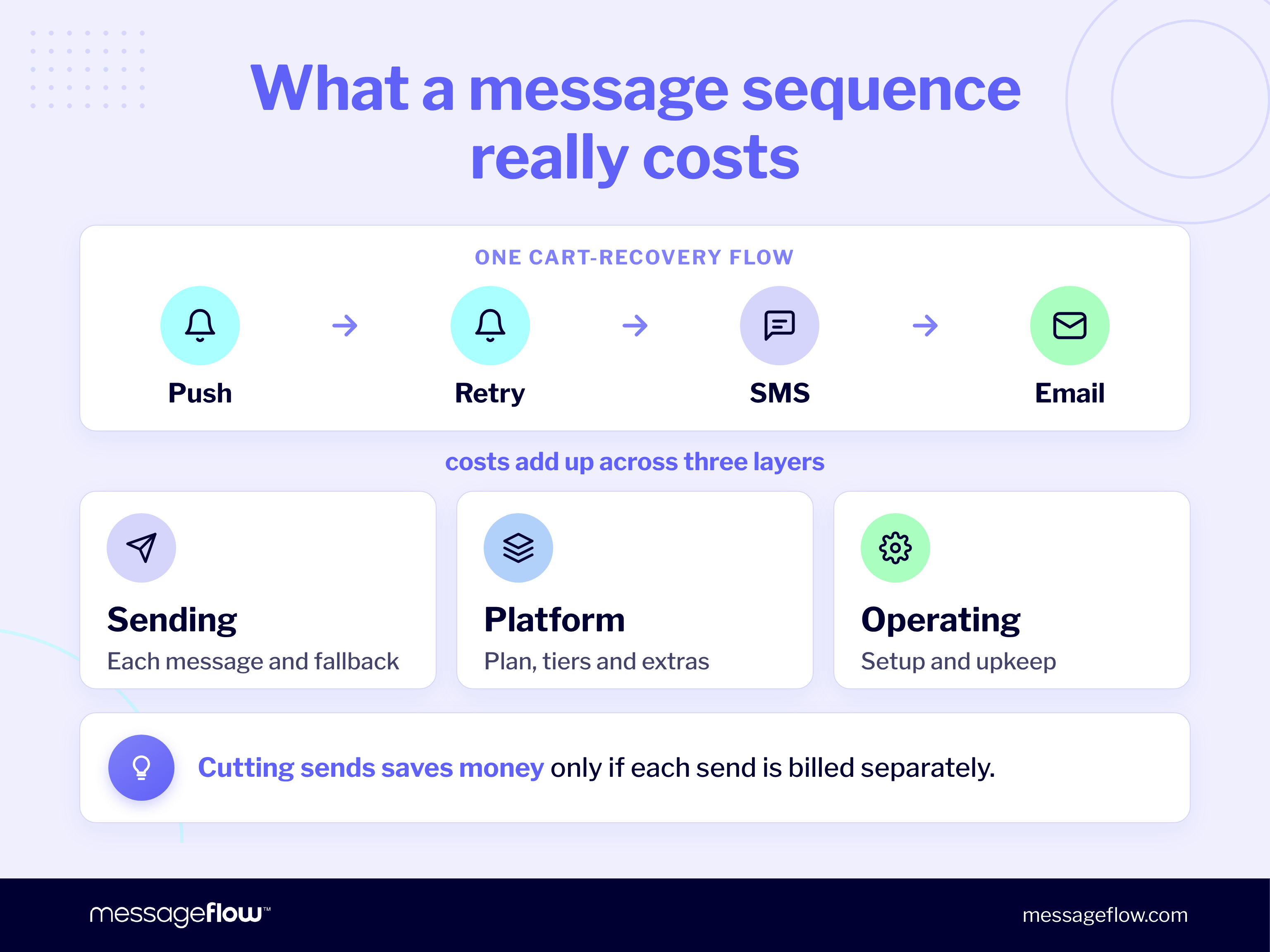
This gives you two useful views: the full cost of running the sequence and the amount your proposed change would actually save. Use the first to assess overall efficiency and the second to build the case for a specific change.
Compare how email, SMS, RCS and push are billed
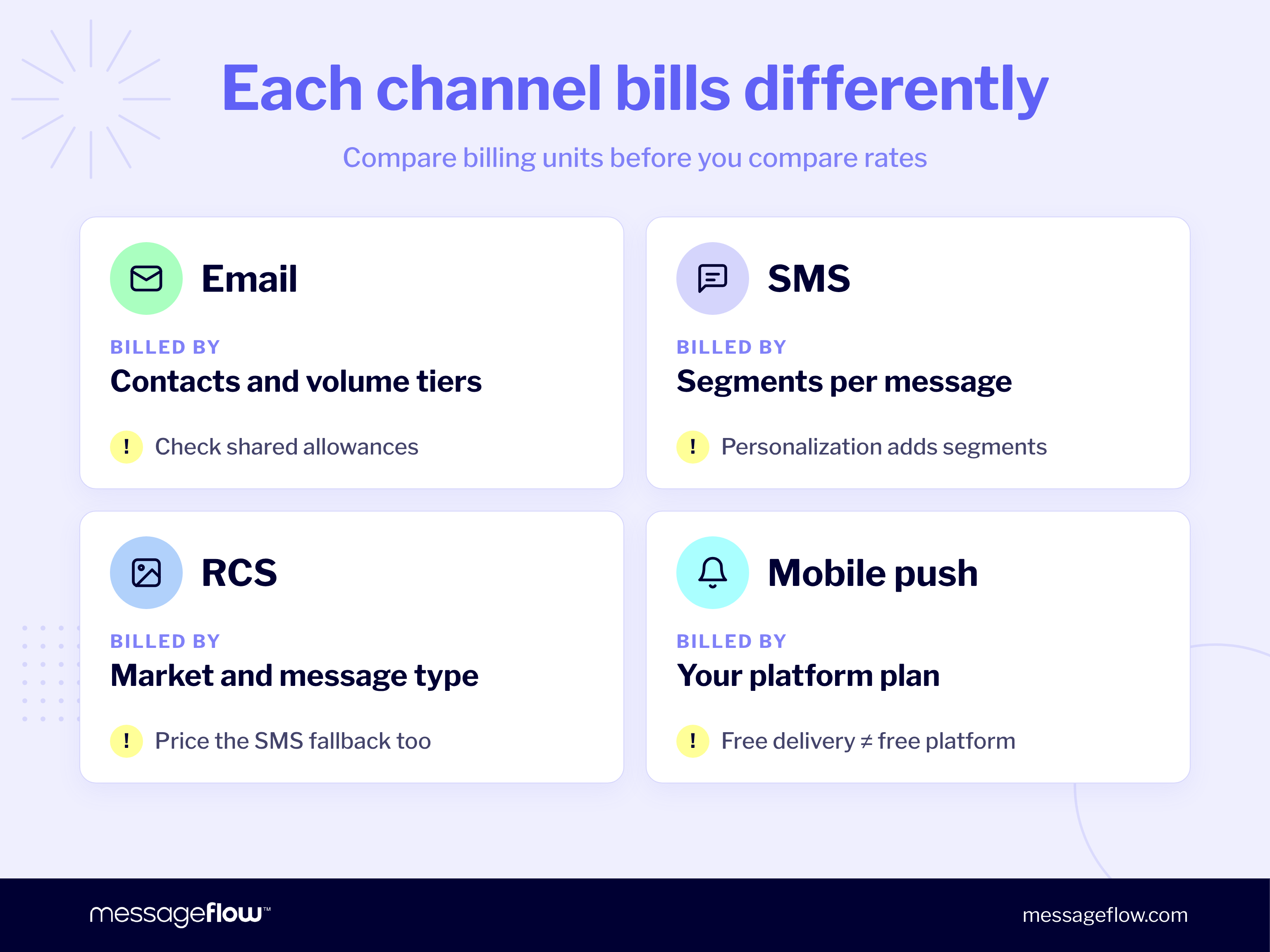
A quoted “price per message” can represent different things across channels. An SMS may contain several billable segments, an email may draw from a monthly allowance, and a push notification may carry no additional delivery charge within a paid platform plan. Compare the billing units before comparing the rates.
| Channel | What can determine the bill | What to check before estimating costs |
|---|---|---|
| Contact tiers, sending volume, included allowances and overages | Whether marketing and transactional sends share an allowance, and which limit would trigger a higher charge | |
| SMS | Billable segments, destination, carrier fees and sender-related charges | The segment count of the final personalized message and the full rate for each destination |
| RCS | Market, carrier, message classification and conversational or non-conversational billing | How the provider prices your planned message format, replies and any SMS fallback |
| Mobile push | Platform subscription, audience or usage tiers, and supporting infrastructure | Whether push is included in your current plan and whether expanding its use changes your platform costs |
Email plans can combine several limits. For example, MessageFlow’s subscription plans specify contact tiers alongside separate marketing and API-triggered email allowances. Estimate the bill using both audience size and sending frequency.
For SMS, check the finished message, including personalization and links. Text length and character encoding determine segmentation, so a small copy change can increase the number of billable units. Campaigns in your non-native market may also incur carrier fees, number charges and registration costs beyond the advertised sending rate.
RCS needs a quote matched to the destination and use case. There are US and non-US models, with conversational and non-conversational categories and carrier-specific rate cards. Ask your provider to price the actual flow, including what happens when a recipient receives a fallback SMS instead.
For an SMS vs. push notification cost comparison, separate delivery charges from the platform that manages the sends. Firebase Cloud Messaging is available at no charge (although it has its own limitations and isn’t fit for every business), but a commercial messaging platform can still charge for access, audience size or other services. Push therefore offers potential savings when you already have the app audience and infrastructure to use it. “Free delivery” alone does not establish the total cost.
Match the channel to the message, audience and deadline
Choose the first channel by asking where the recipient can receive the message, what they need to do and how long they have to act. The lowest sending rate only helps when the channel fits those conditions.
Start with the reachable audience. Build channel choices around the contact details, permissions and app relationships you actually have. A push-first sequence needs a separate route for customers you cannot reach through push. Likewise, an email address or phone number in a customer record does not, by itself, establish eligibility for a marketing campaign.
Then match the format and timing to the task:
| Communication need | Channel choice to evaluate | What should drive the decision |
|---|---|---|
| A detailed offer or product comparison | Email, or RCS where supported | Whether the recipient needs images, options or enough detail to make a decision |
| A routine update for an active app customer | Mobile push | Whether the notification can take the customer directly to the relevant task |
| A time-sensitive update for a customer without a usable push subscription | SMS | Whether the value of reaching them promptly justifies the sending cost |
| A renewal reminder several days before expiry | A sequence beginning with an eligible, lower-cost channel | Whether there is enough time to wait for action before considering another send |
These are starting points for testing. Customer behavior can change the choice: a channel that performs well across your database may be ineffective for a particular segment.
Set the deadline before choosing the waiting period. An appointment reminder sent two days ahead leaves room for a follow-up. A delivery change that matters within the next hour requires a different approach. Starting with a cheaper channel has little value if the delay leaves the next message too late to help.
💡 For each use case, record four decisions: the eligible audience, the first channel, the required action and the latest useful delivery time. Together, they give your routing rules a business purpose and make the choice easier to evaluate.
Remove unnecessary sends through segmentation and suppression
Reduce avoidable volume by checking who still needs each message when it is due to go out. A customer can qualify when a campaign is scheduled and become ineligible before delivery.
Segmentation defines the relevant audience. Suppression excludes people who should not receive a particular send, even if they belonged to that audience earlier.
Focus on four controls:
- Segment by the reason to communicate. Combine relevant signals such as product ownership, renewal date, recent activity and expressed interest. An upgrade offer should exclude customers who already have the advertised plan.
- Check completion before each reminder. Connect the sequence to the event that resolves its purpose. Once a subscription renewal is recorded, suppress pending renewal prompts while retaining the confirmation the customer needs.
- Coordinate overlapping campaigns. Apply frequency limits across promotional workflows so separate teams do not each treat the same customer as available for another send. Define exceptions for essential transactional messages.
- Prevent duplicate triggers. Make sure repeated processing of the same order, booking or account event does not launch identical sequences. Use the relevant event or transaction identifier to distinguish a duplicate from a legitimate new occurrence.
The timing of these checks matters. A branch evaluated before a long delay can leave the customer on a path that no longer fits their situation. Place delays before decision points and use flow filters to prevent reminders after purchase. Apply the same principle in your own system: evaluate eligibility as close to the send as the platform allows.
Also check how quickly completion events reach the messaging platform. Correct suppression rules cannot act on a renewal or purchase that has not yet been reported.
Track exclusions by reason – completed action, frequency limit, duplicate event or channel ineligibility. This helps distinguish intentional reductions from data problems that accidentally remove customers who should still receive the message.
Define when to switch channels and when to stop
A channel switch needs a specific trigger. “Send an SMS if push does not work” leaves a costly ambiguity: did delivery fail, is its status unknown, or did the customer receive the notification without acting?
Separate these conditions when designing messaging channel fallback:
| Condition | What it means | Appropriate response |
|---|---|---|
| The first channel is unavailable or returns a definitive failure | You cannot reach the recipient through that route | Use an eligible alternative if the message still needs to reach them |
| Delivery remains unconfirmed after a defined interval | You lack confirmation, the message may still arrive | Apply a timeout rule based on urgency and the risk of duplicate delivery |
| The customer has not completed the intended action | The business goal remains unmet, regardless of delivery status | Evaluate a follow-up against its expected value and the customer’s eligibility |
Provider acceptance does not prove delivery to the device. A returned message ID confirms acceptance, while an offline device may receive the notification later. A missing click also tells you nothing definitive about whether delivery succeeded.
Before configuring fallback, confirm which recipient-level signals your integration exposes and how quickly they arrive. If timely delivery confirmation is unavailable, describe the rule accurately as a timeout or lack-of-action trigger. Do not label everyone on that branch “undelivered”.
For a push-to-SMS route, define the failure conditions that permit an immediate switch and the uncertain conditions that require a wait. Also set an appropriate expiry for the original push message.
Finally, put a limit on escalation. Define the maximum attempts across channels and the conditions under which the sequence ends without another send. A low-value promotion may not justify a paid fallback at all. An important service update may justify one, even without an immediate conversion to measure.
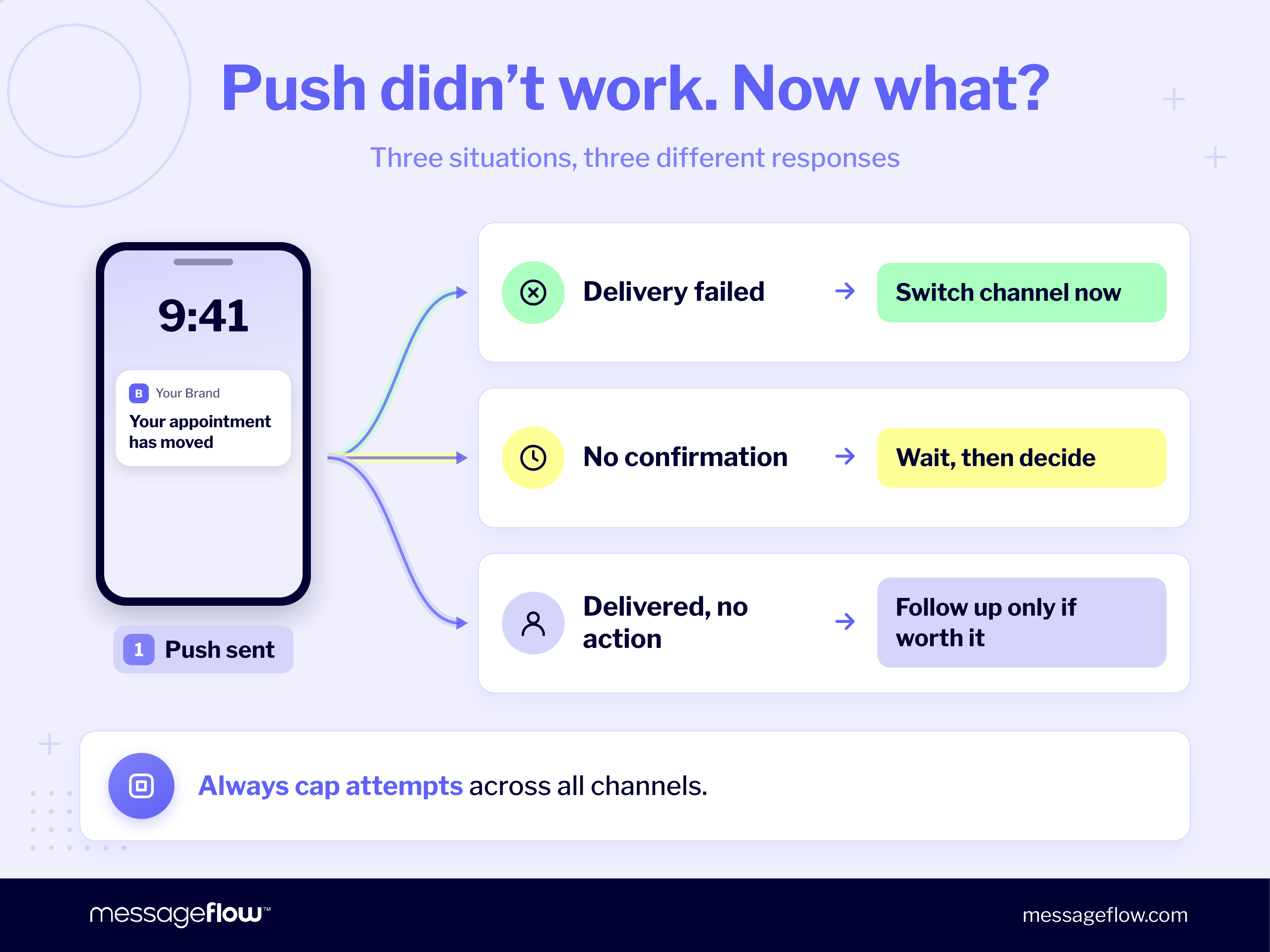
💡 Each additional channel should address a defined delivery problem or a justified follow-up opportunity. Otherwise, fallback becomes another source of unnecessary volume.
Compare the cost of two sequences
Consider a service update for 10,000 customers who are eligible to receive it by SMS. Of those, 6,000 also have a usable push subscription. You want to compare sending SMS to everyone with using push first for that reachable group.
The following figures are illustrative assumptions, not market rates or measured campaign results:
- Each SMS fits into one segment and costs $0.04, including applicable variable fees.
- Each push costs $0.001 under the hypothetical platform contract.
- Of the 6,000 push recipients, 1,200 qualify for SMS fallback under the predefined failure or timeout rules.
- Subscription costs remain unchanged. Additional setup and maintenance costs are excluded from this sending-cost comparison.
| Sending activity | SMS to everyone | Push first where available |
|---|---|---|
| Push notifications | 0 | 6,000 |
| Direct SMS to customers without push | 4,000 | 4,000 |
| SMS to customers with push | 6,000 | 1,200 |
| Total SMS | 10,000 | 5,200 |
| Push charges | $0 | $6 |
| SMS charges | $400 | $208 |
| Total sending cost | $400 | $214 |
Under these assumptions, the push-first sequence reduces sending costs by $186, or 46.5%. The savings come from the 4,800 customers who do not require an SMS, after accounting for the push charges.
The fallback rate materially changes the result. If 3,000 push recipients require SMS instead of 1,200, the sequence costs $286, reducing the saving to 28.5%. If all 6,000 require SMS, it costs $406, slightly more than sending SMS directly.
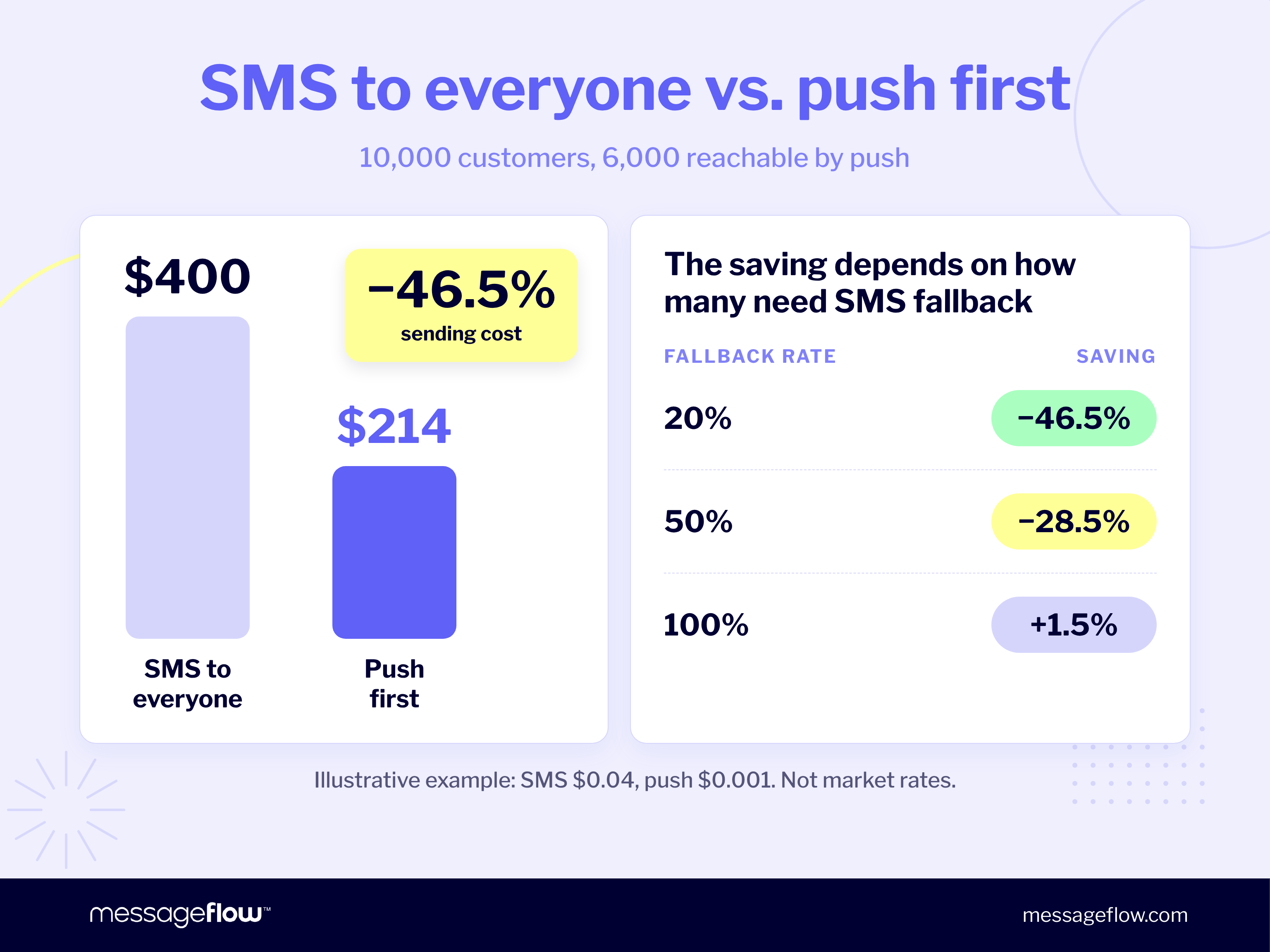
Use historical delivery data or a pilot to estimate that rate. Keep confirmed failures separate from timeouts: a timeout-triggered SMS may reach someone whose push notification also arrives later.
This calculation establishes the potential sending-cost saving. It does not establish equivalent reach or effectiveness. For this service update, the next test is whether customers receive the information within the useful window and whether missed updates or support contacts increase.
Measure cost per outcome and test whether savings preserve results
A lower cost per conversion can still hide a loss of valuable business. Track it alongside the conversion rate, total outcomes and margin generated by the audience you contact.
For a campaign with a purchase or renewal goal, calculate:
Cost per conversion = total sequence cost ÷ unique conversions attributed to that sequence
Use the same cost categories and attribution window for each comparison. Count each qualifying purchase or renewal once, even if several channels receive attribution credit. For service messages, choose an outcome that fits the purpose, such as an appointment attended, and monitor timely delivery separately.
To test a proposed sequence:
- Randomly split the eligible audience between the current sequence and the proposed alternative. Assign customers before the first send.
- Keep other conditions comparable, including the offer, campaign period and outcome definition.
- Assess the complete sequences. Comparing push responders with customers who needed SMS fallback would compare groups selected by different behavior or delivery conditions.
- Set an acceptable performance threshold before launch. Decide how much change in conversion rate or timely delivery would make the savings unacceptable, and collect enough data to assess that threshold.
Distinguish attributed conversions from incremental conversions: the additional actions caused by the communication. The same experimental principle can inform promotional messaging: a randomly selected no-message group helps estimate how many customers would have converted anyway. Reserve that approach for optional promotions, retain essential service communications.
For customer communication ROI, compare incremental contribution margin with communication costs rather than treating all attributed revenue as a return. Alongside the financial result, check unsubscribes, complaints and support contacts for signs that the cheaper sequence creates problems elsewhere.
Adopt the change when the saving holds up against those checks. If the test is too small to rule out a meaningful decline, treat the result as inconclusive rather than assuming effectiveness stayed the same.
Start with one sequence you can measure
Choose a recurring sequence with enough volume to make a change worthwhile and a clear outcome you can track. Give one person responsibility for the pilot, with access to both messaging invoices and performance data. That connection matters: the team changing the workflow needs to see whether the saving reaches the bill.
Expand gradually once the results justify it. Review the economics again when your audience, provider terms or channel availability changes. A sequence that makes sense today may need a different balance as more customers adopt your app or your sending volume crosses a pricing threshold.
The goal is a communication budget you can defend: each send has a purpose, and the results justify the expense.
Find savings in your messaging mix
Want to explore where your communication budget could go further? Share your sending volumes, target markets and a use case with MessageFlow. We’ll help you assess channel options and estimate the costs for your needs. Talk to an expert.