You already know SMS marketing works. You’ve seen the benchmarks, read the case studies, maybe even examined competitor’s results. Clearly, the issue isn’t the channel – it’s getting on board someone who hasn’t seen the data yet. SMS marketing delivers open rates around 98%, and conservative industry estimates put returns at $21-$41 in revenue for every $1 spent. By most standard metrics, SMS marketing ROI outperforms email, paid social, and display. Yet in many organizations it still sits in the “maybe next quarter” column.
With this article I aim to give you three things: comparison data you can drop straight into a presentation deck, ready-made answers to the objections your stakeholders will raise, and a pilot template with KPIs concrete enough to land on a budget meeting agenda. If you’re looking for an SMS campaigns platform that lets you launch a pilot in a single business day, we’ll come back to that at the end. Now let’s get into it!
Why SMS marketing is underestimated and what the data actually shows
The perception of SMS as an old or intrusive channel doesn’t hold when confronted with the data. When you put its core metrics next to email – a channel that already has a guaranteed line in many marketing budgets – the gap is hard to dismiss.
Numbers that silence even the most sceptical stakeholders
A range of factors affects SMS marketing performance, so it’s worth noting that the figures below aren’t absolute. They do, however, serve as valuable comparative benchmarks.
| Metric | SMS | Source | |
|---|---|---|---|
| Open rate | ~98% | ~20% | Forbes |
| CTR | ~18% | ~2.5% | Tabular |
| Response rate | ~45% | ~6% | Tabular |
| Time to read | 3 min | ~90 min | Validity |
SMS isn’t a channel merely worth trying. It’s the top-engagement medium in modern marketing. The table above can serve as the slide that ends the “do we really need another channel” conversation before it starts.
Global adoption tells the same story
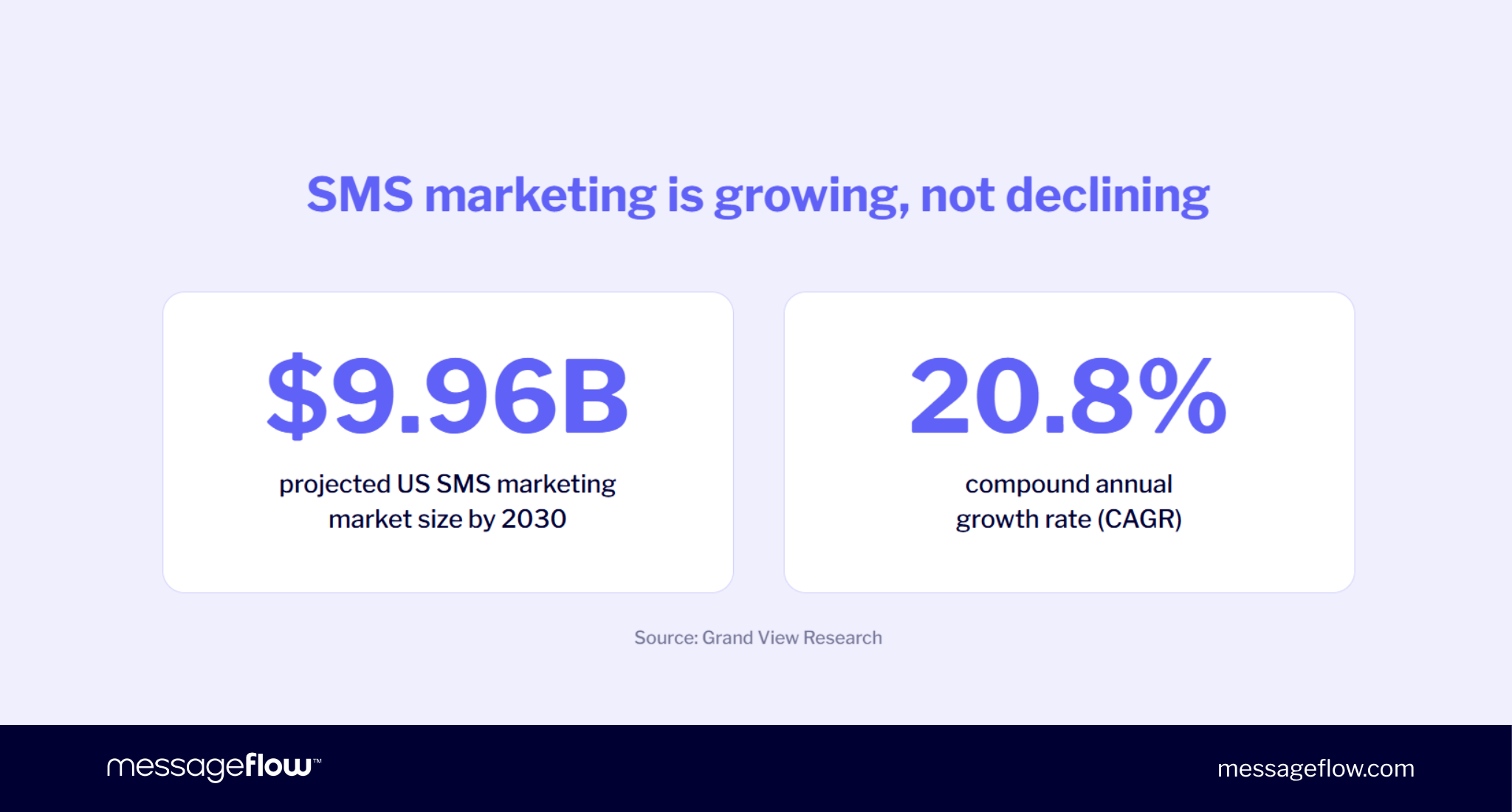
Individual benchmarks are one thing, market-level investment is another. The US SMS marketing market size is projected to reach $9.96 billion by 2030, growing at a 20.8% CAGR (Grand View Research). This doesn’t look like a niche experiment but rather a maturing industry category.
The momentum isn’t limited to the US. Industry data shows that During Cyber Week 2024, business SMS usage grew 47% in Europe and 11% in North America. And as recently reported by TXTImpact, 82% of businesses agree that SMS marketing is an effective way to drive revenue. When adoption is this broad and accelerating, the burden of proof shifts: the question goes from “why SMS?” to “why not yet?”
RCS – the messaging evolution that makes SMS infrastructure even more valuable
For stakeholders worried about investing in old tech, there’s a development worth flagging: Apple’s adoption of Rich Communication Services in 2024 triggered a 500% surge in global RCS traffic, and by 2026 approximately 2.1 billion users are projected to be active on RCS worldwide.
RCS adds rich media, branding and interactive elements on top of the same messaging infrastructure SMS already uses. Platforms like MessageFlow offer both SMS and RCS campaigns which means an investment in SMS today isn’t a dead end but a foundation. For a deeper comparison of the two channels sharing infrastructure, see our breakdown of SMS vs. RCS: key differences for business.
How to calculate SMS marketing ROI – formula and real numbers
This is the section you can take straight into a meeting with your CFO. Not some channel theory – you get a concrete formula, a non-abstract example, and independent benchmarks to back it up.
The ROI formula
The calculation is the same one you’d use for any other channel:
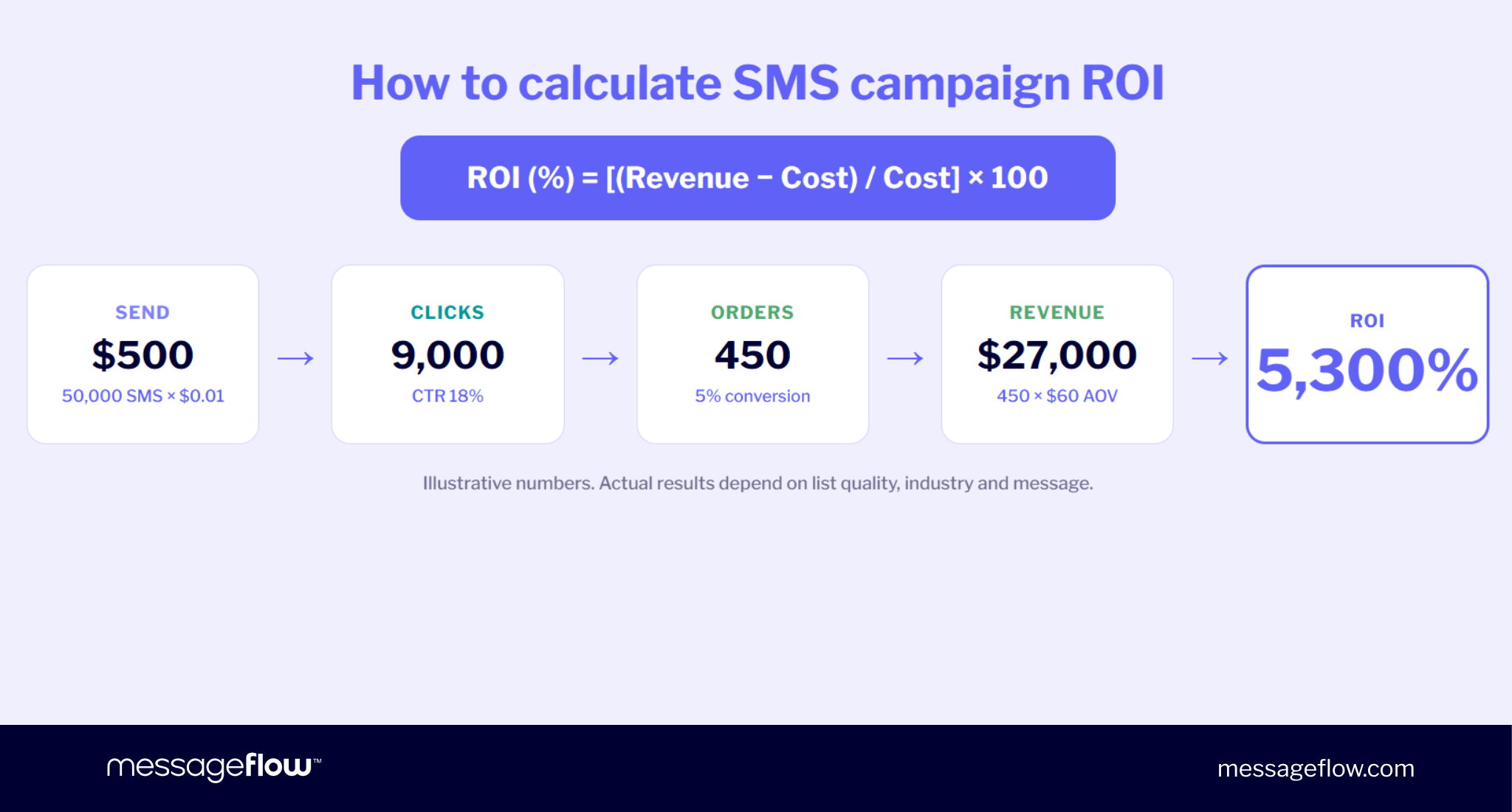
ROI (%) = [(Revenue from campaign − Campaign cost) / Campaign cost] × 100
Here’s what that looks like with realistic US / global pricing:
| Element | Value |
|---|---|
| Send | 50,000 SMS × $0.01 = $500 cost |
| CTR (18%) | 9,000 clicks |
| Conversion (5%) | 450 transactions |
| Average order value | $60 |
| Revenue | $27,000 |
| ROI | [($27,000 − $500) / $500] × 100 = 5,300% |
These numbers are illustrative – actual results depend on list quality, industry, the offering, and message contents. But even at half the conversion rate, ROI still exceeds 2,500%. That’s the kind of number that holds up in a spreadsheet without much narrative support needed.
For a full breakdown of how to track email and SMS performance together, see our guide to email marketing KPIs and ROI.
Independent ROI benchmarks
The example above is a simulation but external data confirms the scale of returns:
- Conservative industry estimates place SMS marketing ROI at $21-$41 in revenue per $1 spent. Email marketing, for comparison, returns $10-$36 per $1 – a strong result but SMS consistently exceeds it.
- Retail flash sale campaigns via SMS can reach ROI exceeding 3,000%. Seasonal urgency and high open rates combine to produce returns that no other digital channel matches at comparable cost.
- The US SMS marketing market is predicted to hit $9.96 billion in 2030 at a 20.8% CAGR – a strong signal of channel maturity.
Cost vs. value – what stakeholders typically overlook
When the conversation turns to budget, it helps to reframe: SMS marketing isn’t expensive – reaching the same customer through other channels is.
Per-message cost sits at roughly $0.005-$0.015 depending on volume and provider. No algorithm, no auction, no major creative production budget required. Compare that with Google Ads or Meta CPC, which in many industries runs 5-30× higher per contact. And brands that use both SMS and email see a 97% higher click rate than those relying on email alone.
💡 The argument that wins budget conversations isn’t “SMS is cheap” but rather “SMS delivers more revenue per dollar than the channels we’re already funding.”
Answers to 4 objections you’ll hear from stakeholders
Data and ROI calculations get you into the room. What keeps you there is being ready for the pushback. Below are the four objections that come up most often along with responses you can paste straight into your speaker notes.
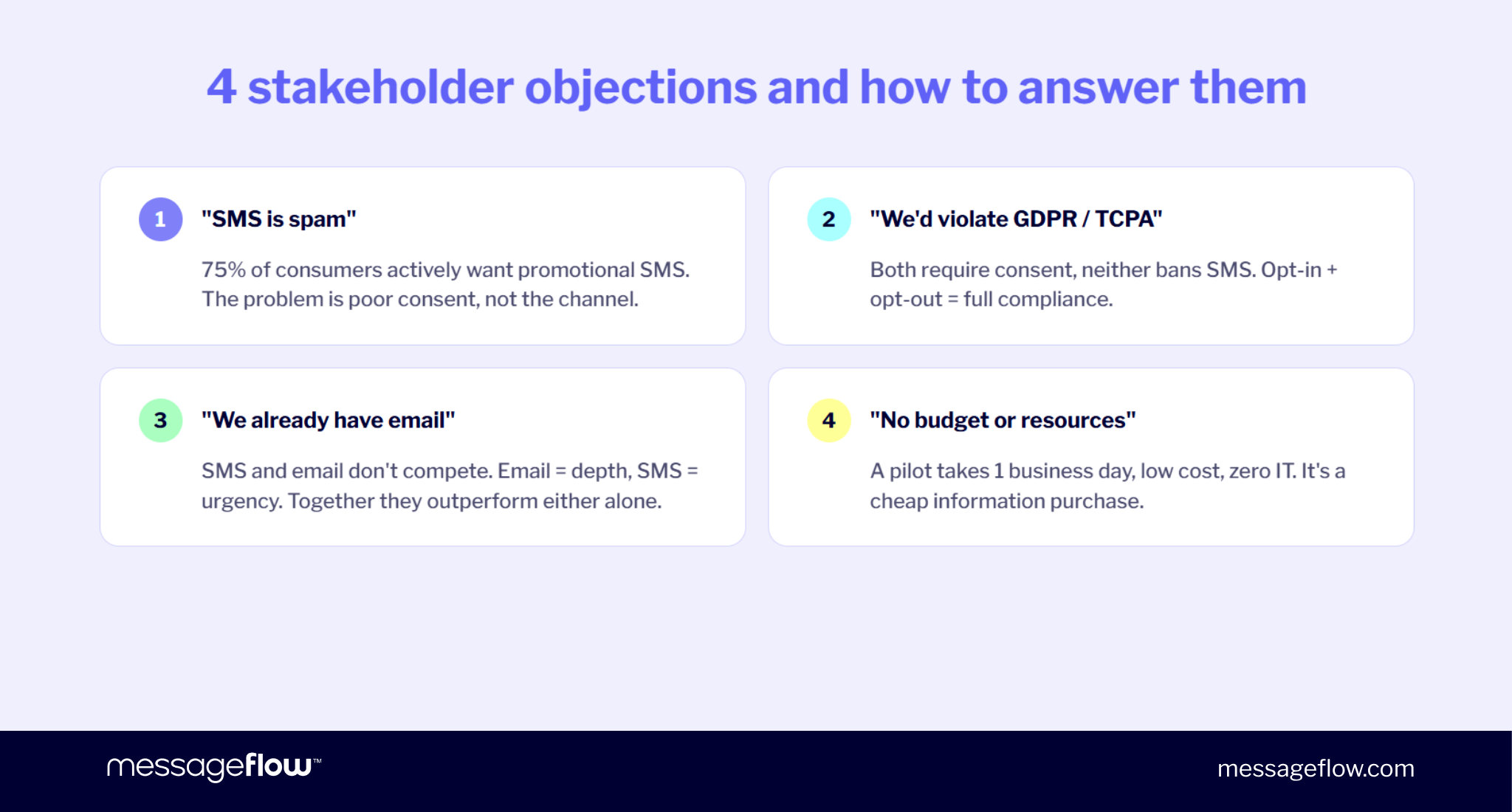
“SMS is spam, customers hate it”
Texting is the number one mobile activity for 83% of consumers, and 75% of customers actively want to receive promotional offers via SMS.
💡 The problem was never the channel, it was lack of consent and poor segmentation. SMS marketing built on opt-in, with precisely defined segments and controlled frequency is permission marketing in its purest form. The spam label belongs to companies that skip consent, not to the channel itself.
“We’d violate GDPR / TCPA”
Neither GDPR nor TCPA ban SMS marketing – both require clear, documented consent before sending. In the US, TCPA demands prior express written consent for marketing messages, and A2P senders must complete 10DLC registration with carriers. In the EU, GDPR requires granular, recorded opt-in. The UK adds PECR (Privacy and Electronic Communications Regulations) on top of GDPR.
💡 In every jurisdiction the principle is the same: a company with a properly collected opt-in database and a functioning opt-out mechanism is fully compliant and often in a stronger legal position than one relying on cold email. (Consult legal counsel for your specific jurisdiction.)
“We already have email, why another channel?”
SMS and email aren’t competitors, they cover different jobs. Email handles depth: long-form nurturing, segmented newsletters, detailed product content. SMS handles urgency: abandoned carts, flash sales, OTPs, time-sensitive alerts. That’s the difference between a channel read within 3 minutes and one that waits an average of 90 minutes.
💡 Brands combining both consistently outperform single-channel strategies in overall revenue. For specific scenarios on how to connect the two, see our guide to SMS and email workflows and our overview of types of SMS messages in business communication.
“We don’t have the resources or budget for a new channel”
This objection sounds serious until you compare it with the actual cost of entry. An SMS pilot can be live in one business day with no IT involvement, no integration project, no new hires. Minimum pilot budget is a few hundred dollars. And pilot data will justify or rule out further investment within 30 days.
💡 That’s not a spend but a relatively cheap information purchase about whether the channel works for your business. The next section shows you exactly how to structure that test.
The pilot template – how to propose a test that gets approved
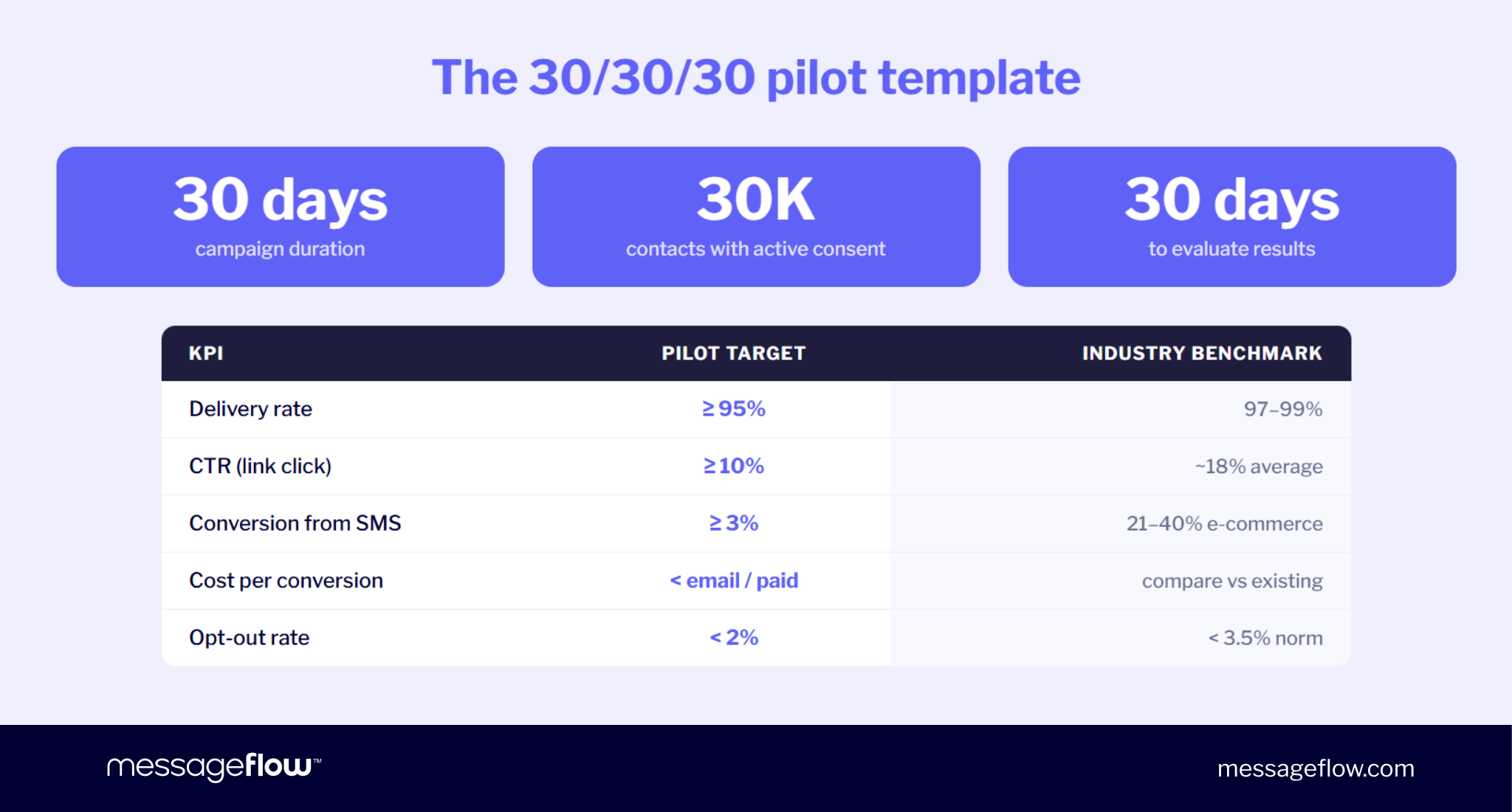
Industry benchmarks can only provide some insight. The strongest argument for SMS marketing will come from your own campaign. The template below is designed to minimize risk from the stakeholder’s perspective: it’s limited in time and spend, has clear success criteria and a clean exit if results disappoint.
The 30/30/30 pilot formula
| Element | Value |
|---|---|
| Campaign duration | 30 days |
| Audience segment | 10,000-30,000 contacts with active SMS consent |
| Evaluation period | 30 days post-send |
Why does this formula work on stakeholders? Because you’re not asking for a year-long commitment or a permanent budget line. You’re asking for one month of your own company’s data including a clear off-ramp if results fall short. Thirty days gives you a statistically meaningful sample. The following thirty days allows time to capture conversions with longer purchase cycles.
KPIs to report – ready to paste into a presentation
| KPI | Pilot target | Industry benchmark |
|---|---|---|
| Delivery rate | ≥ 95% | 97-99% (quality providers) |
| CTR (link click) | ≥ 10% | ~18% average (Sender) |
| Conversion from SMS | ≥ 3% | 21-40% for e-commerce |
| Cost per conversion | < cost from email / paid | Compare against existing channels |
| Opt-out rate | < 2% | < 3.5% (industry norm) |
Note the “Pilot target” column – the values are deliberately set below industry benchmarks. You set a bar you’ll realistically clear, and a result that reads “above target” is a far stronger argument in a budget conversation than “we didn’t quite hit the industry average.”
Pilot campaign preparation checklist
✅ Audience segment with active SMS consent (min. 10,000 contacts)
✅ Defined conversion goal (purchase, sign-up, store visit)
✅ 1-3 messages with tracked links (UTM parameters)
✅ Platform with campaign dashboard and delivery reporting
✅ Pilot budget (est.: 10,000 SMS × $0.01 = $100)
✅ Results review date confirmed with stakeholder
For a step-by-step walkthrough of campaign setup, see our SMS marketing automation guide. And if you need guidance on send timing, check our article on the best time to send SMS campaigns.
MessageFlow lets you launch an SMS pilot in one day with no integration or IT involvement needed. Start with 100 free messages.
Summary – what to take into your stakeholder meeting
Three key takeaways:
- SMS isn’t an old channel – on open rate, CTR and ROI benchmarks it outperforms email and paid across every standard metric. Returns of $21-$41 per $1 spent are the conservative estimate.
- Stakeholder objections have ready answers – GDPR, TCPA, cost, resources, spam – every one is addressable with data.
- A pilot is the cheapest way to get your own evidence – one month of data from your own list beats any external report in a budget conversation.
Readiness checklist:
✅ SMS vs. email comparison data
✅ Global market growth data
✅ ROI formula with worked example
✅ Ready answers to 4 core objections
✅ 30/30/30 pilot template with KPIs
✅Platform ready to launch in 1 business dayStart your SMS pilot with MessageFlow – first 100 messages free.
Frequently asked questions
Conservative industry estimates put SMS marketing ROI at $21-$41 in revenue for every $1 spent. Peak seasonal campaigns such as retail flash sales can reach returns exceeding $71 per dollar.
Email marketing typically returns $10-$36 per dollar. Results vary significantly by list quality, industry and campaign type though.
Track five core metrics: delivery rate (target ≥ 95%), click-through rate (~18% industry average), conversion rate (21-40% in e-commerce), cost per conversion vs. existing channels, and opt-out rate (< 3.5%).
Platforms like MessageFlow provide these reports, making it straightforward to present results to stakeholders.
Yes, when recipients have provided clear, documented consent. GDPR (EU), TCPA (US) and PECR (UK) all require explicit opt-in before sending marketing messages.
A company with a properly collected consent database and an easy opt-out mechanism is fully compliant. Consult legal counsel for your specific jurisdiction.
Per-message costs typically range from $0.005 to $0.02 depending on volume and provider. A 10,000-message pilot costs roughly $100-$200 in the US. SMS subscriber acquisition cost starts at approximately $0.45 – significantly below the cost-per-click of Google Ads or Meta in most industries.
Propose a time-limited pilot with clear KPIs: delivery rate, CTR and cost per conversion vs. existing channels. Your own campaign data is a stronger argument than any industry report.
A 30-day pilot with a 10,000-30,000 contact segment is enough to produce credible, decision-quality results.
Both channels perform best together. SMS delivers ~98% open rates and ~18% CTR, email handles deeper content and long-term nurturing. Use SMS for urgency (cart abandonment, flash sales) while email for depth.