
Mobile app push notifications are messages sent from your app server directly to a user’s device, appearing on the lock screen or notification bar even when the app is closed. For most apps, they are the primary mechanism for re-engaging users after the first session.
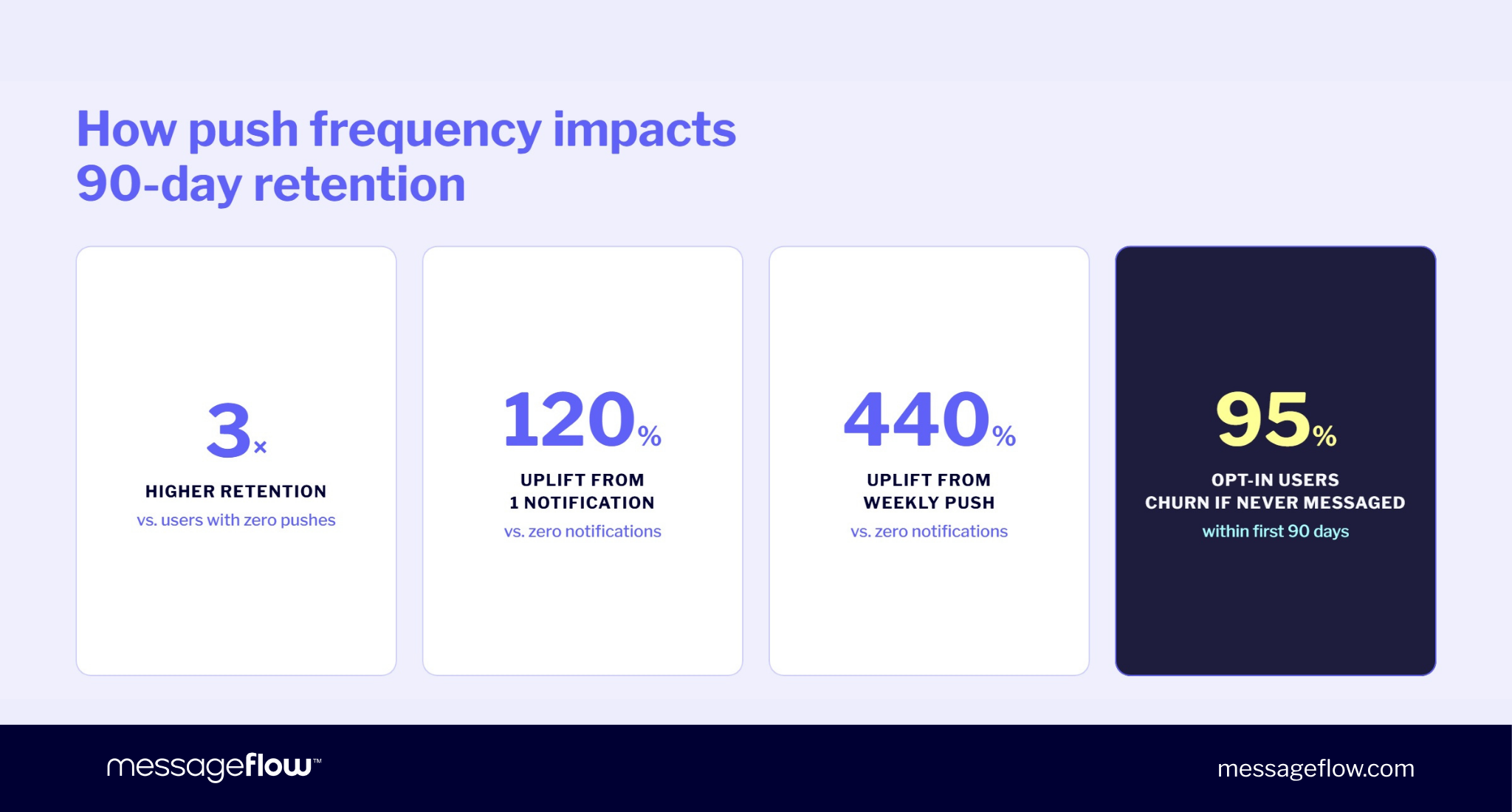
Users who receive at least one push notification in their first 90 days show retention rates nearly 3 times higher than those who receive none (Airship, study of 63 million app users). Apps that send no push notifications lose 95% of opted-in users within that same window. That’s 95 cents of every dollar spent on user acquisition, gone.
1. Push notifications dramatically improve app retention
Most apps lose the majority of users within the first 30 days. The industry average Day 30 retention rate sits at 2.82–3.10%, depending on platform (Pushwoosh Benchmarks 2025, 600+ apps). Push notifications are one of the few levers that consistently move that number.
Airship studied 63 million app users across 1,500 apps and found that retention scales with notification frequency:
| Push frequency | Retention uplift vs zero pushes |
|---|---|
| 1 notification | +120% |
| Weekly | +440% |
| Daily | +820% |
Users who opted in to push are 4 times more engaged overall and twice as likely to still be active compared to opted-out users (Pushwoosh, 2025). In retail, weekly push results in 2–5x higher retention; daily push in 3–6x (Airship).
Why? Without notifications, users who haven’t opened your app in two weeks have no prompt to return. They don’t uninstall; they just stop opening.
2. Push notifications reach users at the moments that drive revenue
Retention is one metric. Revenue is a different question. Push notifications let you show up at the exact moments where users are most likely to convert, or most at risk of walking away.
Abandoned cart recovery: A notification sent 30 minutes after cart abandonment recovers sessions that email can’t reach in time. Push arrives when the user is still near their phone.
Flash sales and limited-time offers: 48% of mobile app users have made an in-store purchase after receiving a push notification triggered by profile data (Localytics). Offers that arrive instantly convert better than those discovered hours later in an inbox.
Back-in-stock and price drop alerts: Users who saved a product and haven’t returned often need one relevant trigger. A price drop alert for a specific item they watched performs far better than a weekly blast to the full list.
Loyalty milestones and rewards: Notifying users when they’ve hit a threshold (points, purchases, streaks) gives them a non-promotional reason to open the app.
Post-purchase follow-ups: Delivery updates, rating requests, and cross-sell suggestions tied to a completed purchase extend the revenue from a single transaction.
3. Push notifications generate actionable campaign data
Each push campaign produces a set of performance numbers. Across campaigns, those numbers tell you what actually works for your specific audience.
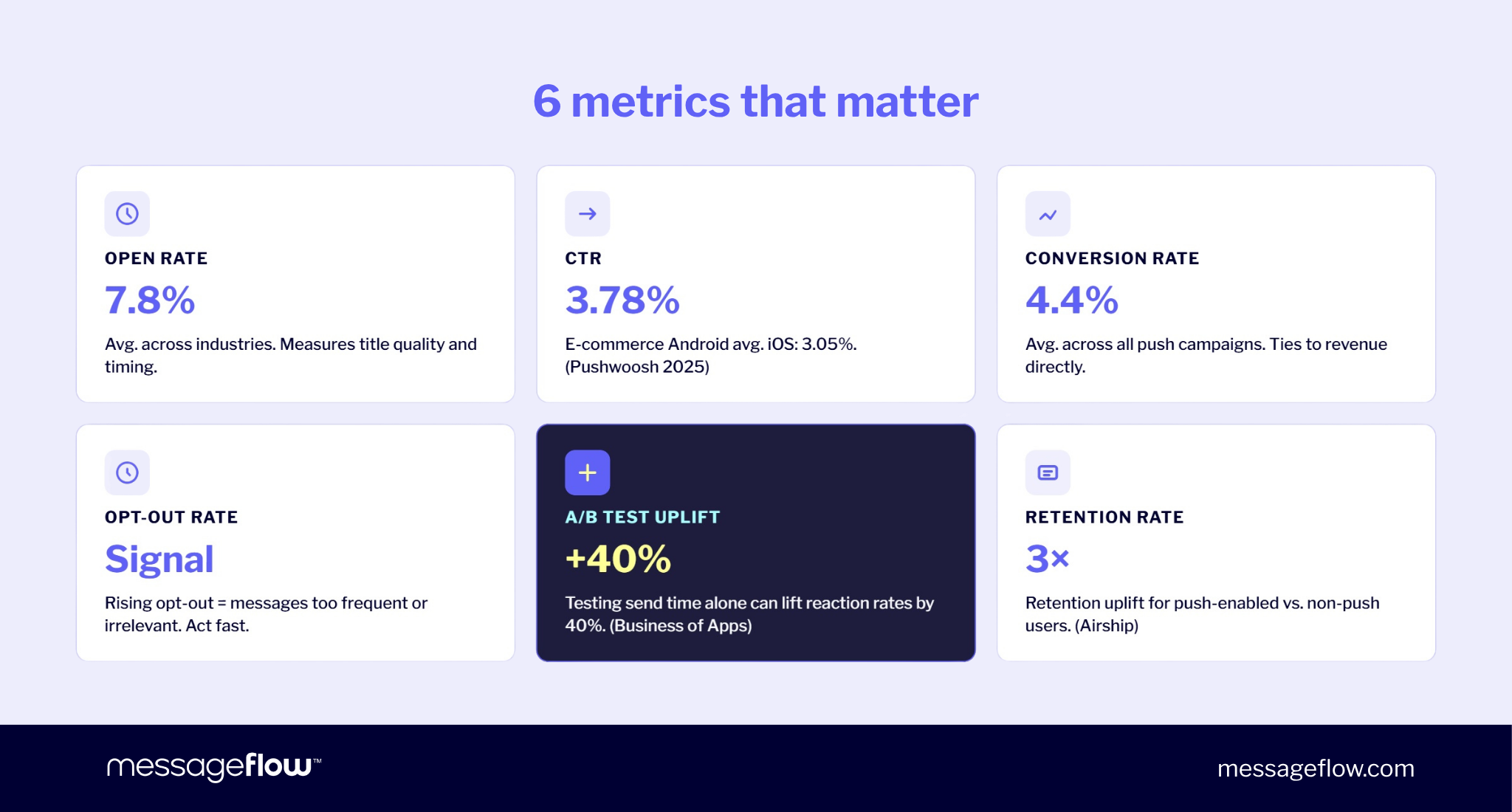
Open rate: percentage who opened the notification. Measures title quality and timing relevance. Industry average is around 7.8% reaction rate (Airship).
Click-through rate (CTR): percentage who tapped a link or action button. E-commerce benchmarks: Android 3.78%, iOS 3.05% (Pushwoosh 2025).
Conversion rate: percentage who completed the desired action after clicking. This is the one that connects push performance to revenue.
Opt-out rate: percentage who disable notifications after a campaign. A rising opt-out rate signals that messages are too frequent, too generic, or arriving at the wrong time.
A/B test results: comparing two variants reveals what language, timing, format, and CTA works for your audience. Testing send time alone can increase reaction rates by 40% (Business of Apps, 2025).
Segment performance: which user groups respond best, so you can concentrate frequency where it produces the most return.
Push analytics sit closer to the actual purchase decision than most channels. Because notifications link to specific in-app behavior, you can trace the path from notification to conversion without approximation.
4. Push notifications are a lower-cost sales channel than SMS or email
Push costs less per message than SMS and arrives faster than email. That combination makes it the right channel for time-sensitive, high-frequency communication without running up per-message costs.
Promotional offers: discounts, limited-time deals, early access. The notification shows up when the user is holding their phone, not when they happen to check email.
Product recommendations: personalized suggestions based on purchase history and browsing. Personalization increases push reaction rates by up to 400% compared to untargeted sends (Business of Apps, 2025).
New product launches: your opted-in users have already shown intent. They’re a more qualified audience for a launch announcement than a cold list.
Cross-sell and upsell: post-purchase is a favorable timing window. The user just completed a transaction; they’re in a buying state.
Geotargeted offers: location-triggered notifications when a user is near a physical store or pickup point. See our proximity marketing guide for how this works in retail.
Event-based campaigns: Black Friday, seasonal sales, product anniversaries. Users expect to hear from brands during these windows, which is why delivery and open rates both run higher.
5. Push notifications keep your brand visible between purchases
Push notifications don’t operate in isolation. Alongside email, SMS, and in-app messages, they cover the moments a user might engage that other channels miss.
Someone who ignores your email might open a push notification. Someone whose push permissions are off can still be reached by SMS. Running all three means you’re not entirely dependent on any one channel finding the right person at the right time.
Between transactions, push keeps users in contact with your brand. Informational notifications, product updates, and content recommendations give people a reason to open the app without requiring a purchase first. That ongoing contact correlates with higher lifetime value.
For apps that already use transactional push notifications (payment confirmations, shipping updates, security alerts), push carries a trust signal that promotional channels don’t. Users expect those messages; they’re not noise.
Rich push notifications extend this further: your logo, brand colors, and visual identity appear in the notification tray on every send. The format turns a functional delivery mechanism into something that looks like your brand.
Setting up mobile push notifications with MessageFlow
MessageFlow’s Mobile Push platform handles Android (FCM) and iOS (APNs) delivery, audience segmentation, deep links, rich media, and analytics in one place. You can build campaigns from the visual panel or connect directly via API.
For strategy guidance, see our mobile push notification marketing guide and our creative push notification ideas with ready-to-adapt copy examples.
If you’re running A/B tests on your campaigns, MessageFlow supports split testing with holdout groups and automatic winner rollout.
With 250+ million Pushes sent every day and a flexible API allowing for close interaction with your existing digital ecosystem, we’re ready to boost the performance of your mobile app. Talk to an expert from our team and start sending Push notification campaigns with MessageFlow.
FAQ: Mobile app push notifications
Mobile app push notifications are messages sent from an app server to a user’s device that appear on the lock screen or notification bar, even when the app is closed. They require the user to have installed the app and granted notification permissions.
Push notifications are the primary re-engagement mechanism between sessions. Users who receive at least one notification in their first 90 days have 3x higher retention rates than those who receive none (Airship, 63 million user study). Apps that send no notifications lose 95% of opted-in users within 90 days.
Higher user retention, re-engagement at revenue-driving moments (abandoned cart, flash sales, back-in-stock), measurable campaign data, a lower-cost sales channel than SMS or email, and consistent brand presence between purchases.
The overall average is 67.5%. Android runs higher than iOS due to historical differences in default permissions. Finance and travel apps consistently achieve the highest opt-in rates across industries.
E-commerce benchmarks: Android 3.78%, iOS 3.05% (Pushwoosh 2025, 600+ apps). Fintech runs higher; gaming runs below 1%. Behavior-triggered, personalized notifications sit well above these averages.
Data shows positive retention impact up to daily frequency, but opt-out risk increases above 5–6 per week. Most high-performing apps send 1–3 per week, focused on behavioral triggers rather than scheduled broadcasts.