- On March 26, 2026, the GSMA finalized RCS Universal Profile 4.0, the biggest upgrade to the RCS standard in years.
- The headline feature is Messaging-Initiated Video Calls (MIVC): the ability to start a video call directly from a text conversation, without leaving the messaging app.
- The update also adds rich text formatting (bold, italics, strikethrough) and streaming video in Rich Cards for business messaging.
- The RCS 4.0 specification is ready. When will the features reach users’ phones? That now depends on carriers and device and software manufacturers.
March 26, 2026. The GSMA announced the finalization of RCS Universal Profile 4.0. This is not a minor patch. It’s the most significant step forward for RCS since Apple added support for the standard in iOS 18. The new profile defines what a native video call initiated from a text thread should look like, introduces text formatting familiar from modern messaging apps, and opens new doors for businesses already using RCS to reach customers.
The context matters. In the US alone, Google reported over one billion RCS messages sent daily by mid-2025. Verizon, AT&T, and T-Mobile all support RCS, and Apple’s entry into the ecosystem with iOS 18 triggered a fivefold increase in global RCS traffic almost overnight. Across Europe, adoption is accelerating too: Germany has already seen RCS penetration surpass WhatsApp in some segments. The market is maturing fast.
We asked Piotr Kudzior, Product Owner for Conversational Channels & Push at MessageFlow, to share his perspective on what the new spec means in practice. Piotr brings over 10 years of performance marketing experience and has spent the last several years specializing in RCS at MessageFlow, helping businesses design and roll out conversational campaigns. He’s a recognized voice in the industry, regularly appearing as an RCS expert in trade media and podcasts.
Below, we break down exactly what RCS 4.0 changes, when these features will reach devices, and what businesses running RCS campaigns today should know.
What is RCS Universal Profile 4.0 and what does it introduce?
RCS Universal Profile is a single, industry-agreed set of features and technical requirements. It tells operators, device manufacturers, and OS providers how RCS should work on every phone. When everyone builds to the same spec, users get a consistent experience regardless of their carrier or device.
Version 4.0 is the most comprehensive upgrade yet. It brings three major changes:
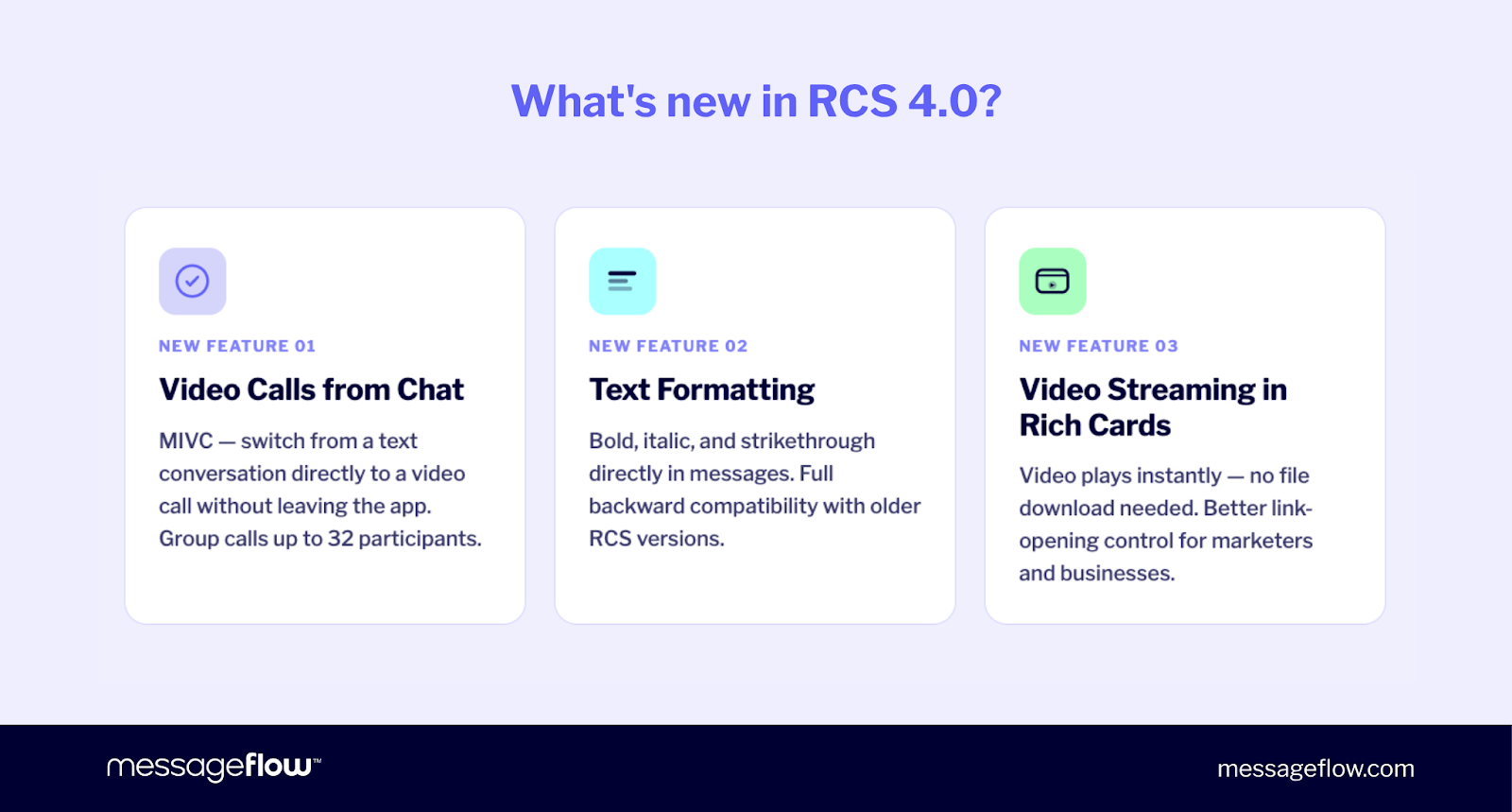
- Messaging-Initiated Video Calls (MIVC): native video calls launched directly from a chat thread, including group calls with up to 32 participants.
- Rich text formatting: bold, italics, and strikethrough in standard text messages.
- Enhanced Rich Cards: streaming video playback without file downloads, plus better control over how links open.
You can see the influence of iMessage here – in the approach to enriched P2P communication. This is no longer just ‘SMS 2.0’. It’s an attempt to build a consistent, native messaging standard with features that have until now been locked inside closed ecosystems.
The real potential only materializes with full implementation on both sides: Android and Apple. If that universal rollout happens, we’re looking at a fundamental shift: communication that becomes simpler and more capable without any external OTT app required. – states Piotr Kudzior, Product Owner Conversational Channels & Push, MessageFlow.
One important clarification: finalizing the spec is not the same as shipping the feature. Think of it as publishing a recipe. Someone still has to cook the meal.
What is MIVC and why does it matter?
Messaging-Initiated Video Calls (MIVC) let you escalate a text conversation into a video call without ever leaving your messaging app.
Today, switching from a text thread to a video call means closing the app and opening something else: FaceTime, Google Meet, WhatsApp, Zoom. The list goes on, and nobody agrees on which one to use. MIVC changes that. A video call button sits directly inside the chat thread.
According to the GSMA, MIVC supports both one-to-one and group conversations. Group calls can include up to 32 participants. The spec also includes “late joining”: if someone misses the initial invite, they can hop into an active call at any point. Call logs sync directly into the chat timeline, keeping the full context of a conversation in one place.
When implemented, MIVC will be the first natively supported video call standard that’s interoperable across a wide range of devices and networks. That’s a meaningful gap to close. Currently, no third-party app covers everyone, and cross-platform video calling remains fragmented.
Google Messages is the most likely first mover. Samsung discontinued RCS support in its own messaging app in January 2025 and redirected users to Google Messages, consolidating Android’s RCS experience in a single client. T-Mobile customers alone are sending an average of 613 million RCS messages per day in 2025. That’s a large and growing base ready for what comes next.
I’ve been predicting for some time that RCS would evolve into a kind of super-app: a single place combining communication, marketing, customer service, AI agents, and complete purchase journeys. Video is the next step in that direction. It opens the door to RCS being used for business meetings, which in the longer term puts it in direct competition with tools like Zoom, Teams, or Slack.
In A2P communication, it’s easy to picture a scenario where a user contacts support over RCS, the text conversation can’t resolve the issue, and escalating to a video call with an agent becomes the natural next step – one that makes resolving the problem significantly easier. How this plays out in practice remains to be seen. One thing is clear: RCS has the potential to reshape yet another dimension of communication – adds Piotr Kudzior.
Rich text in RCS 4.0: How does message formatting work?
RCS 4.0 adds support for bold, italics, and strikethrough directly in text messages. It’s a change users have been waiting years for.
Standard SMS and RCS apps today treat every message as plain text. Want to emphasize a word? You’re stuck with ALL CAPS or asterisks. RCS 4.0 changes that, bringing formatting on par with what WhatsApp and iMessage users already take for granted.
The GSMA built in backward compatibility. If the recipient is on an older version of RCS or plain SMS, the app will prompt them to view a plain-text version so formatting codes don’t clutter the message.
Media quality gets an upgrade too. Phones will now automatically identify the formats supported by the person on the other end and choose the best encoding for video, photos, and audio. No more unnecessary compression. No more blurry images that arrived perfectly sharp on your phone.
What do the new rich cards mean for marketers?
Rich Cards are one of the most powerful formats in RCS Business Messaging. They combine images, text, action buttons, and links into a single interactive message card. They’re already driving strong results: RCS campaigns achieve open rates of 72% and click-through rates between 15 and 30%, with top-performing campaigns reaching 51% CTR.
RCS 4.0 introduces two meaningful upgrades for businesses:
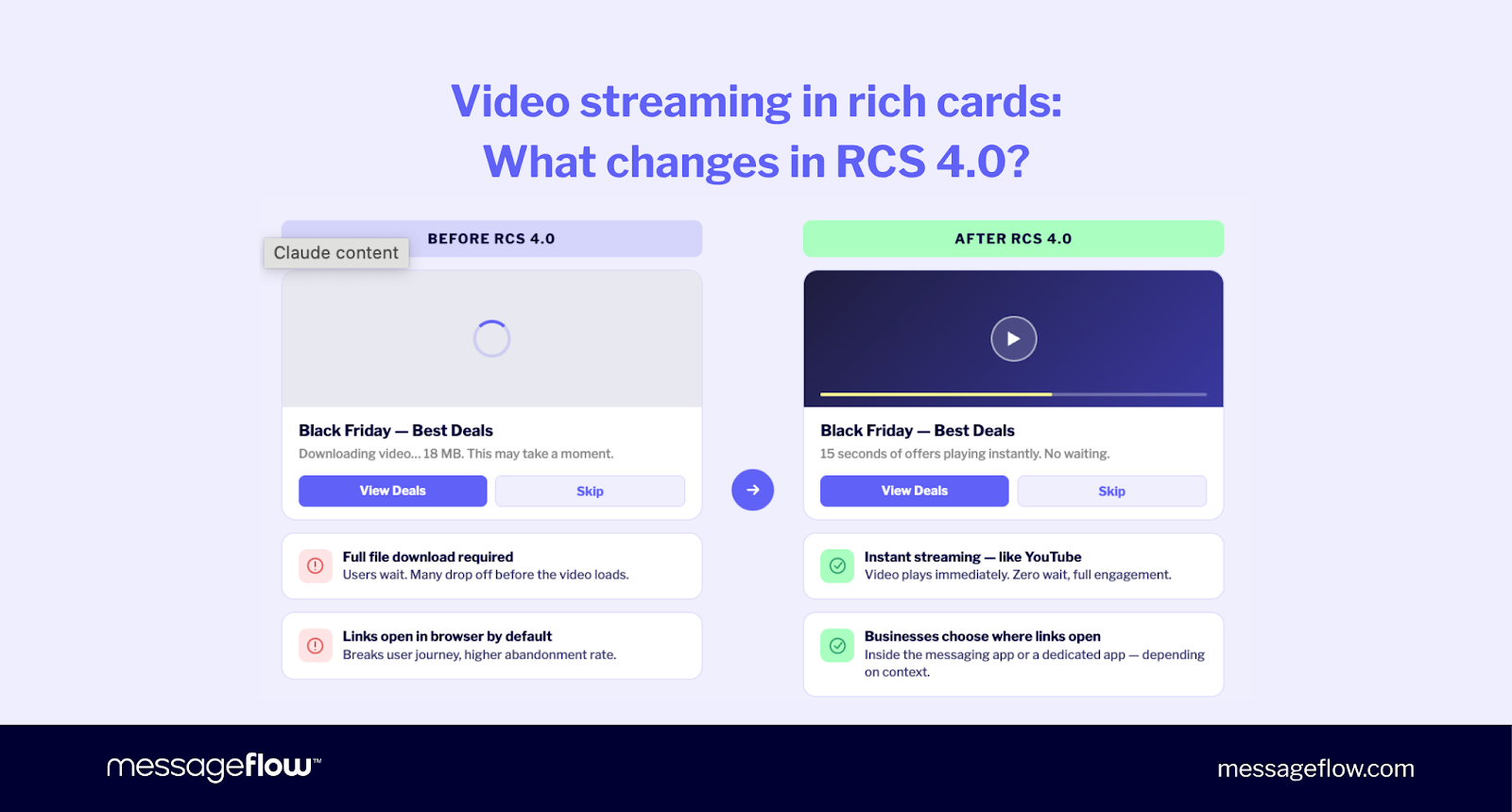
First, streaming video in Rich Cards. Until now, video in a Rich Card required the user to download the full file before anything played. That friction kills engagement. Under the new standard, video streams instantly, the same way it does on YouTube or Instagram Stories. For campaigns where motion and visual impact are the hook, this is a fundamental improvement.
Picture a retail brand sending a pre-Black Friday campaign. Instead of a static image, the customer sees a 15-second video of the best offers playing immediately on arrival. No download bar. No waiting. That’s the difference.
Our clients have been working with various RCS formats for some time, and Rich Cards remain the most popular. Video-based solutions have also been deployed – but in practice their use came with real limitations.
Two issues stood out. First, the need to download the full video file before playback: on a weak signal, that meant long wait times or no playback at all. Second, the lack of autoplay, which reduced the naturalness and fluidity of the user experience.
The first of these issues is set to be resolved with version 4.0. The question now is whether the second barrier will also be addressed – explains P. Kudzior.
Second, smarter link handling. Businesses will now be able to choose whether a link in a Rich Card opens inside the messaging app (ideal for quick tasks like checking an order status) or deep-links into a dedicated app (for secure payment flows, for example). It sounds like a small detail. In practice, it keeps users on the path you’ve designed rather than dropping them somewhere unexpected.
All of this layers on top of a channel that’s already outperforming traditional messaging. RCS campaigns drive click-through rates up to seven times higher than SMS, and conversion rates of 20 to 40% in well-executed campaigns, compared to roughly 3 to 5% for SMS and under 2% for email.
When will RCS 4.0 features reach users?
Finalizing the spec is only step one. From standard publication to consumer availability, the typical timeline runs 12 to 18 months under favorable conditions.
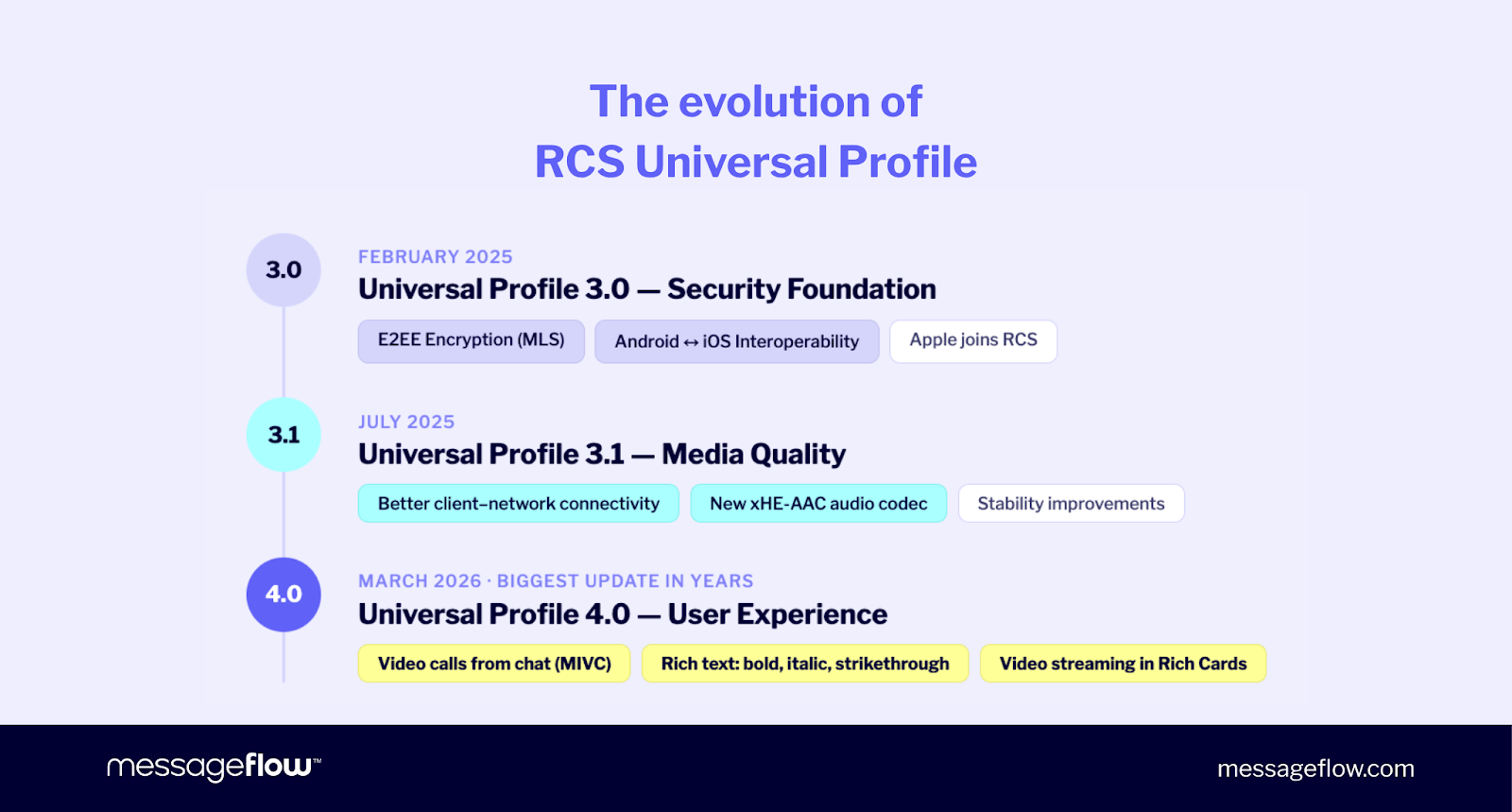
That’s not pessimism: it’s history. RCS Universal Profile 3.0, which introduced end-to-end encryption via Messaging Layer Security, was announced in March 2025. A year later, Apple and Google are still testing cross-platform E2EE and it hasn’t reached all users yet.
The path to a working feature on your phone requires several moving parts to align:
- App developers (Google, Apple) must implement the new profile.
- Carriers must update their network infrastructure and enable the features.
- Device manufacturers must push software updates.
- All sides must interoperate cleanly.
For MIVC specifically: Apple took years to adopt RCS at all. Implementing an advanced feature like video calling is a separate decision that requires active commitment from Apple. Android-to-iPhone video calls through RCS are technically within reach once the spec is in place. Whether Apple moves quickly is a different question.
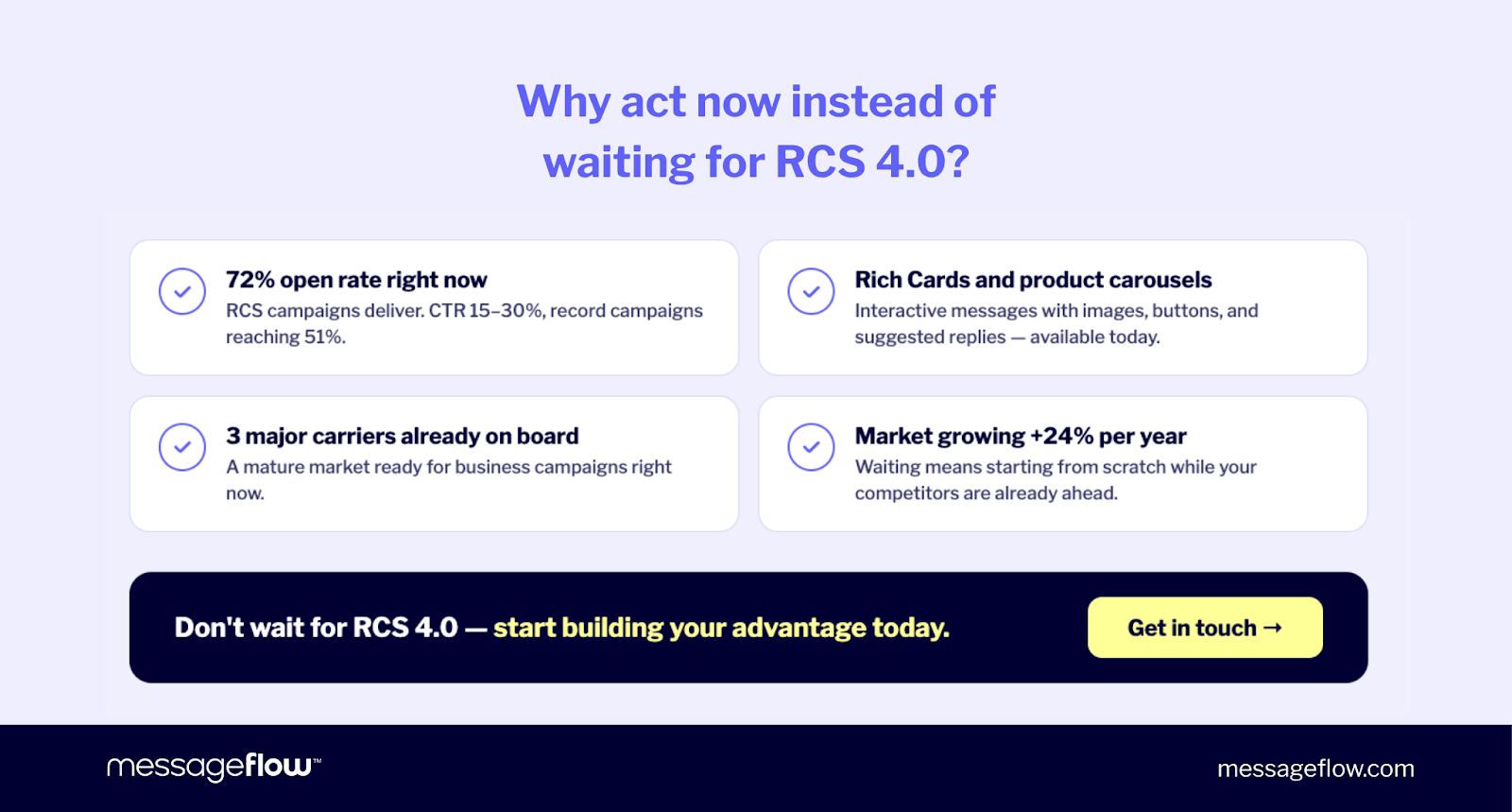
For businesses using RCS for business today, the practical advice is simple: don’t wait for RCS 4.0 to start. The features available right now are more than enough to run campaigns that outperform SMS and email by a wide margin.
What does RCS 4.0 mean for businesses sending messages today?
RCS Universal Profile 4.0 is good news for anyone thinking about mobile communication long-term. But it doesn’t change what’s already working.
Businesses using RCS Business Messaging today can already expect CTR up to 13 times higher than SMS, verified sender profiles with full brand logos and colors, interactive product carousels, suggested replies, and bot-driven conversation flows. That’s available now, on the devices your customers are already using.
The new standard signals that the GSMA, Google, Apple, Samsung, and carriers are aligned on a shared roadmap. The RCS market is valued at $2.87 billion in 2025 and projected to reach $10.93 billion by 2031, growing at 24.95% annually. That’s the kind of trajectory that justifies building expertise and infrastructure now rather than later.
For marketers thinking about launching their first RCS campaigns, the message is clear: start now and build your team’s skills progressively. When streaming video in Rich Cards becomes widely available, you won’t be starting from scratch.
Consider e-commerce. Campaigns with product carousels, dynamic offers, and suggested replies are effective today. Adding streaming video to that toolkit is the next logical step in the same direction, not a pivot.
I don’t have major concerns about the pace of adoption by device manufacturers like Samsung – or even Apple, though MIVC is essentially a direct challenge to FaceTime. The bigger unknown is how quickly carriers roll out support, and that varies significantly by market.
The iOS 18 RCS rollout is a useful reference point: adoption moved quickly in Western Europe and the US, while other markets lagged behind. That pattern is likely to repeat with Profile 4.0 features, which is exactly why building expertise now rather than waiting for full availability is the right call – adds Piotr Kudzior.
What does RCS 4.0 change for security and encryption?
The new profile doesn’t overhaul the encryption layer: that work was already done. RCS Universal Profile 3.0 (February 2025) introduced E2EE based on Messaging Layer Security (MLS). Apple and Google are currently testing this feature between Android and iOS.
RCS 4.0 focuses on user experience, not cryptography. That’s a good sign. The security foundation is in place. Now the standard grows upward with new features on top of it.
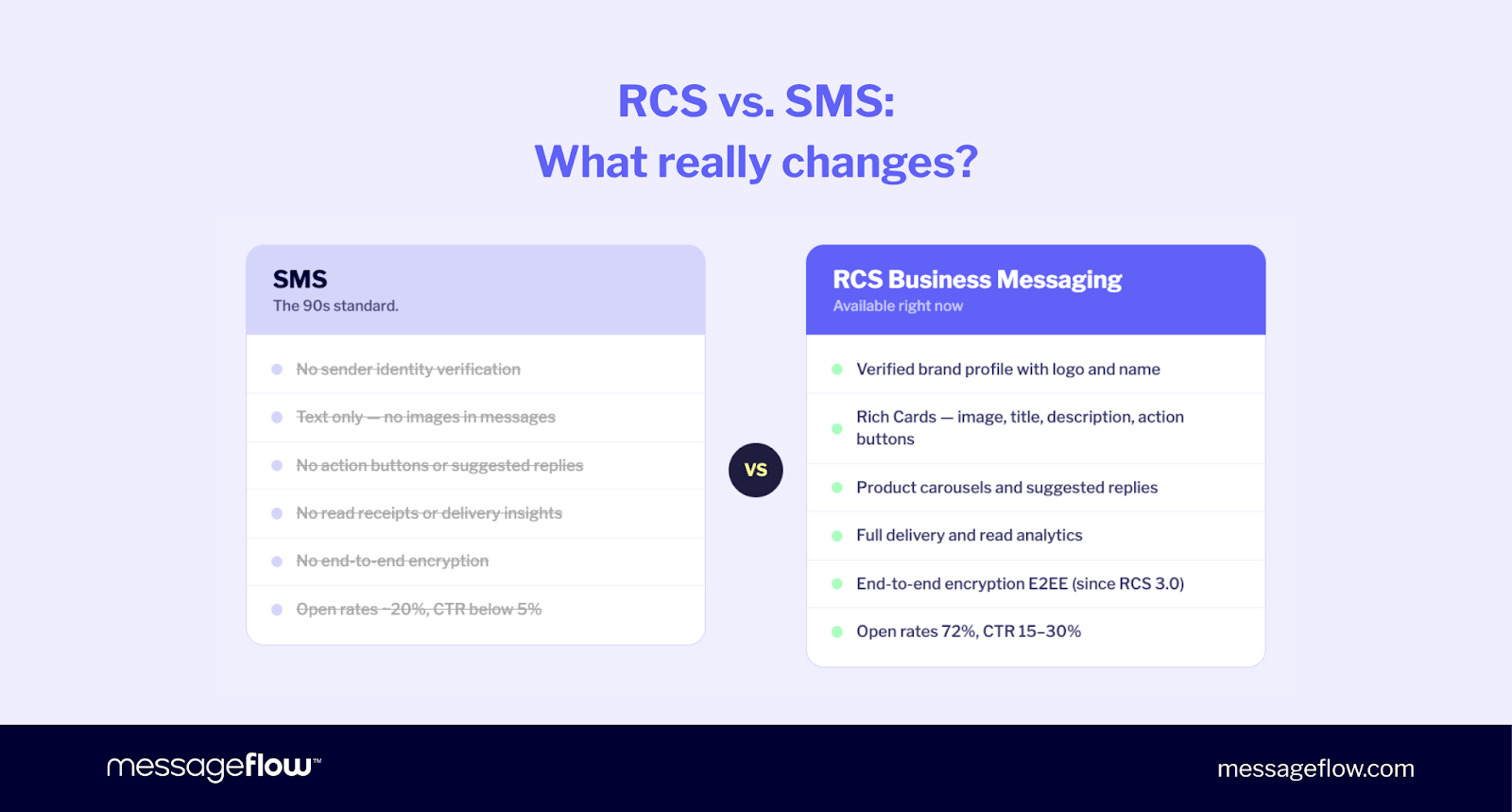
For businesses, one key protection is already baked in. RCS requires sender verification before a message can reach a user. That’s a fundamental difference from SMS, which has no mechanism to confirm a brand’s identity. A verified sender profile builds trust with recipients, lowers the barrier to interaction, and provides genuine protection against phishing and spoofing. In a landscape where SMS fraud reached $5.8 billion globally in 2023, that matters.
If you want to see how to set up your first RCS campaign, our team is ready to walk you through it. Contact MessageFlow and find out what RCS can do for your business today!