Key takeaways
- In customer communication, there are two primary types of SMS messages: transactional SMS messages and promotional text messages. Each serves a different purpose and requires a different approach.
- How a message is classified affects its content, timing, consent requirements, and performance metrics.
- Key differences between transactional SMS and promotional SMS include their purpose (operational vs. marketing), legal compliance requirements, and the type of user consent needed. Transactional SMS delivers essential information like order updates, while promotional SMS is used for marketing and requires explicit opt-in.
- Transactional SMS messages are considered operational communication, while promotional SMS messages fall under marketing activities and require explicit user consent.
- Mixing message types (for example, adding a sales offer to an order confirmation) can lead to legal risks and a loss of customer trust.
- Platforms such as MessageFlow allow businesses to manage all types of SMS communication in one place, while keeping goals clearly separated and staying compliant with regulations.
Introduction: Why does SMS communication need clear categories?
The first SMS message was sent in 1992, but SMS communication for businesses only became a standard practice in e-commerce brands after 2010, alongside the rapid growth of online shopping and rising customer expectations.
Today, SMS is a true “here and now” channel:
- text messages are delivered within seconds,
- content is concise (the classic 160-character limit without special characters, fewer when using Unicode),
- and it works equally well for operational notifications and marketing campaigns.
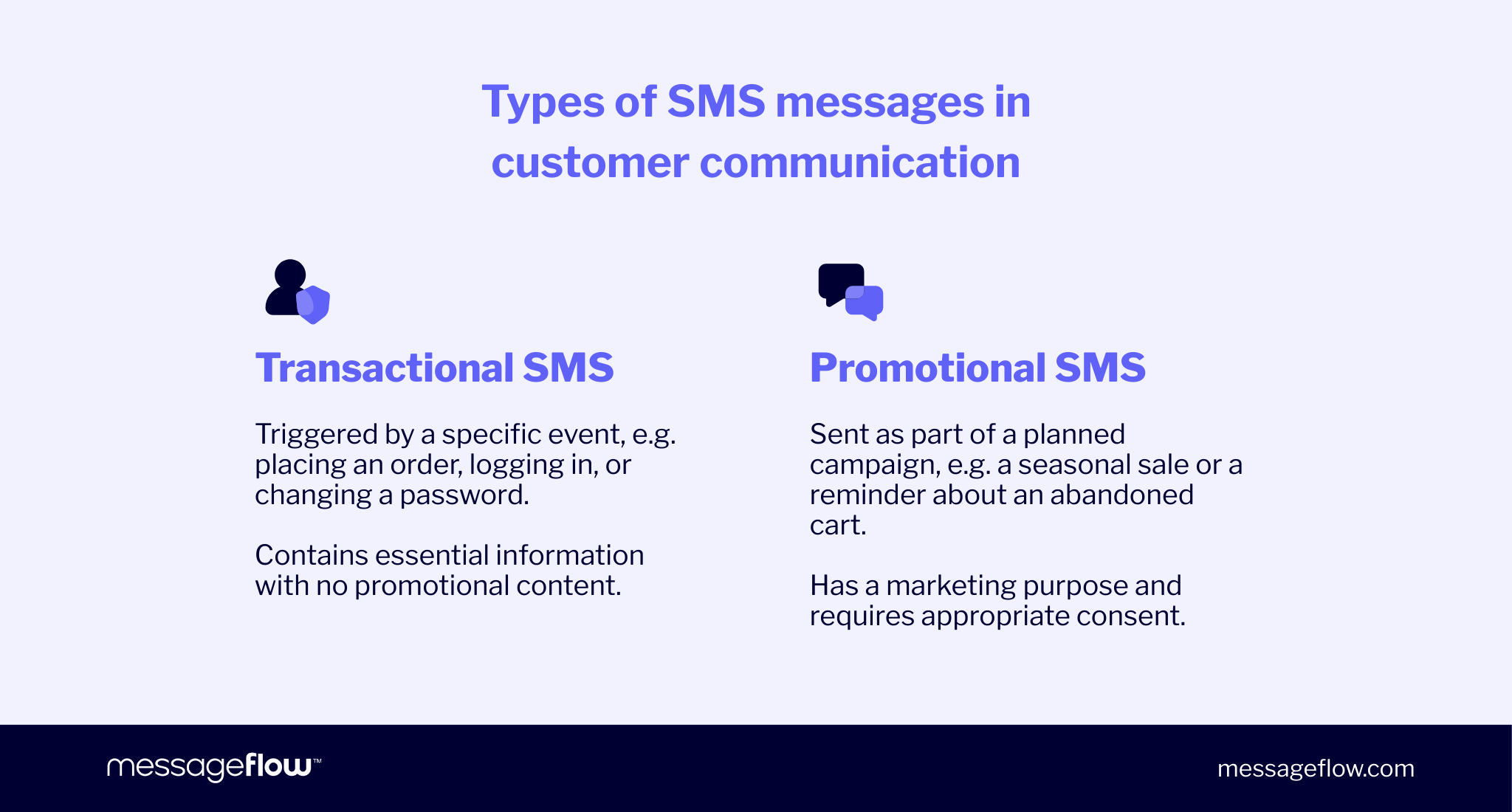
In business practice, SMS text messages fall into two main categories, known as message types. A transactional SMS is sent in response to a specific customer action or a system event. A promotional text message has a marketing goal – encouraging a purchase or engagement with an offer. Some businesses also use conversational SMS to enable two-way interactions with customers, further enhancing engagement.
This distinction is far from theoretical. The message type determines the rules for content, timing, and consent, and it directly impacts:
- required consents (operational vs. marketing),
- how text message content is written,
- when text messages should be sent,
- and how success is measured (delivery and reliability vs. clicks and conversions).
In real-world communication strategies, SMS is often combined with other channels such as email, RCS (Rich Communication Services), and mobile push notifications. Platforms like MessageFlow help businesses manage the entire process in one tool – from promotional campaigns and transactional notifications to critical alerts.
The two main types of SMS messages in customer communication
Before diving into details, it’s important to understand the fundamental differences between these two types. Each has a distinct purpose, timing, consent model, and set of KPIs.
Transactional SMS
A transactional SMS is triggered by a specific event – for example:
- placing an order in an online store,
- logging into an account,
- resetting a password,
- or receiving a shipment status update.
Common examples include order confirmations, shipping and delivery notifications, one-time passwords (OTP), and two-factor authentication (2FA) codes.
This type of text message builds trust and reliability and is a natural part of customer service. Customers expect to receive it, and its primary role is to provide timely, essential information.
Promotional SMS
A promotional SMS has a clear marketing objective: driving sales, increasing engagement, or bringing customers back to a purchase journey.
These text messages are sent as part of a planned campaign to a specific customer segment. Typical examples include:
- Black Friday discounts,
- seasonal sales,
- abandoned cart reminders with a promo code,
- or invitations to exclusive events for loyal customers.
Because promotional SMS messages are classified as marketing communication, they require explicit opt-in consent and careful attention to timing, relevance, and frequency.
The risk of mixing text message types
One of the most common mistakes in SMS communication is adding sales-driven content to transactional messages. An order confirmation followed by a line like “Why not add product X with a discount?” is no longer purely operational – it becomes a marketing message that may require separate consent.
Mixing purposes like this doesn’t just blur definitions. It can undermine customer trust, trigger complaints, and even lead to filtering or blocking by mobile operators.
In larger organizations, it’s a good practice to clearly document internal definitions of each SMS type. This ensures that marketing, customer support, and IT teams all work with the same assumptions, terminology, and compliance rules.
Transactional SMS: notifications triggered by customer actions
A transactional SMS is a text message sent in response to a specific customer action or system event. These are typically sent as automated messages, triggered by events such as purchases, appointment bookings, or password resets. It’s a natural part of a process the recipient expects – a confirmation, status update, or security alert, and businesses use SMS platforms to send messages efficiently and reliably.
Unlike marketing SMS, transactional communication is non-promotional by nature. Its primary purpose is to ensure process continuity, security, and transparency.
When is a transactional SMS sent?
Transactional SMS messages are typically triggered automatically after events such as:
- placing an order in an online store
- creating an account in an app or registering on a website
- logging in from a new device (security alert)
- a change in shipment status (dispatched, in transit, delivered)
- an upcoming loan repayment or invoice due date
- appointment reminders
- payment confirmation or a refund being processed
These SMS notifications are informational, but they are always directly tied to a process initiated by the customer. They should not include any sales or promotional elements. Through transactional text messages, companies primarily build trust, reliability, and transparency.
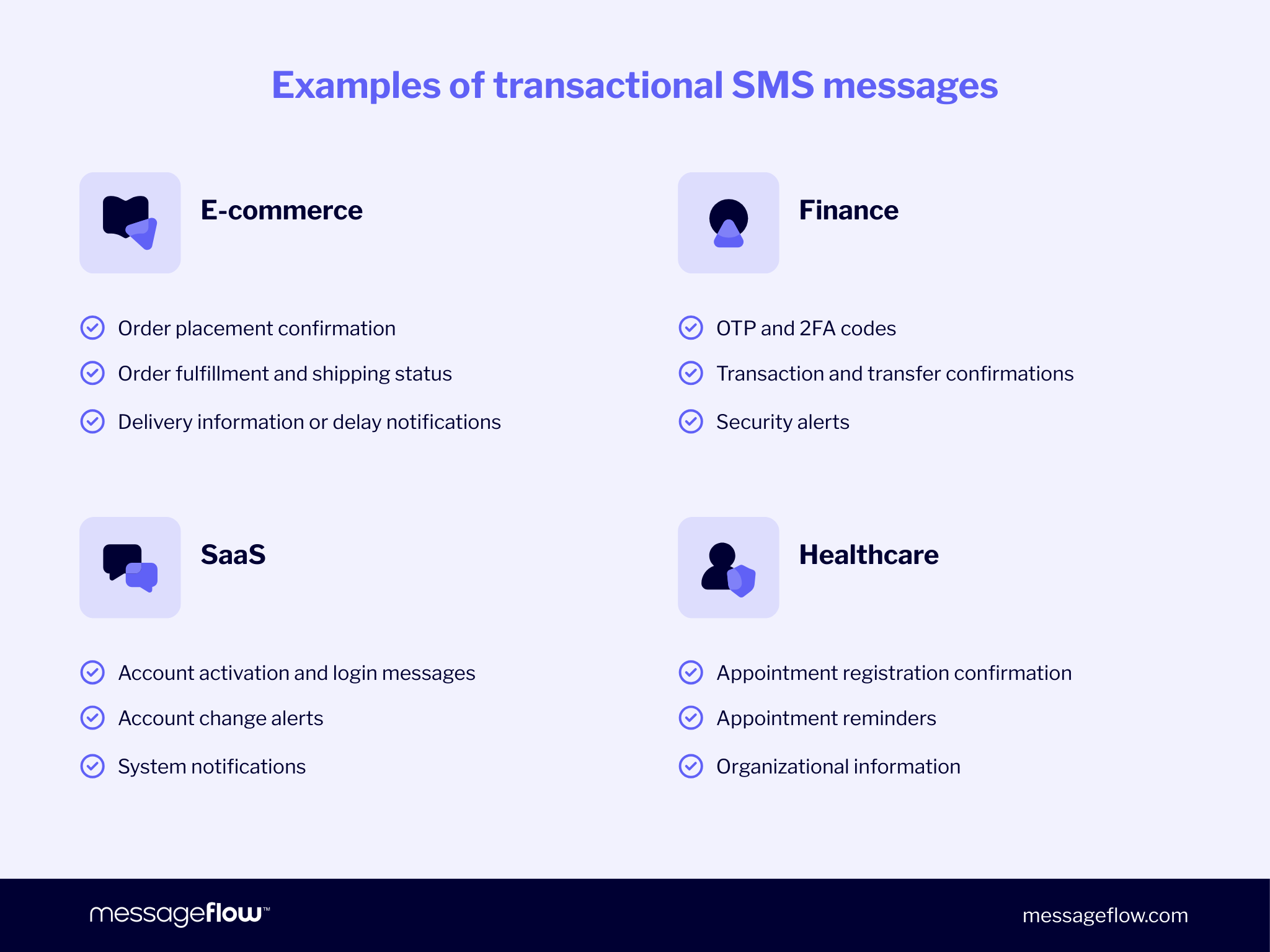
Common use cases for transactional SMS notifications
| Industry | Typical use cases |
|---|---|
| E-commerce | Order updates, shipping notifications. |
| Finance | 2FA codes, transfer confirmations, loan repayment reminders. |
| Healthcare | Appointment confirmations, visit reminders. |
| Logistics | Estimated delivery time, pickup notifications. |
| SaaS | OTP codes, security alerts, account change confirmations. |
Many of these use cases are managed through automated workflows within SMS platforms, streamlining the process of sending timely notifications.
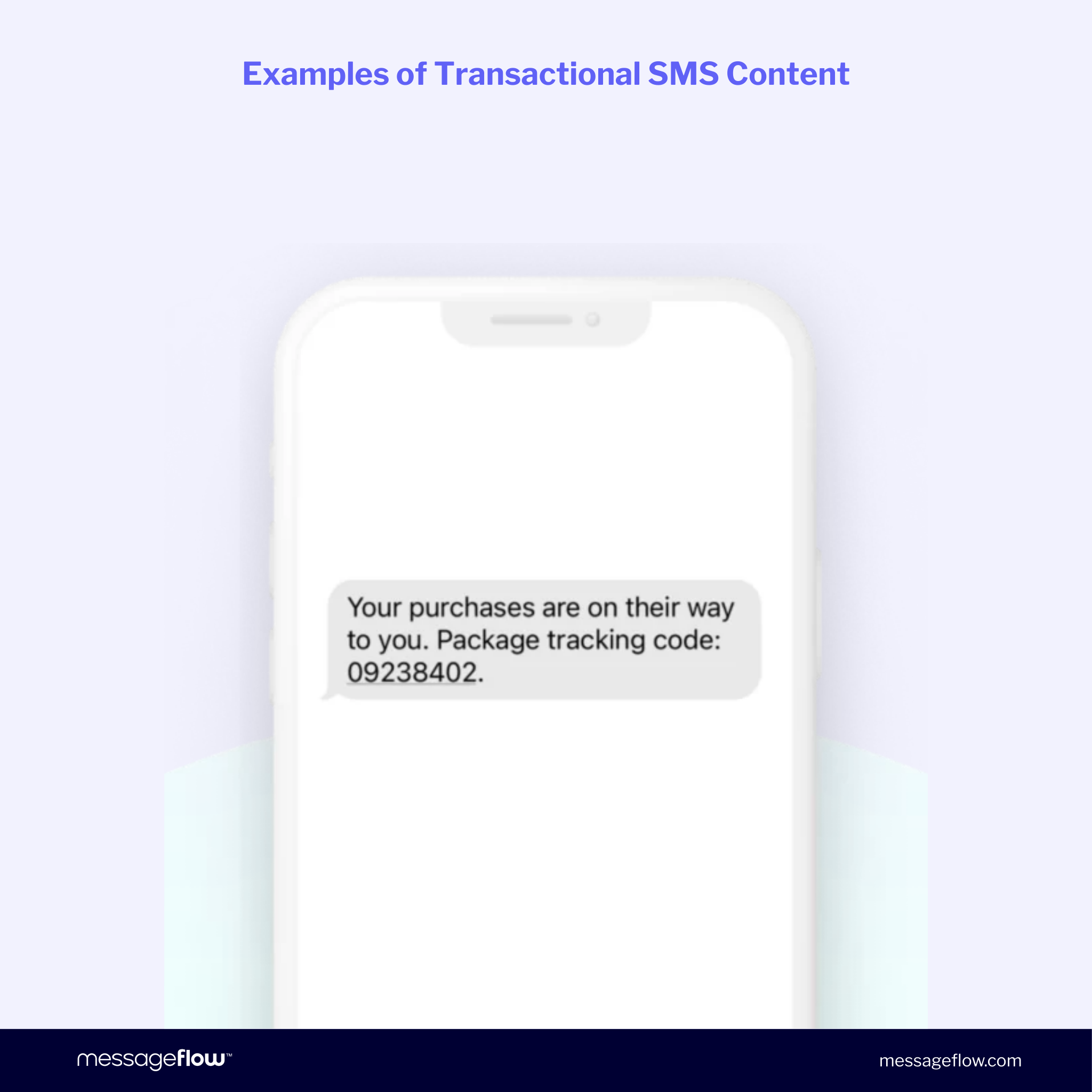
Transactional SMS examples
- “Order confirmation #78234. Amount: €59.90. Estimated shipping date: Jan 29, 2026. StoreXYZ”
- “Your parcel has been shipped. Tracking number: PL123456789. Track here: link.com/tracking”
- “Your OTP code: 123456. Valid for 5 minutes. Do not share this code. BankABC”
- “Payment for invoice INV/2025/0234 has been successfully processed. Thank you. CompanyXYZ”
- “Reminder: loan repayment due on Feb 15, 2026. Installment amount: €295. Details in the app.”
- “Delivery address updated to: 15 Flower Street, Krakow. Order #78234.”
- “Security alert: new device login detected (Warsaw). If this wasn’t you, please reset your password.”
- “Appointment confirmed: Dr. Kowalski, Feb 20, 2026 at 2:30 PM. Address: 5 Medical Street.”
- “Your refund of €19.90 has been processed. Estimated completion time: 1–3 business days.”
- “Your account password has been changed successfully. If this wasn’t you, contact support immediately.”
These transactional texts are concise, clear, and strictly informational. They avoid any sales-driven language and focus on delivering timely, essential updates related to actions initiated by the customer.
Best practices for transactional SMS
- Clear sender identification (Sender ID): The sender name should be instantly recognizable so the recipient immediately knows who the message is from.
- No offers or discounts in critical text messages: Avoid any promotional content in sensitive flows such as OTP, login alerts, or account data changes. These messages are about security and trust, not sales.
- Unambiguous, specific wording: For transactional messages, always include key details such as the amount, date, order number, or reference ID where applicable.
- Use SMS templates: Standardize transactional SMS content with SMS templates to ensure consistency, compliance with best practices, and easier management of time-sensitive updates.
- Priority delivery routes: Platforms like MessageFlow use dedicated infrastructure for OTP and critical alerts, where delivery speed and reliability are crucial – often at high scale.
- Channel fallback strategy: If a transactional SMS notification cannot be delivered, use a secondary channel (such as push notifications or email) as a backup to ensure the message still reaches the user.
Legal and operational considerations for transactional SMS
- No marketing consent required – but the message must be directly linked to an existing customer relationship or a user-initiated action.
- Transactional SMS content should include only the information strictly necessary to fulfill its purpose.
- The sender name must comply with local operator regulations and country-specific requirements.
- Quiet hours should be respected where possible, but never at the expense of security-related messages such as OTPs or fraud alerts.
Promotional SMS: marketing and sales campaigns
A promotional SMS is a form of marketing communication aimed at increasing sales, reactivating customers, or promoting specific offers. These messages are planned as part of SMS marketing campaigns and sent to clearly defined audience segments of SMS subscribers who have opted in to receive promotional messages.
Unlike transactional SMS, promotional communication requires prior marketing consent (opt-in) and is subject to different legal and operational rules.
Typical use cases for promotional SMS
- Discount codes and shopping coupons.
- Early access or presales for new product collections.
- Event invitations (webinars, in-store events, open days).
- Seasonal and holiday promotions (Black Friday, Mother’s Day, sales campaigns).
- Last-minute offers (travel, fitness, hospitality, food delivery).
- Loyalty programs and rewards for repeat customers, including updates on loyalty points balances and redemption options sent directly via SMS.
- Abandoned cart reminders to encourage customers to complete their purchase and help recover lost revenue.
Three key elements of effective SMS marketing
Here are a few ways to ensure effective SMS marketing:
- A clear customer benefit. SMS example: “20% off all items until Jan 30, 2026”.
- A strong call to action (CTA). SMS example: “Shop now”, “Sign up”, “Claim the offer”.
- Time or quantity limitations. Creating urgency significantly improves conversion rates.
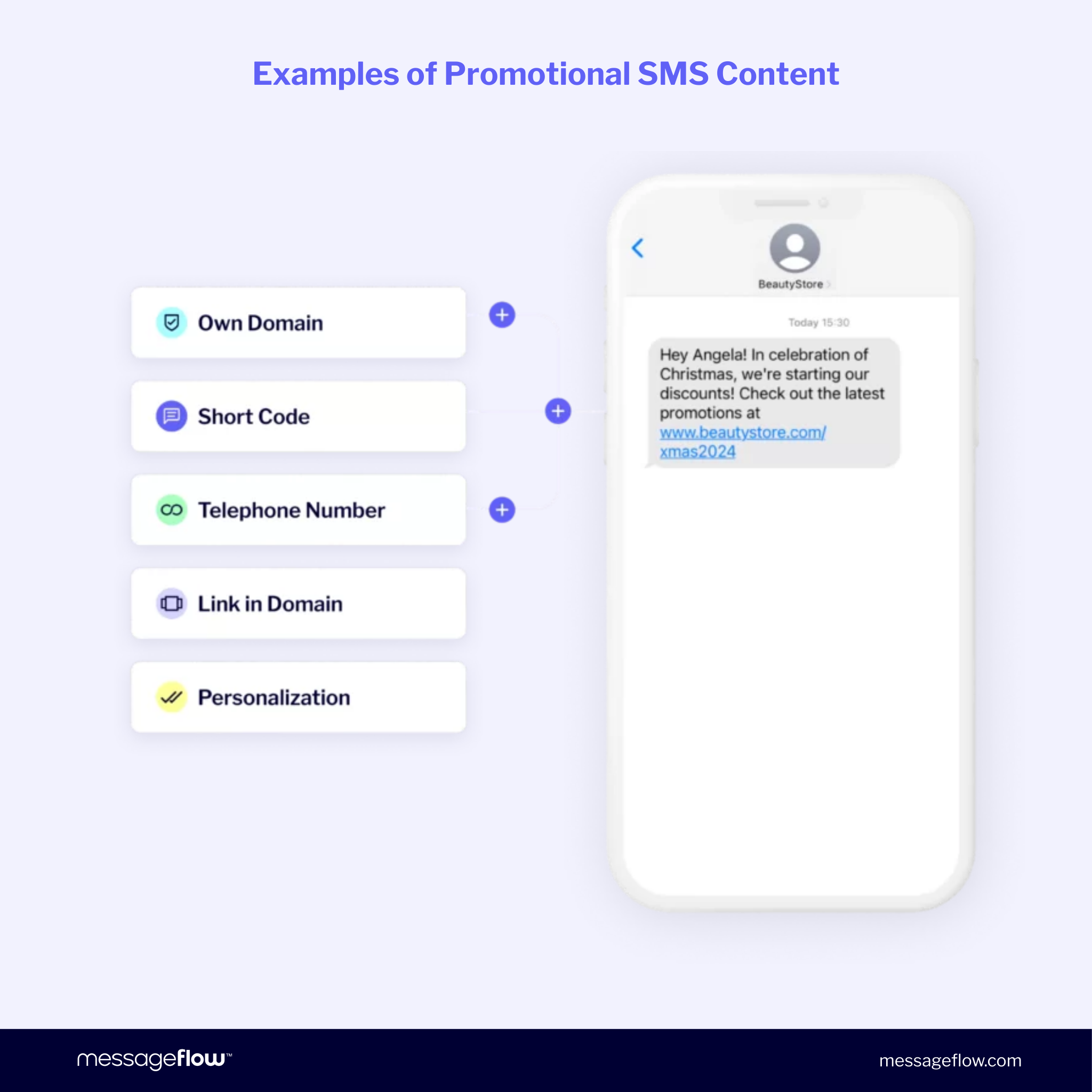
Promotional SMS examples
Businesses often send SMS messages as part of their promotional campaigns. Examples include:
- “Mother’s Day 2026! Get 25% off gift sets. Code: MOM25. Valid until May 26. Shop now: store.com/mothersday”
- “Welcome to the club! Enjoy 15% off your first purchase. Code: START15. Valid for 7 days.”
- “Forgot something? Complete your order and get 10% off with code CART10. Finish here: store.com/cart”
- “Autumn sale at our Wroclaw store, Main Street 10. Up to 50% off selected items. Oct 25–27 only!”
- “Last-minute deal: personal training sessions 30% off. Sign up by Jan 31. FitClub Wroclaw.”
- “Concert tickets for March 15, 2026 — save €5 with code MUSIC20. Buy now: tickets.com/concert”
- “We miss you! Come back and get €10 to spend. Code: COMEBACK. Valid until Feb 15, 2026.”
- “Exclusive for loyalty members: 40% off for 48 hours only. Check the app!”
- “Flash sale: electronics up to 35% off. Today only until 11:59 PM. Don’t miss out: store.com/flash”
- “Spring 2026 collection is here! Presale access for subscribers. Sign up: link.com/spring”
Features that support promotional SMS campaigns
Bulk SMS platforms such as MessageFlow enable:
- Audience segmentation: For example: active customers, users inactive for 90+ days, loyalty program members.
- Message personalization: Dynamic variables such as first name or recently viewed product category.
- Tracked links: Smart links with click tracking and CTR analytics.
- Opt-out management: Simple and accessible unsubscribe options for recipients.
Unlike transactional SMS, promotional campaigns are primarily measured by click-through rates, promo code usage, and revenue, not just message delivery.
Legal requirements and best practices for promotional SMS
- Explicit marketing opt-in is mandatory.
- Each message must clearly identify the sender.
- Easy opt-out mechanism (e.g. replying with “STOP”) to ensure recipients can easily choose whether to receive messages.
- Reasonable sending frequency – over-messaging reduces campaign effectiveness and increases churn.
Consent and compliance: When does an SMS notification require marketing opt-in?
Understanding the difference between operational (transactional messages) and marketing communication is the foundation of legal, effective, and safe SMS messaging. As a business owner, it is your responsibility to ensure compliance with SMS consent and all relevant legal requirements. Mistakes in this area can result not only in a loss of customer trust, but also in regulatory and legal consequences.
Operational vs. marketing communication
| Communication type | Description | SMS examples |
|---|---|---|
| Operational (transactional) | Related to delivering a service or fulfilling a contract. | Order status updates, appointment confirmations, security alerts. |
| Marketing | Aimed at promotion or increasing sales. | Discounts, special offers, promo codes, sale invitations. |
When is marketing consent required for SMS?
- Promotional SMS messages generally require prior, explicit marketing consent (opt-in).
- Transactional and informational SMS messages may be sent based on the existing customer–company relationship and contract execution – as long as they do not contain promotional content.
Effective use of both transactional and promotional SMS can support customer retention by maintaining ongoing engagement and fostering long-term loyalty.
Marketing consent must be:
- freely given,
- specific (SMS consent, not generic “marketing contact”),
- and demonstrable (recorded and auditable).
The risk of mixing communication purposes
Problems arise when multiple objectives are combined in a single SMS, for example:
- an order confirmation with an added message like “Why not also buy product X?”
- a notification about updated terms and conditions combined with a discount code.
Such messages may be classified as marketing in their entirety, even if the primary purpose was operational. The safest approach is to fully separate operational and marketing communication and send promotional content only to users with active marketing consent.
Best practices and practical tips
- Separate consent checkboxes in forms: One for terms & conditions, another specifically for SMS marketing.
- Clear sender identification (Sender ID): The recipient sees the brand name instead of a random number.
- Easy opt-out mechanism: For example: “Reply STOP to unsubscribe” or a link to a preference center.
- Frequency control: Too many messages increase complaint and unsubscribe rates.
- Content relevance: Messages should match the customer relationship and interaction history, which helps in increasing customer satisfaction.
SMS communication platforms for businesses should include built-in consent and opt-out management, making compliance easier without manual tracking.
Note: In case of legal uncertainty, companies should consult their legal team or a data protection specialist. This article is for informational purposes only and does not constitute legal advice.
How to choose the right SMS type? A quick checklist for marketers and operations teams
Choosing the correct SMS type should be based on the communication goal, timing, and relationship with the recipient. This checklist helps make the right decision quickly.
If you want to:
- Inform users about organizational changes or important updates → Transactional SMS
- Confirm a customer action or provide order status → Transactional SMS
- Sell, re-engage customers, or promote an offer → Promotional SMS
Key criteria for selecting the SMS type
| Criterion | Informational SMS | Transactional SMS | Promotional SMS |
|---|---|---|---|
| Message goal | Operational | Operational | Marketing |
| Timing | Planned or reactive | Event-triggered | Campaign-based |
| Content | Facts, updates | Status, confirmations | Discount, CTA, offer |
| Required consent | Operational | Operational | Marketing |
| KPIs | Deliverability | Deliverability, latency | Clicks, conversions |
Internal decision framework
To maintain consistency and compliance, it’s worth clearly defining:
- who owns operational content (e.g. customer support, IT),
- who owns marketing content (e.g. marketing team),
- how communication effectiveness is tested and measured (e.g. A/B testing promotional copy),
- what the approval process for SMS campaigns looks like.
Tip for multi-channel campaigns
When combining SMS with other communication channels:
- Use SMS for short, urgent, high-priority messages (alerts, codes, reminders) and last-minute promotions.
- Use email for detailed information (terms, long descriptions, visuals).
- Use mobile push notifications as a supplement or reminder for app users.
Keeping all campaign data in a single communication platform such as MessageFlow simplifies reporting, performance analysis, and prevents message duplication.