
TL;DR: In January 2026, Google embedded Gemini 3 directly into Gmail, placing an AI layer between your email and your reader. For most marketers, this feels like a threat. It isn’t. AI in email marketing is a filter that rewards what good email marketing always required: clarity, relevance, clean lists, and solid technical setup. Here are the five rules that now decide whether your emails get seen, or quietly disappear.
Something changed in your subscribers’ inboxes in January 2026. If your email marketing metrics have shifted recently, this is likely part of the reason.
AI in email marketing used to mean tools that help you write subject lines faster. That’s still true. But in 2026, it means something else entirely. Gmail’s Gemini 3 integration put an AI system directly inside the inbox of over 3 billion users. That system now summarizes your emails, decides how prominently to surface them, and repackages your content before a human ever opens it. Gmail accounts for between 25% and 32% of all email opens globally. That’s the majority of your list, now inside an AI-mediated inbox.
So yes, your email goes to an algorithm before it goes to a person.
Take a breath, though. This isn’t the end of email. It’s a sharper version of the same test your emails have always faced. The five rules below aren’t new inventions. They’re what good senders were already doing. What changed is that ignoring them now has fast, measurable consequences.
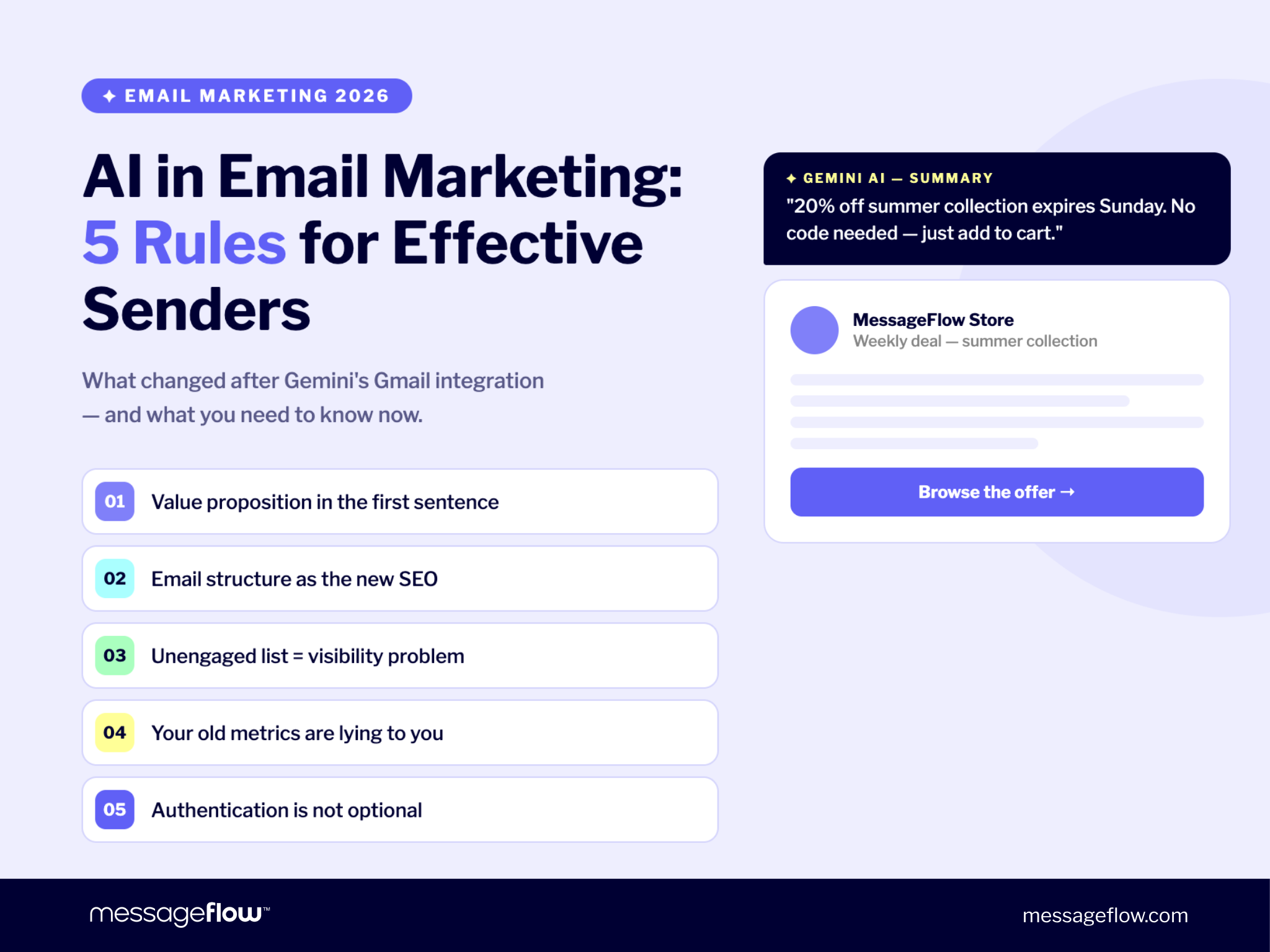
What does AI in email marketing actually mean in 2026?
AI in email marketing in 2026 means two things happening at once. First, AI tools help senders write, personalize, and optimize campaigns faster than before. Second, and more disruptively, AI inside Gmail, Yahoo, and Outlook now mediates how recipients experience every email you send before they open it.
These are different problems. Most of the industry is focused on the first one. The second one is where the real shift is happening.
AI as a sender tool
The benefits of AI in email marketing on the sender side are real. AI helps you generate copy variations, personalize content at scale, optimize send times, and automate complex email marketing sequences. These capabilities matter, and they’re worth using.
But they’re not what changed in 2026.
AI as an inbox filter
Here’s what Gmail specifically rolled out in January 2026:
AI Overviews
When a subscriber opens a long email thread, Gmail synthesizes the conversation into a short summary. For standalone marketing emails, this means 1-2 sentences representing your entire message appear at the top before the email body loads.
One of the more significant – and underestimated – features, however, is the search-based mechanism built into the Ask Gmail window. Instead of manually digging through their inbox, a user types a natural language question like “What active discount codes do I have?” or “When does my subscription expire?” – and receives a synthesized answer generated from multiple emails at once, without opening any of them individually.
For senders, this signals a new reality: your message needs to be legible not just to a human, but to a model that will decide whether and how to surface it in response to a user’s query. An email with a clearly stated offer – a specific discount amount, expiration date, product name – is far more likely to appear in that summary than one filled with vague copy and persuasive language.
AI Inbox
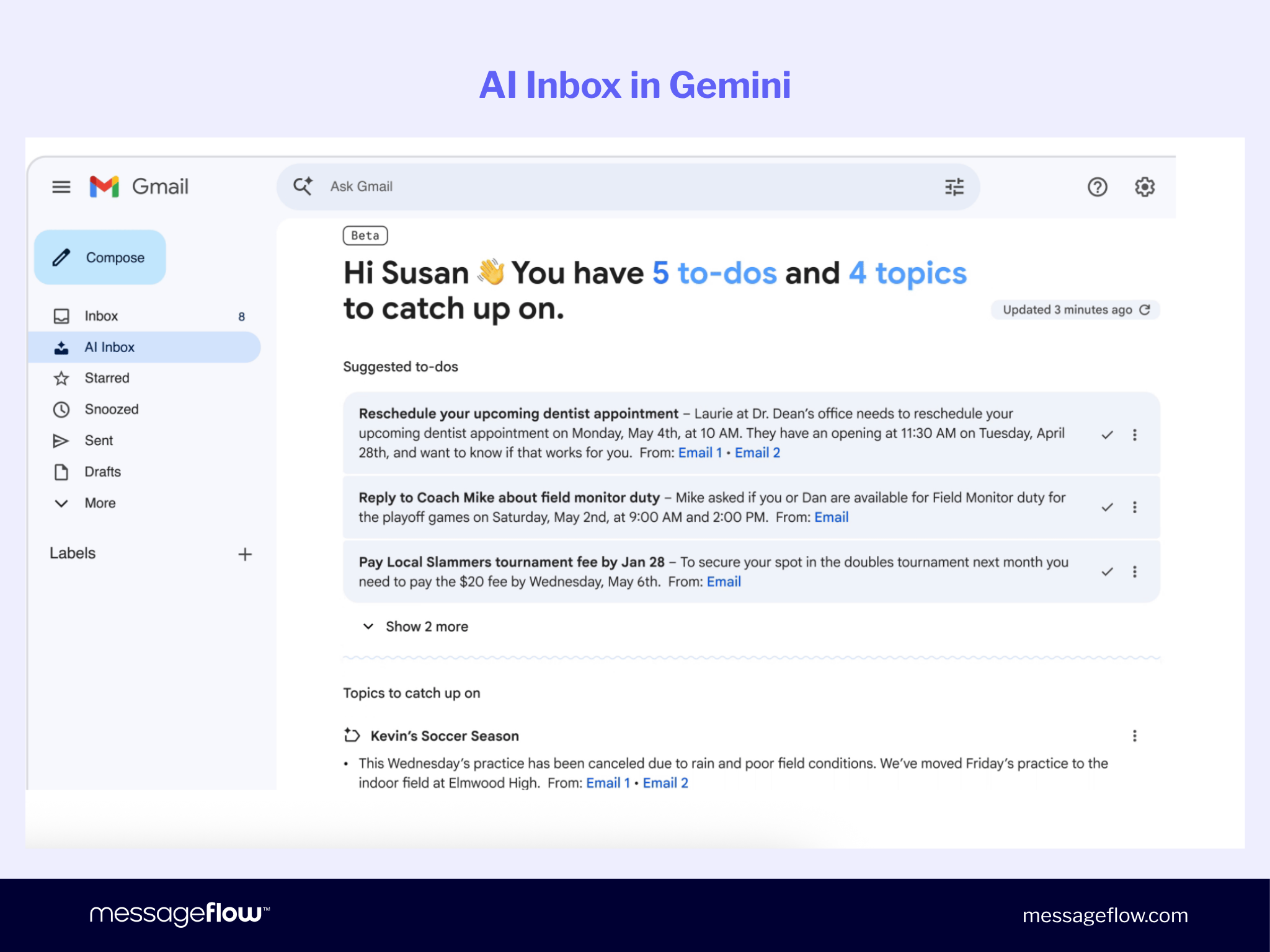
Currently in testing with limited users, this feature replaces chronological sorting with relevance-based prioritization. Gmail surfaces the messages it believes matter most to that specific person, based on their engagement history.
The Promotions tab already sorts by relevance rather than recency, and chronological sorting is expected to eventually disappear entirely.
Manage Subscriptions
A new tool that shows users exactly how often you email them and offers one-click removal. Brands with high send frequency are displayed prominently. This one rewards quality over quantity in a very direct way.
Yahoo and Microsoft are moving in the same direction. The inbox is no longer a passive container. It’s an active, AI-managed filter.
Fact 1: Your value proposition lives or dies in the first sentence
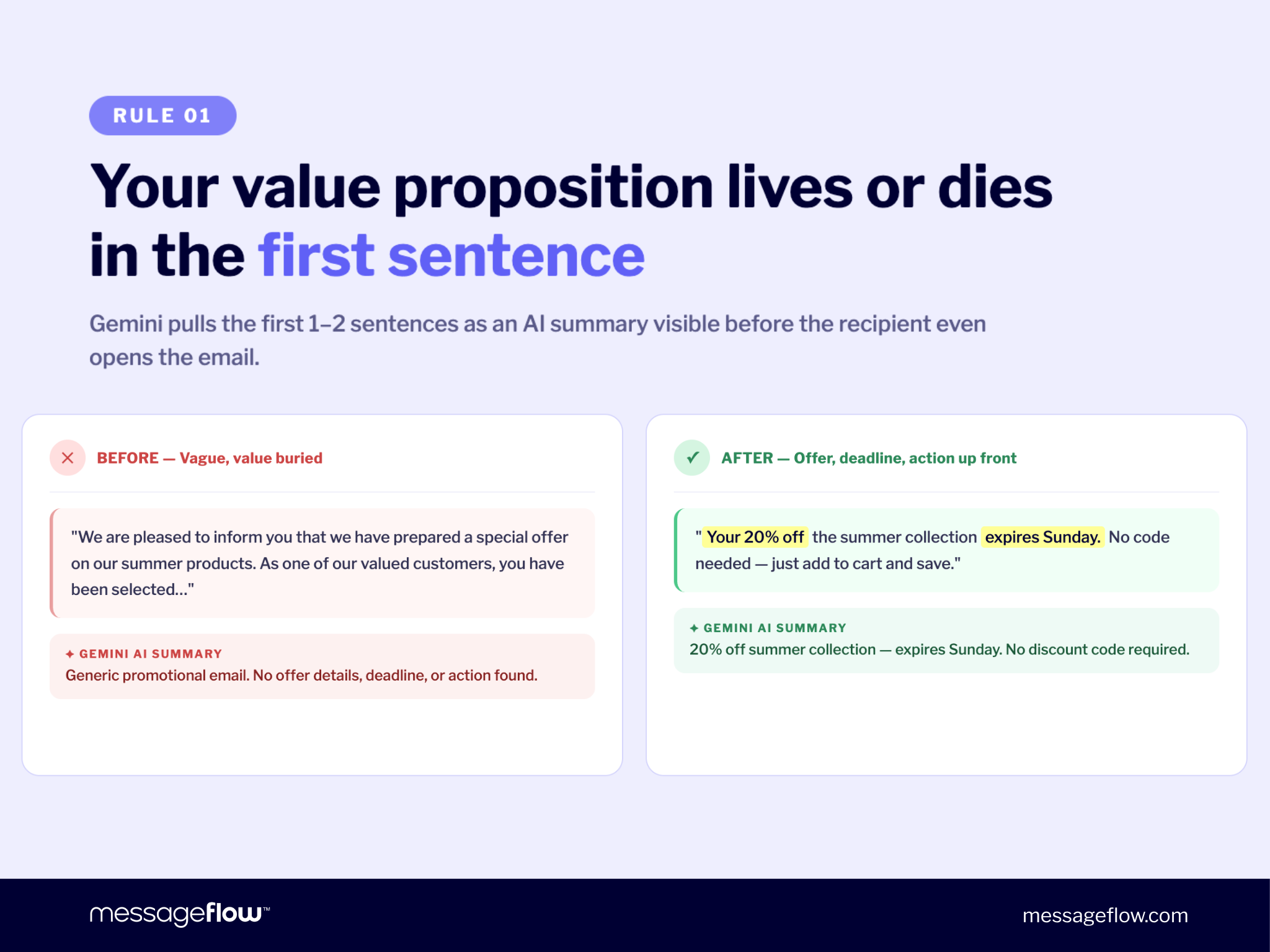
Gemini’s summary cards extract 1-2 sentences from your email to represent its entire message to the subscriber. Those sentences almost always come from the opening lines of your email body. If your key offer, deadline, or benefit is buried two paragraphs in, it won’t appear in the summary your subscriber sees first.
This is one of the most actionable AI in email marketing best practices you can implement today, before your next send.
The inbox-critical zone
Think of the first 100-200 characters of your email body as prime real estate. That’s where Gemini looks first. That’s where your campaign either lands or gets lost.
Here’s what this looks like in practice:
Before: “We’re thrilled to share some exciting news about our summer collection. As a valued member of our community, you’re among the first to know about…”
After: “Your 20% discount on the summer collection ends Sunday. No code needed, just shop and save.”
The second version gives Gemini exactly what it needs to generate a useful summary. The first version gives it nothing to work with.
Subject line and body alignment
The same logic applies to subject lines. If your subject promises a discount and your first sentence delivers it, you’re aligned. If your subject promises a discount and your first sentence starts with a brand story, you’ve already lost the AI’s attention and probably the subscriber’s.
Subject line and opening sentence need to tell the same story. When they do, the AI summary reinforces your message. When they don’t, the summary may surface something your subscriber wasn’t expecting.
Fact 2: Email structure is the new SEO
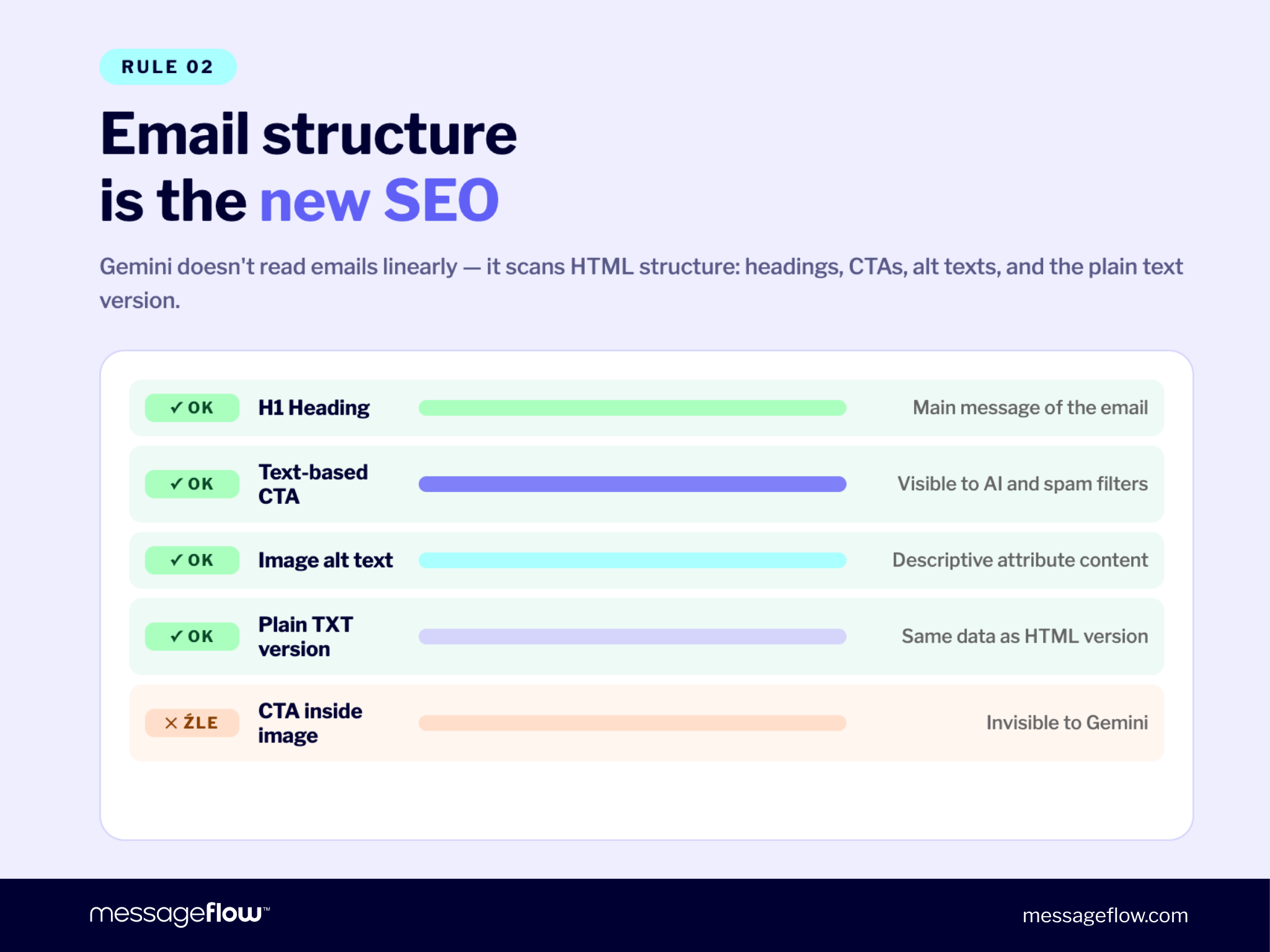
AI in email marketing now functions like search engine optimization did for websites a decade ago. Gemini reads your email the same way a screen reader does: it scans for headings, scannable sections, clear calls to action, and proper HTML markup. Emails built around a single large image, or dense walls of unstructured copy, are increasingly invisible to AI summarization.
This is where structured data (schema markup) comes into play. Just as websites use schema to help Google display rich results, emails can implement the same standard to pass key information: prices, dates, promo codes. Gmail already supports this, meaning that information can be extracted and presented to the recipient without them ever opening the email.
The accessibility connection
This isn’t a new concept for good email marketers. Accessibility work over the last several years already pushed teams toward cleaner structures. Anyone who built properly tagged HTML, added alt text to images, and included a plain-text version of their campaigns was unknowingly preparing for this moment. The overlap between accessibility best practices and AI in email readability is almost total.
What Gemini actually scans for
The AI in email automation systems powering Gmail’s summaries prioritize specific structural signals. Your audit checklist:
Does your email have a clear heading that states the main message? Does your primary CTA appear as actual text, not embedded in an image? Do your images have descriptive alt text? Is there a plain-text version that carries the same key information as the HTML version?
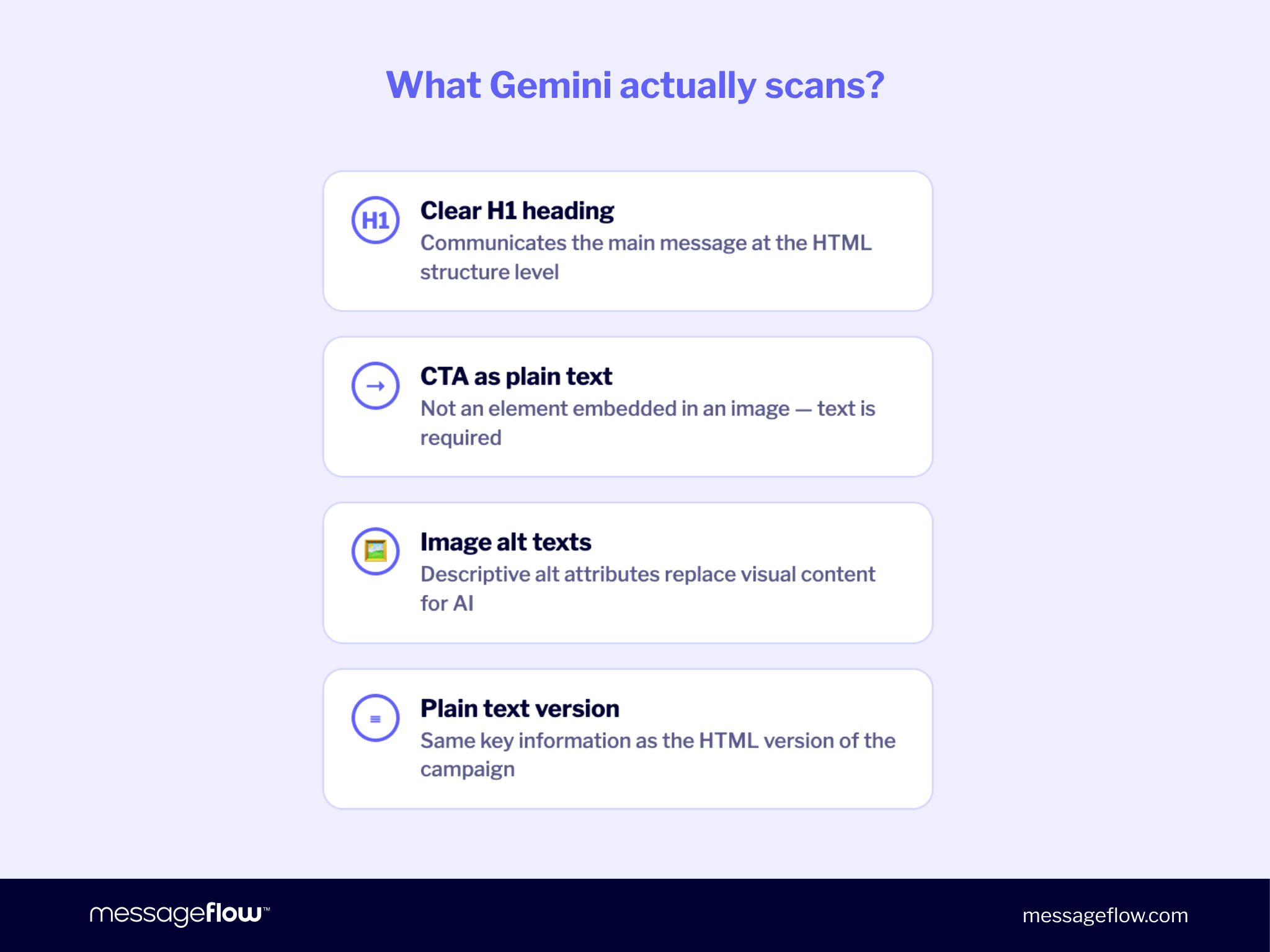
These aren’t design preferences. They’re now functional requirements for AI in email deliverability. If Gemini can’t parse your email’s structure, it can’t generate a useful summary. And an email without a useful summary competes poorly in a relevance-ranked inbox.
The end of the image-only email
One rule now applies without exception: the era of “one big image” emails is over. If your key message exists only as text baked into an image file, it’s invisible to every AI system touching your email, including spam filters.
This single change, adding real text alongside or instead of image-based copy, is one of the highest-impact AI in email marketing best practices you can act on this week.
Fact 3: Sending to a disengaged list is now a visibility problem, not just an AI in email deliverability problem
Gmail’s AI Inbox prioritizes messages based on each subscriber’s individual engagement history with your brand. If your contacts haven’t opened, clicked, or interacted with your emails in months, the AI has already learned that. Your next campaign lands lower in their inbox before it even has a chance to prove itself.
AI in email marketing deliverability is no longer just about reaching the inbox. It’s about where inside the inbox you land.
The buried inbox problem
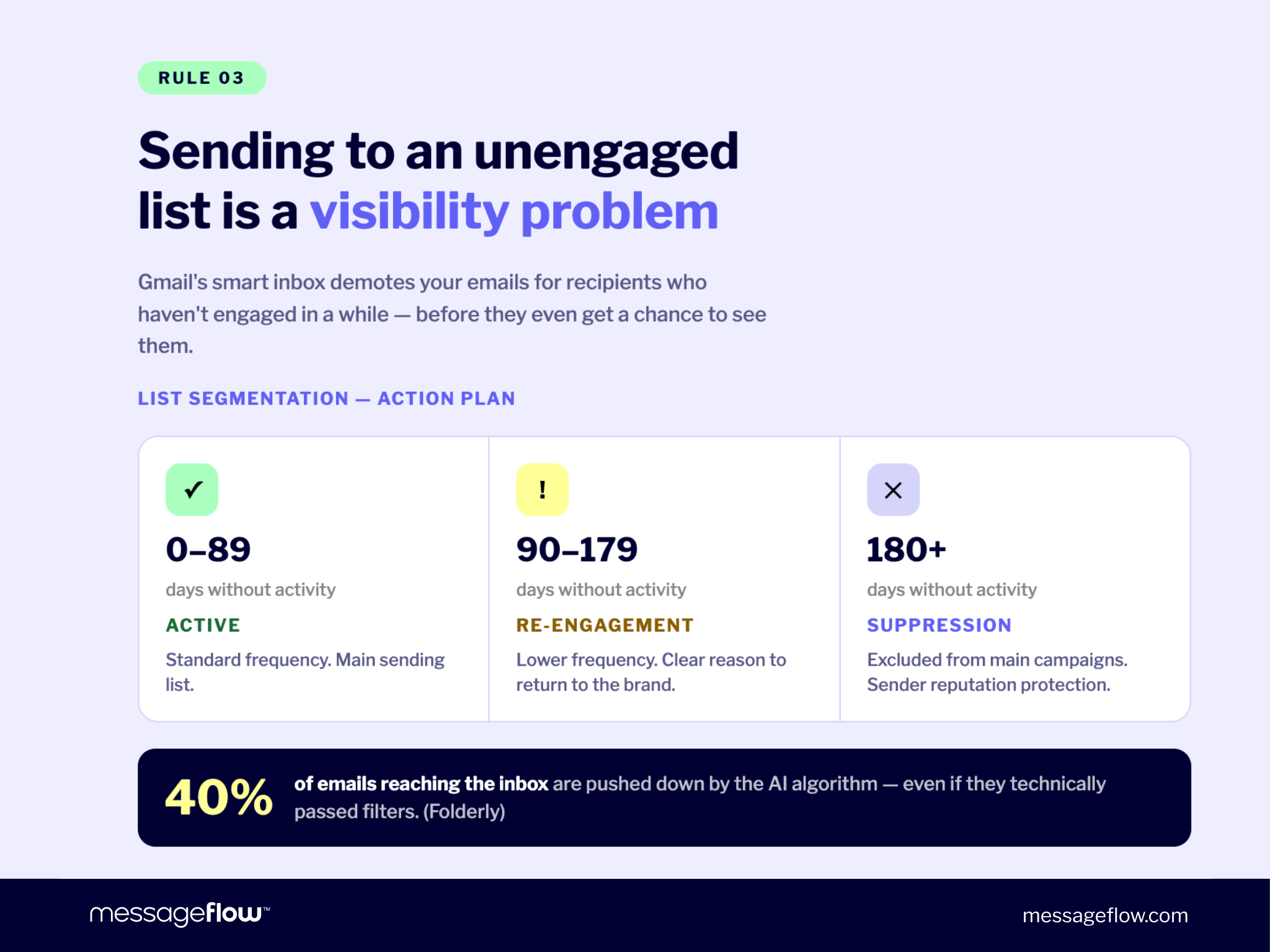
This matters beyond the obvious bounce and reputation implications. Research from Folderly suggests that up to 40% of emails that technically reach a Gmail inbox are being deprioritized by AI filtering. These emails aren’t in spam. They’re just buried. And buried, in a relevance-ranked inbox, is functionally the same as unseen.
AI in email marketing deliverability has always had a behavioral component. What’s new is how fast and precisely Gmail acts on engagement signals now.
AI in email segmentation: your practical fix
For an e-commerce brand running a regular promotional calendar, this means one concrete change: stop treating your inactive segment the same as your engaged one. Before your next major send, split your list.
For subscribers who haven’t engaged in 90 or more days, run a dedicated re-engagement sequence with lower frequency and a clear reason to come back. For subscribers who haven’t engaged in 180 or more days, suppress them from the main send entirely.
This isn’t about shrinking your list. It’s about protecting the engagement signals that determine your visibility with every subscriber going forward. Good AI in email segmentation practice protects your sender reputation across your entire list, not just the inactive portion.
Check our advanced email deliverability guide for the specific thresholds that matter most to Gmail right now.
Fact 4: Your metrics are lying to you (and what to measure instead)
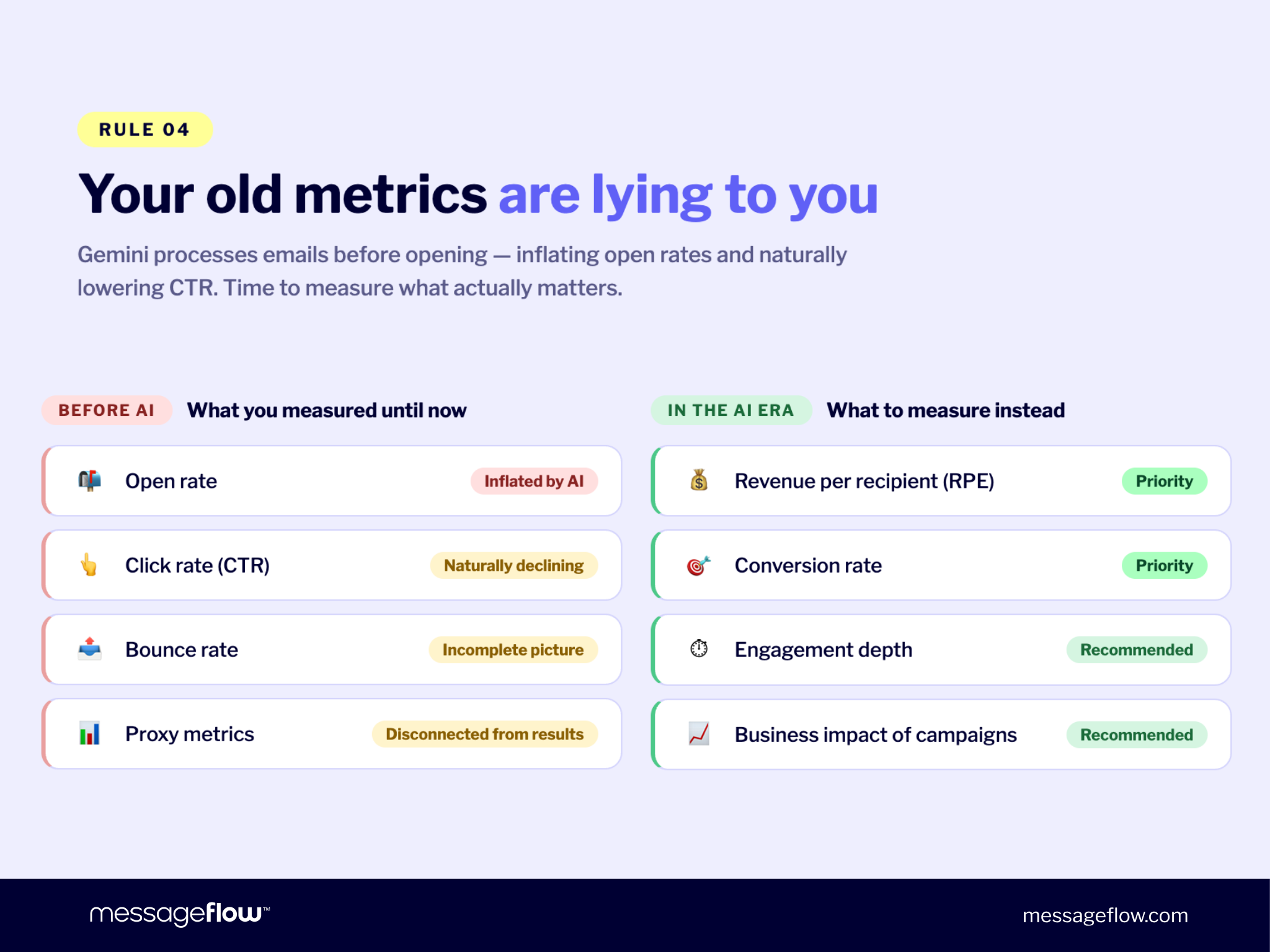
Two specific distortions have emerged since Gemini’s January 2026 rollout. Both affect decisions marketers make every day. Getting AI in email marketing optimization right starts with measuring the right things.
Open rate inflation
Gmail auto-opens emails to generate AI summaries. Some email platforms record these auto-opens as human opens. That means your open rate is now a mix of actual human engagement and AI processing events.
AI in email open rate optimization based on inflated figures will push you in the wrong direction. Benchmarks from six months ago are no longer reliable.
AI in email click-through rate: the new reality
Subscribers now extract key information from AI-generated summaries without clicking through to the full email. Average click-through rates dropped from 4.35% to 3.93% following the Gemini rollout.
That gap will widen as AI Inbox expands beyond its current test group. AI in email click-through rate optimization now means writing content compelling enough to drive a click even when the summary has already given away the headline.
Neither of these should cause panic. But both should change what you optimize for.
AI in email marketing optimization: the new metrics that matter
Start anchoring your performance reporting to metrics that AI processing can’t distort. Revenue per recipient. Conversion rate from email. If your platform supports it, scroll depth and dwell time are stronger signals of genuine engagement than a click on a tracked link.
These are the email marketing KPIs that will tell you the truth about how your campaigns are actually performing.
The marketers who adjust their measurement frameworks now will have a real advantage. The ones who keep optimizing for open rate will make increasingly bad decisions based on increasingly unreliable data.
Fact 5: Authentication is not optional. It never was.
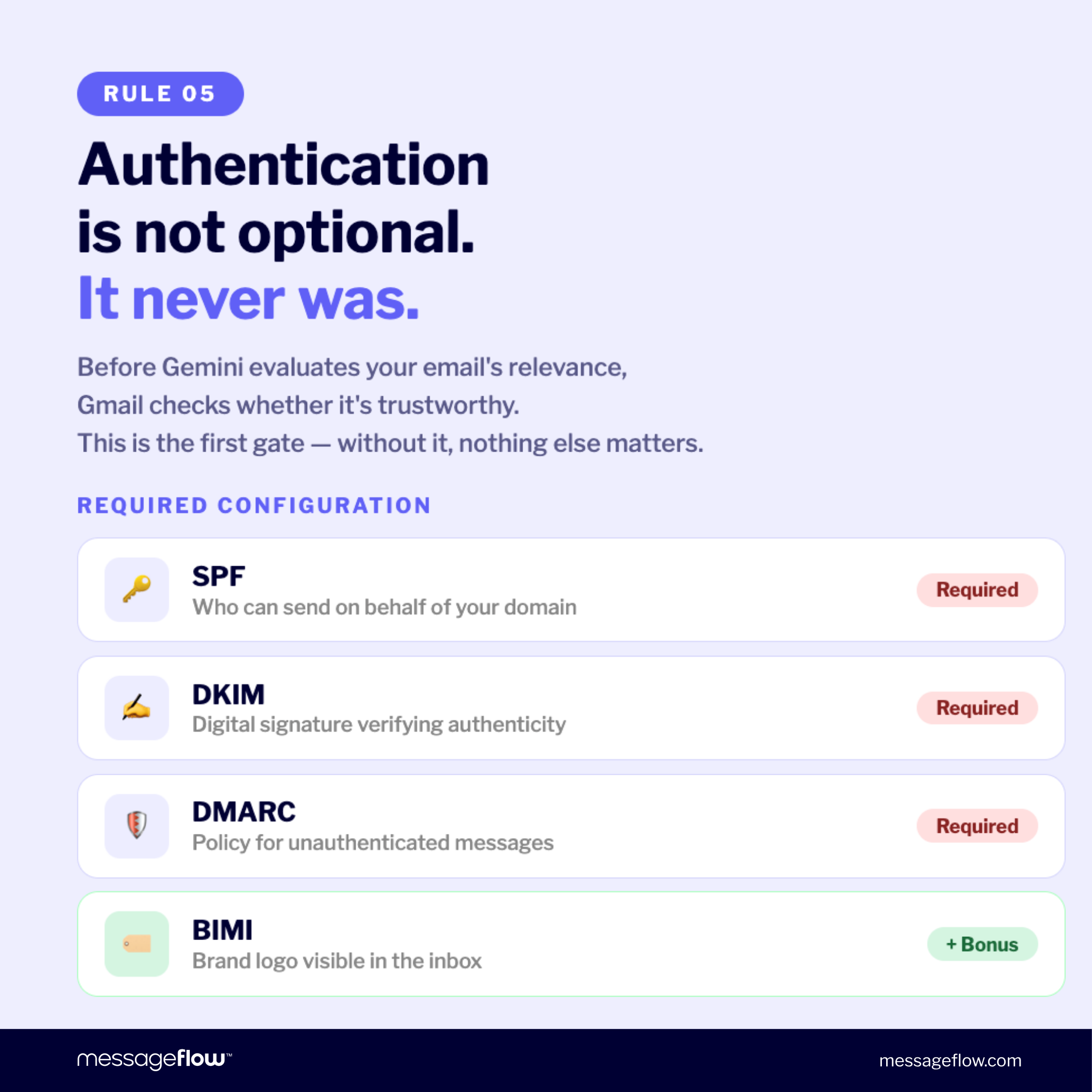
Before Gemini evaluates whether your email is relevant, Gmail checks whether it’s trustworthy. SPF, DKIM, and DMARC are the technical prerequisites that determine whether your email reaches the AI filter at all. Senders missing any of these face automatic rejection or aggressive spam filtering, regardless of how well their email is written.
AI in email marketing compliance starts here. Everything else, relevance, structure, segmentation, only matters if your email clears this gate first.
What’s now enforced
Gmail and Yahoo began enforcing bulk sender requirements in February 2024. Microsoft followed with identical requirements from May 2025. Together, these three providers cover the inboxes of the vast majority of your subscribers. Spam complaint rates above 0.3% now trigger hard consequences, not just soft deliverability dips.
Think of authentication as the floor. It’s not a competitive advantage. It’s the minimum requirement to be in the room where AI relevance decisions happen.
Your next steps
If you’re not certain your authentication is fully configured, check Google Postmaster Tools. It shows your domain reputation and authentication status in near real time. Fix any gaps before your next send.
BIMI, which lets you display your brand logo in supporting inboxes, is the next layer worth adding. It’s a trust signal that both AI systems and human readers pick up on.
The one thing AI cannot summarize
Gemini can extract your discount code. It can surface your deadline. It can repackage your call to action into a one-line summary card. But it can’t summarize your design.
AI in email personalization vs. brand experience
A visually distinctive, well-crafted email still creates a brand impression that no AI summary replicates. AI in email personalization tools can tailor copy and offers to individual subscribers at scale. What they can’t do is replicate the visual and emotional experience of opening a beautifully designed email.
When a subscriber opens your email because the summary was compelling, the experience they have inside that email determines whether they engage, convert, and stay subscribed. That experience is entirely yours to control.
Why design is your competitive moat
This is the final competitive advantage in AI-mediated email marketing. The brands that win over the next few years will nail both sides: AI-readable structure that earns good summaries and prominent placement, and visual quality that converts when the email is opened.
At MessageFlow, we built our email marketing platform around exactly this combination. The drag-and-drop editor and HTML builder give you full creative control. An efficient sending infrastructure processing 11.7 billion emails per month ensures delivery stability, while advanced authentication mechanisms and the ability to allocate dedicated resources help build a strong sender reputation.
AI in email marketing (2026): Three things to take away
AI in email marketing didn’t change what good email looks like. It made the cost of ignoring it impossible to avoid.
The five rules above aren’t a new checklist. They’re a mirror. If your emails already front-load value, use clean structure, send only to engaged subscribers, measure what actually matters, and pass authentication checks, you’re in a strong position right now.
If they don’t, the gap between your results and your competitors’ is going to widen faster than it would have a year ago.
Start with the easiest wins: check your authentication setup, audit your inactive segments, and rewrite the first sentence of your next email. Those three changes can happen before your next campaign goes out.
Ready to upgrade the infrastructure behind your emails? See what MessageFlow’s email platform can do.
Frequently Asked Questions about AI in Email Marketing
AI in email marketing affects deliverability in two ways. First, AI-powered spam filters now evaluate content quality and intent, not just technical signals. Second, AI inbox systems like Gmail’s Gemini rank messages by relevance within the inbox itself.
An email can pass spam filters and still be deprioritized if the subscriber’s engagement history suggests they don’t find your content valuable. Good deliverability now means both reaching the inbox and landing prominently inside it.
Gmail’s AI Inbox uses behavioral signals specific to each subscriber: how often they’ve opened your emails, whether they’ve clicked, whether they’ve added you to contacts, and what their past interaction patterns suggest about the relationship.
Senders with strong engagement histories consistently land higher in the prioritized view. Senders with low engagement get progressively less visibility, even when their emails technically reach the inbox.
No. You need to audit your email structure and opening lines, not rebuild everything from scratch. The most important changes are practical: front-load your key message in the first sentence, make sure your HTML uses proper markup with text-based CTAs rather than image-only designs, add alt text to all images, and include a plain-text version. These changes apply to your templates going forward, not retroactively to past sends.
The five most important best practices right now are: putting your value proposition in the first sentence of every email, using clear HTML structure that AI can read and summarize, segmenting your list to prioritize engaged subscribers, measuring revenue and conversion instead of open rate, and maintaining full SPF, DKIM, and DMARC authentication. Each of these improves your position both with AI inbox systems and with the humans reading your emails.
Open rate is now less reliable than it was. Gmail auto-opens emails to generate AI summaries, which some platforms record as human opens. This inflates open rate figures without reflecting actual human engagement. The metric isn’t useless, but it shouldn’t be your primary KPI. Focus instead on click-through rate, conversion rate, and revenue per recipient as your primary indicators of genuine engagement and campaign performance.