

More and more companies are using verified Viber messages to communicate with their customers – sending delivery updates, authorization codes, order confirmations, and service notifications.
At the same time, phishing attempts and brand impersonation are increasing across all communication channels, including email, SMS, and messaging apps. Fraudulent messages are becoming more sophisticated and often look almost identical to legitimate company notifications.
So how can you tell whether a Viber message is genuinely from a trusted company?
Below, you’ll find practical, easy-to-follow tips that will help you verify the sender and protect yourself from potential fraud.
Key Takeaways
- Trusted Viber messages come from verified business accounts. Before engaging with a message, check the sender’s profile. Official business accounts display a consistent brand name, a professional logo, a verification badge, and a clear business description. Legitimate companies do not communicate through random phone numbers or use generic profile images.
- Viber messages are protected with end-to-end encryption. This means that only you and the sender can see the content of your conversation.
- Always review the profile and links before clicking. Take a moment to confirm the sender’s name, logo, and business description. If the business message includes a link, examine the URL carefully. Make sure the domain exactly matches the company’s official website. If you are unsure, compare the information with details published on the brand’s official website or contact customer support directly through verified channels.
- If something feels suspicious, pause. Do not click on links or share personal data, passwords, or authorization codes. Instead, block and report the sender within the app. When in doubt, reach out to the company directly using contact information listed on its official website.
- Technology supports security, but awareness makes the difference. Even the most advanced safeguards cannot fully eliminate risk. Staying attentive and approaching digital communication thoughtfully is just as important as technical protection.
Why trusted Viber messages matter more than ever
Over the past few years, phishing attempts via messaging apps and SMS have increased significantly. Fraudsters are no longer relying only on email. Instead, they are targeting the channels people use every day and naturally trust.
By impersonating banks, online retailers, and courier companies, scammers take advantage of urgency and momentary inattention. A business message about a delayed parcel or a payment issue can trigger quick reactions, and that is exactly what fraudsters count on.
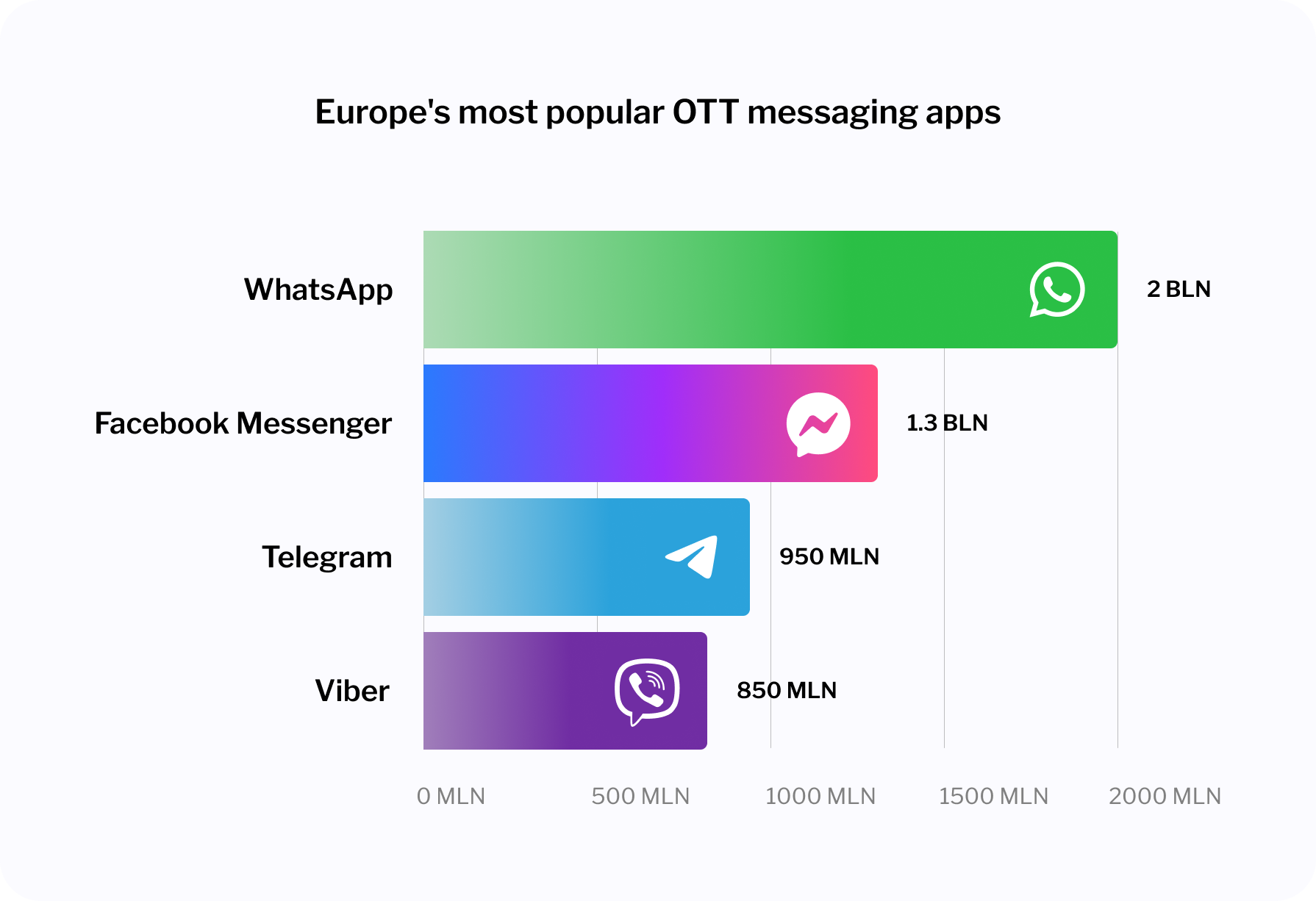
At the same time, OTT messaging apps such as Viber, WhatsApp, and Signal have become standard tools for official customer communication. Order confirmations, delivery updates, payment reminders, and one-time passcodes are now commonly delivered through these platforms.
As messaging apps play a larger role in everyday interactions, the ability to distinguish legitimate business communication from fraudulent messages has become essential.
What are OTT messaging apps – and why do companies use them?
OTT (Over-The-Top) apps are internet-based messaging platforms that operate independently of traditional telecom networks. They enable instant communication using a data connection.
For users, they offer convenience and real-time interaction. For businesses, they provide a direct and efficient way to reach customers in a channel they actively use.
With high open rates and the ability to include branded elements such as logos and verified profiles, OTT messaging has become a core component of modern customer communication.
Are OTT messaging apps a secure channel for business communication?
In industries such as e-commerce, fintech, and retail, customers regularly receive automated notifications about payments, deliveries, or login activity. At the same time, awareness of phishing and fraud is growing. Increased caution toward unexpected messages is not an overreaction – it’s a rational response to today’s threat landscape.
But does this mean OTT messaging apps are insecure? Not at all. Security depends largely on how the channel is used.
On Viber, business communication security is built around verified company accounts and clearly defined authorization standards. These mechanisms allow users to confirm the sender’s identity and ensure that the message comes from an official brand channel.
The goal of this article is to help you confidently distinguish legitimate communication from attempts to obtain sensitive information.
If you would like to learn more about how Viber works and its key features, you can explore our separate guide explaining the platform in detail.
What are official business accounts on Viber?
An official Viber for Business account is a verified brand profile designed for secure and professional customer communication. It combines three essential elements: clear sender identification, enhanced user security, and the ability to communicate at scale.
Instead of receiving a message from a random phone number or anonymous username, users see the full brand name, the official company logo, and a completed business profile with relevant company information. From the very first glance, the sender’s identity is clear.
And this is not just about aesthetics.
In an environment where phishing and brand impersonation are increasingly common, clear sender identification plays a critical role. A verified business profile builds trust and makes it much harder for fraudsters to imitate legitimate companies.
If your bank, an online store, or a delivery provider contacts you via Viber, the message should come from an account that clearly represents the brand – not from an anonymous number. Today, this is simply the standard for responsible business communication.
Private vs. official Viber business account – what’s the difference?
At first glance, both accounts may look similar. However, the difference is fundamental: verification. A private account can be created by anyone. A business account must go through Viber’s approval process.
Here’s how they compare:
| Feature | Private Account | Business Account (Viber for Business) |
|---|---|---|
| Sender Name | Phone number or user nickname | Official brand name (e.g., “Bank XYZ”) |
| Profile Photo | Any image, often personal | Official logo |
| Profile Description | Optional or minimal | Professional business description |
| Verification | No formal verification | Approved through Viber’s verification process |
| Account Status | Standard user profile | Clearly marked as a business account |
The Viber verification process: What does “Business” status actually mean?
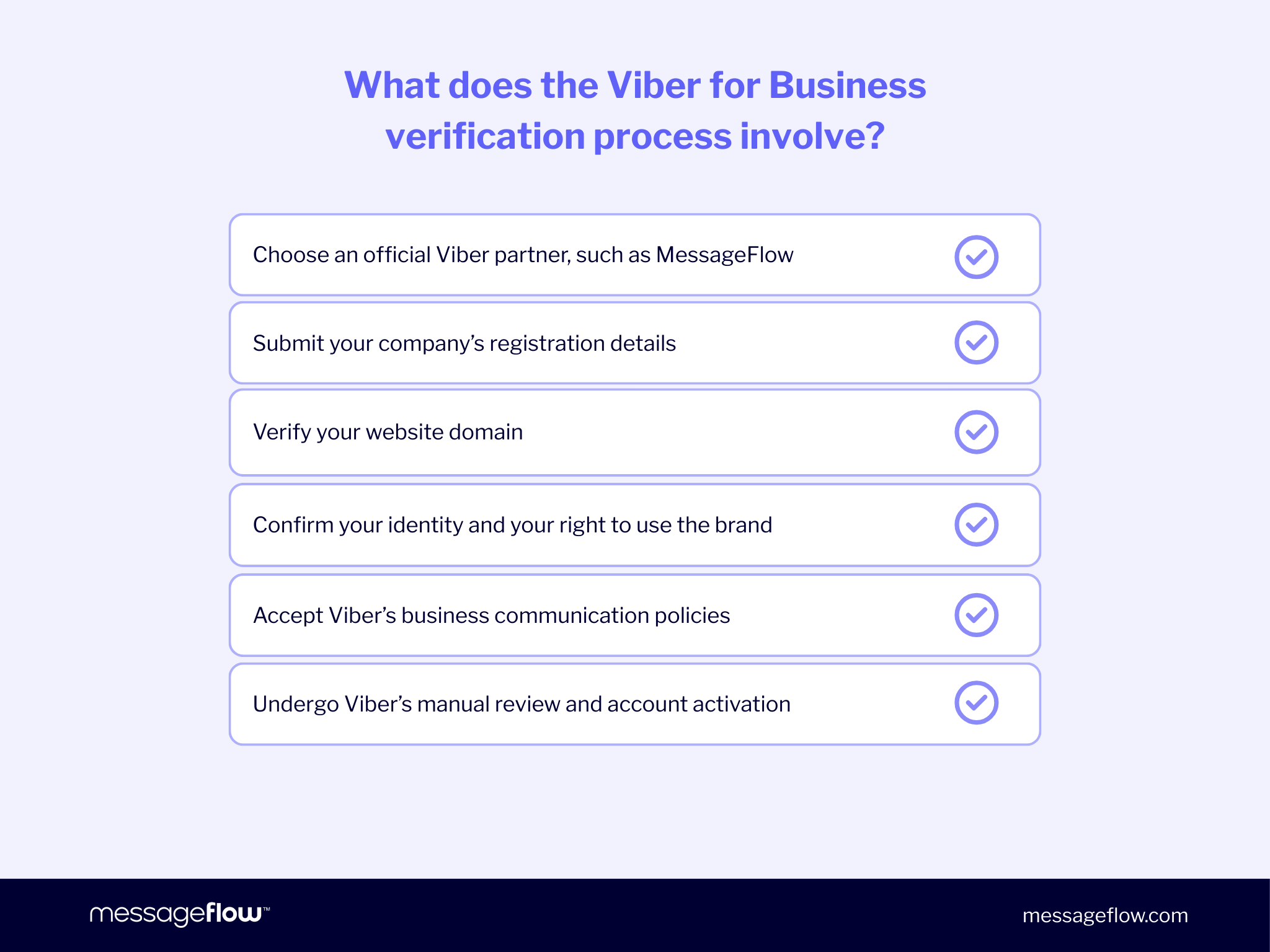
Obtaining a verified business account on Viber is not automatic. Before a company can launch an official profile, it must go through a formal approval process.
This typically includes:
- Providing official company registration details
- Verifying ownership of the company’s domain
- Confirming its identity and legal right to use the brand name
- Accepting Viber’s business communication policies
Only after successfully completing these steps does the account receive verified business status.
Why does this matter?
Because verification significantly reduces the risk of brand impersonation. It creates a clear barrier between legitimate companies and fraudulent actors attempting to mimic them.
Inside the app, verified business accounts are easy to recognize. They are:
- Clearly marked as “business”,
- Visible in the business section or marketplace search results,
- Equipped with a dedicated “View Business Info” panel,
- Often accompanied by a verification badge (blue tick ✓).
These visible markers help users quickly confirm that they are interacting with an official and authorized source.
How companies use Viber business profiles
Viber for Business is designed to deliver communication that genuinely matters to customers.
In practice, companies use it to send various message types, including:
- Order and delivery updates,
- Payment and booking confirmations,
- Appointment reminders,
- Banking and account notifications,
- Two-factor authentication (2FA) codes,
- Promotional offers and special campaigns with rich content that drive sales,
- Personalized communication that encourages customer interactions,
- Real-time customer support messages.
These are messages that are expected, relevant, and often time-sensitive – which makes a secure and reliable channel essential.
Viber Business Account: What does it offer companies?
For brands, an official Viber account is more than just a way to send messages. It is a complete communication ecosystem that combines customer service, transactional messaging, and marketing within one secure platform.
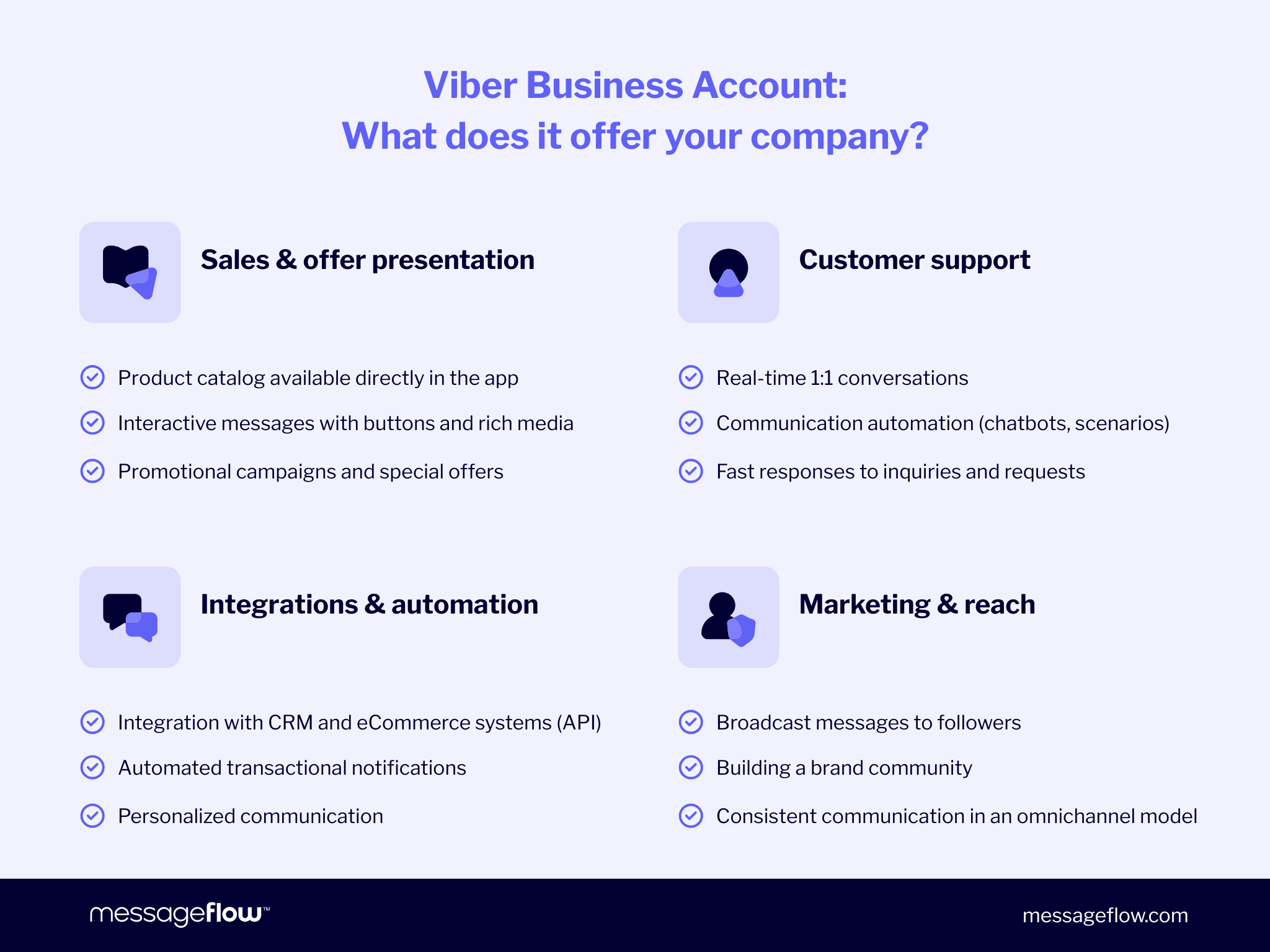
With Viber for Business, companies can:
- Present product catalogs with rich media directly within the Viber app,
- Send broadcast Viber messages to followers,
- Deliver Viber verification messages,
- Conduct one-on-one conversations with loyal customers,
- Integrate with CRM and eCommerce systems via a single API,
- Automate communication through chatbots,
- Track performance using delivery and read reports,
- Boost conversions through interactive buttons and rich media content,
- Build a brand community and increase engagement.
Importantly, Viber is one of the leading messaging apps in many Central, Southern, and Eastern Europe markets, including Serbia, Bulgaria, Greece, and Ukraine.
In these countries, being present on Viber means reaching customers where they already communicate every day. Compared to email or SMS, Viber business messages often achieve higher visibility and stronger engagement – simply because they appear in a familiar, frequently used environment.
How to recognize trusted Viber messages: Key indicators and warning signs
You receive a message on Viber from a “bank” or a “courier company.”
Do you click the link? Reply immediately? Or ignore it?
In most situations, you can assess the message’s credibility yourself. Viber provides several visible signals that help distinguish official business communication from a potential fraudulent activity – you simply need to know where to look.
Core characteristics of trusted Viber communication
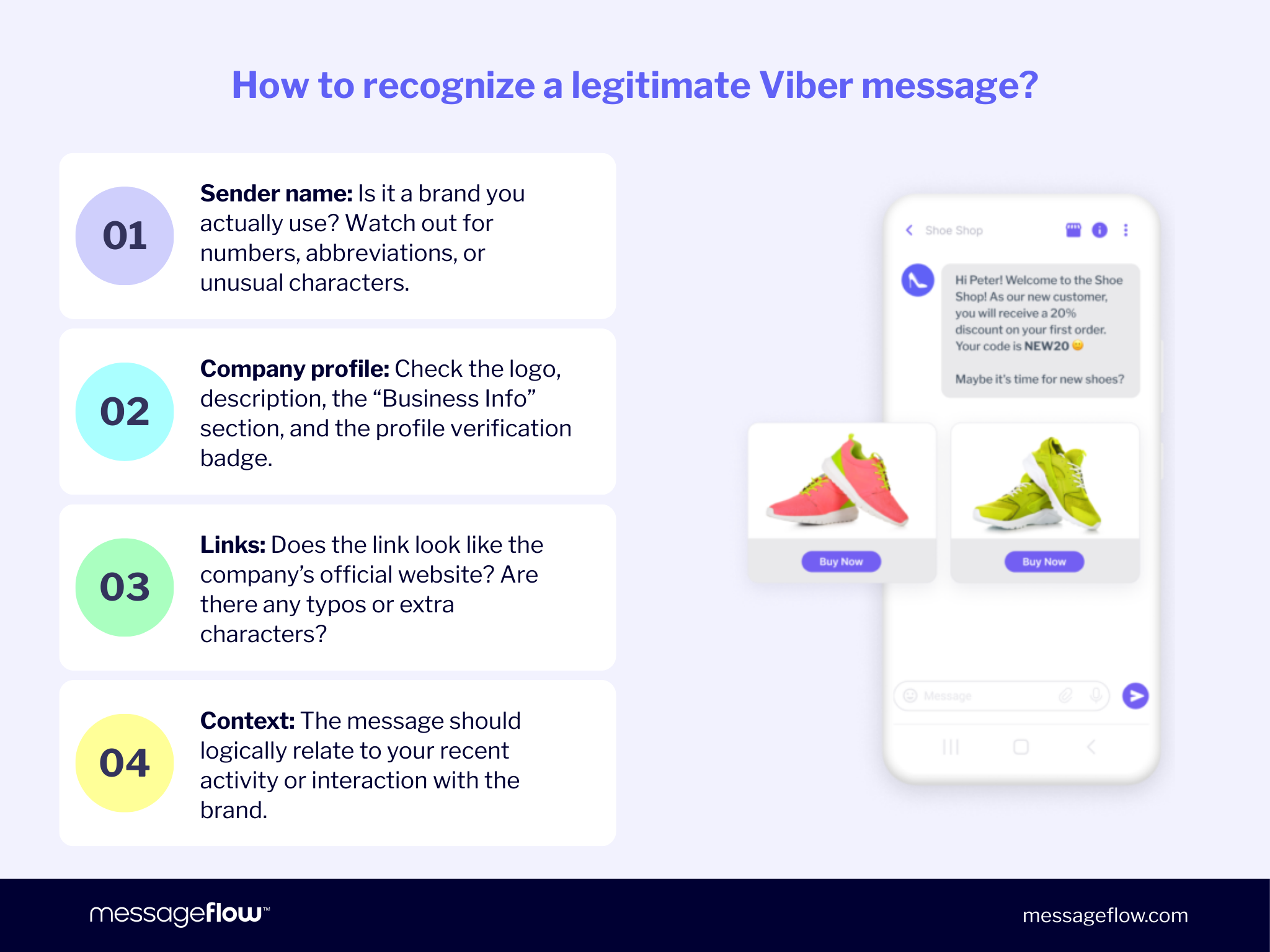
Before reading the message itself, start with the sender’s profile.
A legitimate business account will typically include:
- The full, clearly written brand name (e.g., “Bank XYZ,” “Store ABC”)
- The official company logo – not a generic or random image
- A completed business profile with a clear company description
- Business labels and a visible “View Business Info” section
If instead you see only a phone number, an unusual abbreviation, random characters, or no profile photo at all, treat that as an immediate warning sign.
In many cases, official conversations also appear in a dedicated business inbox, making them easier to identify at a glance.
Look closely at the message itself
The profile is your first checkpoint – but the message content matters just as much.
Authentic business communication is typically clear, structured, and factual. It focuses on information rather than emotion.
In legitimate messages, you will usually notice:
- Correct, natural language without strange formatting or unusual errors,
- Specific details (such as an order number, case reference, or appointment date),
- Links that lead to the company’s official domain,
- A neutral, professional tone.
Be particularly cautious if the message:
- Creates panic (“Your account will be blocked,” “Immediate verification required”),
- Pressures you to act quickly (“Click within 5 minutes,” “Final warning”),
- Requests sensitive information (passwords, 2FA codes, card details, ID numbers, document scans),
- Contains suspicious links (misspelled domains, extra characters, unusual endings, or shortened URLs).
If a message relies on urgency, threats, or emotional pressure, pause before taking any action.
This is especially important for transactional notifications. They should reflect your real activity. If you have not made a purchase and suddenly receive a delivery or payment alert, do not click the included link. Instead, verify the information independently, for example, by opening the company’s official app or typing the website address directly into your browser.
A brief moment of verification can prevent a costly mistake.
Why should brands ensure consistency in Viber cusiness communication?
Trust is built through consistency.
When a company communicates via Viber, every visible element should align: the sender name, the logo, the tone of voice, the writing style, and even the domain included in any link. Together, these elements create a clear and recognizable brand presence.
Even small inconsistencies: a slightly altered name, a different logo version, an unfamiliar tone, or a suspicious-looking link – can raise doubts. And in today’s environment, doubt often leads to hesitation or lost trust.
That is why brands using professional messaging infrastructure, such as MessageFlow, ensure that every detail of their Viber communication remains aligned with their visual identity and established security standards. This is not just about presentation. It is about protecting customers, strengthening credibility, and safeguarding brand reputation.
Viber message security: How privacy protection works
Is Viber secure?
There is no single, simple answer. Security depends on two factors: the technology behind the platform and the way it is used.
From a technological perspective, Viber is a secure OTT messaging app. Within its business model (Viber for Business), it also applies formal sender verification, which significantly reduces the risk of brand impersonation. The platform includes mechanisms specifically designed to protect privacy and ensure communication integrity.
However, technology alone is not enough. Even the most advanced safeguards cannot prevent fraud if users click suspicious links, share confidential information with unverified senders, or ignore basic cybersecurity principles. Security is always a combination of infrastructure and user awareness.
To better understand how privacy protection works in Viber, it helps to look at three key areas: encryption, metadata handling, and the risks related to human behavior.
End-to-End Encryption (E2E)
Since 2016, Viber has used end-to-end encryption (E2E) – the same security standard adopted by privacy-focused apps such as Signal and WhatsApp.
In practical terms, this means:
- A message is encrypted on the sender’s device,
- It travels through servers as encrypted data,
- It is decrypted only on the recipient’s device.
No intermediary, including Viber itself, can access the content of private conversations.
Encryption applies to:
- One-on-one chats,
- Group conversations,
- Photos and videos,
- Voice messages,
- Audio and video calls.
Viber also implements forward secrecy. This means that even if an encryption key were compromised in the future, past conversations could not be decrypted. This significantly increases long-term resistance to attacks.
Does all Viber communication use End-to-End Encryption?
Not exactly.
Private user conversations are fully protected by end-to-end encryption. However, public spaces such as communities and channels operate under a different model. Business communication also follows a distinct framework.
Viber Business messages are sent through the official business infrastructure. They rely on verified sender profiles and controlled authorization standards. While they comply with Viber’s security policies, they are designed specifically for transactional notifications and campaign communication rather than private peer-to-peer messaging.
Viber business communication security with MessageFlow
When companies integrate Viber business messages via the MessageFlow single API, communication is transmitted exclusively through encrypted HTTPS connections. Access to the system is secured using an API key, and webhooks can be further protected with Basic Authentication process.
Before launching a Viber Business channel, a company must complete formal brand verification. As a result, recipients see the official company name, logo, and business designation – significantly reducing the risk of impersonation.
Importantly, MessageFlow’s infrastructure does not have access to private conversations protected by end-to-end encryption. Its role is limited to the technical delivery of business messages through the official channel, in compliance with Viber Business policies and applicable regulations, including GDPR.
Privacy-enhancing tools within the app
Beyond encryption, Viber for business offers additional features that strengthen user protection.
Users can:
- Manually verify chat security keys,
- Receive notifications when encryption keys change (e.g., after app reinstallation),
- Enable two-step verification (PIN protection),
- Use hidden chats secured with a passcode,
- Send disappearing messages,
- Block or report suspicious senders.
Social engineering: The real risk
Despite strong technical safeguards, the most common threats are not technical. They are behavioral.
Phishing messages impersonating banks or courier companies, fake websites designed to steal credentials, downloading apps from unofficial sources, or failing to secure a device with a screen lock remain the most frequent causes of security breaches.
No messaging app – whether Viber, WhatsApp, Signal, Telegram, or Messenger – can protect a user who voluntarily shares a one-time code or login credentials with a fraudster. Technology provides a strong foundation. But awareness, caution, and responsible usage remain the most effective safeguards.
The role of Viber for Business in building trusted communication
OTT messaging apps such as Viber are no longer used only for private conversations. They have become an essential part of modern business communication.
Companies rely on them to send transactional notifications, authorization codes, delivery updates, and order confirmations. For users, this feels natural – these apps are already part of their daily routines. Messages arrive instantly, in a familiar environment, without requiring them to check email or wait for SMS.
At the same time, the growing popularity of messaging platforms makes them attractive targets for fraudsters. The real question today is no longer “Should businesses use messaging apps?”
It is “How can they use them securely and responsibly?”
Technology as the foundation of secure Viber communication
Security on Viber is not accidental. It is built into the platform.
Private conversations are protected by end-to-end encryption. Business accounts must complete a formal verification process. Official brand profiles are clearly labeled and identifiable. At the infrastructure level, communication is supported by secure APIs, encrypted HTTPS connections, and strict access authorization mechanisms.
Together, these safeguards significantly reduce the risk of impersonation and abuse. They create a reliable technical foundation for secure, large-scale communication between brands and customers.
Trust is a shared responsibility
Technology, however, is only one part of the equation. Even the strongest infrastructure cannot prevent risky behavior if users click suspicious links or ignore warning signs. The final decision always rests with the recipient.
That is why security depends on two sides:
- Companies must ensure verified profiles, consistent communication, and high technical standards.
- Users must remain attentive and verify unexpected messages before taking action.
Organizations using Viber business messages should invest not only in secure infrastructure, but also in transparent communication and customer education. Clear security principles strengthen credibility and reduce uncertainty.
In the digital environment, lasting trust is built where three elements meet: secure technology, consistent brand communication, and informed users. And today, trust is one of the most valuable assets any brand can have.
FAQ: Frequently asked questions about verified Viber messages
For private chats (one-on-one and group) as well as voice and video calls, Viber uses end-to-end encryption (E2E). This means message content is encrypted on the sender’s device and decrypted only on the recipient’s device. Even Viber itself cannot access the content of these conversations.
For Viber business messages, the protection model differs from private chats. While communication is encrypted in transit and secured within official infrastructure, message processing depends on the integration model and the systems used by the company.
Like most messaging platforms, Viber may process certain metadata, such as the date and time of sending, delivery status, or account identifiers, even though private chat content remains protected by E2E encryption.
Security during device changes depends on how you transfer your data.
If you use backups, make sure they are protected with a password, PIN, or two-factor authentication process. When installing Viber on a new device, the app re-verifies your phone number, adding an extra layer of protection.
It is also essential to secure your device with a screen lock (PIN, fingerprint, or facial recognition). An unprotected phone significantly increases the risk of unauthorized access.
Companies must comply with:
- Applicable data protection and marketing communication laws,
- Viber’s business messaging policies, including opt-in and unsubscribe mechanisms.
In general:
- Marketing and business messages require prior user consent.
- Transactional messages (e.g., order confirmations or delivery updates) are typically linked to a service you requested, though the exact rules depend on local regulations.
As an end user, you can:
- Block a sender,
- Unsubscribe from communication (where available),
- Report messages as spam.
Viber and SMS are based on different technologies.
Traditional SMS does not provide end-to-end encryption. Viber applies E2E encryption to private conversations, which offers a higher level of content protection.
However, encryption alone does not eliminate all risks. Security also depends on:
- Sender verification,
- Careful handling of links and attachments,
- Using official apps (e.g., banking or retail apps),
- Keeping your operating system and applications updated.
Many companies use a multi-channel strategy (Viber, SMS, email), allowing users to choose their preferred method of contact.
No communication channel can eliminate fraud entirely. Threat actors constantly adapt their techniques.
However, combining strong technology (encryption, verified business accounts), responsible infrastructure on the company side, and informed user behavior significantly reduces the likelihood of successful attacks.
RCS (Rich Communication Services) is an evolution of SMS that operates through carrier infrastructure and compatible messaging apps (such as Google Messages). Rakuten Viber is an independent OTT messaging app that works over an internet connection.
From a security perspective:
- Rakuten Viber applies end-to-end encryption by default in private one-on-one and group chats.
- RCS may offer end-to-end encryption in selected implementations, but it is not universally available across all carriers and markets.
Both RCS and Viber support transactional and marketing messages with multimedia content. The choice between them typically depends on market availability, user reach, and the company’s mobile marketing strategy.
All of these are popular OTT messaging platforms, but they differ in their encryption models and privacy approaches.
Regarding end-to-end encryption (E2EE):
- Signal, WhatsApp, and Rakuten Viber apply E2EE by default in private chats.
- Messenger offers E2EE, though it may not always be enabled by default depending on settings and conversation type.
- Telegram does not apply E2EE by default in standard chats; it is available only in “Secret Chats.”
Signal is widely recognized for its strong privacy focus and minimal metadata collection. WhatsApp and Messenger are part of the Meta ecosystem. Viber, owned by Rakuten, combines encrypted private communication with verified business account mechanisms. Telegram emphasizes large-scale groups and channels but uses a different encryption model for standard chats.
In practice, all of these apps provide a high level of security. The key differences lie in default encryption settings, metadata handling, privacy philosophy, and intended use, whether for personal communication, business messaging, or large public communities.