
Many marketing teams respond to declining email performance the same way – they increase send frequency. More messages, more segments, more variants. This, however, results in higher costs, subscriber fatigue, and further drops in engagement.
The problem is rarely about how many emails you send. It’s more so about how you select your audience and what actually reaches their inbox.
Email personalization and segmentation are two terms that often get used interchangeably in industry conversations. But they’re distinct mechanisms that operate at different levels of your communication strategy. It is only when you combine them deliberately that you can meaningfully improve open rates, CTR, and conversions without increasing send volume.
In this article, you’ll learn:
- How segmentation and personalization differ and why treating them as the same thing holds your campaigns back
- Which segmentation models (declarative, behavioral, transactional) work in practice and when to use each
- Why personalization goes far beyond inserting a first name
- How behavioral data and dynamic segments let you improve results without increasing send volume
- What role automation plays in making precision scalable
Segmentation vs. personalization – Why the distinction matters
Before getting into tactics, it’s worth clarifying terminology that causes more confusion than it should. In everyday marketing work, email segmentation and personalization are often treated as the same thing. They’re not, and conflating them leads to shallow implementations and underwhelming results.
Segmentation is the process of dividing your contact base into groups based on defined criteria: demographic, behavioral, transactional, or declared. It answers the question who you’re talking to.
Personalization is the adaptation of content, format, timing, or channel to a specific recipient or segment. It answers the question of what you’re saying and how you’re saying it.
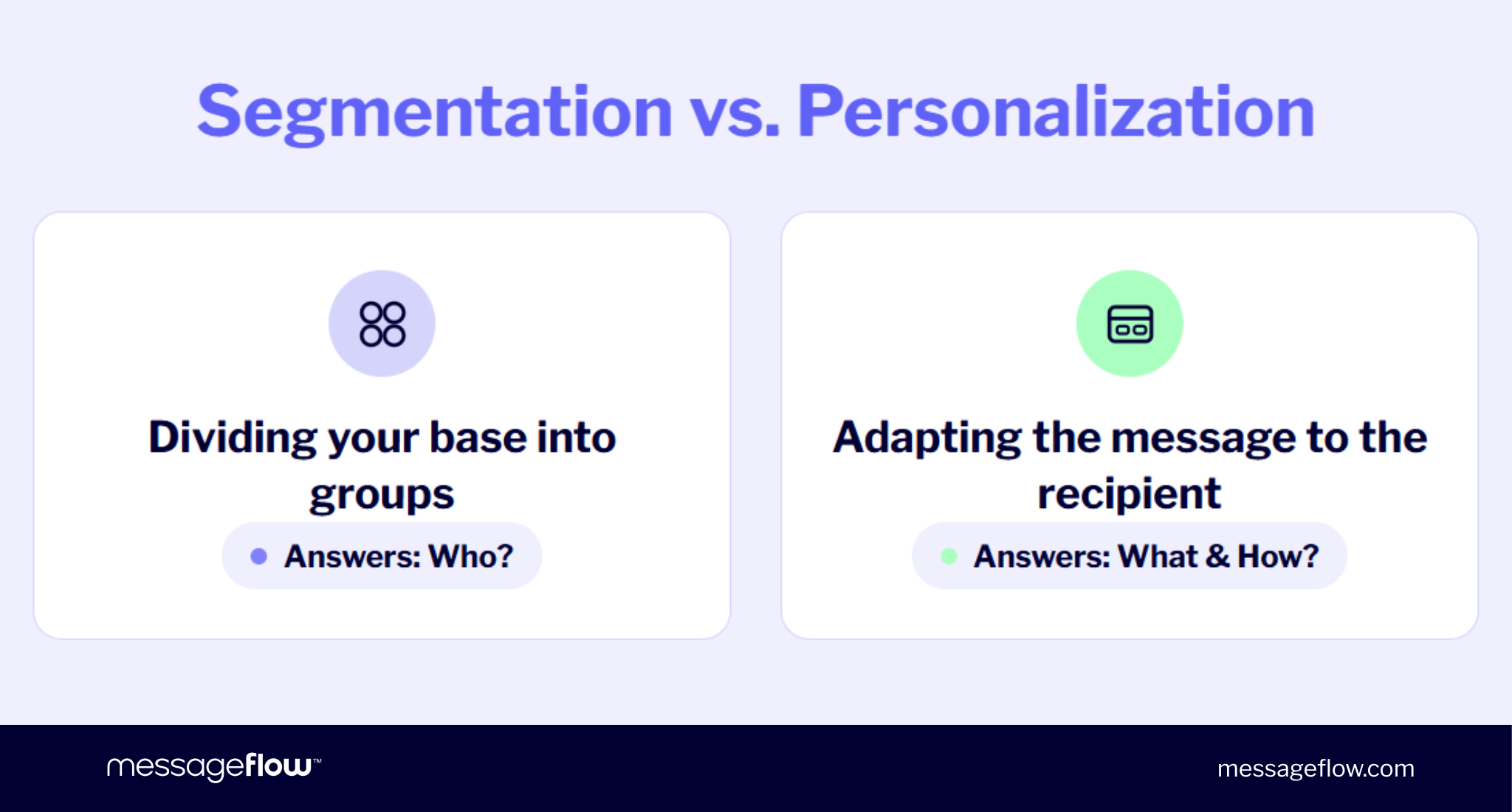
Segmentation without personalization means you’re sending the same message to a narrower group – better than a mass blast, but far from optimal. Personalization without segmentation means you’re dynamically inserting a first name into a message that goes to your entire list – cosmetics, not strategy.
💡 The real gains begin where both approaches converge: a precisely defined segment receives a message tailored to its context, behavior, and position in the buyer journey.
How segmentation and personalization work together
Consider an online retailer with 80,000 users. The default approach: a weekly promotional newsletter goes out to everyone. Open rates decline month over month because most recipients see offers that have nothing to do with them.
The alternative, built on behavioral segmentation email data: the list is split by activity over the past 30 days – active buyers, browsers who haven’t purchased, and dormant accounts. Each group gets a different message:
- Active buyers receive product recommendations based on their last order – complementary items, restocks, or upgrades.
- Browsers get a reminder about the categories they viewed, paired with a time-limited incentive.
- Dormant users receive a short reactivation message asking about their current preferences.
Send volume stays the same or even drops. But relevance increases dramatically because each message responds to the recipient’s actual situation rather than competing for attention with a generic promotion.
This is the shift that turns email targeting from a question of “how many people should we send to” into “who needs to hear what.”
Personalization beyond {first_name}
Inserting a recipient’s name in the subject line is the most commonly cited example of email personalization. It’s also the most misleading because it implies that personalization is a matter of a single merge tag.
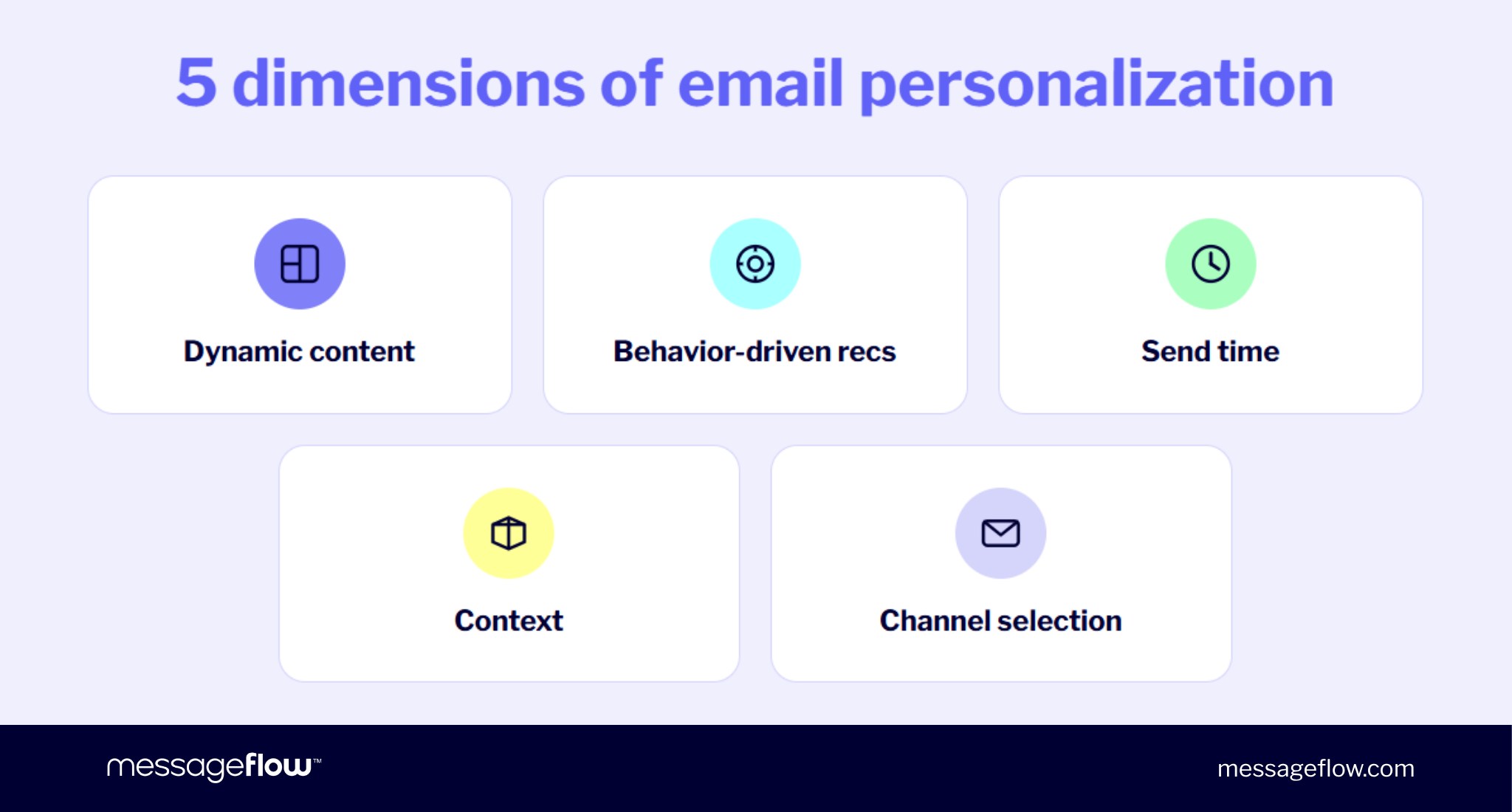
In practice, personalized email campaigns involve far more layers than a {first_name} field. Here are the dimensions where personalization actually moves the needle:
Dynamic content blocks. Different sections of the same email rendered based on segment membership, purchase history, or stated preferences. A single template can contain three variants of a product section, each served to a different group. The recipient sees only the one that’s relevant to them. This is where personalization and segmentation intersect most directly: the segment determines which content block gets displayed.
Behavior-driven recommendations. Algorithms that analyze browsing history, click patterns, and transaction data to surface products or content tailored to the individual. This mechanism is well-known in ecommerce, but it’s equally effective in SaaS – recommending features a user hasn’t activated yet – or in media, where article suggestions adapt based on past reading behavior.
Send time optimization. Not everyone opens email at 9 a.m. Adjusting delivery time at the individual level, based on each recipient’s historical engagement patterns, is one of the simplest changes that can improve open rates without any content rework. The magnitude varies by list and industry, but case studies from a variety of platforms point to measurable gains in engagement of anywhere between 10% to 20%.
Contextual relevance. A welcome email, an abandoned cart follow-up, an expiring subscription reminder – each of these scenarios demands a different tone, different length, and a different CTA. Personalization at the context level means the recipient gets a message appropriate to where they are in their relationship with the brand, not just who they are.
Channel selection. For platforms that support multiple channels – email, SMS, mobile push, RCS – personalization extends to the choice of medium itself. Some recipients respond better to a short SMS with a discount code. Others prefer a visual, content-rich email. Channel preference data is one of the most underused yet highest-impact dimensions of personalization available today.
The common thread across all of these: none of them rely on a single database field. Each requires a combination of behavioral, contextual, and transactional data plus infrastructure capable of processing that data in near-real time and translating it into the right message type.
This is the point where email personalization stops being a tactic and becomes a system-level capability. And the point where the difference between a sending tool and a communication platform starts to matter.
How segmentation and personalization affect campaign performance
Marketers managing large contact databases are familiar with the pattern: a mass campaign generates a decent number of opens in absolute terms, but percentage metrics – open rate, CTR, conversion – keep sliding. The instinct is to send more often, which only accelerates the decline. Recipients start ignoring messages, flagging them as spam, or unsubscribing.
Email segmentation combined with personalization reverses this dynamic. It does so not because it produces some miraculous uplifts, but because it addresses the root cause: a mismatch between the message and the person receiving it.
What actually changes
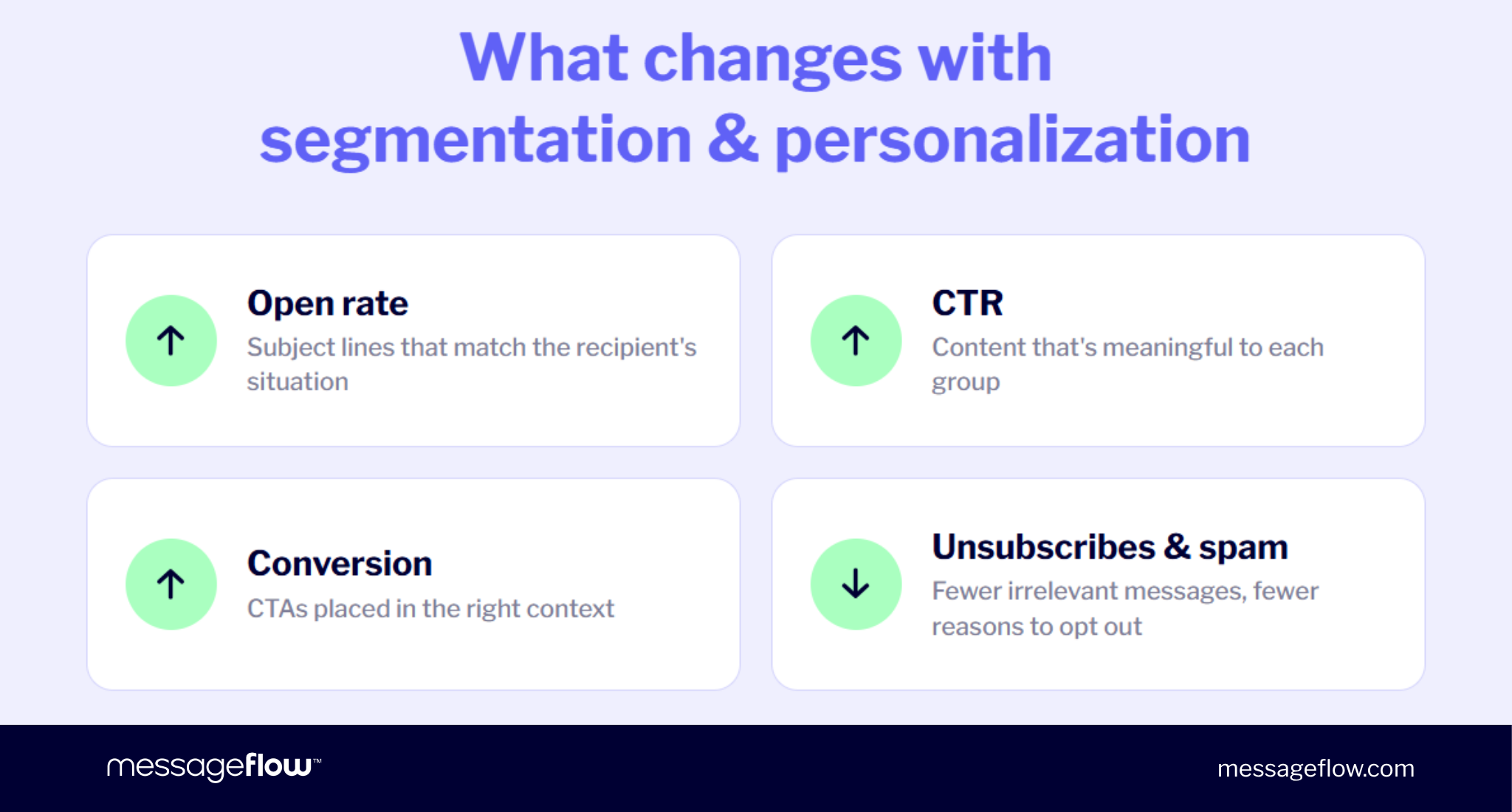
Open rates improve because the subject line speaks to the recipient’s situation. A generic subject like “Our Latest Deals” competes with plenty of similar messages in the inbox. A subject referencing a specific category the recipient recently browsed, or acknowledging the stage they’re at, has a much better chance of earning the click because it signals relevance before the email is even opened.
CTR improves because the content inside is meaningful to that particular group. When your entire list receives the same product selection or the same offer, most recipients see things that don’t apply to them. Segmentation narrows the offer to what makes sense for each group. Personalization goes further, reordering elements within the message based on likely interest.
Conversion improves because the CTA sits in the right context. A “Buy Now” button works differently when preceded by content tailored to the recipient’s purchase history than when it follows a generic promotional block. Matching the CTA to the segment and the buyer journey stage is one of the fastest ways to lift conversion rates without changing the offer itself.
Unsubscribes and spam complaints drop. This is the side effect that rarely gets enough attention. People don’t unsubscribe because they dislike your brand but rather because they receive too many messages that aren’t relevant to them. When every email is tailored to the recipient’s situation, there are simply fewer reasons to opt out.
Fewer sends, better outcomes
Let’s make something clear: email targeting built on segmentation and personalization doesn’t require sending more messages. It requires sending the right messages to the right people. In practice, this often means reducing volume because instead of one campaign to your entire list, you send three smaller ones, each with significantly higher engagement metrics.
For teams that report not just on emails sent but on revenue per email (RPE) or cost per conversion from the channel, this shift is measurable and direct. Fewer messages, less infrastructure load, less sender reputation risk and stronger business results.
The role of data and automation
Everything discussed so far – segmentation models, personalization layers, contextual relevance – shares a single dependency: the quality and accessibility of your data. Without data, segmentation defaults to a crude split between buyers and non-buyers. Without automation, personalization means manually building message variants, which becomes unworkable the moment your list exceeds a certain number of contacts.
Data as the foundation
Every interaction a recipient has with your brand generates data that can feed into segments: an email open, a link click, a site visit, a purchase, an abandoned cart, a period of inactivity. The problem isn’t that this data doesn’t exist – most platforms collect it. The issue is that it often lives in silos: CRM in one place, email platform in another, analytics somewhere else still.
Effective behavioral segmentation email strategies require this data to be accessible in one place and in near-real time. A segment like “users who abandoned a cart in the last 2 hours” only works if your communication platform sees the abandonment event almost immediately, not after an overnight CSV export.
This is where the distinction between static and dynamic segments becomes critical. A static segment is a list built once, based on data from a specific point in time, say, “everyone who purchased in December.” A dynamic segment updates automatically based on live data: recipients enter and exit it as their behavior changes. Dynamic segments are the foundation of scalable personalization because they eliminate the need to manually maintain lists.
Automation as the execution layer
Data tells you who and what. Automation handles when and how. In the context of email marketing, automation goes well beyond autoresponders and basic welcome sequences. It means the system’s ability to:
- trigger a campaign the moment a condition is met
- select the right content variant based on segment attributes
- adjust send time to individual engagement patterns
- shift communication to a different channel if email doesn’t generate a response
Each of these mechanisms requires both data and decision logic – rules the platform executes without human intervention. The more granular the data and the more rules you can define, the more precise the communication becomes.
Scaling without losing relevance
Manual personalization scales linearly: twice as many segments means twice as much work. Automation lets you scale nonlinearly. A single well-designed flow serves thousands of recipients, each receiving a different message variant, different timing, and potentially a different channel.
If you’re operating on large databases, the key question shifts from “what content should we create” to “what data and automation infrastructure should we build.”
A platform that consolidates data from multiple sources, provides a flexible email API for integration with existing systems, and supports dynamic segmentation based on user behavior becomes the backbone of your communication strategy whether you operate on a single channel or across several simultaneously.
This moves the weight from content production to communication architecture. Once implemented, the effect compounds: the more data the system collects, the sharper the segments become, and the more effective personalization gets.
Putting segmentation and personalization into practice
The theory behind segmentation and personalization is compelling. The challenge starts at implementation, especially in organizations that have been running primarily mass campaigns. Here are a few principles that help bridge the gap between concept and working system without overcomplicating things.
Start with two or three segments, not a dozen
A common mistake when implementing segmentation: trying to build an elaborate segment structure that covers every possible scenario from day one. The result is dozens of microsegments, half of which are too small to produce statistically meaningful results, while the other half require dedicated content that nobody has time to create.
A more effective approach: identify two or three segments with the highest potential impact on your results. For ecommerce, this is often the split between active buyers, browsers who haven’t converted, and dormant subscribers. For SaaS, trial users, active paying customers, and those at risk of churning. Start there, measure what happens, then expand the structure incrementally.
Combine declared and behavioral data
Declared data – what users tell you themselves (their industry, job title, preferences) – paints a picture of who the recipient is. Behavioral data – opens, clicks, purchases, site activity – tells you what they actually do. Neither is sufficient on its own.
A segment built purely on declared data can go stale fast: someone indicated an interest in running shoes when they signed up two years ago but they’ve been buying exclusively outdoor gear for the past twelve months. A purely behavioral segment, on the other hand, lacks intent – frequent browsing of premium products doesn’t always signal purchase readiness.
💡 The most effective email targeting combines both sources: declared preferences as the starting point, behavior as the ongoing correction and real-time update.
Personalize incrementally, starting with what you have
You don’t need to deploy recommendation algorithms and predictive send-time models on day one. If your platform supports dynamic content, start with a single block in your email that changes based on segment membership. If you have last-purchase data, use it in the subject line or in a recommendations section.
Personalization is an iterative process. Each additional dimension like timing, channel, content, and CTA is an incremental improvement you can measure and optimize. The key is to start with data you’re already collecting rather than waiting for a perfect setup.
Measure relevance, not just volume
Standard email marketing KPIs like open rate, CTR, and conversion take on a different meaning in the context of segmentation. An 18% open rate across your entire list could mean something completely different from 18% for a dormant segment (which would be an excellent result) versus 18% for loyal customers (which would suggest a relevance problem).
It’s worth expanding your reporting to include segment-level metrics: revenue per email (RPE) broken down by segment, unsubscribe rate per segment, conversion per segment. Advanced analytics and heatmaps let you see which elements of a message engage specific groups, giving you a concrete basis for optimizing subsequent sends.
FAQ
Email segmentation is the practice of dividing your user base into smaller groups based on shared characteristics – demographic, behavioral, transactional, or declared. The goal is to match your messaging to the specifics of each group instead of sending one email to everyone.
Well-designed email segmentation makes campaigns more relevant, which improves engagement metrics without requiring you to increase send frequency.
Declarative segmentation relies on data the user provides directly – industry, role, product preferences selected at signup. Behavioral segmentation uses observed actions: opens, clicks, purchases, pages viewed, periods of inactivity.
Declarative data tells you who the recipient says they are. Behavioral data tells you what they actually do. The strongest approach treats declared data as a starting point and behavioral data as a continuous, real-time correction.
Personalization can cover the subject line, preheader, individual content blocks (dynamic content), product or content recommendations, CTAs, send time, and even channel selection (email, SMS, push notifications). Each of these is a separate lever that affects performance, and combining them produces a compounding effect.
Yes, provided personalization goes beyond cosmetic changes. Inserting a name in the subject line may produce a marginal lift in open rates, but meaningful conversion improvements come from matching content, offer, and context to the recipient’s segment and buyer journey stage.
Personalized email campaigns grounded in behavioral data and dynamic content consistently deliver higher CTR and conversion at the same or lower send volume because each message reaches someone for whom it’s genuinely relevant.
Two to three. Elaborate segment structures sound appealing in theory, but in practice they create problems: groups too small to generate statistically significant results, insufficient resources to produce dedicated content for each, and difficulty measuring impact. Start with the segments that have the greatest potential to move your metrics – active vs. dormant, buyers vs. browsers – measure the results, and iterate from there.
Platforms that support dynamic segments make this process considerably easier, since group membership updates automatically based on incoming data.