Boost your marketing campaign conversion by using the latest insights about your customers. Thanks to its flexible logic and integration of multiple data types, you can precisely implement even complex communication scenarios to remain confident that your messages will reach the right people at the right time through real-time customer segmentation and marketing automation.
Smart customer segmentation
in real-time
BATTLE-TESTED BY OVER 79K DEMANDING BRANDS
What is MessageFlow Segments?
MessageFlow Segments is a tool for customer segmentation that allows for dynamic creation of audience segments in real time – even while actively running email, SMS or push campaigns.
This flexible feature is based on data from various sources and rules that you can set at any time. It enables dynamic segmentation and marketing personalization, ensuring that your campaigns always reach the perfectly matched audiences.
Four key data sources, one segmentation tool
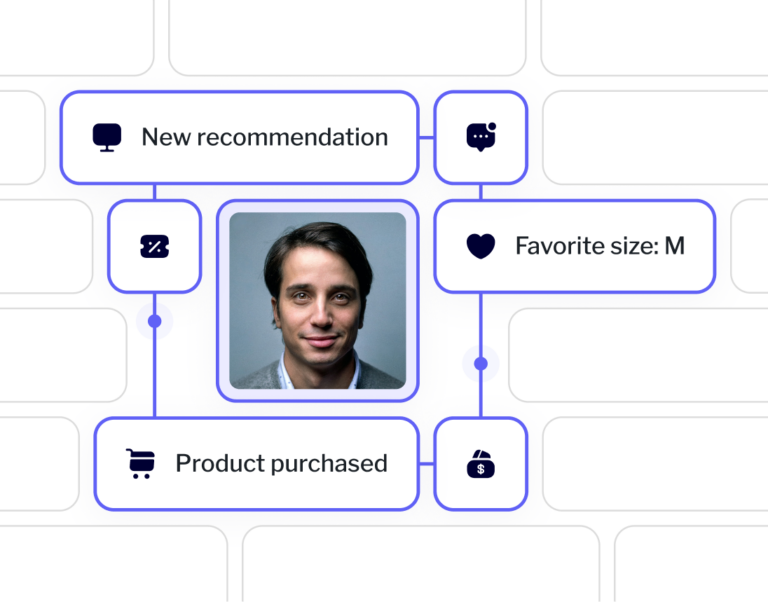
Sex, age, location, tags, purchase history.
→ Make use of what you already know about customers as segmentation criteria in your customer segmentation tool.
Browsed pages, products, time spent on-site.
→ React to ongoing user interest with real-time segmentation based on website behavior.
Clicks, opens, deliveries.
→ Run communication based on actual engagement to improve marketing campaign performance through audience segmentation.
Transactions, customer statuses, CRM/ERP data.
→ REST API – real-time data streaming for advanced customer segmentation scenarios.
Advantages of dynamic
customer segmentation
- Always fresh data: Segments update automatically at the time of sending. Rest assured that the message will only reach recipients who meet the conditions here and now thanks to real-time customer segmentation.
- Hyperpersonalization: Create precise groups of recipients based on complex logical rules (“and”, “or”) using MessageFlow’s intuitive panel interface to support marketing personalization at scale.
- Higher ROI, lower cost: Better tailored campaigns eliminate misdirected campaigns, increasing the effectiveness of your marketing efforts through customer segmentation and marketing automation.
- Saving time: Automatic segment generation lets you forget about manual list management. There is no need
for coding or complex tech integration. - Advanced campaign scenarios: Real-time segmentation supports activities such as reactivation campaigns or
recovery of abandoned shopping carts.
Key features
- Dynamic target audience lists: Always up-to-date, generated at the time the campaign is sent, with no need for
manual updates. Ready to use in any campaign run from the MessageFlow panel as part of a real-time customer segmentation workflow. - Multidimensional segmentation criteria: Build segments based on demographic, behavioral, transactional, and
custom contact attributes, including events from your systems (CRM, POS, mobile apps) using advanced customer segmentation criteria. - Integration with panel campaigns: Dynamic segments are natively integrated into the campaign builder in the panel. All you need to do is select them as a target group when sending emails, SMS or pushes.
- Using purchase data: Feed the segmentation with purchase data, sent via APIs for example, to build even more accurate customer profiles and drive more relevant communication through real-time segmentation.
- Real-time content personalization: With dynamic segments, the content adapts to the current status of the
recipient. Personalization takes place exactly when the user meets the conditions defined in your customer segmentation rules.
Customer segmentation
use cases in practice
- Real-time marketing: User keeps reading more articles on a topic – gets a related newsletter triggered by real-time segmentation.
- Active on mobile: App users who have been active within the last 7 days identified via audience segmentation.
- New subscribers: Onboarding campaign aimed at new contacts based on customer segmentation rules.
- VIP Clients: Individuals who spent $1,000+ within the last 3 months identified through dynamic customer segmentation.
- Reactivation: No activity for at least 30 days detected via real-time segmentation.
- Interested: 2+ visits to a product page within a week tracked via website activity segmentation.
- Birthday: Segment based on the date of birth – for example, a discount offer enabled by customer segmentation data.
- Location: Promotion related to the opening of a new store using geographic segmentation criteria.
- Cross-selling: They bought A but not B – an opportunity to cross-sell identified through customer segmentation.
- Multi-channel activity: Email click + a website visit within 24h combined through real-time audience segmentation.
How to start building campaigns based on real-time segments?
QUESTIONS
FAQs
Here are some of the most frequently asked questions answered by our experts.
Customer segmentation is the process of dividing your audience into groups based on shared characteristics, behaviors, or data attributes. In MessageFlow, customer segmentation is dynamic and real-time, meaning recipient lists are generated at the moment a campaign is sent. This ensures your communication always reaches the right people, improving marketing personalization, conversion rates, and overall campaign effectiveness.
The key difference is when and how the recipient list is created. Dynamic segmentation is based on constantly active rules, while static segmentation is a one-time generation of a fixed list of contacts.
- Dynamic segmentation works based on a set of rules, and the recipient list is generated automatically just before the campaign is sent, which guarantees it is always up-to-date.
- Static segmentation is a one-time operation (e.g., merging groups or filtering), which results in a new, fixed list of contacts (a group).
The possibilities are almost limitless. Here are a few popular scenarios:
- VIP Clients: People who have spent over $1,000 in the last 3 months.
- Reactivation: Contacts who have not opened any message in the last 30 days.
- Cross-selling: Customers who bought product A but not product B.
- Abandoned Cart: People who added a product to their cart but did not complete the transaction within the last 2 hours.
- Location: Residents of a specific city to whom you are directing a promotion related to a new physical store.
You can build segments based on four key data sources, which can be freely combined within our customer segmentation tool:
- Declarative data: Attributes assigned to a contact’s profile, e.g., name, location, customer status, age, or values in custom fields.
- Website activity: Data about interactions with your website (requires implementing a tracking script), e.g., the URL of a visited product page.
- MessageFlow system events: Automatic responses to interactions with your campaigns, e.g., a mail open or a click on a link in an SMS.
- Custom events (via API): The most advanced option, allowing you to send any events from your systems (CRM, e-commerce, ERP).
Yes, and that is where the great flexibility of this tool lies. You can create advanced scenarios by combining data from various sources within a single segment. This makes your communication even more relevant and contextual.
Example: You can create a segment that includes customers who have clicked a link in an email campaign in the last 24 hours (System Event) AND visited a specific product page (Website Activity).
To enable segmentation based on website behaviour, you just need to implement a special MessageFlow tracking script on your site. Once the script is active, the system automatically collects information about your customers’ interactions, such as visited pages or time spent on the site, which you can then use to create precise rules in your segments.
Marketing automation is combined with customer segmentation by using real-time data and predefined rules to automatically trigger campaigns. You do not need coding skills to create or manage segments — everything is configured in the MessageFlow panel. APIs are used to feed segmentation with live data from external systems, enabling fully automated and highly precise communication scenarios.
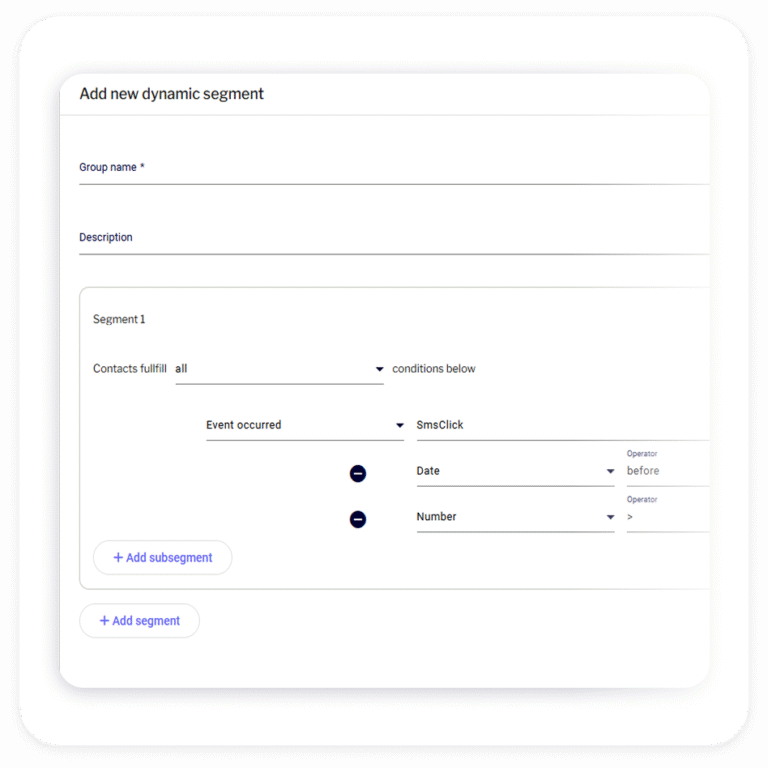
Customer segments are created using an intuitive, no-code wizard in the MessageFlow panel. The process involves naming the segment and defining logical conditions using “and” / “or” rules. This allows you to build advanced segments without technical knowledge or developer support.
A detailed, step-by-step guide with screenshots can be found in our technical documentation: Creating a new dynamic segment.
This is a key element of campaign planning. In the MessageFlow panel, when creating a campaign, after selecting a specific dynamic segment as the target audience, the system will automatically calculate and display the current number of recipients who meet its criteria. This allows you to verify the correctness of the rules and estimate the campaign’s reach just before launching it.
Yes. Dynamic segments are available across all communication channels currently available in the panel, including email, SMS, and mobile push. This ensures you can deliver consistent, personalised experiences to your audience, regardless of their preferred channel.
Defined dynamic segments are available exclusively as recipient groups for campaigns (email, SMS, and push) created and sent from the MessageFlow panel. It is not possible to retrieve the list of contacts belonging to a dynamic segment via the API for use in external systems.
Yes, the MessageFlow Segments service comes with an additional fee. To use it, you must have at least the Advanced pricing plan.
The pricing for the service itself consists of two parts:
- a fixed monthly subscription fee of 450 €,
- a variable fee that depends on the number of events in the database (e.g., Custom Events sent via the API), which is billed in a CPM model.
Please note that the quoted price does not include the implementation of the website activity tracking module.
For details and a full quote tailored to your needs, please contact our support team.
Real-time customer segmentation works by continuously evaluating contact data against active rules and conditions. When a campaign is sent, MessageFlow automatically builds the recipient list based on the most current data from multiple sources, such as website activity, campaign engagement, or system events. This allows marketers to react instantly to customer behavior and deliver timely, relevant communication.
Customer segmentation improves marketing campaign performance by ensuring messages are sent only to audiences that meet specific criteria at a given moment. By combining real-time data with automation, segmentation reduces wasted impressions, increases relevance, and leads to higher engagement and conversion rates across email, SMS, and push campaigns.
The most common customer segmentation criteria include demographic data (age, location), behavioral data (website visits, engagement), transactional data (purchase history, order value), and lifecycle status (new subscriber, inactive user, VIP customer). Combining these criteria enables more accurate and actionable segmentation.
Marketing campaigns that benefit most from real-time segmentation include onboarding campaigns, abandoned cart recovery, reactivation campaigns, cross-selling and upselling, location-based promotions, and time-sensitive offers. Real-time segmentation ensures these campaigns react instantly to customer behavior.
The effectiveness of customer segmentation can be measured by tracking key performance indicators such as open rates, click-through rates, conversion rates, and revenue per campaign. Comparing segmented campaigns against non-segmented ones also helps assess the impact of segmentation on overall marketing performance.

Haven’t found the answer to your question?
If you have any other questions on your mind or would like to figure out which plan best suits your needs, just contact us!