Being present on multiple channels isn’t a strategy. Making them work together is. That’s where omnichannel communication comes in, and where OTT messaging apps like Viber, WhatsApp, and Telegram play an increasingly important role.
OTT messaging channels don’t deliver value simply because they’re popular. Their strength lies in how intentionally they’re integrated into a broader communication ecosystem powered by shared data and customer context.
In this article, we’ll show you:
- How OTT messaging complements SMS, email, push notifications, and RCS;
- When OTT is the right choice, and when it isn’t;
- How to design a consistent, high-performing omnichannel strategy,
When done right, your communication becomes more engaging, more relevant, and fully aligned with customer expectations.
Key takeaways:
- Omnichannel messaging is about synergy, not channel volume. More channels don’t automatically mean better results. True omnichannel communication connects SMS, email, push notifications, RCS, and OTT messaging platforms like Viber into one unified ecosystem, powered by shared data and real-time customer context.
- OTT messaging drives engagement, while SMS ensures reach. OTT channels like Viber are ideal when you want interactive, conversational communication. However, when urgency is critical or internet connection is uncertain, SMS remains unmatched in reliability and reach.
- RCS bridges the gap between SMS and OTT messaging. It brings rich features into the device’s native messaging app – no additional downloads required. It allows brands to enhance visual communication, strengthen brand identity, and deliver interactive experiences.
- Fallback mechanisms maximize effectiveness. The most effective omnichannel strategies use automatic fallback logic, e.g. OTT messaging as the primary channel, and SMS as a backup (for guaranteed delivery if the recipient is inactive or offline).
- A unified platform is the foundation. Omnichannel success requires consistent messaging across channels, shared customer data, coordinated campaign management, and automated fallback logic. With MessageFlow, businesses can manage both marketing and transactional communication across SMS, OTT, RCS, email, and more. All from one intuitive platform or through a single, flexible API.
What is omnichannel communication?
Today’s consumers move naturally between channels. They may begin with an email, continue the conversation in Viber or SMS, and complete their purchase on another device entirely. What they expect in return is simple: continuity. No repeated information. No disconnected touchpoints.
Omnichannel communication creates a connected experience across every brand touchpoint. Whether interactions happen via SMS, email, OTT messaging, RCS, mobile apps, websites, or in-store, the experience remains consistent and aligned.
This approach goes beyond simply being present in multiple channels. It focuses on cohesion – and that distinction becomes clear when compared to multichannel communication.
Multichannel vs. omnichannel messaging: key differences
| Aspect | Multichannel | Omnichannel |
|---|---|---|
| Data structure | Data silos – each channel operates independently | Single source of truth with a unified database |
| Message consistency | Different messages across different channels | Consistent messaging tailored to each channel |
| Customer context | No continuity of interaction history | Full interaction history accessible across all channels |
| Customer value | Customers must repeat information | Seamless transition between channels |
Research shows that 73% of customers switch devices during the purchasing process – yet their expectations remain unchanged. The experience should feel seamless, regardless of where it unfolds.
Companies with mature omnichannel strategies achieve 91% higher customer retention and up to 30% higher customer lifetime value compared to single-channel approaches.
The difference isn’t the number of channels used, but how well they’re orchestrated. Platforms like MessageFlow enable this coordination by unifying channels, data, and customer context.
All communication is built on shared data and unified customer insight. Preferences, interaction history, and behavioral signals shape every message – making communication intentional rather than fragmented.
The Role of OTT messaging apps in an omnichannel strategy
Just because OTT messaging apps are widely used doesn’t mean they automatically deserve a central role in your communication mix. What matters is how you use them.
Viber, WhatsApp, Telegram, Facebook Messenger – your customers already use them daily. The real question isn’t whether these channels matter. It’s whether you’re using them with intention.
What makes OTT messaging valuable for business?
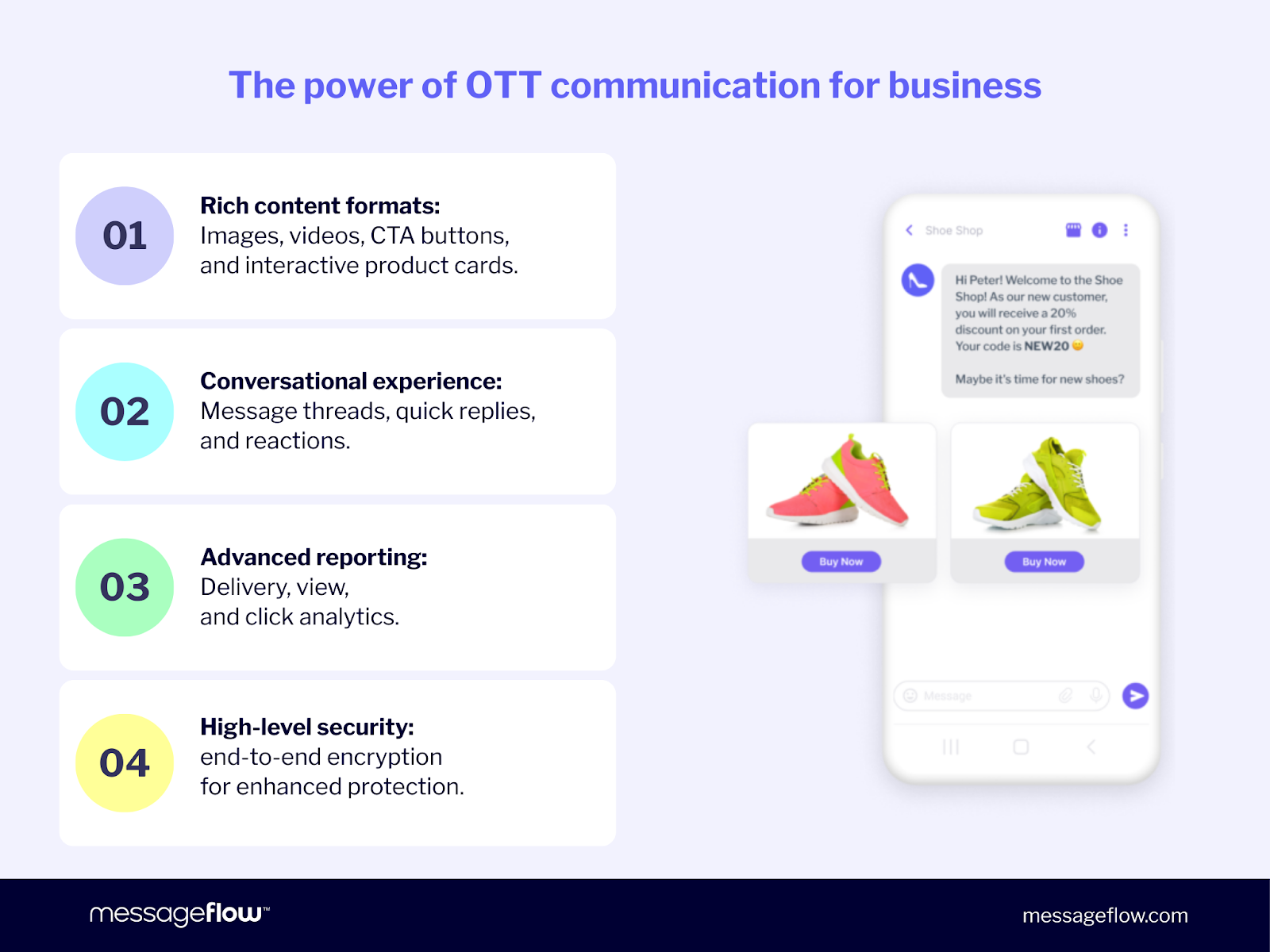
- Richer formats, clearer actions: Images, videos, carousels, CTA buttons, and product cards turn simple messages into interactive experiences. Customers don’t just read – they explore and act.
- Built-in conversation: Threaded chats, quick replies, and reactions make dialogue natural. Instead of broadcasting messages, brands can respond and engage in real time.
- Measurable engagement: Delivery, view, and click data provide clear insight into performance, making campaigns easier to evaluate and optimize.
- Stronger security: End-to-end encryption (available on platforms like Viber) enhances data protection and supports compliance requirements.
- Access to app-first audiences: OTT channels help brands reach customers who prefer messaging apps. In many markets, these environments remain less saturated, offering more room for meaningful engagement.
Where does OTT perform best in the customer journey?
Within an omnichannel strategy, OTT messaging performs best in moments that call for immediacy, interaction, and a format richer than standard text. It supports communication where responsiveness matters and engagement adds value.
Its impact becomes especially clear across three key stages:
- Driving engagement: Content-led campaigns, product inspiration, video materials, and brand storytelling benefit from visually structured formats. OTT messaging allows brands to present ideas in a way that feels dynamic yet personal.
- Customer dialogue and support: Live chat with an agent or chatbot, handling inquiries, or delivering contextual notifications all require fluid, two-way communication. OTT platforms are designed for this type of exchange, making conversations feel natural and continuous.
- Retention and loyalty: Offer reminders, cross-sell and upsell campaigns, loyalty program updates, and post-purchase communication gain depth when interaction is possible. OTT messaging helps maintain presence without feeling intrusive.
OTT messaging compared to other channels
Effective brand communication starts with context. Sometimes a short, immediate message is all a customer needs. In other moments, they’re looking for reassurance, conversation, or inspiration.
Compared to traditional messaging formats, OTT stands out for its flexibility and conversational nature. It enables brands to go beyond simply delivering information. Products can be presented visually, actions can trigger real-time responses, and exchanges feel continuous rather than one-sided.
Let’s see how OTT messaging compares to other channels:
| Aspect | OTT | SMS | RCS | Push | |
|---|---|---|---|---|---|
| Communication Format | Rich content, multimedia, interactive elements | Short text | Rich formats, buttons, graphics | Longer text, visuals, downloadable assets | Short messages |
| Two-Way Communication | Yes – natural conversation | Limited (requires 2-way SMS setup) | Yes | Yes | No |
| User Response Speed | Very high | High | High | Low | High |
| Attention Level | Very high | High | High | Low | High but short-lived |
| Availability | Requires specific OTT app | Works on any phone | Device- and carrier-dependent | Universally accessible | Requires brand app |
| Open Rates | Very high | High | High | Low | High |
| Best Use Cases | Dialogue, engagement, customer support | Alerts, urgent information | Rich campaigns, CTAs, offer presentation | Promotions, informational content | Reminders, quick actions |
In the omnichannel messaging model recommended by MessageFlow, OTT is not positioned as a replacement for other channels. Instead, it functions as an equal component within a unified communication strategy.
It can be combined seamlessly with SMS, RCS, email, and push notifications within a single scenario, allowing brands to adapt the channel to the customer’s context, rather than forcing the customer to adapt to the channel.
OTT messaging vs. SMS vs. RCS: A practical decision-making framework
The very same message can drive outstanding results – or be completely ignored – depending on the channel you use.
That’s why channel selection in an omnichannel strategy should never be an afterthought. It needs to align with your business model, industry, audience profile, purchase journey length, and the communication consents stored in your database.
Below is a practical framework to help you decide between SMS, RCS, and OTT messaging. We focus on these three because they are conversational, phone-number-based channels designed for direct, immediate communication.
Five criteria for choosing the right channel
Unlike email (often read with delay) or mobile push notifications (which require a dedicated app), SMS, RCS, and OTT messages reach users directly within their native messaging environments. They share several advantages: immediacy, high visibility, fast response times, and strong conversational potential.
But this is where the similarities end.
Each channel comes with its own technological requirements, cost structure, level of interactivity, and audience reach. The decision should therefore be strategic, not incidental.
Before choosing between SMS, OTT services, and RCS, consider:
- Criticality and timing: Does the message need to reach the recipient within seconds, or is delivery within minutes – or even hours – acceptable?
- Content complexity: Is plain text enough, or do you need rich media elements such as images, buttons, or forms?
- Two-way communication: Do you expect a reply or an ongoing conversation with the user?
- Reach: Do you need universal device coverage, or are you targeting a specific audience segment?
- Database maturity: What communication consents do you have in place? How large is your reachable audience for each channel? Do your priority segments actively use the selected channel?
When to choose SMS over OTT messaging
SMS remains the most reliable channel when speed and guaranteed delivery are critical, regardless of internet access.
It is particularly effective for:
- Transactional communication: Login notifications, fraud alerts, and OTP codes. Up to 95–98% of SMS messages are opened within minutes of delivery.
- Urgent operational alerts: Same-day delivery updates, appointment changes, and reservation reminders.
- Offline scenarios: When you cannot risk delivery failure due to a lack of internet connection.
- Universal reach: When you need to reach every mobile phone, not just smartphones.
When RCS is the better choice than OTT messaging
RCS bridges the gap between SMS and OTT messaging apps. It enables richer, more engaging messages, including graphics, buttons, and interactive elements, while still operating via the phone number, without requiring users to install an additional app.
However, RCS availability depends on both device and mobile carrier support. It is widely available across Android smartphones. On iPhones, RCS support was introduced with iOS 18, but activation depends on carrier enablement, meaning availability may still vary by market.
RCS works particularly well when you want to:
- Present offers in an engaging format: Financing options, subscription plans, or travel packages – displayed using rich cards, visuals, and CTA buttons that simplify decision-making.
- Enable quick actions within the message: Such as confirming an agreement, checking directions on a map, completing a short form, or taking another action directly within the conversation.
- Primarily target Android users: RCS currently has its strongest adoption among Android devices, while iPhone support remains carrier-dependent.
If you would like to explore this topic further, see our article comparing RCS and OTT messaging apps, where we outline their similarities and key differences in more detail.
When to Use OTT messaging in an omnichannel strategy
The choice between SMS and RCS often comes down to format and interactivity. SMS is simple and universal, ideal for short, urgent notifications. RCS enhances communication with visual elements and CTAs, making it better suited for online sales support and more engaging customer interactions.
OTT messaging goes a step further. It is not just a delivery channel, but a fully developed conversational environment. It offers advanced rich media capabilities, real-time dialogue, chatbot integrations, and automation.
Choose OTT when:
- You prioritize conversational communication: For quizzes, surveys, lead qualification, or collecting customer preference data.
- You want to automate customer service: For example, by implementing AI-powered chatbots.
- You are planning a visually driven campaign: Designed to guide users step by step and increase online sales.
- You operate in markets with high OTT adoption: For example, in Central and Eastern Europe (Ukraine, Bulgaria, Serbia), where Viber is part of daily communication and can serve as an effective, and often more cost-efficient, alternative to SMS.
OTT messaging in business
OTT messaging has become a fully established and reliable way to communicate with customers. It’s no longer just a marketing add-on – it’s an essential part of a modern omnichannel strategy, supporting everything from promotions and transactional updates to post-purchase communication.
When to use OTT messaging in marketing
In marketing, OTT messaging performs best where message differentiation and conversion optimization are key. It is particularly effective in industries where purchasing decisions are made quickly and product presentation significantly impacts campaign performance—such as e-commerce, retail, and digital services.
Rich formats allow brands to present offers directly within the message itself, reducing the number of steps required for users to complete a purchase.
Examples of OTT use cases in promotional campaigns
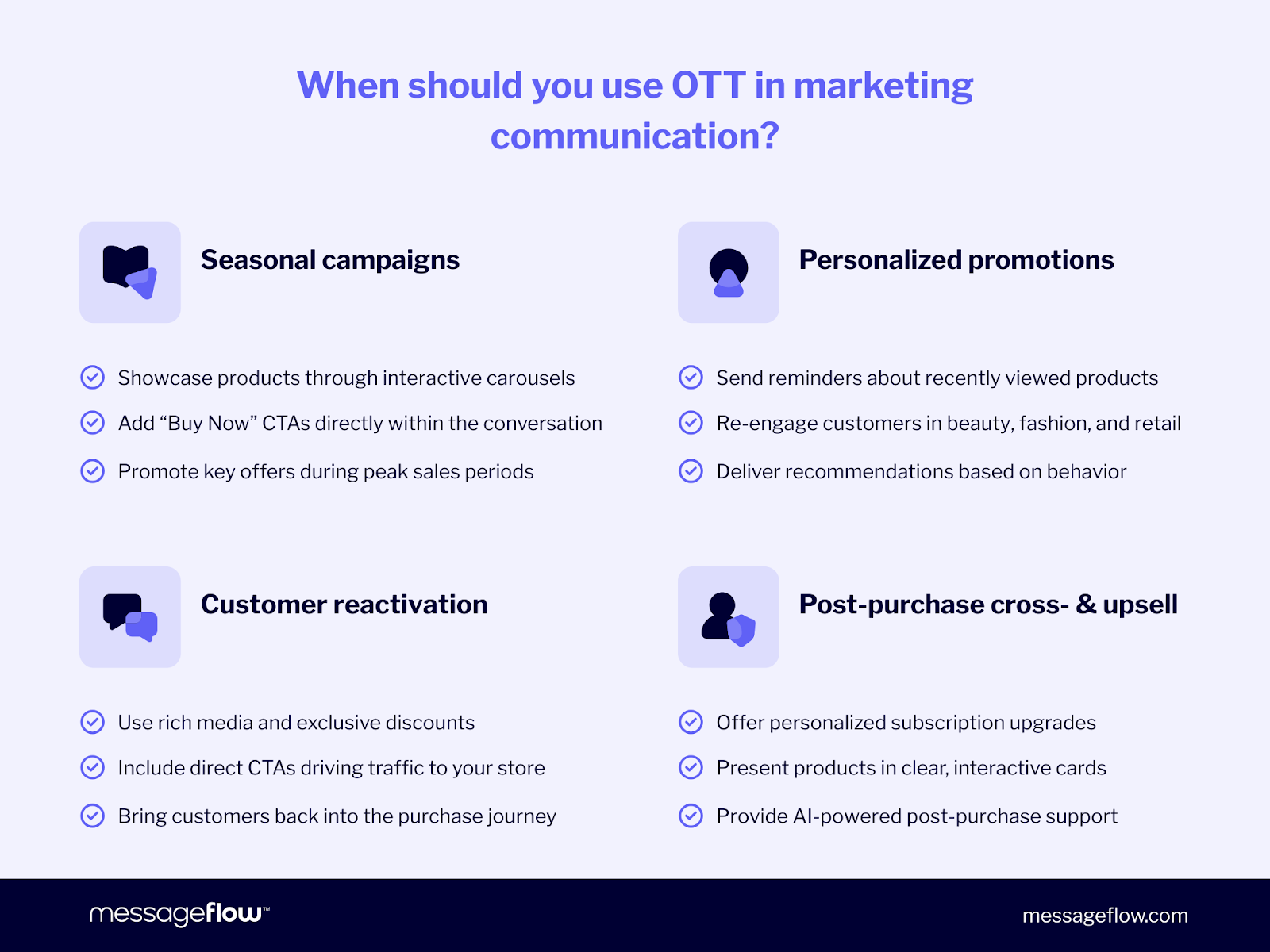
Seasonal campaigns: Peak periods such as Black Week, Cyber Monday, holidays, or back-to-school drive intense competition. OTT allows brands to remain competitive by showcasing products through interactive carousels, high-quality visuals, and embedded “Buy Now” buttons, turning a message into a mini storefront.
Personalized promotions: Instead of sending a generic discount, brands can display curated product selections, particularly effective in fashion, beauty, and consumer electronics, where inspiration drives conversion.
Reactivating inactive customers: Rich messages with compelling visuals, limited-time incentives, and direct purchase buttons can reignite interest and guide users back into the buying journey in a single interaction.
Post-purchase cross-sell and upsell: Subscription upgrades, complementary products, or premium add-ons can be presented through clean product cards that make the next step obvious and immediate, shortening the path from recommendation to decision.
Event invitations and communication: Webinars, product launches, store openings, and exclusive drops can be promoted with built-in RSVP options. Instead of redirecting users to external forms, attendance can be confirmed directly within the chat.
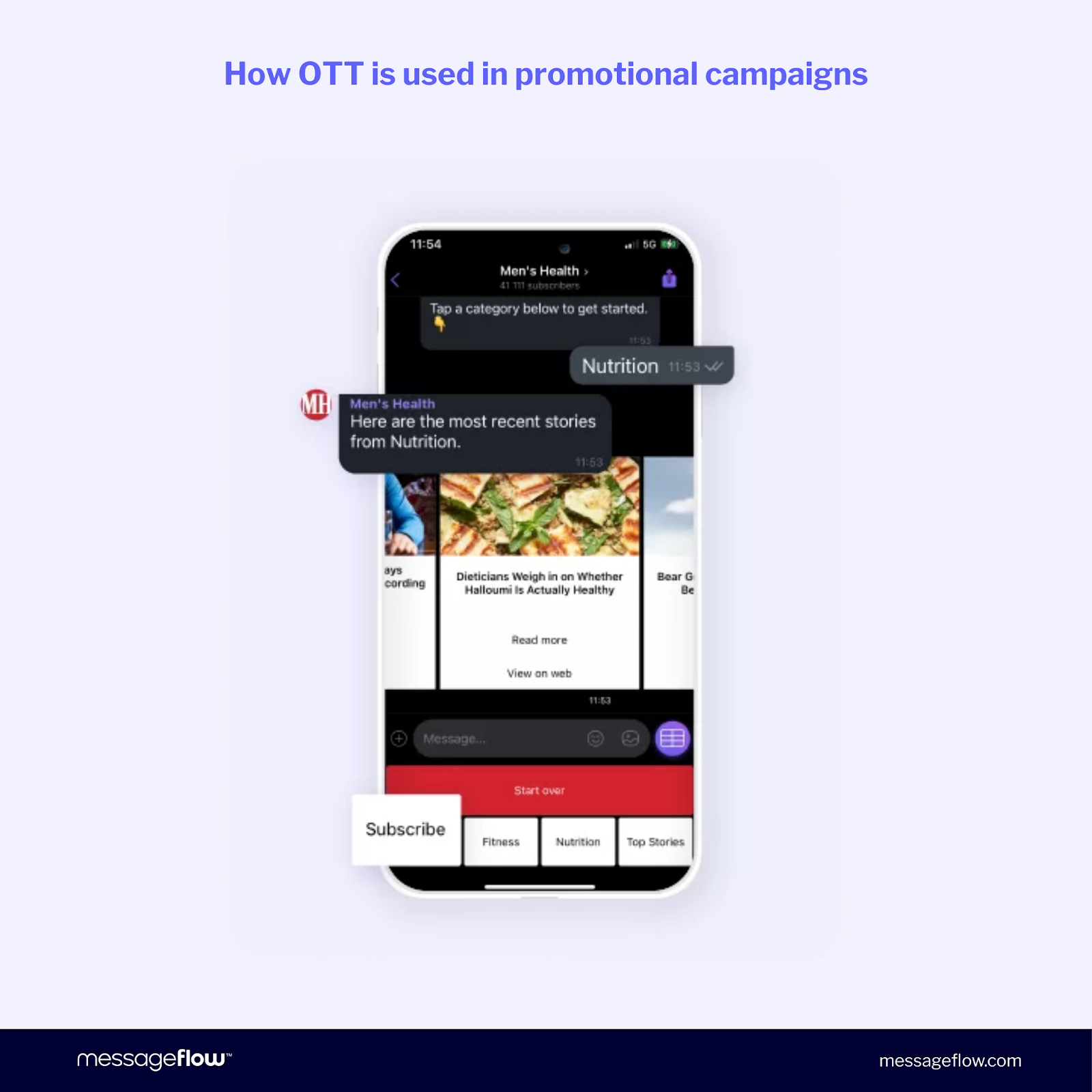
Market data highlights the performance advantage of interactivity. OTT campaigns that include rich, clickable elements can generate up to 40% higher click-through rates compared to SMS.
For example, fashion brands using messenger carousels to recover abandoned carts report recovery rates of up to 18%, while comparable SMS campaigns average closer to 5%.
Industries that most frequently capitalize on OTT’s promotional strengths include fashion and footwear, consumer electronics, digital subscriptions (VOD, SaaS), and fintech – sectors where speed, presentation, and ease of action directly influence revenue.
When to use OTT for transactional and post-purchase communication
OTT messaging apps are not limited to promotional campaigns. In transactional and post-purchase communication, it can meaningfully elevate the customer experience – especially when clarity, context, and speed of action matter.
With OTT messaging apps, instead of sending a simple status update, brands can provide context and enable the next step within the same interaction, reducing friction and improving satisfaction.
Examples of OTT use cases in transactional and post-purchase communication
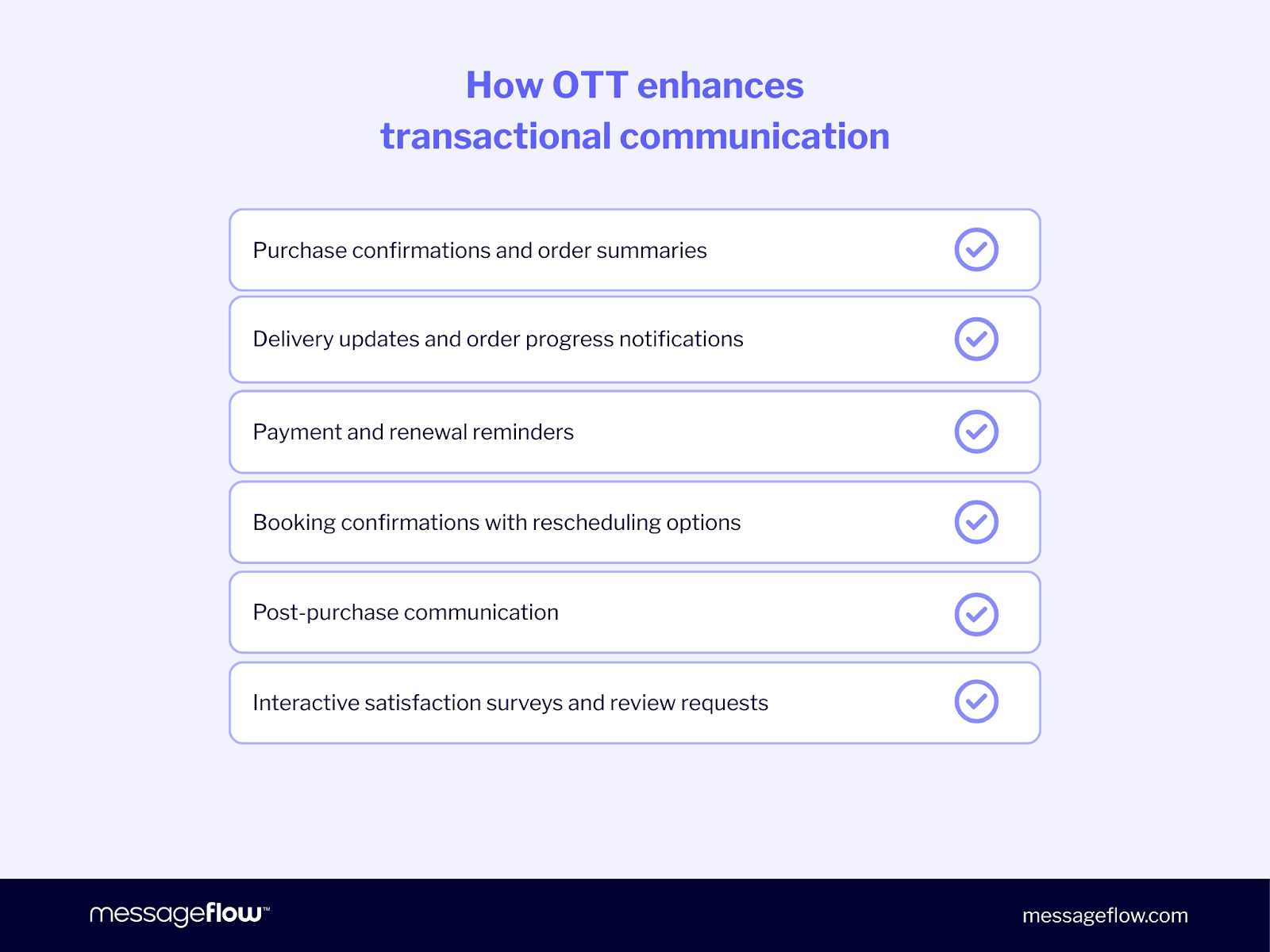
Purchase confirmations: Order summaries with product visuals and a button that lets customers track their shipment.
Delivery status updates: Notifications for key fulfillment milestones: picked, dispatched, handed to courier, delivered – combined with quick access to a map or additional information.
Payment and renewal reminders: Messages about expiring subscriptions or upcoming due dates, including a direct button to complete the payment.
Booking and appointment confirmations: Allowing customers to reschedule or contact support without having to make a phone call.
Post-purchase communication: Interactive satisfaction surveys and review requests that typically generate higher response rates than SMS links.
OTT vs. SMS in transactional and post-purchase messaging
The choice between OTT messaging apps and SMS should reflect the nature of the message and the level of interaction required.
SMS remains the preferred option for highly critical, time-sensitive communication such as OTP codes or short confirmations. Its simplicity and universal reach make it exceptionally reliable.
OTT apps become the stronger option when immediate action adds value, whether that means tracking a shipment, completing a payment, answering a survey, or rescheduling an appointment.
| Message type | SMS | OTT apps |
|---|---|---|
| OTP / verification codes | ✅ Best choice | Possible, but SMS is more reliable |
| One-line confirmations | ✅ Sufficient | Often unnecessary |
| Status updates with interaction | Limited to a link | ✅ Buttons, maps, FAQ |
| Review / feedback request | Lower response rate | ✅ Interactive survey |
How to build an omnichannel strategy with OTT apps in MessageFlow
A strong omnichannel strategy is not about adding more channels. Its real power lies in designing an ecosystem where each channel has a clearly defined role, and where data flows in a controlled, measurable way, ready to power automation and optimization.
With MessageFlow, you can build that ecosystem using SMS, email, RCS, mobile push, and OTT. Our current OTT channel is Viber – fully integrated through our API and managed within the same communication environment as other channels.
MessageFlow provides infrastructure (Viber Business API) that enables rich media messaging while giving you full visibility into delivery, engagement, and performance.
What Viber implementation looks like in MessageFlow
In MessageFlow, Viber operates within the same environment as SMS and email. Thanks to a unified request structure, you can design multichannel communication scenarios without maintaining separate integrations for each channel.
This translates into faster implementation, lower technical complexity, and full control over the end-to-end communication process.
Full visibility into what you send
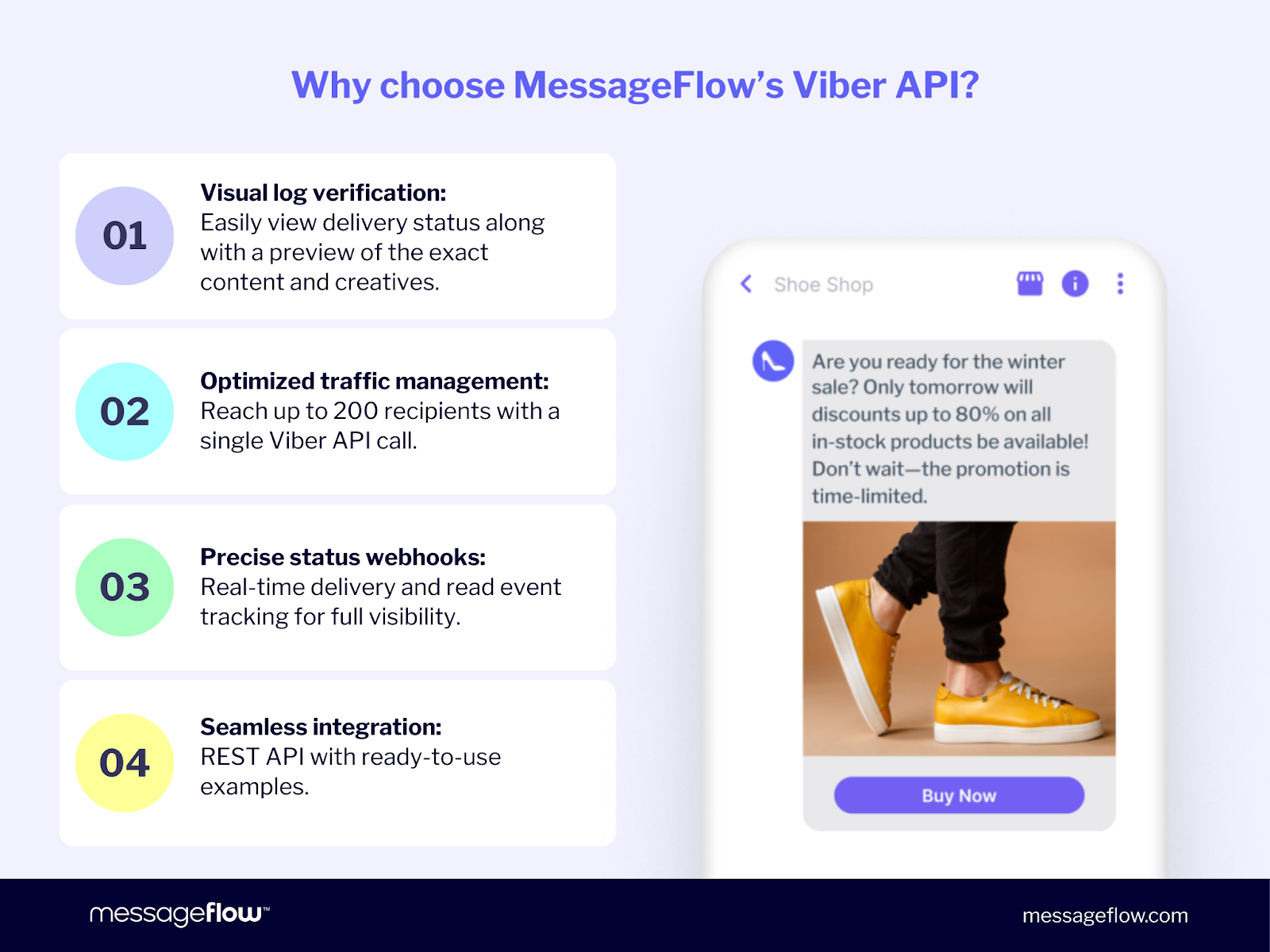
Visual Audit Logs fundamentally change how teams work with customer communication. You do not only see message status – you also see the exact creative and content that was delivered to the recipient.
For support teams, this means cases can be verified in seconds – without involving developers or querying databases. This level of transparency is often missing in fragmented messaging setups.
Real-time status updates
Our webhooks provide detailed, real-time signals – not only whether a message was delivered, but whether it was opened, including the exact timestamp.
This enables true behavior-based orchestration:
- No read within a defined time window → automatically send SMS
- Read → trigger the next step in the campaign
- Not delivered → switch channels instantly
Smart fallback and cost optimization
In many Central and Eastern European markets (such as Ukraine, Bulgaria, and Serbia), Viber is part of everyday communication. In these regions, OTT apps can serve as the primary channel. If delivery fails – the system can automatically fall back to SMS.
In practice, this allows you to use a richer, more engaging channel where possible, optimize messaging costs, and maintain full reach through SMS as a safety net.
Verified Sender (Blue Tick)
All Viber messages in MessageFlow are sent from an official, verified brand profile. The logo and Blue Tick increase trust and reduce phishing risk, especially critical in industries such as finance, logistics, and e-commerce.
Built for scale
MessageFlow enables sending Viber messages to up to 200 recipients within a single API request. At scale, high-performance batching reduces system load while maintaining throughput, making OTT viable not only for targeted campaigns, but also for high-volume transactional communication.
When to add OTT to your omnichannel strategy
A modern marketing strategy should not rely on a single channel. Customers move fluidly between online stores, physical locations, apps, and social platforms. Brand communication needs to reflect that reality, adapting to context rather than forcing customers into one fixed path.
OTT messengers become a natural addition when you need more than simple delivery.
If your goal is for the customer to click, reply, return to their cart, confirm an appointment, or complete a payment, interactive formats and conversational flows make a measurable difference. Channels such as Viber, Telegram, Facebook Messenger, or WhatsApp transform a message from a notification into an action-driven interaction.
There is also a practical dimension: cost and reach. In markets where messenger adoption is high, OTT communication can be both more engaging and more cost-efficient than traditional SMS, particularly in international delivery scenarios. When customers already use these platforms daily, meeting them there is both logical and effective.
OTT delivers the best results as part of an integrated strategy
OTT apps perform best when it is not treated as a standalone experiment. In an omnichannel model, it should operate within one cohesive ecosystem, alongside SMS, RCS, and email, powered by shared data, unified reporting, and full visibility into customer interactions and purchase history.
In the MessageFlow approach, every channel has a defined role:
- SMS for critical messages and maximum delivery reliability
- RCS for rich communication in the native messaging app
- Email for detailed information, documents, and longer content
- OTT apps for interaction, engagement, conversational flows, and cost optimization
This prevents communication chaos. Customers do not receive the same message in three channels at once. Instead, they experience a coherent, logically designed journey.
A mature omnichannel strategy is not about activating every channel simultaneously. It is about orchestrating them intelligently, so each performs a specific function and contributes to a consistent, measurable customer experience.