
- Official Viber business account enables companies to communicate with users worldwide through two distinct types of Viber messages: transactional messages and promotional messages.
- Viber business messages are particularly strong in Central and Eastern Europe, including markets such as Poland, Ukraine, Serbia, and Bulgaria, where they play a key role in both marketing and customer service communication.
- Viber promotional messages are marketing-focused. They promote products, special offers, campaigns, or brand initiatives. Transactional messages, on the other hand, deliver service-related information directly connected to a user’s action, such as order confirmations, payment receipts, or delivery updates.
- Correct classification is critical. Mislabeling a promotional message as transactional can lead to GDPR violations and regulatory risk.
- To manage both types effectively, companies often rely on cross-channel communication platforms such as MessageFlow, which allow them to handle various message types in one place. These platforms also integrate Viber with SMS and email while ensuring consistent and compliant consent management across all channels.
What is the Viber app?
Before diving deeper into business messaging, it’s worth understanding the scale of the platform itself.
Viber is a free messaging app with a global coverage and over one billion registered users worldwide. Owned by Rakuten Viber, the platform is one of the major players in the OTT (over-the-top) messaging market. It enables users to send messages, make voice and video calls, and share rich media content quickly and securely.
In Central and Eastern Europe, Viber holds a particularly strong position. In countries such as Poland, Ukraine, Romania, Bulgaria, and Serbia, it is not just a personal messaging tool – it is also a powerful channel for business communication.
What are Viber Business Messages?
Viber Business Messages are the official, verified communication channel created specifically for companies. Unlike private accounts used on a personal level, business accounts are clearly marked and designed for professional customer communication.
When a company sends a message via Viber for Business, users immediately see the brand name, logo, and business description within the verified business profile. There’s no confusion about who the sender is. This transparency builds trust, strengthens brand recognition, and increases the likelihood that the message will be opened and read. Businesses can also set a custom sender name and sender ID, ensuring consistent branding across every interaction.
However, Viber Business Messages go far beyond simple text communication. They combine the reach of OTT messaging with advanced rich media capabilities and interactive features. Companies can:
- Send longer, more engaging messages enhanced with images, links, and clear call-to-action buttons,
- Use rich media formats such as product cards, interactive carousels, and other dynamic message types,
- Enable two-way communication to support real-time conversations and ongoing support,
- Track message statuses in real time (sent, delivered, seen) for full visibility and performance monitoring.
In practice, this means brands can support the entire customer journey – from first engagement to post-purchase communication – within a single channel. Through one verified business account, companies can send:
- Promotional messages, including special offers, product launches, and marketing campaigns designed to engage both new and loyal customers.
- Transactional messages, such as order confirmations, delivery information, important notifications, and detailed transaction information.
The result? One channel with two distinct purposes – driving marketing impact while ensuring operational reliability.
Definition and characteristics of promotional Viber messages
What makes Viber business messages promotional? It comes down to one thing: intent.
Promotional Viber messages are marketing communications designed to drive action. They are typically part of broader campaigns and aim to encourage customers to make a purchase, try a service, download an app, or re-engage with a brand.
Unlike transactional messages, which are triggered by a specific user action (such as placing an order or requesting a password reset), promotional messages are proactive. They initiate contact with the goal of generating interest, increasing engagement, and ultimately driving conversions and sales.
What do promotional Viber messages typically include?
Promotional Viber messages are built to attract attention and motivate action. Most contain one or more of the following elements:
- Sales-driven incentives, such as discounts, promo codes, seasonal campaigns, or limited-time offers,
- Persuasive language designed to encourage immediate action,
- A clear call to action (CTA) – for example, “Check the offer,” “Order now,” or “Claim your discount”,
- Direct links leading to a website, mobile app, landing page, or product catalog,
- Rich media formats, including images, interactive buttons, product cards, or Viber carousel messages that showcase multiple offers within a single message.
These components work together to guide Viber users toward a specific commercial objective.
Promotional Viber message examples across industries
The format and tone of promotional messages may vary depending on the industry and campaign goal. For example:
- E-commerce: “Weekend Sale – get an extra 15% off sports shoes. Offer valid until Sunday, May 12, 2026.”
- Retail: Announcement of a new spring–summer collection with a direct link to the online catalog.
- Fintech: Limited-time Viber offer for a new credit card featuring an attractive cashback program.
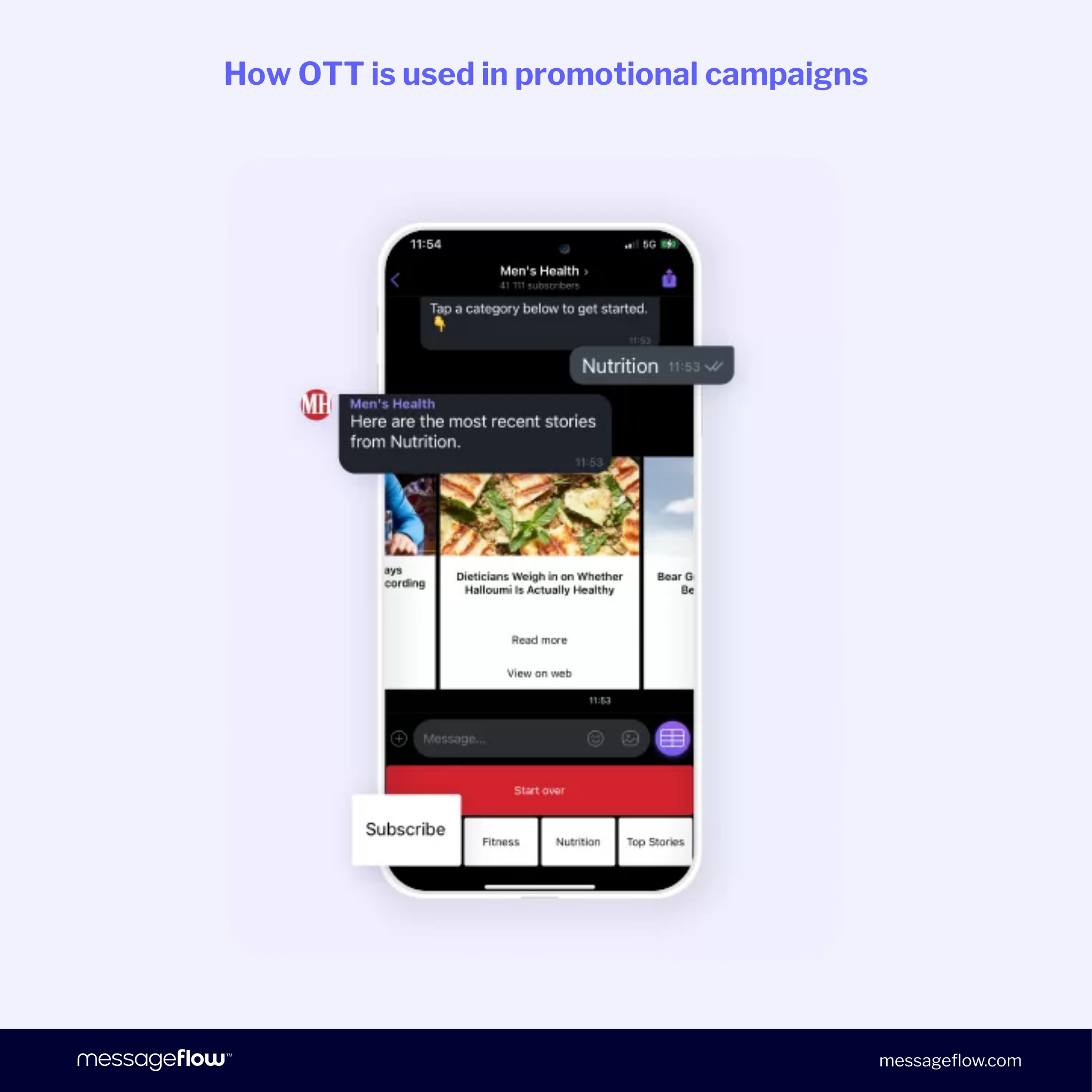
In practice, promotional messages are often sent in bulk, but not indiscriminately. They are typically targeted at carefully selected audience segments to drive sales, support customer retention, or encourage re-engagement. For example, campaigns may focus on customers who have been active within the last 90 days, users who abandoned their shopping carts, or members of a loyalty program.
This segmentation enables more personalized and relevant communication, which in turn improves engagement rates and overall campaign performance.
Compliance rules for sending promotional messages via Viber
Because these messages are commercial in nature, they are regulated in most markets worldwide. The exact requirements depend on where your audience is located, but one principle remains consistent: promotional messaging requires careful compliance planning.
Consent requirements in the EU and the UK
In the European Union and the UK, the rule is clear: you generally need prior explicit opt-in consent under GDPR and ePrivacy regulations. That means users must actively agree to receive marketing messages, and your company must be able to prove when and how that consent was collected. Every promotional message must also include a clear and easy way to opt out.
Regulatory standards in the United States
In the United States, the situation depends on how the message is sent. Under the TCPA, marketing messages sent to mobile numbers using automated systems typically require prior express written consent. Businesses must also clearly identify themselves and provide a straightforward opt-out mechanism. The stakes are high. Non-compliance can lead to significant financial penalties.
Canada and other regulated markets
In Canada, CASL requires express consent in most cases before sending commercial electronic messages. Businesses must clearly identify the sender and include a functional unsubscribe mechanism that can be used at any time.
Similarly, countries such as Australia (Spam Act), Singapore (PDPA), and many Latin American markets require either express or clearly documented consent, transparent sender identification, and a straightforward unsubscribe process.
Compliance is also about frequency
To protect user experience and maintain compliance, Viber recommends limiting promotional communication to approximately four to six messages per user per month. Maintaining reasonable frequency helps prevent messages from being marked as spam and supports long-term engagement.
Definition and characteristics of transactional Viber messages
Not every Viber message is meant to sell.
Transactional Viber messages are service-driven communications sent in direct connection with a specific user action, service request, or contractual relationship. Their purpose is straightforward but essential: to deliver operational information needed to complete a process, confirm an action, or ensure security.
Unlike promotional messages, transactional messages are not proactive marketing efforts. They are reactive by design. They are triggered by something the user does – or by a system event directly tied to the user’s activity.
Typical triggers include placing an order, completing a payment, logging into an account, a change in delivery status, ticket issuance, a password reset request, or the detection of suspicious activity.
Without that action or event, the message would not exist. That trigger-based logic is what fundamentally defines transactional communication.
What does transactional communication look like in Viber Business?
Viber Business accounts allow companies to send messages that include text, buttons, links, and multimedia elements. However, in transactional messaging, format is secondary. Purpose always comes first.
A transactional Viber message should clearly relate to a specific user action and provide precise, relevant information. The tone should remain neutral and factual, avoiding any persuasive or sales-oriented language.
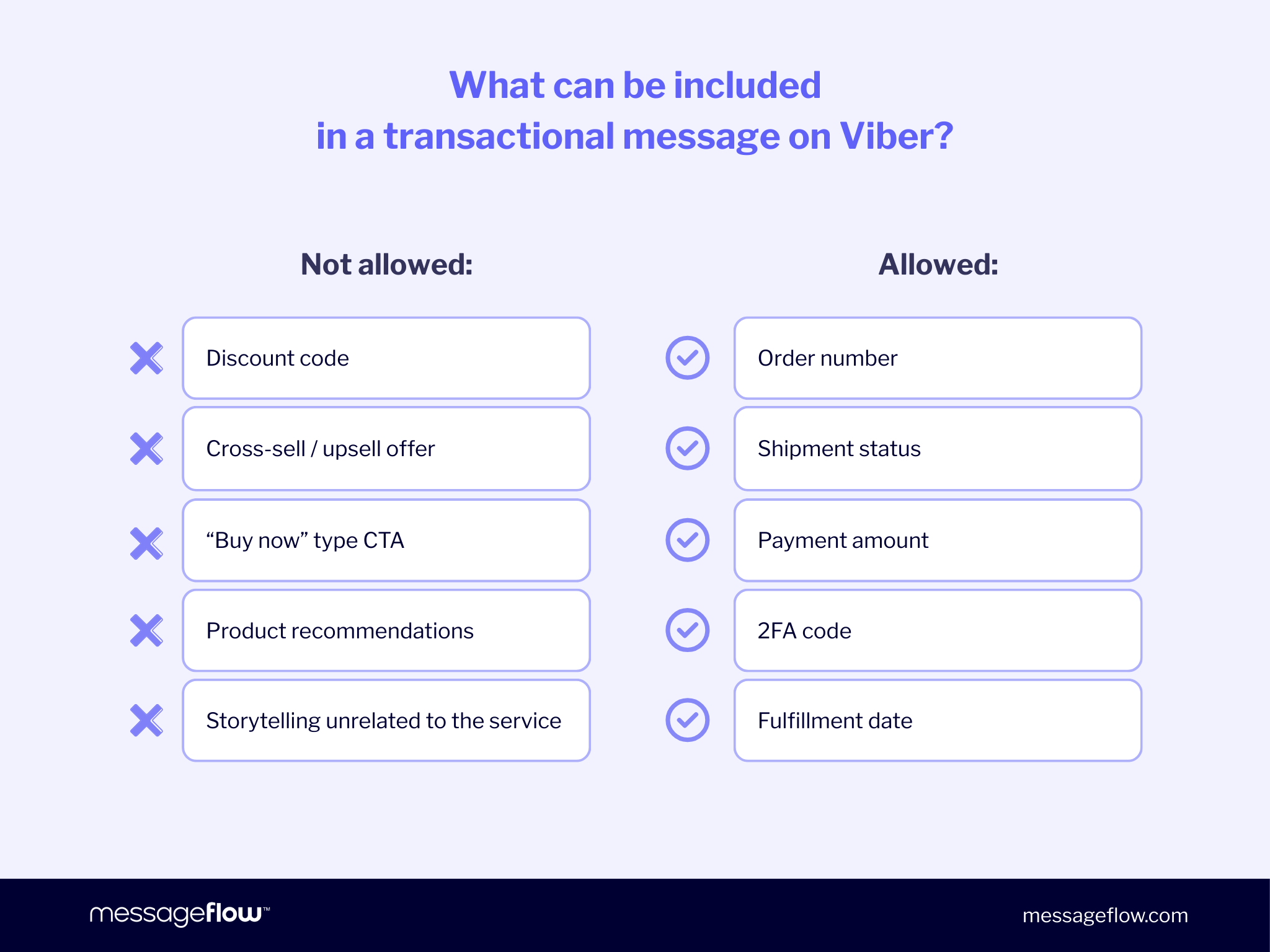
These messages typically contain operational details such as order numbers, transaction amounts, delivery dates, or authorization codes. If the recipient needs to take action, for example, to confirm a login attempt, the instruction should be clear and unambiguous.
Although Viber supports rich and visually engaging formats, transactional messages must not cross into promotional territory. They should not include discounts, promo codes, product recommendations, or incentives for additional purchases.
Even excessive branding or unrelated visual elements can blur the line and weaken the operational character of the message. For this reason, transactional communication is often kept simple: clear, concise, and strictly service-related.
Examples of transactional messages sent via Viber
What does a transactional message actually look like in practice? Here are a few typical examples:
- Logistics: “Your parcel no. 123456 has been dispatched. Estimated delivery: March 20, 2026.”
- Fintech: “We have received your payment of PLN 259.00. Current balance: PLN 1,240.50.”
- Digital services: “Your login code: 483921. The code is valid for 5 minutes.”
Each of these messages is sent as a direct result of a user’s action. They provide specific, operational information and contain no promotional or sales elements.
Legal basis for sending transactional messages via Viber
While promotional messaging relies on consent, transactional communication is typically justified by the need to deliver a service or fulfill a contract.
In other words, the message exists because the service exists.
European Union and UK
Under the GDPR, transactional messages are generally lawful when personal data is processed on one of two legal bases.
The first is Article 6(1)(b) – processing necessary for the performance of a contract. This applies to messages such as order confirmations, delivery updates, payment notifications, or ticket issuance. If the message is required to fulfill what the customer has requested or purchased, this legal basis is typically appropriate.
The second is Article 6(1)(f) – legitimate interests. This may apply to fraud prevention alerts, account security notifications, or other essential service communications. In such cases, the organization must ensure that its legitimate interest is not overridden by the user’s rights and freedoms.
If the message is strictly operational and directly related to an existing customer relationship, separate marketing consent is not required.
United States
In the U.S., transactional or relationship messages are generally permitted under the TCPA, provided they are directly connected to an existing transaction or account and contain only informational content.
Canada
Under CASL, messages that facilitate or confirm a completed transaction, such as receipts, warranty information, or account notifications, are typically exempt from consent requirements.
Australia and Other Markets
Similarly, under Australia’s Spam Act and comparable regulations in APAC and Latin America, factual, service-related messages connected to an existing relationship are generally permitted without prior marketing consent.
Across regions, the key principle remains consistent: If a Viber message is strictly operational and necessary for delivering a service, it can typically be sent on a contractual or legitimate interest basis, without requiring separate marketing opt-in.
Promotional vs. transactional messages in the Viber app
In Viber communication, the difference between promotional and transactional messages isn’t just a technical detail. It’s the foundation your entire messaging strategy rests on.
Get it right, and your communication stays clear, effective, and compliant. Blur the line, and you risk confusing users – or regulators.
Let’s break it down in a practical, no-nonsense way.
Side-by-side comparison
The distinction between promotional and transactional Viber messages can be understood across four core dimensions: purpose, content, timing, and legal basis. When these elements are aligned, your communication works exactly as it should.
| Aspect | Promotional Viber messages | Transactional Viber messages |
|---|---|---|
| Purpose | Sales, brand awareness, lead generation | Providing operational information related to a service |
| Content | Personalized offers, discounts, CTAs, persuasive language | Neutral communication, facts, status updates, verification codes |
| Examples | Black Friday 2026 campaign, abandoned cart reminder, loyalty offer | Order confirmation, 2FA code, shipment notification |
| Timing | Scheduled (campaign calendar, seasonal timing) | Reactive (triggered by user action) |
| Legal basis | Marketing consent (explicit opt-in) | Performance of a contract / legitimate interest |
| Consent required | Prior consent required; documentation maintained for audit | No marketing consent required for purely transactional content |
| Sales element | Core element of the message | Not permitted without changing classification |
Promotional messages aim to influence behavior – to sell, engage, and drive action. Transactional messages support an action that has already taken place. They confirm, inform, and protect.
The tone reflects this. Promotional messages use persuasive language and clear calls to action. Transactional messages are neutral, precise, and strictly service-related.
The sending logic matters just as much. Promotional campaigns are planned and require prior consent in most regulated markets. Transactional messages are reactive, triggered automatically by user activity, and typically rely on contract performance or legitimate interest.
From a user experience perspective, the difference is simple. Promotional messages aim to attract and convert. Transactional messages must deliver clarity and reliability. Understanding – and respecting – this boundary is essential not only for compliance, but for maintaining user trust.
Easily manage transactional and promotional communication in Viber with MessageFlow
Managing different message types shouldn’t mean managing different systems.
MessageFlow is a flexible API and intuitive platform built for multichannel customer communication. From one environment, you can manage SMS, email, push notifications, and Viber, fully integrated with your CRM, e-commerce platform, and backend systems. This makes it easy to automate both marketing and transactional communication based on real-time data and user behavior.
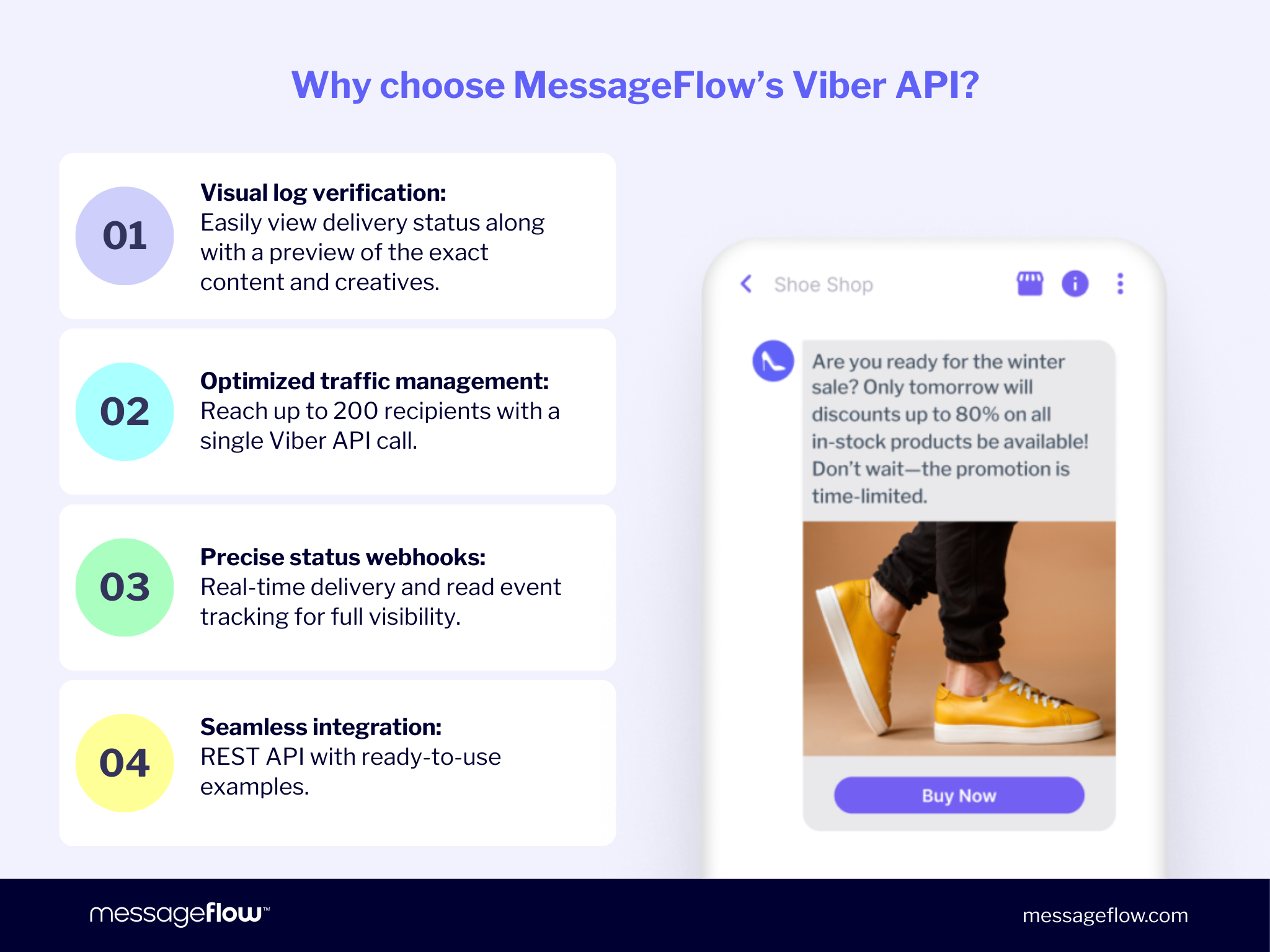
When it comes to transactional messaging, the MessageFlow Viber API enables instant delivery triggered by system events. Status webhooks, precise timestamps, and SMS fallback mechanisms ensure continuity and reliability, especially critical in industries such as finance, logistics, and e-commerce, where timing and accuracy matter.
For marketing campaigns, the platform supports bulk rich media messaging, advanced audience segmentation, and performance monitoring. Unsubscribe events are updated in real time, helping you maintain GDPR compliance without manual processes. As a result, Viber Business becomes a secure, scalable channel for both revenue-driven and operational communication.
Viber Business Messages in MessageFlow’s multichannel communication strategy
Viber rarely works in isolation.
In practice, it forms part of a broader omnichannel strategy alongside email, SMS, and both transactional and promotional push notifications. The right channel is selected based on the message type, the customer journey stage, and user preferences.
With MessageFlow, you can combine Viber with other channels within a single, unified communication strategy – without building separate integrations or juggling multiple tools. All campaigns, events, and delivery statuses are available in one dashboard, simplifying reporting and enabling faster reactions to customer behavior.
The result? A consistent, personalized ecosystem that supports both customer experience and business growth – from one centralized system.
FAQ – Frequently Asked Questions about Rakuten Viber Messages
Choosing between Viber and SMS depends on your communication goals, audience, and market.
The Viber app, owned by Rakuten Viber, is a globally used messaging app with strong adoption in Central and Eastern Europe. It offers rich content capabilities that go far beyond plain text. With an official Viber Business Account, companies can send Viber promotional and transactional messages using images, interactive buttons, carousel cards, and Viber list messages, all within a single message.
SMS remains valuable when guaranteed reach is critical, especially for users without the Viber app. That’s why many businesses combine both channels. With MessageFlow, you can integrate Viber and SMS in one scenario- first sending Viber messages, then triggering SMS if needed. This ensures global coverage and reliable delivery of important notifications.
Promotional messages are designed to drive sales, increase engagement, and support marketing campaigns. They often include personalized offers, discounts, call to action buttons, and rich media formats such as Viber carousel messages or list messages.
Transactional Viber messages are service-related. They confirm actions, provide transaction details, send order confirmations, share delivery information, or protect an account. They are operational, not sales-driven.
An official Viber Business Account allows a company to communicate professionally with Viber users through a verified business profile.
This profile displays the company name, logo, and business description, along with a unique company sender ID (sender ID). This strengthens brand recognition and makes it clear that users are interacting with a legitimate business account.
With Viber for Business, companies can send various message types, including promotional campaigns, delivery updates, appointment reminders, and customer care notifications. The platform also enables two-way communication, allowing customers to reply, ask questions, and receive real-time support.
Yes. A user may choose to receive only transactional messages, such as order confirmations or account notifications, while declining promotional communication.
Your system should allow these preferences to be managed separately. This ensures compliance and allows you to send important notifications without sending marketing content to users who have opted out.
Viber works best as part of a broader communication ecosystem.
With MessageFlow, you can integrate Viber alongside SMS, email, and other channels within a single system. This allows you to design end-to-end communication flows across the entire customer journey, from onboarding and promotional campaigns to post-purchase support and customer care.
Instead of duplicating messages across channels, you can define the role of each one. For example, email may provide detailed content, Viber may deliver rich media with interactive buttons, and SMS may act as a fallback for critical notifications.
All delivery statuses and responses are visible in one dashboard, helping you measure success, optimize campaigns, and manage communication more efficiently.
Viber promotional messages help brands connect with customers on a more personal level.
Through rich content formats, branded stickers, carousel cards, and call to action buttons, businesses can create engaging experiences that increase engagement and build loyalty among customers, including loyal customers who interact frequently.
Because messages appear directly in the chat list of the Viber app, visibility is high. Combined with segmentation and personalized messaging, this makes Viber a powerful channel to drive sales while staying within your marketing budget.