Yes, iPhone supports RCS (via Apple’s Messages app) on iOS 18 and later, but availability depends on your carrier and country.
Android ↔ iPhone read receipts and typing indicators can work with RCS, but feature availability varies by carrier implementation and conversation setup.
If RCS isn’t available, your message will typically fall back to SMS/MMS.
Introduction
Cross-platform texting has been messy for years: great features on iMessage for iPhone-to-iPhone, and a different standard on Android. Apple’s decision to support RCS (Rich Communication Services) changes that baseline by enabling richer messaging between iPhone and Android–including better media sharing, improved group chats, and (in many cases) typing indicators and read receipts.
This guide explains what Apple’s RCS support means in 2025 and beyond, what you can realistically expect today, and how brands should think about RCS for Business as carrier coverage expands.
💡 The global mobile network has relayed approximately 1,500,000,000,000 (that’s 1.5 trillion) RCS messages in 2024, including both P2P and A2P communication. By 2029 this number is expected to quadruple to 6 trillion.
Why Apple’s RCS support matters
Apple supporting RCS matters for two practical reasons:
Better iPhone ↔ Android messaging experience RCS improves cross-platform conversations with richer media and modern chat behaviors that SMS/MMS simply can’t match.
A more unified channel for brands (A2P) As carriers enable business-grade RCS, brands can design interactive mobile messaging experiences that work across iOS and Android–without splitting strategy by operating system. If you’re exploring customer communication flows beyond basic SMS, it’s worth comparing with a programmable approach like SMS automation flows.
A lot of people search for “android iphone receipt sharing 2025” but the intent is usually read receipt sharing (read receipts) between Android and iPhone.
Here’s the reality:
Read receipts can work in Android ↔ iPhone chats when the conversation uses RCS and both sides have the relevant settings enabled.
Not every carrier supports every RCS capability equally, and some features can vary by region, operator provisioning, and device settings.
If the chat falls back to SMS/MMS, read receipts won’t behave like modern chat apps, because SMS/MMS doesn’t support them the same way.
If your goal is to understand what’s secure, what’s encrypted, and what is not, use this dedicated breakdown of RCS security and encryption.
Apple RCS support comes with iOS 18 (and grows with carrier support)
Apple introduced RCS support in the iOS 18 cycle. That’s the milestone that made richer iPhone ↔ Android messaging possible in Apple’s default Messages app.
However, RCS on iPhone is carrier-dependent. That means:
Some users will see RCS toggles and features immediately, others later as carrier provisioning rolls out.
Two people on iOS 18 can have different RCS experiences depending on carrier and country.
iOS and Android are coming together to facilitate rich, cross-platform messaging.
Is RCS messaging available on all iPhones?
RCS availability depends on two things:
Device / iOS version RCS requires iOS 18 or later on supported iPhone models.
Carrier support Even with the right iPhone and iOS version, your carrier must support RCS on iPhone in your market.
How to enable RCS on iPhone (and how to check if it’s active)
If your carrier supports it, you can typically enable it here:
Settings → Apps → Messages → RCS Messaging
If you don’t see the option, it often means your carrier hasn’t enabled RCS on the iPhone in your region yet–or your plan/SIM setup isn’t provisioned for it.
iMessage vs RCS – what changes for iPhone users?
Apple’s RCS support does not replace iMessage.
iMessage still powers Apple-to-Apple conversations (blue bubble behavior).
RCS improves iPhone-to-Android and cross-platform messaging where available.
For everyday users, RCS helps modernize “green bubble” conversations–especially around media quality and group chat experience.nce.
💡 Instead, RCS complements iMessage by creating a more feature-rich experience when communicating with Android users or businesses. Now, when you see a green bubble, it means you’ve received an RCS rather than a basic SMS.
iMessage vs. RCS: How they compare
Feature
iMessage (Apple-to-Apple)
RCS (iOS & Android)
Typing indicators
✅ Yes
✅ Yes
Read receipts
✅ Yes
✅ Yes
High-resolution media
✅ Yes
✅ Yes
Group chats with full features
✅ Yes
✅ Yes
Reactions (tapbacks, emoji responses)
✅ Yes
✅ Yes
Works over Wi-Fi & mobile data
✅ Yes
✅ Yes
End-to-end encryption
✅ Yes
🚫 Limited (Google Messages offers it, but not universally supported in RBM)
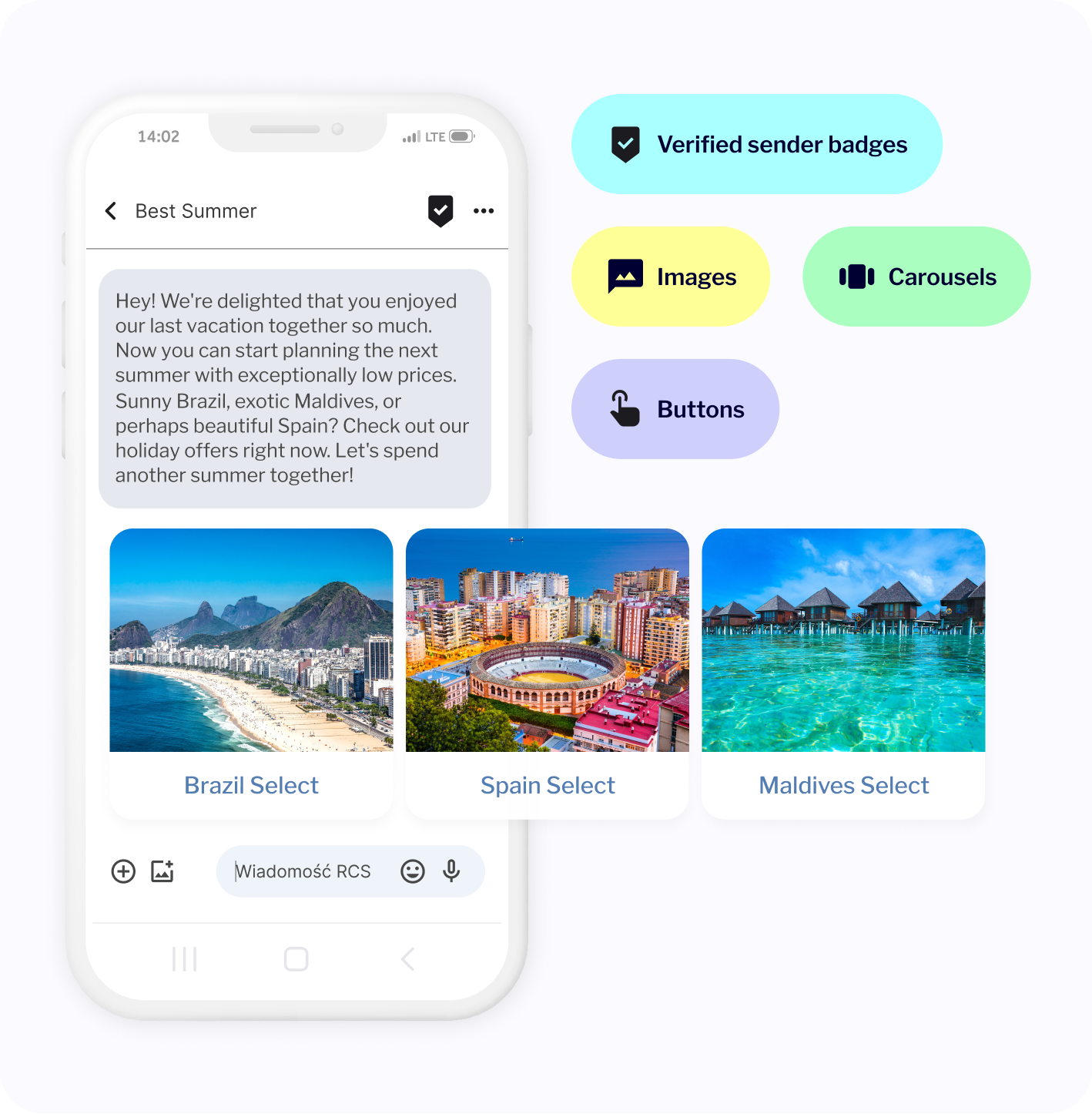
Additionally, RCS communication offers interactive features such as appointment scheduling, customer surveys, and direct purchase options, all within the messaging app.
With Apple RCS adoption, you gain a unified way to reach both iOS and Android users with modern, feature-rich messaging, bridging a long-standing gap in cross-platform communication.
Is it safe to use RCS on your iPhone?
Communication security is one of the foundational features of RCS. End-to-end encryption is provided for exchanges between the Google Messages app users and iMessage users, however, it isn’t there just yet for cross-platform messaging.
Text chats bridging the system gap are protected using TLS (Transport Layer Security) for now, which is a cryptographic protocol widely used for instant messaging, for example. Plans are in place, however, to introduce E2E for all communication between Android and Apple users eventually.
What we know about Apple RBM support (A2P messaging)
Apple enabling iOS-level support is one thing; RBM scale depends on operator readiness. Not every carrier supports business-grade RCS features on iPhone at the same pace.
Practical takeaway for brands:
measure outcomes and scale gradually
treat iOS RBM reach as market- and carrier-dependent
start with pilot campaigns in the regions where coverage is strongest
💡 Importantly, however, although Apple has made the latest version of its operating system capable of handling the business-oriented RBM, its reach is somewhat limited still. Not every carrier supports RCS on iPhones just yet.
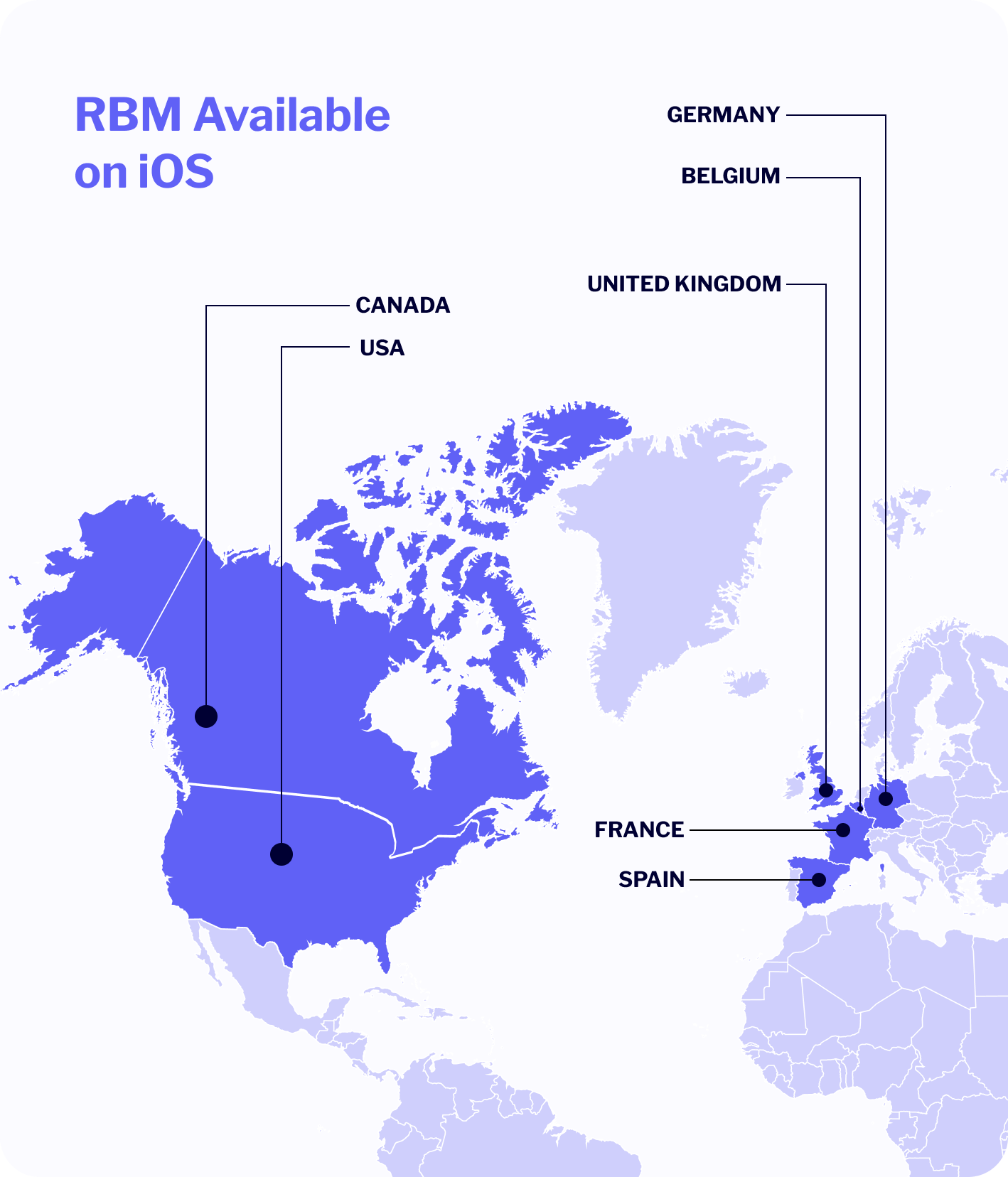
As of January 2026, you can run RBM campaigns targeting iOS-operating smartphones in the following countries:
Belgium
France
Germany
Spain
United Kingdom
Canada
United States
Japan
Where is RCS Business Messaging available?
As mobile network operators increasingly join the party, brands can already experiment with the business version of RCS, sending smaller, test campaigns to selected iPhone owners.
How would a business know the scale of legible users in their database?
Is it safe to use RCS on an iPhone?
RCS security depends on the standard and implementation details.
RCS conversations use modern transport security compared to SMS.
End-to-end encryption for cross-platform RCS has been a major industry focus, with standards evolving and platform support improving over time.
For a clear, non-marketing explanation of what’s protected and what isn’t, see our full guide to RCS security.
Capitalising on early-stage RBM adoption on iOS
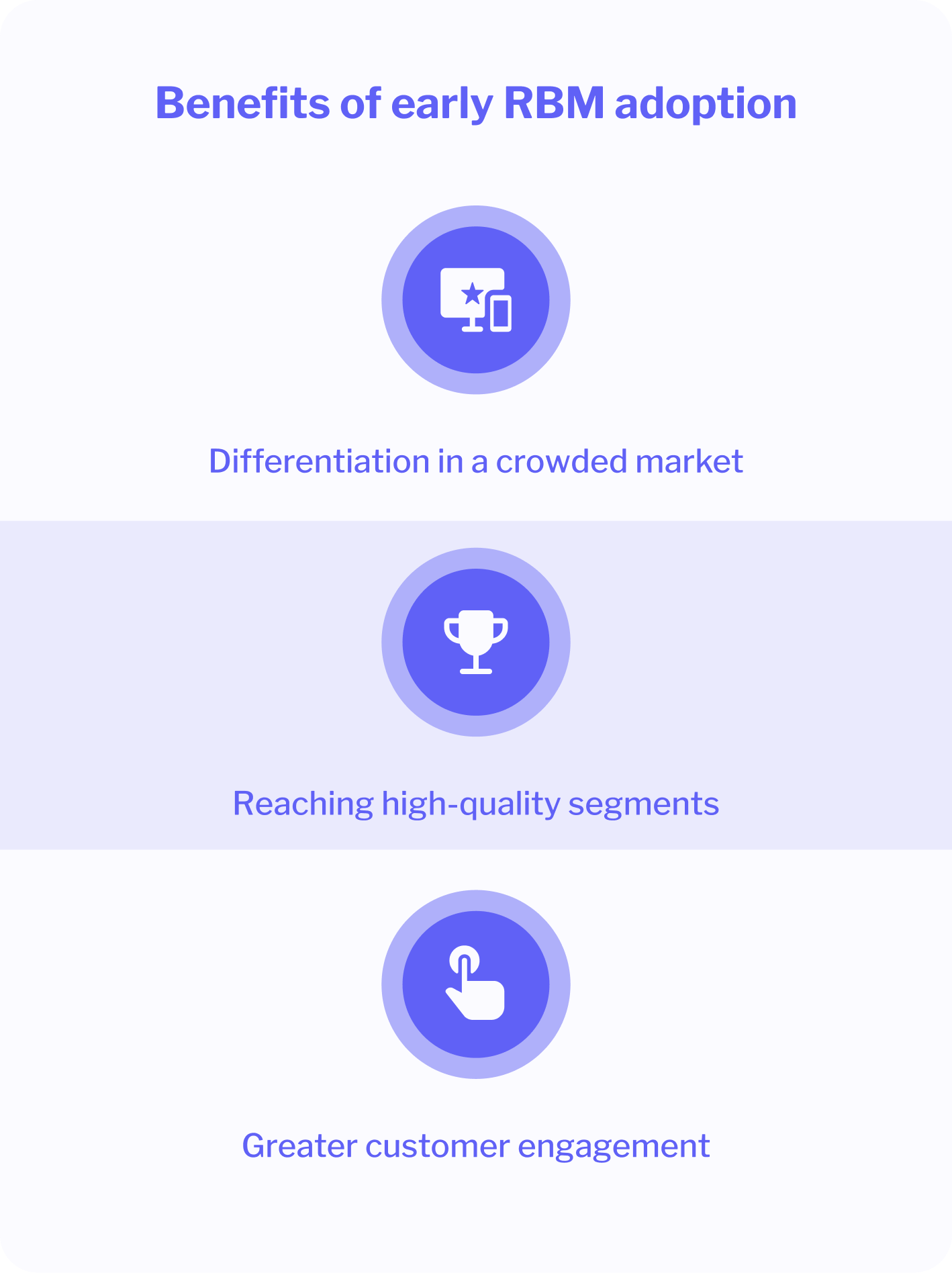
✅ Adopting RBM now allows your brand to stand out in a crowded market by embracing exclusivity and innovation. By being one of the first to leverage RBM on iOS, you signal to your customers that you’re at the forefront of technological advancements.
This early-mover advantage builds a reputation for innovation and creates buzz through exclusive offers and experiences that resonate with tech-savvy audiences eager to try something new.
✅ Focusing on high-value segments is another smart strategy. Instead of rolling out a mass campaign, you can target regions and carriers already supporting RBM such as key markets in the U.S., Western Europe, or Canada.
Running carefully designed pilot programs in these areas helps you understand customer behaviours, fine-tune your messaging, and build a strong case for scaling your efforts. Such a segmented approach ensures that your early tests generate actionable insights without the risk and expense of a broad rollout.
✅ RBM’s advanced features like interactive buttons, dynamic product showcases, and media-rich catalogues can transform customer engagement on iOS.
Experimenting with these capabilities through test campaigns allows you to directly measure how consumers interact with your content, providing valuable data to refine your strategies. Assuming a hands-on approach drives immediate engagement and sets the stage for long-term success as RBM’s adoption continues to grow.
Benefits of early RCS Business Messaging adoption.
Market reality: rollout pace and adoption
Apple’s RCS move matters partly because iOS updates roll out fast. In January 2025, Apple reported iOS 18 adoption at 68% across compatible iPhones, with higher adoption on newer devices (reported widely by Apple-focused outlets). (To masz już podlinkowane zewnętrznie w artykule przez MacRumors.)
The practical impact:
the software baseline improves quickly
carrier coverage becomes the main constraint
Apple RCS is brought to iPhones with carrier support growing
Rich Communication Services, despite originating with Google, have already arrived on iPhones, although the scale of support and coverage isn’t yet ideal.
RCS and RBM entering the world of Apple is a development benefitting both regular users and brands. It creates a genuinely more exciting experience for customers and offers businesses the opportunity to extend their reach.
Mobile carriers, understanding the impact of the emerging communication standard, gradually adjust.
Growing expansion of Rich Communication Services.
Curios about RCS Business Messaging?
At MessageFlow, we follow RCS developments closely–and we build infrastructure that helps brands run messaging programs across channels and devices. If you’re evaluating your next step beyond basic texting, start with MessageFlow.
Key takeaways (better ending pod CTR)
Yes, iPhone supports RCS on iOS 18+, but carrier support is the gating factor.
Android ↔ iPhone read receipts (receipt/read receipt sharing) can work via RCS, but feature consistency varies by carrier and configuration.
For brands, the long-term value is RBM–interactive, rich A2P messaging–where coverage is expanding.
In 2024, we delivered nearly 5.5 million RCS for our customers and are looking to increase this number in 2025. We’re here for you, so let’s talk about how you can start reaching RCS users on Apple’s mobile devices.
FAQ: Apple RCS support on iPhone (2025–2026)
Yes, iPhone supports RCS on iOS 18 and later, but availability depends on your carrier and country. If RCS isn’t available, messaging may fall back to SMS/MMS.
RCS support is part of the iOS 18 cycle, but rollout can vary by carrier. Some regions get support earlier than others because operators must enable RCS on iPhone.
If your carrier supports it, you can usually enable it in: Settings → Apps → Messages → RCS Messaging. If you don’t see the option, your carrier may not support it yet.
Common reasons include missing carrier support in your region, an iOS version below 18, or a SIM/plan that isn’t provisioned for RCS.
Often yes-read receipts can work when the conversation uses RCS and both sides have the feature enabled. Behavior can still vary depending on carrier implementation and conversation setup.
They can work in RCS chats, but not universally in every market. If the chat falls back to SMS/MMS, typing indicators won’t function like modern chat apps.
RCS offers improved security compared to SMS, but encryption specifics depend on implementation and cross-platform support. It’s best to treat cross-platform encryption as evolving and verify current behavior for your use case.
RCS requires an iPhone that can run iOS 18 (or later). Exact compatibility depends on Apple’s iOS support list and device model generation.
iOS can support the foundations for business-grade RCS, but real RBM reach depends on carrier coverage. Brands should plan pilots by region and scale as operator support expands.
Historically, Apple relied on iMessage for rich features and SMS/MMS for cross-platform texting. RCS adoption reflects industry pressure for a more consistent messaging baseline and changing user expectations.
Choose the perfect one-stop-shop for your omnichannel communication