TL;DR: Customer loyalty is declining while acquisition costs keep climbing. A 5% improvement in retention can increase profits by up to 95%. This article shows how zero-party data, micro-segmentation, loyalty programs with a 5.2x ROI, and cross-channel communication help build lasting customer loyalty and grow revenue. You’ll find concrete strategies, success metrics, and real-world examples you can act on right away.
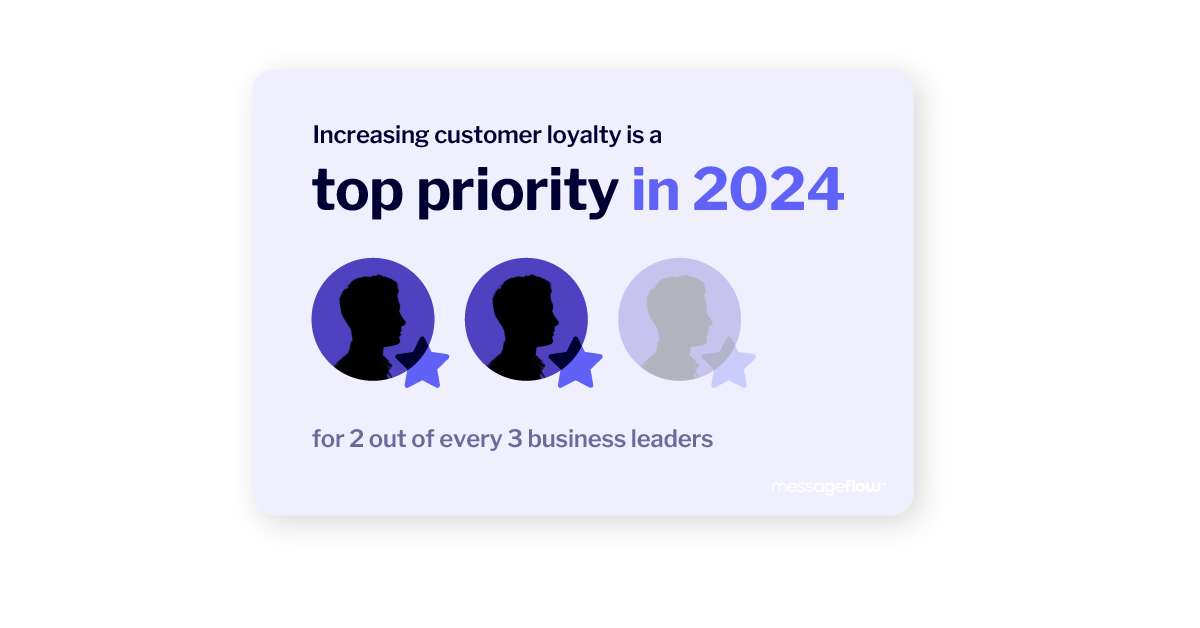
Overall consumer loyalty dropped from 77% in 2022 to 69% in 2024. Traditional brand loyalty is declining. What’s replacing it is experience-driven loyalty: relevance, timing, and trust built through every interaction. At the same time, customer acquisition costs keep rising every year. Companies spend more and more chasing new buyers, while the real money sits in the customer base they already have.
Building customer loyalty isn’t just about being nice. It’s a financial decision. Brands that combine data, personalization, and cross-channel communication grow faster and are far less vulnerable to competition.
In this article, you’ll learn why retention outperforms acquisition, which strategies deliver the best results, and how technology, including the MessageFlow platform, helps you scale these efforts without sacrificing quality.
Why Does Customer Loyalty Drive Business Profitability?
Customer loyalty is one of the strongest financial levers available to any business. Acquiring a new customer costs 5 to 25 times more than keeping an existing one. A 5% increase in retention drives a 25% to 95% profit increase. Customers who stay with a brand for over three years spend 67% more than in their first months of the relationship.
Look at the numbers. Existing customers generate 65-75% of the average company’s revenue. The top 5% of customers account for 35% of e-commerce revenue. The probability of selling to an existing customer is 60-70%, compared to just 5-20% for a new prospect.
In an environment of rising ad costs and economic uncertainty, customers who already know and trust you are exceptionally valuable. Investing in loyalty delivers a higher and more predictable return than continuously burning budget on acquisition. For proven retention tactics, check out our customer retention strategies guide.
How Does a Customer-Centric Approach Build Retention?
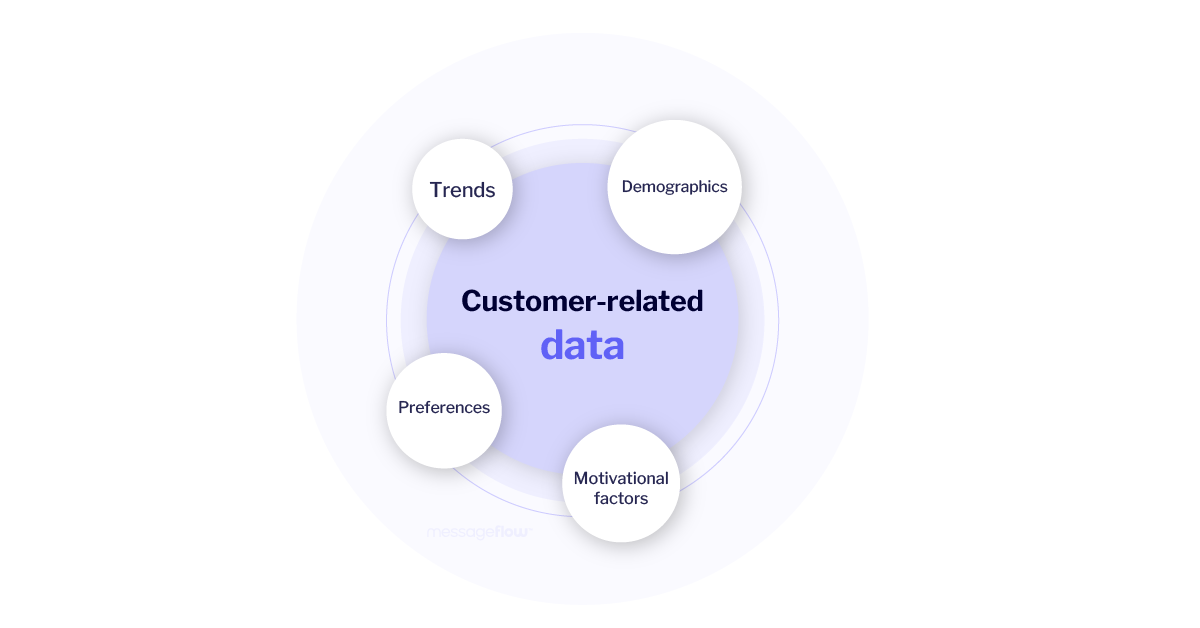
Businesses that put the buyer’s needs at the center of every decision retain more customers than those focused on product or price alone. A customer-centric approach requires three things: collecting data, analyzing behavior, and adapting communication to individual preferences. Without quality data, personalization becomes guesswork.
Forrester’s 2024 research found that truly customer-obsessed companies achieve 49% faster profit growth and 54% better customer satisfaction scores. Yet only 3% of companies currently meet that standard. That gap represents a huge opportunity for those who act.
Zero-party data plays a central role here. It’s information customers share willingly through surveys, product quizzes, or preference settings in their account. 91% of consumers are more likely to engage with brands that personalize their messaging. Companies that excel at personalization generate 40% more revenue from those efforts than average organizations.
A skincare brand, for example, can collect zero-party data through a short product-match quiz at checkout. The answers feed into segmented campaigns that send tailored recommendations over email and SMS. The customer gets relevance. The brand gets a cleaner data asset than any third-party provider could offer. That’s a scenario you can build with MessageFlow, a platform that connects data across channels and automates the communication that follows.
Which Customer Loyalty Strategies Deliver the Best Results?
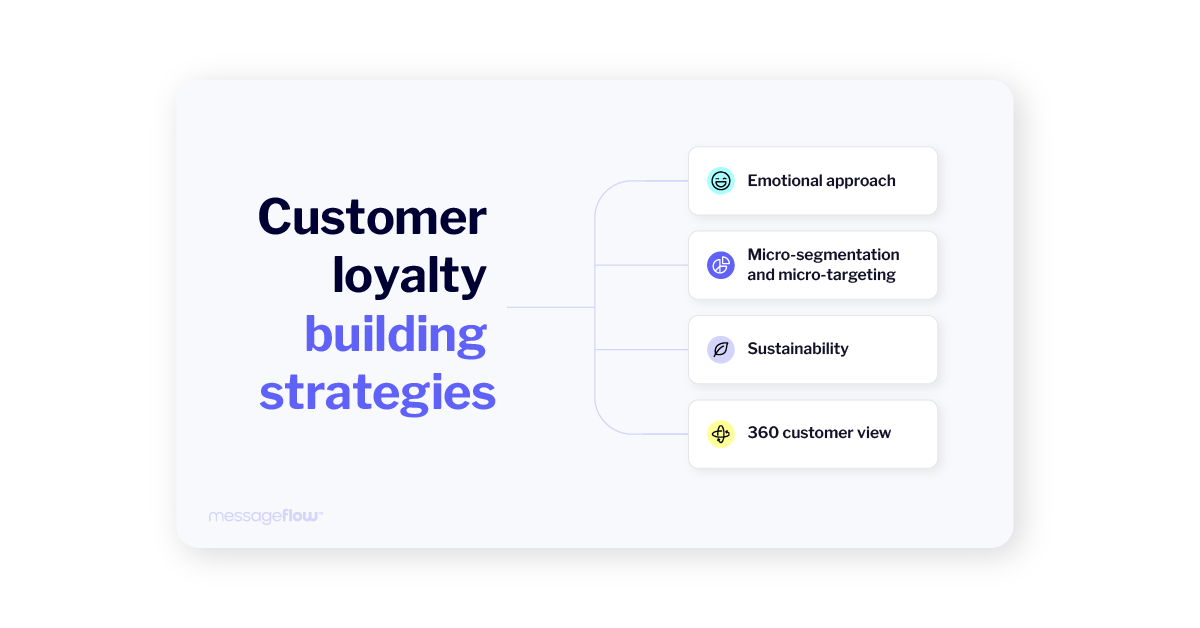
Effective loyalty strategies combine emotion with technology. A discount alone isn’t enough. Customers need to feel valued, understood, and reached through the channel they actually prefer.
Emotional connection and brand community
Customers don’t come back just for discounts. They return to brands they feel connected to. Patagonia built a loyal customer base through genuine environmental commitment. TOMS attracted advocates with its “buy one, give one” program. Emotional connection turns customers into brand ambassadors who recommend you to others, organically reducing acquisition costs.
Sustainability and social responsibility strengthen that bond. Customers increasingly choose brands that align with their values. Programs that reward eco-friendly choices build deeper engagement than traditional discounts.
Micro-segmentation and personalization
Micro-segmentation means dividing your customer base into very small, precise groups based on purchase history, on-site behavior, and demographic data. It lets you craft messages that match the specific needs of each segment.
Customers are 8 times more satisfied with loyalty programs tailored to their preferences than with generic ones. Personalization can lift revenues by 5-15% and increase marketing-spend efficiency by 10-30%.
MessageFlow’s Segments feature lets you build dynamic audience groups in real time. It combines CRM data, purchase history, and campaign activity. Each customer gets the right message through the right channel at the right moment.
A 360-degree view of the customer
Combining data from multiple sources gives you a complete picture of each customer. A CPaaS platform like MessageFlow aggregates data from campaigns running simultaneously across multiple channels. You can see which customer opened an email, clicked a link in an SMS, and completed a purchase after a push notification. That data helps you build more effective retention scenarios and eliminate unnecessary messages.ually achieve this? Which areas should you focus on, what trends should you observe, and where should you direct your efforts?
Which Loyalty Program Type Is Right for Your Business?
Not every program fits every business. The right model depends on your industry, customer behavior, and the kind of data you collect. Here’s a comparison of the most common types.
Points-based (e.g., Starbucks Rewards): customers earn points for purchases and redeem them for rewards. Works well in retail and e-commerce where transactions happen frequently.
Tiered: the more a customer spends, the higher their level and the better the benefits. Motivates repeat purchases and works especially well in premium segments.
Cashback: a percentage of spending is returned toward future purchases. Simple, transparent mechanics that customers understand immediately.
Subscription-based (e.g., Amazon Prime): customers pay for membership in exchange for ongoing benefits. Ideal for services where regular contact is built into the business model. Amazon Prime members spend more than twice as much as non-members.
Gamification-based: game elements, badges, and leaderboards motivate regular activity. 87% of loyalty programs that include gamification retain more customers than those that don’t. 60% of members prefer accessing their program through a mobile app.
Whatever model you choose, speed of reward matters. 75% of businesses now prioritize real-time rewards and instant gratification in their loyalty investments. Fast redemption and clear value outperform complexity every time.
Loyalty programs generally deliver strong returns. According to Antavo’s 2025 report, 83% of program owners report positive ROI, and the median return is 5.2 times cost, up from 4.8x the year before. You can find integrations with external loyalty management tools on the MessageFlow integrations page.
How to Measure Customer Loyalty
You can’t improve what you don’t measure. Four metrics will tell you whether your loyalty strategies are working and help you catch drops in engagement before they turn into losses.
NPS (Net Promoter Score) measures how likely customers are to recommend your brand. You ask: “How likely are you to recommend us to a friend?” Answers on a 0-10 scale divide customers into promoters (9-10), passives (7-8), and detractors (0-6). A score above 50 is considered excellent.
CSAT (Customer Satisfaction Score) measures satisfaction with a specific interaction or purchase. Customers rate their experience on a 1-5 scale. CSAT helps you quickly spot problems at specific touchpoints.
CLV (Customer Lifetime Value) is the projected revenue value of a single customer over the entire relationship. High CLV means the customer buys regularly and is satisfied. The probability of selling to an existing customer (60-70%) is many times higher than to a new one (5-20%).
Churn Rate tracks how many customers stop buying. The average retention rate in e-commerce is only 28.2%. Over 70% of customers don’t return after their first purchase. Every percentage point of improvement translates directly into revenue.
Tracking these four metrics monthly lets you course-correct before you lose customers. A drop in NPS for a specific segment is a clear signal to review your communication and offer for that group.
Review all four together. A high CSAT with high churn often signals a pricing problem. A high NPS with low CLV suggests customers love you but don’t buy enough. The combination tells you exactly where to focus next.
Why Cross-Channel Communication Increases Retention
Companies with a strong omnichannel strategy retain 89% of their customers. Companies with a weak one keep only 33%. That 56-point difference doesn’t come from a better product. It comes from better communication.
Campaigns running across three or more channels achieve 287% higher purchase rates than single-channel campaigns. Omnichannel customers buy 1.7 times more often than single-channel ones. Their lifetime value is 30% higher.
Picture a fashion retailer running a “back in stock” campaign. It sends an email for a product a customer browsed but didn’t buy. If the customer doesn’t open it within 24 hours, a push notification fires. If they click through but still don’t purchase, an SMS with a time-sensitive discount lands an hour later. Each touchpoint builds on the last. The sequence runs automatically, triggered by behavior.
That kind of cross-channel scenario runs from one dashboard in MessageFlow. The platform handles email, SMS, mobile push, RCS, and Viber and automatically selects the right channel based on each recipient’s preferences. For your highest-value customers, that matters, because they rarely live in just one channel. For a closer look at combining channels effectively, read our piece on cross-channel communication essentials.
RCS is worth a specific mention here. It lets brands send image carousels, action buttons, and video directly to Android users’ native messaging app, no separate app download needed. It’s a newer channel that’s seen 40-50% adoption rates in several European markets and significantly outperforms plain SMS for engagement.
Cross-channel communication isn’t about being everywhere. It’s about delivering a consistent message across the channels your customers actually prefer. Learn how to run high-performing email campaigns as one pillar of this strategy.
Challenges in Loyalty Marketing and How to Overcome Them
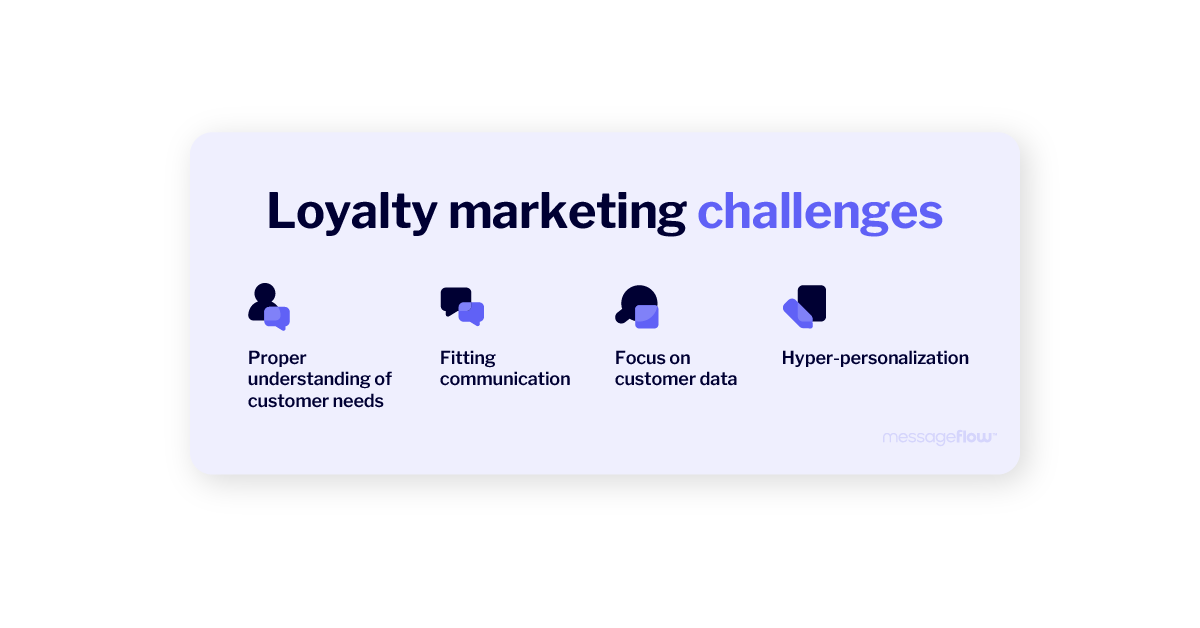
Building loyalty isn’t a frictionless process. The three most common challenges involve data quality, data collection, and the technology needed to personalize at scale.
Inaccurate data leads to poor personalization. The problem usually comes from incomplete or outdated customer profiles. The fix: regular profile updates and integrating data from multiple sources in one place. Companies that manage data well reduce churn and identify at-risk customers faster.
Collecting zero-party data requires an exchange of value. Customers want to know what they’ll get in return. 63% of consumers are willing to share personal data in exchange for rewards and early access to offers. Ask for data at the right moment, explain why you’re collecting it, and deliver visible value immediately. Preference centers and post-purchase surveys work better than generic “tell us about yourself” pop-ups.
Hyper-personalization requires the right technology. Managing segments and campaigns manually across multiple channels doesn’t scale. You need a platform that automates the process. MessageFlow handles over 11.7 billion messages per month for 79,000 businesses in 190 countries. It combines email, SMS, push, RCS, and Viber in a single tool. You can connect it to your tech stack through one RESTful API.
Each of these challenges has one common solution: better data integration and communication automation. The business that collects the right data, analyzes it continuously, and responds with the right message in the right channel builds loyalty more effectively than all its competitors combined.
Start Building Loyalty Today
Customer loyalty isn’t a side effect of a good product. It’s the result of a deliberate strategy built on data, personalization, and consistent communication across multiple channels.
Three things you should do right now: identify the four key metrics you’ll track every month (NPS, CSAT, CLV, and Churn Rate), start collecting zero-party data through a simple preference form or product quiz at the point of first purchase, and launch communication across at least three channels from one place, which drives a 287% higher purchase rate than single-channel campaigns.
MessageFlow gives you all of these tools in one place. Start with a free account and see firsthand how cross-channel communication changes your customer retention. Visit messageflow.com to find out what we can do for your business.