TL;DR: MMS is a mobile messaging format that lands directly in a customer’s native SMS app, no app install required. It supports images, GIFs, and video, and allows for longer text content. The limitation is not the number of characters, but the total message size (depending on the carrier). Its open rate reaches 90-98%, yet most brands still underuse it. This guide covers when MMS beats SMS and Push Notifications, how to run campaigns that convert, and what to track.
Your Black Friday email is competing with 200 others. Your Push notification only reaches users who installed your app. Your SMS gets read, but it’s just text.
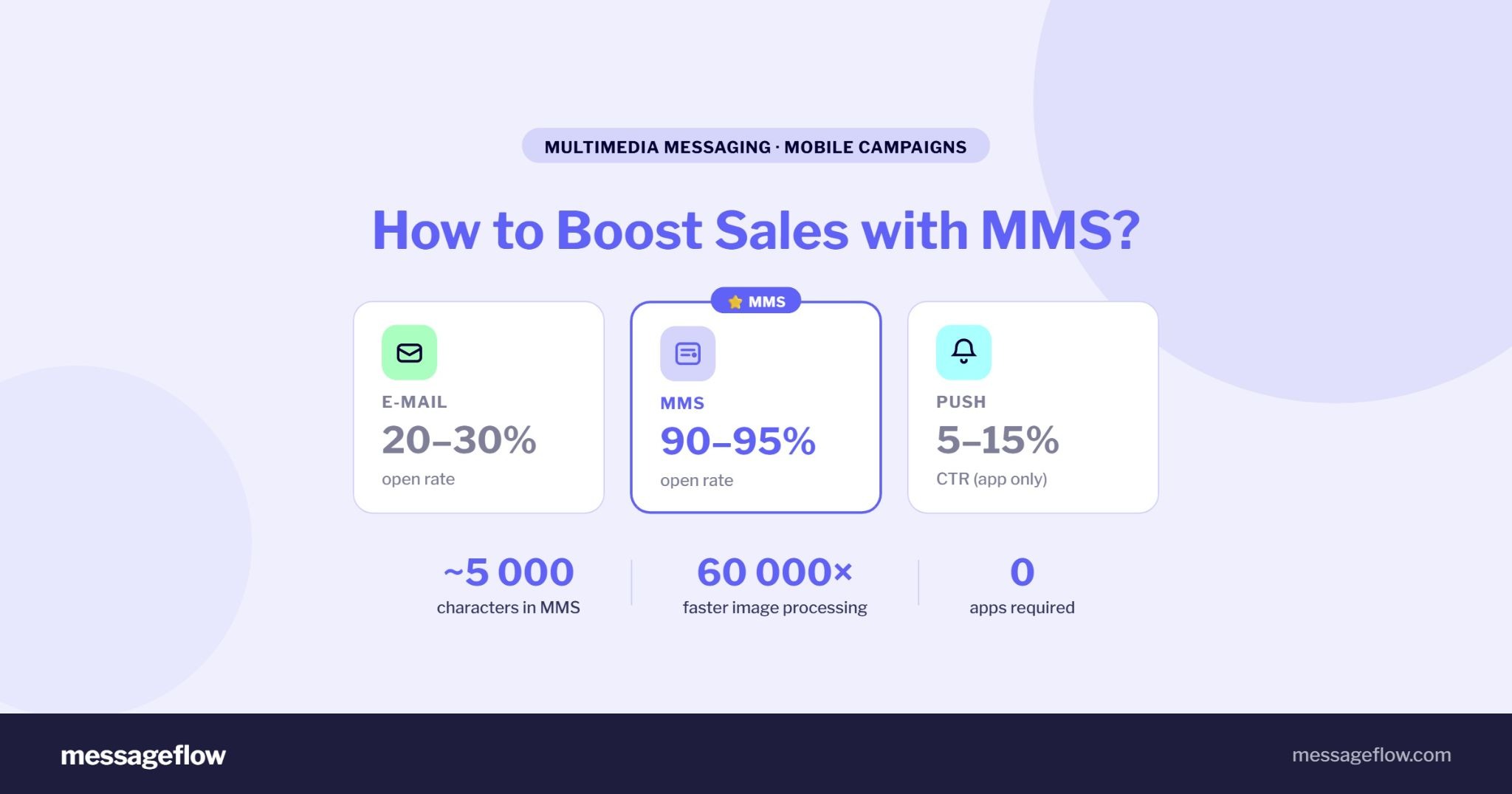
MMS delivers a full visual message directly to every customer’s phone, regardless of whether they have your app. It doesn’t get buried in an inbox. It doesn’t require an app, and is delivered via the carrier network directly to the recipient’s device. And it still carries a 90-98% open rate in a world where most channels are fighting for scraps of attention.
Here’s how to use it properly.
What is MMS, and how does it differ from SMS?
MMS (Multimedia Messaging Service) is a mobile message delivered through the carrier network to the native messaging app on any phone. No app required. No internet connection required on the recipient’s side.
Where SMS caps out at 160 characters and plain text, MMS gives you significantly more room to work with:
- up to 5,000 characters of text (over 30x the SMS limit)
- images, GIFs, audio, and video attachments
- a subject line field, similar to email
- a visual attachment indicator that draws attention before the message is even opened
- full personalization of both text and media content
SMS is the right tool for short transactional messages: order confirmations, OTP codes, delivery alerts. When you want to show a product, trigger an emotion, and drive a click, MMS has a structural advantage. MIT neuroscience research shows the brain can process and identify a visual image in as little as 13 milliseconds, which is significantly faster than reading text. That speed gap translates directly into engagement and conversion.
Why does MMS work well for sales campaigns?
MMS performs in sales contexts for a few concrete reasons.
It stands out. The average customer receives dozens of SMS messages, push alerts, and emails every day. MMS is still used less frequently by brands, which means it gets noticed. Mobile messaging reaches open rates of 90-98%, several times higher than the average email open rate of around 37%.
It reaches everyone, not just app users. Unlike Mobile Push notifications, MMS doesn’t require your app to be installed. If your contact list is broader than your app user base, MMS is the only visual channel that reaches the full audience.
It combines media and copy in a single message. You don’t have to choose between showing the product and explaining the offer. A well-crafted MMS does both, in one message, in one tap.
It drives higher click-through rates. MMS campaigns generate up to 20% higher engagement than plain SMS, because a product image triggers an immediate, emotional connection with the item. Take an e-commerce brand running a cart abandonment campaign: the customer sees the exact product they almost bought, and that visual cue is what brings them back.
When should you use MMS instead of SMS or Push?
MMS isn’t the right call for every campaign, but in specific situations it’s hard to replace.
Choose MMS when you want to:
- showcase a product visually (new collection, limited edition, flash sale on specific items)
- run a seasonal campaign (Black Friday, Cyber Monday, holidays, Valentine’s Day) and need to stand out
- reach customers who don’t have your app installed, so Mobile Push won’t get there
- add a visual layer for segments that respond well to mobile messages but aren’t clicking Push alerts
Stick with SMS when you need to:
- send OTP codes, order confirmations, and transactional alerts (short content, no decoration needed)
- maximize reach at minimum cost per message
- send a message where a visual component adds no value
Choose Mobile Push when:
- you have an active app user base and want the lowest cost per message
- you’re sending real-time, in-app triggered alerts
- the message fits naturally within your app’s ecosystem
If you have an active app user base, Mobile Push is the more cost-efficient channel for that segment. MMS covers everyone else, regardless of app install status. The MessageFlow platform lets you manage all three channels from one place.
Practical MMS campaign scenarios
Black Friday and Cyber Monday
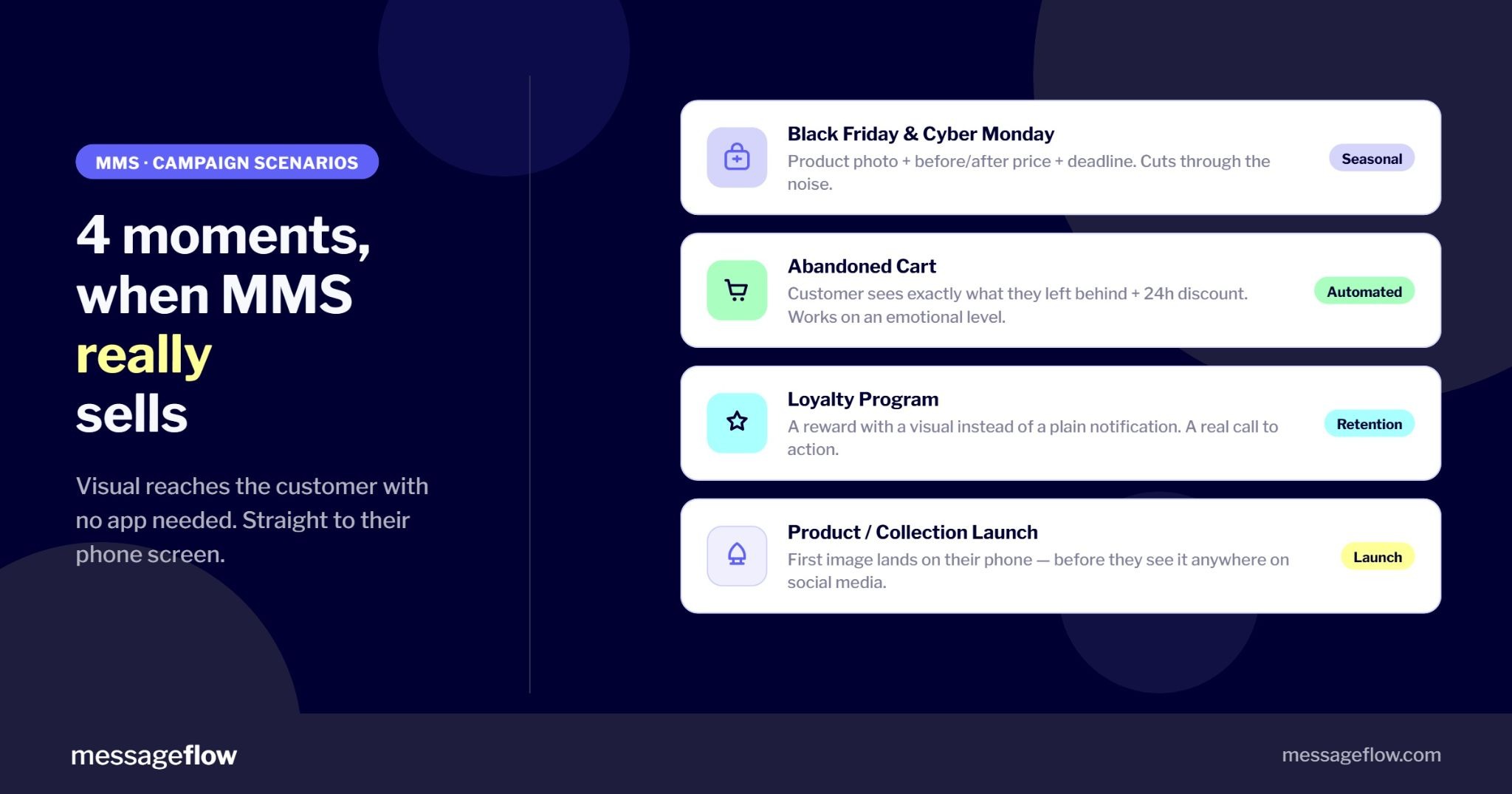
Peak shopping season is when every inbox and notification tray is overloaded. An MMS with a strong product image and a clear offer can break through. Research shows 60% of holiday shoppers make purchases driven by SMS and MMS promotions during Cyber Week. A straightforward structure that works:
- image: the promoted product with before/after pricing clearly visible
- copy: 1-2 sentences with a deadline and a direct link to the offer
- personalization: recipient’s first name and a product matched to purchase history
Abandoned cart recovery
A plain SMS reminds a customer they left something behind. An MMS shows them what they left. Send the exact product image, a short message, and a discount code valid for 24 hours. The visual cue reignites the desire that made them add the item in the first place. Abandoned cart SMS and MMS campaigns convert at 24-39%, making them one of the highest-ROI automations available.
Loyalty program updates
An MMS announcing a reward, a points milestone, or an upcoming members-only sale carries more weight with a visual element attached. A clean image of the reward or discount makes the message feel tangible rather than just another notification. You can set this up as an automated trigger in MessageFlow, firing when a customer hits a specific threshold.
Product or collection launch
If you’re introducing a new collection, an MMS with the first product image reaches your customers before they see anything on social media. That “first look” effect builds loyalty and increases conversion from the launch itself.
How to measure MMS campaign performance
A campaign without data is just spending. Track these metrics:
Open rate benchmarks for MMS sit around 90-98%. If your numbers are significantly lower, check list quality and send timing. Data shows the best-performing send windows are mid-morning and early evening.
CTR (click-through rate) is the percentage of recipients who tapped the link in your message. Industry benchmarks for mobile messaging campaigns range from a few percent to mid-teens, depending on your vertical and content quality.
Conversion rate shows how many clicks turned into a purchase or target action. For abandoned cart flows specifically, industry benchmarks sit at 24-39%.
Opt-out rate is an early warning signal. If it climbs, you’re either messaging too frequently or the content isn’t relevant to that segment.
Use UTM parameters on every link. This lets you see in your analytics platform or ecommerce dashboard exactly how much revenue a specific MMS campaign generated, not just how many clicks it drove.
How MMS fits into a broader omnichannel strategy
MMS doesn’t replace other channels. It fills a specific role within a multi-channel sequence. A well-structured campaign might look like this:
- Email: 3-4 days before the campaign, detailed offer breakdown
- MMS: on launch day, a short visual punch with a direct link
- SMS: a reminder a few hours before the offer expires (see our SMS marketing guide for timing best practices)
- Mobile Push: real-time alert for app users at the moment of highest intent
Each channel contributes something different. The sequence isn’t noisy because the messages aren’t repetitive: they escalate naturally toward a decision point. The MessageFlow platform lets you plan, automate, and run this kind of sequence from one place, including behavior-triggered sends like abandoned cart recovery.
If you’re running campaigns specifically in retail, the SMS retail guide covers complementary tactics worth combining with MMS.
Start your MMS campaign with MessageFlow
MessageFlow supports MMS campaign planning and delivery at scale, from a few thousand messages to millions, with full personalization and send-time control. If you want to see how MMS fits your current communication setup, contact our team!
Frequently Asked Questions
Yes. MMS is supported by virtually every mobile phone capable of receiving text messages, including both smartphones and older devices. It works over the carrier network, so recipients don’t need a data connection or a specific app to receive it.
MMS is an older standard that works on any device without internet. RCS is a newer format with richer interactive capabilities: buttons, product carousels, and branded profiles. RCS requires device and app support. MMS is the safe choice for maximum reach; RCS is stronger for interactivity where it’s supported.
MMS costs more per message than SMS because you’re transmitting a larger file. Exact rates depend on your sending volume and account configuration. Contact MessageFlow for a quote matched to your sending needs.
Yes. Sending marketing MMS requires explicit opt-in consent from recipients, the same as marketing SMS. Transactional consent (for example, for order confirmations) does not cover promotional messaging.
The standard limit is typically 1-2 MB per media file, depending on the carrier. JPEG or PNG images optimized for mobile, around 600×600 px, fit comfortably within limits and display cleanly on any screen size.